Helene Franciska Schmidt (née Vogt)
Helene Franciska Schmidt (née Vogt), born in 1938 at Tanunda in the Barossa Valley, was a German-Lutheran teacher descended from the Old Lutherans who settled South Australia from 1838. Trained in Adelaide, she followed her husband Christoph north to Elizabeth when he took work at the Holden plant, and for some thirty years taught German at South Downs Primary School as "Frau Schmidt" — carrying a guarded, inherited language to the children of the northern suburbs before returning, widowed, to the valley of her birth.
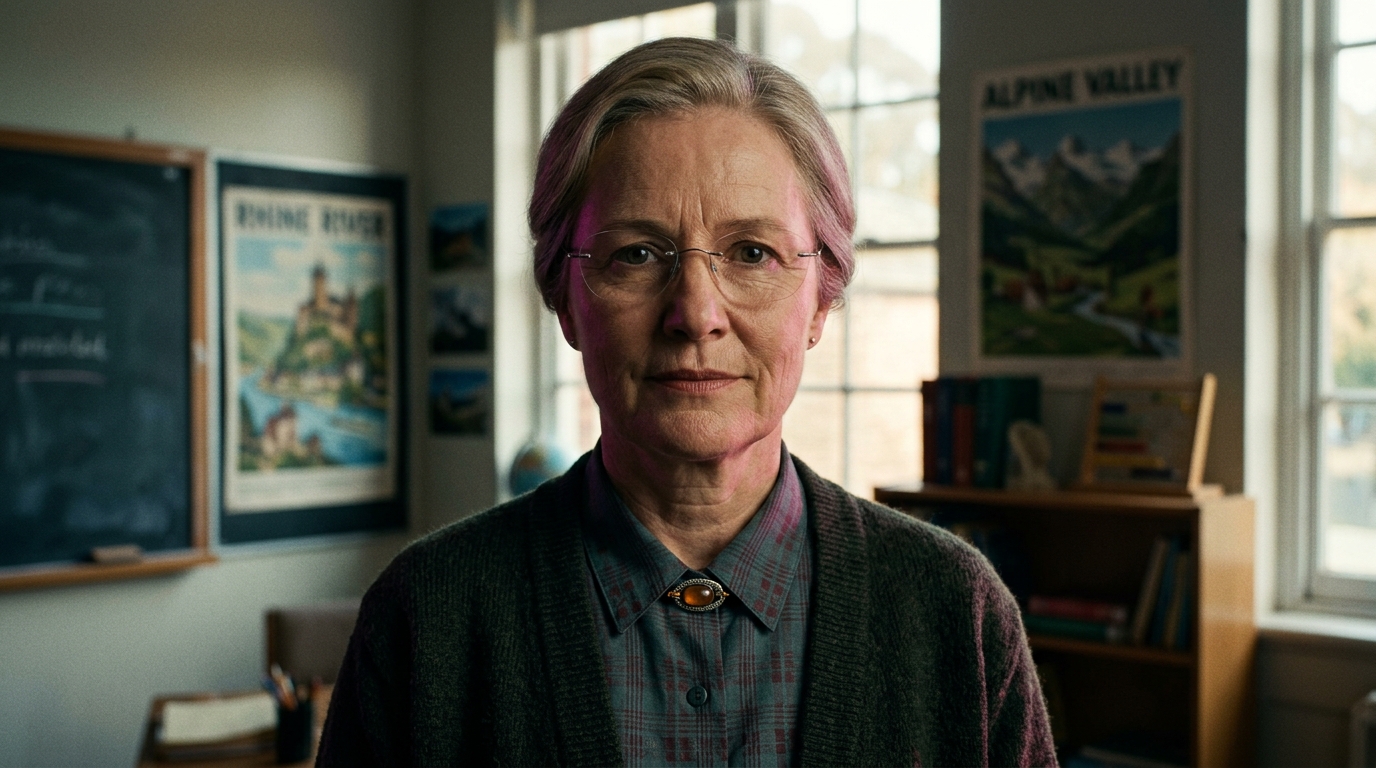
A Daughter of the Valley
Helene Franciska Vogt was born on the fourteenth of April 1938 in Tanunda, in the heart of the Barossa Valley, into a community that had been speaking German on South Australian soil for very nearly a century. She was the third of the four children of Wilhelm Eduard Vogt, a vine-grower and cooper, and Frieda Auguste Vogt, born Liebelt, and she entered a household ordered by the vineyard's seasons, the Lutheran calendar and a German that was spoken at the kitchen table as naturally as English was spoken in the street.
The Vogts belonged to the old stock of the valley. Their forebears had come out of Prussia and Silesia in the wake of the confessional Lutherans who, rather than submit to King Frederick William III's forced union of the Lutheran and Reformed churches, had followed Pastor August Kavel across the world. Kavel's first congregation had stepped ashore at Adelaide from the ship Prince George in November 1838, financed by the merchant George Fife Angas, and within a few years their descendants and successors had pushed north into the Barossa, raising the village of Bethany in 1842 and, after it, a whole landscape of Lutheran settlements bearing names carried intact from the old country.
Into that inheritance Helene was born. The faith was the spine of it — services in the Tanunda churches still partly in German, the hymns her mother sang over the washing, the catechism learned by heart. The land was the body of it: the rows of vines climbing the valley sides, the cellars cut into the hills, the slow round of pruning and vintage that governed the working year. And the language was the breath of it, a Barossa German softened and altered by a hundred years of distance from Europe, spoken in the home and the pew and the singing societies, and increasingly only there.
If the men of the valley carried its work, it was often the women who carried its memory, and Frieda Vogt was a keeper of the old things in the way of her generation. She held the household to the church year and the kitchen to the old recipes, led the children through their German prayers at night, and lent her voice to the Liedertafel that still gathered to keep the choral tradition alive. From her mother Helene took not only the language but the conviction that it was a charge to be kept — that a tongue and a faith were things one held in trust for those who came after, and did not lightly let fall.
Her brothers and sister marked the corners of her childhood. Reinhardt, the eldest, born in 1933, was being shaped for the land before Helene could walk; Gerda, two years younger than he, was the practical one the household leaned on; and Theodor, the baby, born in 1943 into the anxious middle of another war, was the one their mother fretted over most. Among them Helene was the watchful, bookish child, the one most likely to be found indoors with a slate when there was work to be done outside, a tendency her father tolerated rather more than he approved.
The Quiet Language
For the language was no longer the secure possession it had once been. Helene grew up in the long shadow of what had been done to it during the First World War, when South Australia, which had welcomed its Germans more readily than any other colony, turned on them with a particular venom. In 1917 the state closed every German Lutheran school within its borders — forty-six of them, teaching some sixteen hundred children — and reopened them as English-speaking state schools.
That same year the Nomenclature Act struck the German names from the map, changing sixty-nine of them at a stroke. Across the valley the old names fell: Bethanien clipped to Bethany, Langmeil becoming Bilyara, Gnadenfrei turned to Marananga, Kaiserstuhl renamed for Lord Kitchener. Men were interned on suspicion of loyalties they did not hold; German newspapers were shut; even the labels on the wine were forced to change. A number of the names were restored in 1935, but the lesson had gone deep, and it was the lesson that Helene's grandparents handed down to her more vividly than any story of the crossing.
She was an infant when the Second World War renewed the suspicion, too young to remember its sharpest edge but old enough, in the years after, to absorb the wariness that had settled into her elders. Her father, Australian-born and Australian to the bone, had nonetheless learned to be careful where and how loudly his first language was spoken. The result, for the child Helene, was a particular and lasting understanding: that the German she loved was precious precisely because it was vulnerable, a thing that had been taken away once and might be taken again, and that to keep it was a quiet act of fidelity rather than a casual habit.
Leaving for the City
Helene was a serious, orderly child who took naturally to school, where she found that the same temperament her mother prized at home — neatness, diligence, a respect for how things ought to be done — was rewarded with marks and the approval of her teachers. She attended the Tanunda state school, which had grown out of the German educational tradition the valley had maintained since Martin Basedow opened his own school there in 1850, and by the time she finished she had fixed on a course unusual for a Barossa farm girl of her generation: she would become a teacher herself.
The decision took her away from the valley. In the middle of the 1950s she travelled down to Adelaide to train at the Teachers' College, boarding in the city and learning to move through a wider and more secular world than the one that had raised her. She qualified toward the end of the decade and took up her first post in a small school in the mid-north, a young woman in sole charge of a classroom of country children, discovering that she had a gift for the work — not a showy gift, but the steadier kind that lay in preparation, consistency and an unfussy authority that children trusted.
Those first years in the mid-north taught her as much as she taught the children. She learned to run a classroom single-handed, to carry a room of farming children through the distractions of seeding and harvest, and to hold herself as a professional woman in country towns that did not always know what to make of one. She was good at it, and she knew she was good at it, and the knowledge gave her a quiet confidence that the diffidence of her upbringing had never quite allowed her.
Schmidt
It was back in the valley, among the overlapping families of the Lutheran community, that she met Christoph Schmidt. He was Barossa-German like herself — the Schmidts were so thick across the district that the shared name meant nothing and everything — a practical, good-humoured man with a fitter's hands and few illusions about the future the vineyards could offer a couple starting out. They married in 1961, and almost at once their life turned on a decision being made in thousands of households across the state.
For the work was moving north. The new town of Elizabeth, barely six years old, was drawing labour to the great General Motors–Holden plant rising on the plains, and in 1962 Christoph took his place on the assembly line there, as tens of thousands of men would across the plant's lifetime. He and Helene left the valley of their ancestors for a raw, half-finished suburb of brick and bitumen some twenty-four kilometres north of Adelaide, where the streets carried English names and the accents in the next house were as likely to come from the English Midlands as from anywhere in the Barossa.
Their children were born in the new place: Anneliese in 1963 and Martin in 1966. For a few years Helene set teaching aside to raise them, keeping house in a Trust home not unlike those of her neighbours, a Lutheran and a Barossa German among Catholics and Methodists and the cheerfully irreligious, learning the particular character of a community assembled from strangers. She missed the valley with a steady, undramatic ache, and she made of her own kitchen a small outpost of it — the hymns, the food, the language spoken to her children in the hope that they would keep it.
Her faith travelled north with her unchanged. She found the Lutheran congregation nearest to Elizabeth and fixed the family's week around it, and when in 1966 the long-divided Lutheran synods of the country at last joined into the single Lutheran Church of Australia, she followed the union from her kitchen table with the close interest of someone for whom the church was not one institution among many but the frame her whole life hung upon. In a suburb of strangers and English Sundays, it was the thread that still bound her to the valley she had left.
The German Room
When Martin was old enough for school, Helene returned to the classroom, and around 1971 she joined the staff of South Downs Primary School, a modest government school on the Trust's grid where she would remain for the next three decades. To the children she was Frau Schmidt, and few of them ever learned that she possessed a first name. She taught across the ordinary primary curriculum, but the thing that made her particular — the thing the school valued, and that she gave it — was German.
There was an irony in it that she felt more keenly than she ever said. The language her own community had been punished for keeping, she now carried into a classroom of working-class children whose families had come, many of them, from the very country whose forces had made Germans suspect twice over. She taught it without apology and without sentiment, as a discipline and a gift. The walls of her room carried posters of Rhine castles and snow-bound Alpine valleys — a tidy, postcard Germany that her own Prussian and Silesian forebears had never seen — and her lessons opened with a chorus of greeting and moved through the small machinery of articles and genders in an atmosphere of unbroken order.
That order was the heart of her teaching. She believed, without ever framing it as a philosophy, that structure was a form of kindness — that children were steadied by knowing what was expected of them, and that a classroom held firmly was a safe place to be. Her arrival in a corridor was announced by the click of her shoes before she came into view, and a waiting line would straighten of its own accord; yet beneath the strictness ran a real warmth, and the children mostly sensed that the firmness was meant for their good.
She had, too, a particular tenderness for the children who came to her from difficult homes, though she rarely let it show and never spoke of it. Something in her own inheritance — the long family memory of being marked, watched, made to feel that one did not quite belong — gave her an instinct for the child who needed the classroom to be the steadiest hour of the day. Over the years there were a great many such children, and most of them never knew that the orderly German room had been built, in part, for them. They remembered only that Frau Schmidt's class was a place where the rules held.
What the Years Took
Christoph gave the better part of his working life to the Holden line. It was hard, repetitive labour, and it left its marks on him as it did on the men around him — the wear of decades of shifts, the slow accumulation of strain on a body used hard. He retired in the early 1990s, and he did not have long to enjoy it. In 1996 his heart failed him, and Helene, not yet sixty, found herself widowed while still standing in front of a classroom each morning.
She kept teaching. Work had always been her ballast, and the German room held her steady through the grief as it had held so many children through theirs. But the world that had given her vocation its meaning was contracting around her. The teaching of German in South Australian primary schools, once a point of pride rooted in the state's distinctive history, was thinning year by year as budgets tightened and priorities shifted, and she understood that she was among the last of a long line — that when she left, the language would very likely leave the school with her.
It was a loss mirrored closer to home. Anneliese and Martin, raised in English-speaking Elizabeth far from the valley, had kept only fragments of the language Helene had laboured to give them, and her grandchildren had less than that — a few words, a carol at Christmas, the name of a dish. The long inheritance that reached back to Kavel's congregation and the ship Prince George was guttering out in her own family within her own lifetime, quietly, without anyone ever deciding that it should. She did not reproach them for it. She had spent her life understanding how a language is lost, and she knew that it was rarely anybody's fault.
Home to the Valley
She retired from South Downs around the turn of the new century, after some thirty years in the school, and not long afterward she went home. She returned to the Barossa — to a small house near Tanunda, within reach of the churches and the cemeteries where four generations of her people lay — and resumed, in old age, the rhythms that had shaped her childhood: the Lutheran services, the singing, the slow valley year. After four decades on the northern plains she settled back into the landscape as though she had never quite left it.
Her children had made their own, more ordinary Australian lives. Anneliese stayed in the north, married, and raised her family within reach of the suburb where she had grown up; Martin took a trade and moved away, to Adelaide and then further, the way sons of the plains often did. They came to the valley to visit her with their children, and Helene loved them without ever quite closing the distance between the world that had formed her and the one that had formed them. Of her own brothers and sister it was the youngest, Theodor, who remained nearest, the two of them in their old age the last of the Vogt children to keep the German their mother had pressed upon them all.
The world she had worked in went on changing without her. The Holden plant that had drawn Christoph north, and with him their whole adult life, built its last car in October 2017 and fell silent, closing the chapter of Elizabeth's history that had begun about the time she first arrived there. The school carried on, though the German room had long since been given over to other uses, and the children she had taught were scattered across the country and the decades, grown into lives whose endings she would never hear.
She had become, almost without noticing, one of the last keepers of a thing nearly gone — the Barossa German of her grandparents, the inherited memory of the schools that were closed and the names that were struck from the map, the particular fidelity of a people who had crossed the world to hold their faith and then spent a century learning how much of themselves they could safely show. Helene Schmidt had carried that language out of the valley and into a suburb that had never asked for it, given it to children who mostly forgot it, and brought what remained of it home again. In her quiet old age among the vines, that was enough.







