Guardians of Brierly
The Guardians of Brierly were the five founders recruited by Jonathan Blackwood to open a settlement on the barren plains of Clivilius. Each carried a blood-bound Portal Key and a single indispensable craft: Thomas Ainsworth led and charted, Elizabeth Carrington greened the land, George Whitmore planted the vines, Mary Fairchild kept its people alive, and Robert Aldridge raised its walls. Crossing in 1810, they built a self-sustaining community on the Whitmore River. As each died their Key fell silent, and with the last Guardian's death in 1857 Brierly's link to Earth closed.
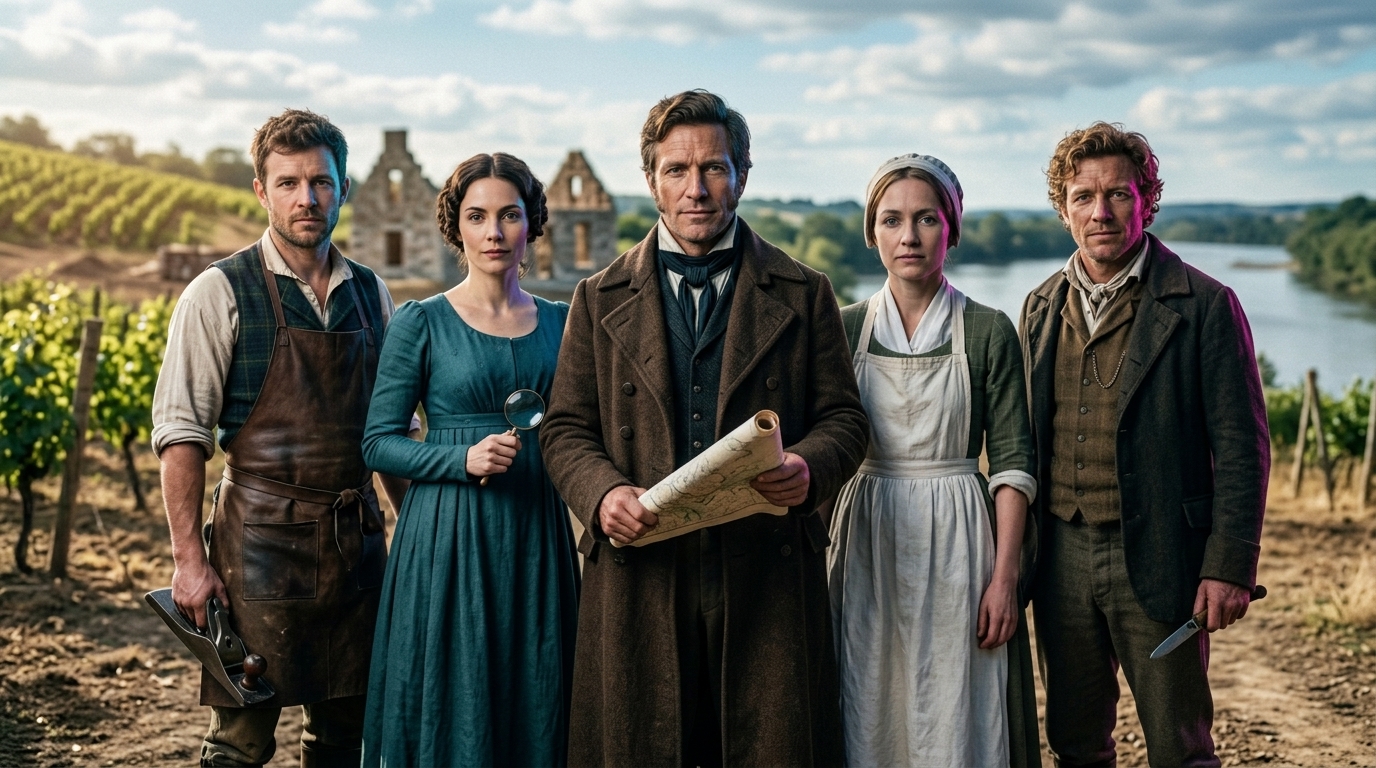
A Company of Five
The Guardians of Brierly were the five men and women who carried the settlement of Brierly out of nothing — the founding company recruited by Jonathan Blackwood to open a habitable place on the barren plains of Clivilius and to hold it against the long odds that had broken so many ventures like it. They were a Guardian Atum Ra-Ling, a working group of five in the manner the Guardians always took, each chosen for a single indispensable craft and each bound to the others by the shared and secret labour of building a world.
What made them Guardians in the true sense was the Portal Key each one carried. Bound to its bearer's own blood, a Key was the only means of passage between Earth and Clivilius, and it could not be lent, inherited, or used by any other hand. Every settler who crossed to Brierly did so through a door one of these five opened; every link the settlement kept to the world of its origin ran, quite literally, through their veins. To be a Guardian was to be both founder and lifeline, and the responsibility did not end once the settlement stood — it lasted as long as the Guardian lived.
The Recruiter's Design
The company was the deliberate work of Jonathan Blackwood, a figure who moved through the learned and scientific circles of early nineteenth-century England and whose true purposes few who met him ever fully grasped. Blackwood did not gather his Guardians at random. He spent years searching out particular people, looking for the rare combination of exceptional skill, steadiness of character, and willingness to give up everything familiar for a venture he could only partly explain until they had agreed to hear it.
His design was a balance of crafts. A new settlement, he understood, would live or die not on any single talent but on the right handful of them held together: someone to lead and to chart the unknown ground, someone to make the land yield food, someone to give it an economy and a craft of its own, someone to keep its people alive, and someone to raise the roofs over their heads. Across 1808 and 1809 he found his five, approaching each in turn, presenting each with a Key, and drawing them one by one into a shared undertaking none of them could yet fully imagine.
The Five
Thomas Edward Ainsworth was the company's leader. A Yorkshire landowner's son, explorer, and cartographer recruited through his boyhood friendship with Blackwood himself, he brought the gifts of command and of mapping — the ability to organise a frightened, struggling band of settlers and to chart the wilderness beyond the settlement's edge. He was the first of the five to cross, and the steady centre around which the others worked.
Elizabeth Anne Carrington, later Sinclair, was the botanist. Sussex-born and gifted with growing things, she carried the knowledge that would make Earth's crops take root in alien soil, devising the selective-breeding methods and the seed bank on which the settlement's food supply ultimately rested. In time she gave Brierly its schoolhouse and its botanical garden, and compiled the four-volume Flora Clivilia that recorded the plant life of a new world.
George Henry Whitmore was the vintner. A Somerset master of the vine, he turned barren Clivilian ground into flourishing vineyards, giving the settlement the craft, the wine, and the harvest traditions that would come to define it. The river the settlement was built along, and the plains around it, would carry his family's name down the generations.
Mary Ellen Fairchild was the healer. A Painswick midwife and herbalist, daughter of a herbalist and a midwife, she carried the one craft the settlement could not survive a week without. She built Brierly's first clinic and its first herb garden, and for nearly half a century she was the constant presence at every birth and every deathbed the settlement knew.
Robert Samuel Aldridge was the builder. A Kentish master carpenter and inventive engineer, he gave Brierly its physical body — the shelters that held against the weather of a new world, and in time the town hall, the workshops, and the homes that turned a patch of empty ground into a place where people could live.
The Crossing
The company opened Brierly in the spring of 1810. Thomas Ainsworth crossed first, on 10 March, stepping alone onto the empty ground to establish the foothold and begin the work of surveying it. Two months later, on 10 May, the main body of settlers crossed with the remaining Guardians, arriving together with the supplies and provisions that would give the venture its start. It was this arrival, of the founders and the first families alike, that truly set Brierly in motion.
From that point each Guardian's Key became a door. As the settlement found its feet, the five drew further settlers and resources across from Earth, each crossing widening the small community and deepening its hold on the land. What had been a barren stretch of the Brierly Plains became, by degrees, a working settlement on the Whitmore River, northwest of distant Bixbus — a place with fields, walls, and a future.
Raising Brierly
The years that followed turned Blackwood's design into a living settlement, each Guardian's craft realised in turn. Thomas Ainsworth led the planning and charted the surrounding wilderness. Elizabeth Carrington coaxed Earth's crops into Clivilian soil and built up the seed bank that secured the food supply. George Whitmore planted the first vineyards and, by the middle of the 1810s, drew Brierly's first vintage from them. Mary Fairchild tended the settlement's health from her clinic and her herb garden. Robert Aldridge raised its buildings, and in 1816, working with Thomas Ainsworth, he began the town hall that would become the community's civic heart.
Between them they gave the settlement not only the means of survival but a character of its own — a place of vineyards and gardens, of inquiry and craft, bound together by the cooperation the five had modelled from the first day. The labours overlapped and supported one another: the builder framed the schoolhouse the botanist filled, the healer kept alive the families the leader organised, the vintner's harvest gave the whole community something to gather around. Brierly grew into a settlement that could feed, house, heal, and teach itself, and that knew how to celebrate what it had made.
The Long Decline
The Guardians were not young when they crossed, and the settlement they built outlived them one by one. Each death carried a weight beyond the personal, for as a Guardian died, the Portal Key bound to their blood went still, and another of Brierly's living links to Earth closed for ever.
George Whitmore was the first to go, dying among his vines in February 1850, and Elizabeth Sinclair followed that same October. Robert Aldridge died two years later, in 1852. Thomas Ainsworth, the leader who had crossed first and charted the empty land, was laid in the Brierly ground in the autumn of 1855. With each passing the company grew smaller and the doors to Earth fewer, until only one Guardian remained.
Mary Fairchild outlived them all. For the last years of her life she was the sole surviving Guardian of Brierly, the single living Key, the one thread by which the settlement was still, in principle, tied to the world it had come from. When she died on 22 May 1857, that last thread broke. Brierly lost the final Guardian of its founding company, and the road to Earth closed behind her.
What the Five Left Behind
The settlement did not fall with its Guardians. By the time the last of them died, Brierly was self-sustaining — fed by Elizabeth's crops, housed in Robert's buildings, healed by the medicine Mary had handed to her successors, gathered each year around George's wine, and ordered along the lines Thomas had first laid down. The five crafts had become the settlement's permanent character, woven so deeply into its life that they outlasted the people who brought them by generations.
Cut off from Earth, Brierly turned inward and endured alone for more than a century and a half, a community of a few hundred souls bound by craft, kinship, and a tradition of inquiry, until a chance contact with Bixbus in 2018 reopened it to the wider world. That it survived those long shut-in generations at all was the founding company's deepest legacy. The Guardians of Brierly were remembered not as five separate lives but as a single act of creation — the men and women who, between them, made a world where there had been none, and left it strong enough to outlast them.







