Gregory Alan Clift
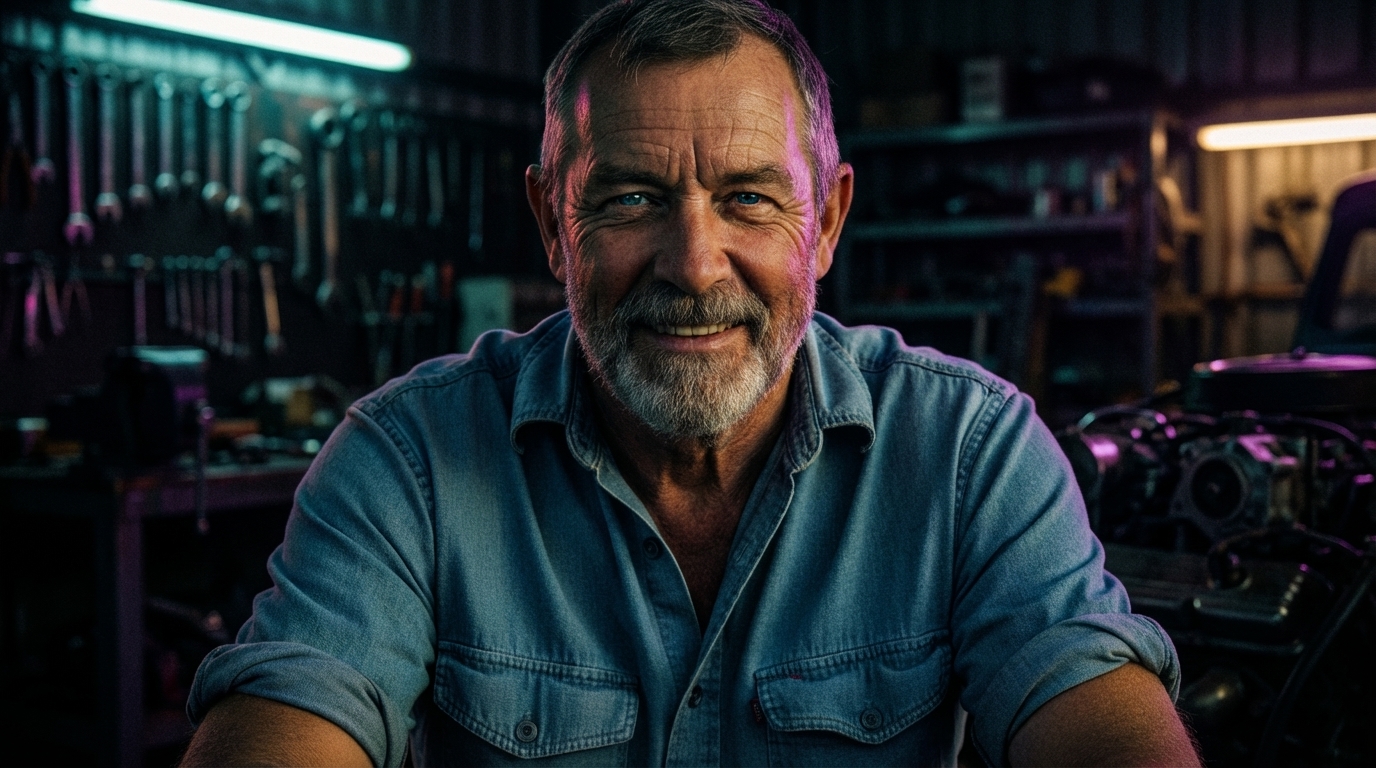
Gregory Alan Clift, born 17 March 1956 in Broken Hill, New South Wales, was a skilled automotive mechanic whose steady hands and quiet dedication built both successful business and devoted family. Married to Dawn Parker in 1978, father to Claire and Amelia, Greg expressed love through acts of service rather than words. His pragmatic nature and reserved demeanour defined a life spent fixing what was broken—from engines to leaky taps—leaving a lasting legacy in Australia's red dust mining town.
Early Life and Family Background (1956–1972)
Gregory Alan Clift was born on 17 March 1956 in Broken Hill, New South Wales, into a working-class family deeply tied to the town's mining industry. The son of Albert John Clift (1925–1988), a miner, and Eileen Margaret Clift (née Donnelly) (1928–2003), a homemaker, Greg grew up in a world where hard work, endurance, and self-reliance were not merely values but necessities for survival. His arrival marked another generation anchored to the harsh red earth of Australia's far west, where mining towns operated according to rhythms dictated by ore prices, union disputes, and the constant danger lurking beneath ground.
He was the second of four children, part of a tight-knit yet occasionally volatile household. His elder brother, William "Bill" Clift (born 1952), followed their father into the mines, known for his stubbornness and strong work ethic. Greg's younger sister, Kathleen "Kathy" Clift (born 1959), became the family peacekeeper, often mediating between strong-willed men before training as a nurse. The youngest, Michael Clift (born 1963), possessed a rebellious streak that eventually led him to Melbourne's factory work, leaving Broken Hill's constraints behind.
Growing up in post-war Broken Hill, Greg's childhood was shaped by the town's stark beauty and brutal conditions. The community was built around mining and trade, and nearly every family maintained ties to the South Mine, North Mine, or the Zinc Corporation. The Clift household operated according to the predictable patterns of mining families—Albert worked long shifts underground, often returning home exhausted and covered in dust, whilst Eileen ran the household with quiet efficiency, ensuring the family was fed and clothed despite perpetually tight finances.
Money remained a constant concern, as the mining industry's unpredictability meant families like the Clifts had to stretch every dollar. Strikes, injuries, and fluctuating ore prices created financial insecurity that taught Greg early lessons about resourcefulness. He quickly learnt to fix and repurpose things rather than replace them, a mindset that fuelled his lifelong passion for mechanics and practical problem-solving.
The family home was a modest weatherboard house on the town's outskirts, with red dust settling into every corner regardless of how often Eileen swept. Summers were blisteringly hot, and winters bitingly cold, but Greg and his siblings found ways to entertain themselves—playing footy in the streets, swimming in the town dam, and building makeshift go-karts from scrap wood and rusted wheels. These improvised projects gave Greg his first taste of mechanical satisfaction, the pleasure of taking disparate parts and making them work together towards a common purpose.
Their father, Albert, was a man of few words, hardened by years underground. He expected his sons to follow him into mining, seeing it as the only reliable way to provide for a family. Mining represented tradition, masculine identity, and economic security in Albert's worldview. But Greg harboured no interest in spending his life underground—he was drawn to machines, engines, and the satisfaction of taking something broken and making it work again. This divergence from paternal expectation would create tension that only eased through tragedy.
Greg attended Broken Hill High School, but academics never captured his imagination. He wasn't a troublemaker, but textbooks bored him whilst working with his hands engaged him completely. Metalwork, engineering, and shop classes were the only subjects where he truly excelled. His teachers recognised his mechanical aptitude, often allowing him to tinker with old motors or help repair school equipment rather than sit through traditional lessons that held no interest for his practically-oriented mind.
At home, Greg often helped his father maintain the family's old Holden, patching up rust spots, adjusting carburettors, and changing oil. By the time he was fourteen, he was repairing lawnmowers and bicycles for neighbours in exchange for small payments or favours, demonstrating the growing independence and resourcefulness that would characterise his adult life.
Unlike his older brother Bill, who dutifully followed Albert into mining, Greg knew the underground life wasn't for him. His father wasn't pleased, dismissing mechanics as "a hobby, not a real job", but Greg stood firm. At sixteen, he left school and began an apprenticeship at a local garage, working under Mick O'Reilly, a grizzled mechanic who had been fixing cars longer than Greg had been alive. Mick was a hard taskmaster but recognised genuine talent when he encountered it. Under his guidance, Greg honed his technical skills, learning not just how to fix cars but how to run a business, deal with customers, and earn a reputation for reliability.
One of the defining moments of Greg's teenage years came in 1971, when his father suffered a mining accident—a partial tunnel collapse that shattered Albert's leg and ended his career. The Clift family suddenly found themselves in financial crisis, struggling to survive on disability payments and Eileen's part-time cleaning work. Greg, still an apprentice, stepped up, working longer hours at the garage and handing over most of his earnings to help support the family. His father, once dismissive of his mechanical career, came to respect Greg's choice, seeing that his son's skills were just as valuable as a miner's wages—perhaps even more so, given the dangers of underground work that had now claimed Albert's physical capacity and economic security.
By the time Greg finished his apprenticeship at eighteen, he had built a reputation as one of the best young mechanics in Broken Hill. He was known for his steady hands, patience, and ability to diagnose engine problems by ear. With a firm career path ahead of him, he began laying the groundwork for his own garage—Clift Automotive Repairs—establishing the business just a few years later.
Marriage and Family Life (1978–Present)
On a warm autumn day in 1978, twenty-two-year-old Greg married Dawn Elizabeth Parker, a vivacious preschool teacher four years his junior whose vibrant warmth balanced his stoic nature. Their courtship had developed with the particular intensity of small-town romance, where limited social options meant relationships either deepened quickly or didn't develop at all. Dawn's spirited determination and social ease complemented Greg's quiet reliability, creating a partnership built on mutual respect despite fundamental differences in temperament.
Their wedding, a modest affair attended by family and close friends, represented the beginning of a partnership that would weather decades of challenges. Greg's steady silence found its perfect counterpoint in Dawn's vibrant warmth—two souls who discovered that love could flourish in the space between words and action. Where he spoke through the careful restoration of engines, she painted their world in colour and conversation, their marriage becoming a testament to how opposites don't merely attract but create something entirely new.
Together, they purchased a home at 86 Wills Street in Broken Hill, not far from where both had grown up, establishing themselves as a young couple with promising futures. The house became an extension of Greg's workshop philosophy—every repair a gesture of care, every improvement a promise to Dawn and their future family. Here, amidst Broken Hill's red dust that settled into every corner despite Dawn's determined efforts, Greg's reserved nature found its truest expression: not in words, but in the careful maintenance of their shared sanctuary.
Their first daughter, Claire Elizabeth Clift, arrived on 16 April 1982, bringing profound joy to parents who had built a solid working-class life in the remote mining town. Claire was artistic and independent from early childhood, eventually establishing a successful dance school in Broken Hill despite the geographical limitations that made advanced training difficult. Between Greg's calloused hands and Claire's graceful movements lay a profound contrast—the pragmatic mechanic who spoke through service and the expressive dancer who found her voice through art. Though their worlds seemed incompatible, his quiet dedication to providing stability became the foundation upon which she built her creative confidence.
Their relationship was characterised by mutual respect rather than deep understanding. Greg struggled to connect with Claire's artistic sensibilities, her world of dance and creative expression remaining somewhat mysterious to his practically-oriented mind. Yet he showed his support in the ways he knew best—building her a barre along one wall of her bedroom, attending her performances with Dawn, ensuring she had the physical infrastructure needed to pursue her passion. His love manifested through acts of service: fixing broken things, building furniture, maintaining the stable home environment that allowed her creativity to flourish.
When their second daughter, Amelia Violet Clift, was born on 5 October 1986, Greg discovered a different kind of connection. On that crisp spring day, his weathered hands—calloused from years beneath car bonnets—first cradled his youngest daughter, and in that moment, the pragmatic mechanic who spoke through spanners and oil changes discovered a different kind of precision: the delicate art of fatherhood. Born into Broken Hill's red dust and mining legacy, Amelia would inherit his steady patience and problem-solving instincts, though she would channel them into bringing life into the world rather than breathing life back into engines.
In Greg's youngest daughter, his pragmatic soul found its truest echo. Amelia inherited not just his steady hands but his instinct to heal through action rather than words. Where he mended engines with patient precision, she would guide life into the world as a midwife, both understanding that care often speaks louder than conversation. Their shared language of practical devotion created a bond that transcended the need for extensive verbal communication. With Amelia, Greg found easier connection—their shared pragmatism made communication more straightforward, though her eventual move to Townsville, Queensland, to pursue her medical career left him with a quiet sense of loss he lacked the vocabulary to express.
Greg's marriage to Dawn, though solid in its foundations, was not without its challenges. Their different temperaments occasionally created friction—Dawn's need for verbal communication and emotional expression sometimes clashed with Greg's preference for silence and practical action. She wanted conversations about feelings and future plans; he showed his feelings through maintaining their home, ensuring financial stability, and being present in the ways he knew how. Dawn sometimes interpreted his silence as emotional absence, whilst Greg felt overwhelmed by her need for words when his actions seemed to him like clear communication of devotion.
Yet they built a life together that worked, despite or perhaps because of these differences. Dawn managed the household's social calendar, maintained relationships with extended family, and ensured their daughters received the educational and extracurricular opportunities that Greg's income made possible. Greg provided the economic foundation, maintained their home and vehicles, and offered the steady reliability that allowed Dawn's more spontaneous nature to flourish. They learned to read each other's unspoken languages—Dawn recognising when Greg needed solitude, Greg understanding when Dawn required reassurance through words rather than actions.
Career and Business Ownership
After completing his apprenticeship under Mick O'Reilly's exacting tutelage, Greg worked for several years as an employed mechanic before opening Clift Automotive Repairs in the early 1980s. The garage, located on the industrial edge of Broken Hill, became a fixture of the community—a place where locals brought their vehicles knowing they'd receive honest assessment, fair pricing, and skilled workmanship. Greg built the business on principles that reflected his character: reliability, transparency, and competence.
Clift Automotive Repairs thrived through Greg's technical expertise and reputation for trustworthiness. In a small town where word-of-mouth determined business success or failure, Greg's honest dealings earned him loyalty that transcended competitive pricing or convenient location. Customers knew that Greg wouldn't recommend unnecessary repairs, wouldn't overcharge for parts, and would stand behind his work. His diagnostic abilities—honed through years of careful listening to engines, understanding the subtle differences between normal operation and developing problems—made him invaluable to a community heavily dependent on reliable vehicles for work and daily life.
The physical demands of automotive repair took their toll over decades. The work required strength, flexibility, and endurance that became increasingly difficult to maintain as Greg moved through his forties and into his fifties. His hands, whilst still skilled, developed arthritis that made certain tasks painful. His back, subjected to years of awkward positions beneath vehicles, began to protest more vocally. The constant exposure to chemicals, oils, and exhaust fumes raised health concerns that he typically dismissed but Dawn worried about constantly.
Running a small business in a town with a fluctuating mining economy presented ongoing challenges. When the mines were operating at full capacity and employment was high, Greg's business thrived—workers needed their vehicles maintained, had disposable income for repairs, and could afford to address problems before they became catastrophic. But during downturns, when layoffs rippled through the community and families tightened their budgets, business slowed. Greg learned to manage these cycles, building financial reserves during good periods, offering payment plans during difficult ones, and maintaining relationships with customers who might struggle temporarily but would remain loyal over the long term.
Greg often internalised financial worries, refusing to burden Dawn or his daughters with concerns about slow months or large unpaid invoices. This tendency towards emotional self-sufficiency sometimes created distance—Dawn would sense his stress without understanding its source, interpreting his withdrawn behaviour as rejection rather than his attempt to protect her from worry. Yet through decades of marriage, they developed patterns of communication that worked despite these gaps. Dawn learned to offer support without demanding detailed explanations, whilst Greg learned to accept help without viewing it as admission of failure.
By the late 2010s, Greg began stepping back from the day-to-day operations of Clift Automotive Repairs. The physical demands had become unsustainable, and he recognised that continuing to work at the same pace would likely result in injury or health crisis. He reduced his hours, began refusing certain types of complex repairs, and started contemplating full retirement. The transition wasn't easy—the garage had been central to his identity for decades, and stepping away meant confronting questions about purpose and value that he'd never had to address whilst work provided clear structure and meaning.
Personality, Interests, and Later Life
Greg possessed the physical presence typical of men who'd spent decades performing manual labour. Broad-shouldered and physically strong, his body bore the evidence of his trade—scarred knuckles, permanently grease-stained nail beds, the slight stoop of someone who'd spent countless hours bent over engines. His hands, in particular, told the story of his life: weathered, calloused, marked by small scars from sharp metal and hot surfaces, yet still capable of the precise movements required for delicate mechanical work.
Though not openly affectionate in the conventional sense, Greg expressed love through acts of service. He showed care by ensuring things worked properly—fixing the broken appliance before anyone asked, building the bookshelf Dawn had mentioned wanting, maintaining vehicles so his daughters would be safe on the roads. For Greg, these actions weren't separate from emotional expression; they were the primary language through which he communicated devotion. The challenge lay in others recognising this language, understanding that his labour represented love even when accompanied by few words.
In retirement, Greg embraced hobbies that had always interested him but for which he'd previously lacked time. Woodworking became a particular passion, his backyard workshop transforming into a retreat where he crafted furniture, small projects, and repairs for family and friends. The skills transferred readily from automotive work—the same precision, patience, and problem-solving abilities that served him well with engines applied equally to working with timber. Dawn's home gradually filled with his creations: a dining table, bookshelves, garden planters, each piece reflecting the care he invested in work undertaken purely for satisfaction rather than income.
Classic car restoration also occupied his retirement years. Though he'd stepped back from running the garage, Greg still enjoyed working on old vehicles, keeping his mechanical skills sharp whilst engaging with automotive history that fascinated him. He acquired a 1965 Holden that he slowly restored in his garage, the project providing structure to retirement days whilst connecting him to the work that had defined most of his adult life. The restoration proceeded at a leisurely pace—this wasn't work with deadlines or customer expectations, just the pleasure of bringing something beautiful back to functional life.
Greg's relationships with his adult daughters evolved as they all aged. Claire's marriage to Paul Smith created distance that Greg didn't know how to bridge. Her artistic career, whilst successful, remained somewhat mysterious to him—he could understand the business aspects, the financial management, the customer relations, but the creative expression at its core lay outside his experiential framework. Yet he maintained connection in his characteristic way: sending money when finances seemed tight, offering to fix things when visiting, being present without demanding emotional intimacy that neither felt comfortable providing.
Amelia's move to Townsville created physical separation that Greg found difficult despite their strong bond. Though their pragmatic similarities made communication easier, the distance meant fewer opportunities for the practical acts of service through which he showed care. Their relationship relied more on phone calls and occasional visits, forms of connection that required more verbal communication than Greg naturally provided. Yet when they were together, they fell easily into the comfortable patterns of working alongside each other—fixing things, cooking meals, sharing space without needing constant conversation.







