Grace Matilda Jeffries (née Woolley)
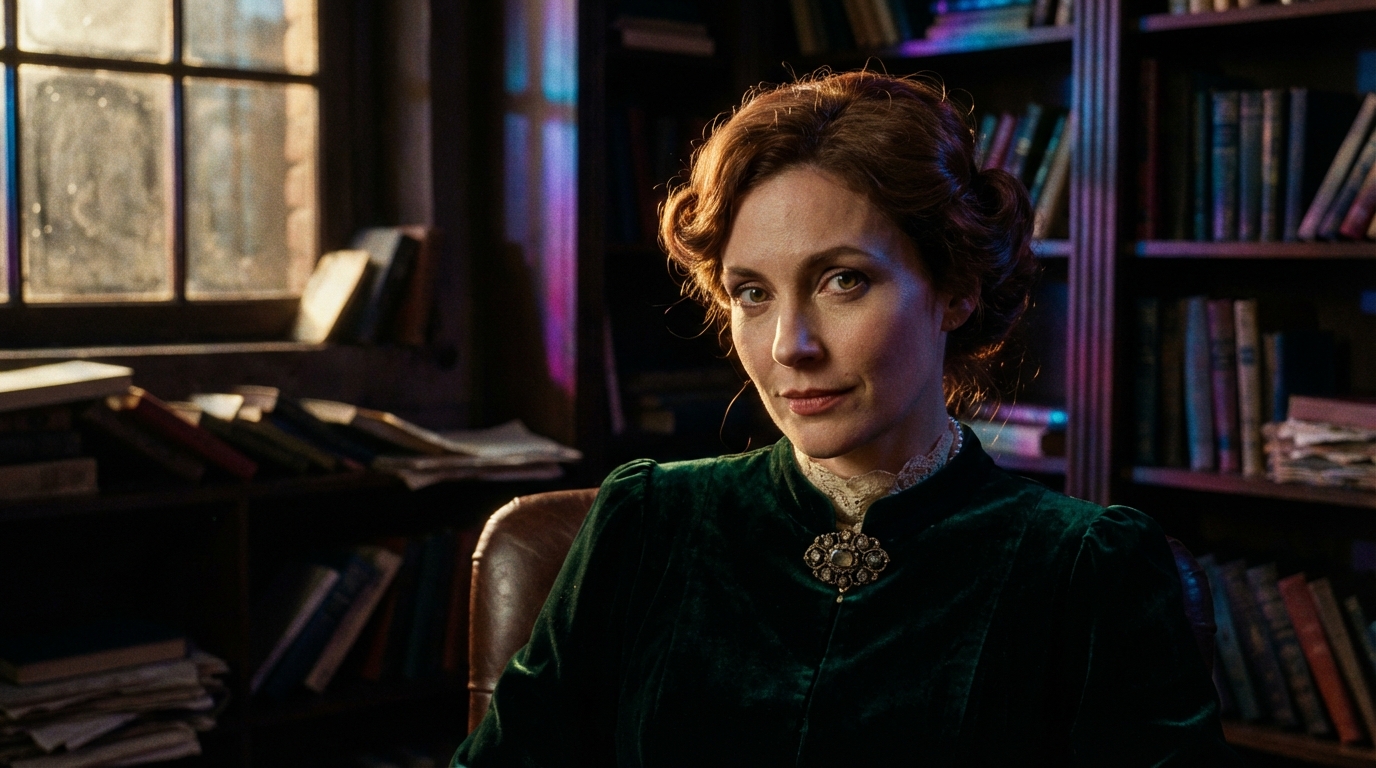
Grace Matilda Woolley spent seventy-one years rising from a shopkeeper's daughter to the unlikely matriarch of Tasmania's most powerful dynasty, wielding influence through intellect and pragmatism rather than birthright whilst harbouring literary ambitions expressed only through carefully guarded pseudonyms. Born into respectable poverty as the sixth of nine children, she understood that her marriage to William Jeffries IV was as much a business transaction as a love match, yet she transformed this calculated union into genuine partnership, ultimately becoming the only person capable of managing both his deteriorating mind and the fracturing family he left behind.
Birth and the Woolley Shop (1890–1900)
Grace Matilda Woolley arrived on 3rd November 1890 in the rooms above the family shop on High Street, New Norfolk, Tasmania, the sixth of nine children born to shopkeeper Thomas Woolley Jr and his wife Elizabeth, née Johnson. A midwife attended because doctors were reserved for those who could afford them. At forty, Elizabeth had thought her childbearing years finished — Charlotte was already three — yet here was another daughter, arriving when the household was already straining with five children aged fifteen down to three.
The Woolley shop sold everything from flour to fabric, serving New Norfolk's working families who bought on credit and paid when they could. By the time Grace could walk, her older siblings had already established their roles: George Alfred, at fifteen, assisted their father with accounts; Harriet Louisa, at twelve, had become their mother's principal domestic help; Thomas Richard III — called Dick — at nine showed mechanical aptitude; Frederick James at six displayed artistic sensibilities; whilst Charlotte May at three was already the acknowledged family beauty. Grace's arrival barely disrupted these established patterns.
From the age of five, Grace stood on a wooden crate to reach the counter, but unlike her siblings who saw shop work as drudgery, she found it absorbing. She observed which families stretched a pound of sugar for two weeks and which men spent their wages on alcohol before their children had shoes, developing an instinct for human nature that no finishing school could have provided. Her ability to calculate prices faster than customers could argue about overcharges emerged early, though she learned to disguise this facility behind appropriate feminine uncertainty.
The arrival of three more siblings after Grace — Albert Henry in 1893, Eleanor Rose in 1896, and Joseph Edward in 1899 — should have pushed her further into invisibility. Instead, it created an unexpected niche. Old enough to help with the babies but young enough to understand their needs, she became the bridge between the older siblings who were entering adult responsibilities and the younger ones who still required nurturing.
Education and Hidden Ambitions (1900–1910)
The parish school Grace attended from 1896 to 1906 was run by Miss Catherine Blackwood, a former governess who had fallen into reduced circumstances after refusing her employer's advances. Miss Blackwood recognised Grace's exceptional intelligence immediately, though in a class that included her younger siblings, she had to be careful about showing favouritism. She lent Grace books from her personal library and taught her French during lunch breaks when other children played. This education, far exceeding what a shopkeeper's daughter might expect, was kept secret from Grace's parents, who would have viewed such learning as putting on airs above one's station.
Grace discovered poetry at age twelve through a water-damaged volume of Wordsworth that a customer had traded for store credit. She began writing her own verses on scraps of brown paper used for wrapping purchases, hiding them beneath the mattress she shared with Eleanor. These early poems dealt with themes of confinement and longing — a caged bird appears repeatedly in the few fragments she later preserved. Albert, finding one of these poems, threatened to tell their parents until Grace agreed to help him with his schoolwork indefinitely.
Meanwhile, the Woolley family was evolving. George married Mary Ellen Simpson in 1900. Harriet's increasing courtship with John Arthur Perkins, whom she married in 1902, suggested more departures would follow. Dick spent most of his time apprenticing at various trades before marrying Elizabeth Jane Barwick in 1905 and departing for Hobart. Frederick had discovered photography and spent every spare penny on equipment. Charlotte's beauty attracted Robert Henry Caldwell, a carpenter whose solid prospects pleased their parents. Each departure shifted more domestic responsibility onto Grace, who by sixteen had been managing household duties for four years whilst maintaining her studies.
Her days developed a careful rhythm: morning assistance with the younger children's preparation for school, shop work from eight until noon, household management in the afternoon, shop duties again until closing, then evening responsibilities for Albert, Eleanor, and Joseph's homework. Only after everyone else slept could she read by candlelight, working through economic texts and philosophical treatises that would have scandalised her parents. Her father, Thomas, increasingly tired at sixty, gratefully accepted her assistance with accounts and correspondence without realising she was learning far more about business than he intended any daughter to know.
Courtship and the Class Divide (1910)
William Jeffries IV's arrival at the Woolley shop in February 1910 was initially unremarkable — another wealthy man purchasing supplies for his estate workers. Grace, now nineteen and resigned to permanent shop work, served him with typical efficiency. But when he complained about the quality of flour, she launched into a detailed explanation of grain economics and milling processes that left him momentarily speechless. His expression shifted from condescension to curiosity as he realised the shopgirl understood supply chains better than many of his managers.
He returned the following week, ostensibly to discuss a large order but actually to test whether her knowledge was memorised or genuine. Grace, recognising the examination, deliberately cited economic principles with subtle improvements on conventional understanding. The game might have continued indefinitely, but William's direct question — "Where did a shopkeeper's daughter learn economic theory?" — forced honest revelation of her self-education.
Their subsequent meetings occurred in carefully chosen locations where neither's reputation would suffer from discovery. They walked in the forest beyond town, discussing everything from Australian federation to women's suffrage. William was drawn to her lack of social pretence; she appreciated his willingness to engage with her intellect despite their class difference. Neither pretended this was conventional romance — both understood they were negotiating terms for a partnership that transcended typical marriage.
The engagement announcement in May shocked colonial society. The speed of the wedding planning — just one month — reflected William's desire to present society with an accomplished fact before opposition could organise. The wedding on 12th June 1910 at Jeffries Manor was deliberately small to minimise opportunities for insult. The entire Woolley family attended in their Sunday best, visibly uncomfortable in the manor's grandeur. Thomas, overwhelmed by expensive champagne, made a rambling speech about "our Gracie moving up in the world" that caused William's siblings to exchange horrified glances. Elizabeth wept throughout the ceremony, whilst Grace's younger siblings explored the manor with inappropriate curiosity that the servants would gossip about for years.
Marriage and the Daughters (1910–1922)
Grace's first weeks as Mrs Jeffries were spent learning to navigate a household that had more rooms than her entire street in New Norfolk. The servants, initially contemptuous of her origins, gradually warmed to her practical approach and willingness to understand their work. She won particular loyalty by establishing a lending library for staff and insisting their children receive basic education, understanding from experience how literacy could transform lives.
The financial elevation of the Woolley family was immediate but complicated. Grace established accounts for her parents that supplemented shop income without creating dependency. She funded Joseph's continued education, ensuring he could attend university — an impossibility before her marriage. Eleanor received finishing school education that prepared her for the middle-class marriage she would achieve with Harold Ernest Pritchard. Albert was offered a position in the Jeffries banking enterprises, though his charm exceeded his dedication.
Eleanor Jane Jeffries, born in 1911, represented Grace's first test as both mother and dynasty-wife. She watched William receive the news of a daughter with polite interest that failed to conceal his disappointment, and she understood immediately the terms of the contract she had entered. Amelia Catherine followed in 1913, deepening the disappointment without resolving it. Charlotte Grace arrived in 1916, greeted by her father with barely maintained courtesy whilst Europe consumed itself in war. Each daughter's birth widened the silence between what William wanted and what Grace could provide, a silence she filled by pouring into her girls the intellectual ambition and self-sufficiency she had cultivated in herself, ensuring they understood that their value existed independently of their father's recognition of it.
Grace's modifications to the manor occurred gradually but systematically during these years. She replaced heavy Victorian furnishings with simpler pieces that admitted more light. She converted unused rooms into a proper library, organising the chaotic collection of books accumulated over generations. Most significantly, she established a study for herself — the first Mrs Jeffries to claim such space — where she could write without interruption. It was here that she began submitting poems to literary journals under the pseudonym "M. Grey," work that received modest acclaim though no one suspected the author's true identity.
Her management of William's increasingly erratic behaviour began almost immediately after the wedding. She recognised patterns in his moods, understanding that his obsession with his great-great-grandfather's disappearance intensified during business stress. She developed strategies for redirecting his attention, engaging him in economic discussions when he began fixating on conspiracy theories. The household staff learned to alert her when he displayed troubling behaviours, allowing her to intervene before public embarrassment occurred.
The relationship with William's siblings required careful navigation. Alice, despite her charity work, remained distantly polite but never warm, though she occasionally sought Grace's advice about managing difficult board members. Henry displayed complete indifference, acknowledging Grace only when absolutely necessary. Edward was actively hostile, making cutting remarks about "shop girls with ambitions" until Grace quietly informed him that she knew about his debts to Chinese opium dealers — information gleaned from careful attention to household accounts. His hostility transformed into wary respect.
The Sons and William's Relief (1923–1930)
The seven-year gap between Charlotte Grace's birth in 1916 and the arrival of William V on 9th March 1923 had been a period during which William IV grew increasingly convinced that his dynasty would end with daughters. Grace, now thirty-two, had made peace with the possibility that the succession question might remain permanently unresolved — a prospect that troubled her far less than it consumed her husband.
William V's arrival transformed the household. William IV's visible relief confirmed what the daughters had always sensed: that their father measured their worth against an absence rather than a presence. The birth itself was difficult, requiring forceps and leaving Grace haemorrhaging dangerously. Dr Morrison warned that future pregnancies carried serious risk, advice that William accepted with satisfaction rather than concern — he had his heir and preferred Grace alive to manage his increasingly complex life.
The unexpected second pregnancy in 1925 terrified everyone. Grace spent months essentially bedridden, writing constantly to distract from fear. James III's birth on 17th November 1925 was miraculously uncomplicated, though the toll on Grace's health was considerable. She later wrote that "two sons are sufficient for any woman who wishes to remain sane and marginally independent."
Yet Florence Mary arrived in 1928, received with near-total disinterest by William IV — a man of fifty-five who had already secured two male heirs and possessed no emotional bandwidth for another daughter. Grace, at thirty-seven, regarded her youngest with a tenderness sharpened by the knowledge that this child, unlike her sisters, would never even register as a disappointment in her father's calculations. The dynasty question had been settled. Florence existed in a space beyond it entirely.
Grace's approach to motherhood differed markedly from the distant style typical of her class. She nursed her own children despite having wet nurses available, read to them personally rather than leaving education entirely to tutors, and included them in daily activities rather than confining them to nursery wings. This hands-on approach scandalised William's remaining family but produced children who adored their mother with unusual devotion — particularly the daughters, who recognised in Grace the same quiet determination they would need to navigate their own lives.
Managing William's Decline (1930–1948)
The 1930s brought increasing challenges as William's mental state deteriorated. His investigations into his ancestor's disappearance evolved from hobby to obsession. Grace found him one night in 1934 attempting to tear up floorboards, convinced documents were hidden beneath. She managed to calm him and repair the damage before servants noticed, but such incidents became increasingly frequent.
Her strategy involved careful medication management — small doses of laudanum to calm his worst episodes without creating dependency. She maintained detailed records of his condition, recognising patterns that predicted violent outbursts or paranoid episodes. This medical knowledge, self-taught through correspondence with psychiatric specialists in Melbourne, allowed her to maintain his public facade whilst privately managing serious mental illness.
Edward's death in 1925 had removed her most hostile in-law, but the broader Woolley family required ongoing attention. George had established successful farming operations. Harriet's children had entered Launceston society. Dick's death from heart disease in 1940 was the first loss among the siblings. Frederick had become New Norfolk's premier photographer. Charlotte raised a large family with her carpenter husband. Albert had married well and lived comfortably on charm and his wife's money. Eleanor managed her husband's banking career with invisible efficiency. Joseph, the baby, had indeed attended university and become a solicitor — the family's first professional.
Grace maintained careful contact with all siblings, hosting annual gatherings that brought the dispersed Woolleys together at Jeffries Manor — events that created surreal juxtapositions, her brothers discussing crop prices in rooms where Tasmania's elite had once planned colonial policy. William tolerated these invasions with sedated bemusement, occasionally startling visitors by discussing their humble origins with inappropriate detail.
World War II brought unexpected challenges. William's paranoia found external focus in genuine threats of Japanese invasion, allowing Grace to channel his obsessions productively. Both sons enlisted despite parental objections — William V in the Navy, James in the Army. Their service took different paths reflective of their characters: William V used family connections to secure intelligence positions in Melbourne, avoiding combat whilst advancing his career; James volunteered for dangerous reconnaissance missions in New Guinea, earning decorations for bravery that seemed motivated more by a death wish than patriotism.
The inheritance crisis began long before William's death. His decision to name James as heir, revealed to Grace only after papers were signed in 1946, created the greatest crisis of their marriage. She understood immediately that this would destroy the family she had worked decades to preserve. The family dinner in March 1947 where William announced the decision remains legendary for Grace's diplomatic management of near violence.
William's stroke on 15th June 1948 left him incapacitated for thirteen days. Grace sat with him through the final hours, though whether this was devotion or duty she never clarified, even to herself. He died at 3:15 AM on 28th June 1948, bringing relief mixed with genuine grief. For all his obsessions and his wilful blindness to four of his six children, he had provided her with education, security, and unexpected moments of tenderness that she would spend fourteen years trying to reconcile with everything else.
The funeral drew Tasmania's elite, though Grace insisted her entire family attend — the Woolley shopkeepers sitting in the same pews as banking magnates, a final assertion of her dual identity.
Widowhood and the Fractured Legacy (1948–1962)
The legal battle between her sons over the inheritance consumed the next two years. Grace attempted mediation, proposing various compromises that both rejected. William V's complete estrangement after the court decision supporting James's inheritance wounded her deeply. She had lost not just a son but the validation of her life's work — creating a unified family from disparate elements.
The 1950s found Grace increasingly isolated at Jeffries Manor with James and his wife Thelma. She approved of Thelma, recognising similar pragmatism beneath the younger woman's romantic exterior. When their son Charles was born in 1950, Grace threw herself into grandmother duties with enthusiasm that surprised everyone, perhaps attempting to correct mistakes made with her own children — or perhaps simply relieved to love a child whose worth no one was measuring against a dynastic ledger.
Her poetry during this period, published as "The Divided House," dealt explicitly with family breakdown and maternal failure. Critics noted M. Grey's evolution from pastoral themes to psychological complexity, unaware that the anonymous poet was documenting real tragedy. The collection won the Tasmanian Literary Prize in 1955, which Grace secretly donated to the New Norfolk Library in honour of Miss Blackwood.
Her health began declining in 1958, with heart problems that doctors attributed to the strain of her two difficult pregnancies decades earlier. She continued writing and maintaining correspondence with her surviving siblings — now reduced by Dick's death and Frederick's passing in 1959. These letters reveal a woman coming to terms with choices made and prices paid, though she refused to indulge in regret.
Death and Revelation (1962)
Grace's final illness was mercifully brief. A massive stroke on 15th September 1962 left her partially paralysed but mentally alert. She spent three days giving James instructions about estate management, revealing hidden accounts she had maintained for emergencies, and finally admitting she had burned many of William's most paranoid writings to protect the family reputation.
Her last coherent words, spoken to Thelma rather than James, were: "I played the role required and played it well. That it was a role doesn't mean it wasn't real." She died at 4:30 PM on 18th September 1962, holding Thelma's hand while James searched the library for documents she had requested — a final gesture ensuring he wouldn't have to watch her die.
The funeral on 22nd September drew surprising crowds, including many New Norfolk residents who remembered the shopkeeper's daughter who had risen so far. All surviving Woolley siblings attended — George at eighty-seven, Harriet at eighty-four, Charlotte at seventy-five, Albert at sixty-nine, Eleanor at sixty-six, and Joseph at sixty-three — a testament to the family bonds she had maintained despite social elevation. William V did not attend, though he sent a wreath with a card reading simply "For Mrs Woolley" — a final insult disguised as respect.
The revelation after her death that she was M. Grey caused sensation in literary circles, with posthumous publication of her complete works revealing the full scope of her talent. Her true legacy, however, lay not in poetry but in transformation — proving that intelligence and determination could bridge colonial society's supposedly fixed divisions, even if the bridge ultimately collapsed beneath the weight it was asked to bear.







