Gödel's Incompleteness Theorems
Goedel's incompleteness theorems, published by Kurt Goedel in 1931, establish that any consistent formal system powerful enough to express basic arithmetic is necessarily incomplete — it contains true statements it cannot prove — and cannot demonstrate its own consistency. These results ended Hilbert's programme to formalise all of mathematics and revealed absolute limits on formal reasoning that arise from the self-referential capacity of sufficiently expressive systems.
Overview
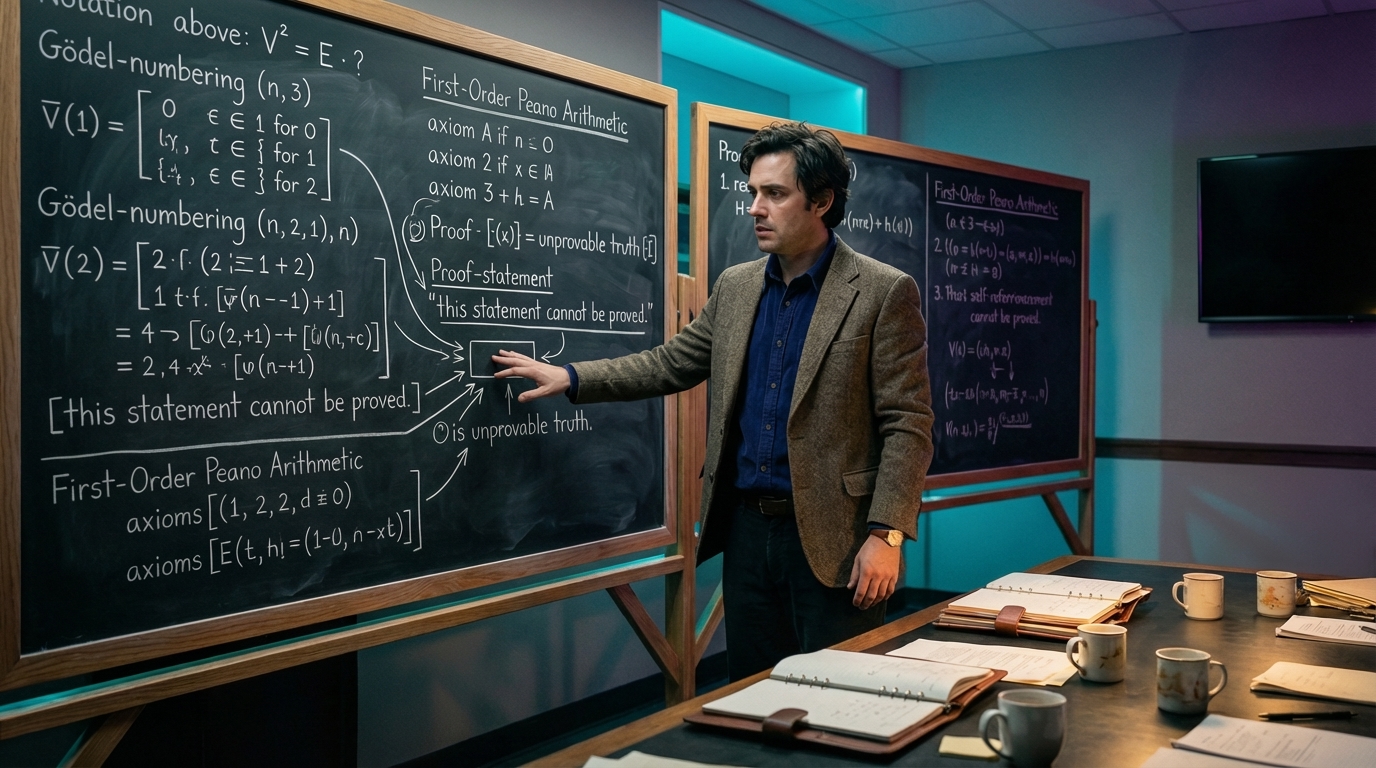
Goedel's incompleteness theorems are two theorems in mathematical logic published by the Austrian-American mathematician Kurt Goedel in 1931. They are among the most important results in the history of mathematics and logic, establishing absolute limits on what formal mathematical systems can achieve. Together, they demonstrate that any consistent formal system powerful enough to express basic arithmetic is necessarily incomplete — it contains true statements that cannot be proved within the system — and that such a system cannot prove its own consistency.
The theorems shattered the foundational programme of David Hilbert, who had envisioned mathematics as a complete and decidable formal system in which every mathematical truth could be proved and every mathematical question could be settled. Goedel showed that this vision is unattainable — not because of human limitation, but because of the logical structure of formal systems themselves. The incompleteness theorems stand alongside Russell's Paradox and the halting problem as the defining results of twentieth-century foundational research, revealing that mathematics, logic, and computation all have inherent boundaries that no amount of ingenuity can transcend.
Historical Context
The incompleteness theorems emerged from the foundational debates that dominated mathematics and logic in the early twentieth century. Following the discovery of paradoxes in naive set theory — most prominently Russell's Paradox (1901) — mathematicians sought to place mathematics on a rigorous, axiom-based foundation that would be provably free of contradiction.
David Hilbert, the most influential mathematician of the era, proposed an ambitious programme to achieve this goal. Hilbert's programme sought three properties for a foundational system of mathematics: consistency (the system should never prove a contradiction), completeness (every true mathematical statement should be provable within the system), and decidability (there should exist an algorithm that can determine, for any mathematical statement, whether it is provable or not).
Hilbert expressed his confidence in the programme's success with the famous declaration: "We must know. We will know." He regarded the idea that there might be inherently unsolvable mathematical problems as an intellectual absurdity — a temporary failure of method, not a permanent feature of reality.
Goedel's 1931 paper, "Ueber formal unentscheidbare Saetze der Principia Mathematica und verwandter Systeme I" (On Formally Undecidable Propositions of Principia Mathematica and Related Systems I), proved Hilbert wrong on the first two counts. Alan Turing's 1936 work on the halting problem subsequently proved him wrong on the third.
The First Incompleteness Theorem
Goedel's first incompleteness theorem states: any consistent formal system F that is capable of expressing basic arithmetic contains statements that are true but not provable within F. Such statements are called undecidable or independent — they are true, but F cannot prove them.
More precisely, the theorem applies to any formal system that satisfies three conditions: it is consistent (it does not prove contradictions), it is effectively axiomatised (its axioms and rules of inference can be listed by an algorithm), and it is sufficiently powerful (it can express basic arithmetic — specifically, the properties of the natural numbers under addition and multiplication).
For any such system, there exist well-formed statements in the language of the system that are true (in the standard interpretation of arithmetic) but not provable from the system's axioms. The system is incomplete: not all truths are theorems.
The revolutionary aspect of this result is that the incompleteness is not a consequence of having chosen the wrong axioms. Adding new axioms to the system does not eliminate the problem — any extension of the system (provided it remains consistent and effectively axiomatised) will contain its own new undecidable statements. Incompleteness is an inherent, unavoidable feature of sufficiently powerful formal systems. No matter how many axioms are added, there will always be truths the system cannot prove.
The Proof: Goedel Numbering and Self-Reference
Goedel's proof is one of the most ingenious constructions in the history of mathematics. Its power derives from a technique that allows a formal system to talk about itself — to construct statements that refer to their own provability within the system.
Goedel Numbering: The first step is to assign a unique natural number (a Goedel number) to every symbol, every formula, and every proof in the formal system. This encoding translates the entire system — its language, its axioms, its rules of inference, its proofs — into arithmetic. Statements about the system become statements about numbers. The question "is this statement provable?" becomes a question about whether certain numerical relationships hold. By encoding the system into arithmetic, Goedel enabled arithmetic to reason about its own formalisations.
The Goedel Sentence: Using the encoding, Goedel constructed a specific sentence G — now called the Goedel sentence — that, when decoded, asserts: "This statement is not provable in system F." More precisely, G is a purely arithmetical statement about natural numbers that, under the encoding, is equivalent to the claim that no number is the Goedel number of a proof of G within F.
The construction is directly inspired by the Liar's Paradox ("this statement is false"), but with a crucial modification. The Liar's Paradox produces a contradiction because it refers to its own truth. Goedel replaced "true" with "provable," which avoids contradiction and instead produces a profound result.
The Argument: Assume F is consistent. Then there are two cases for the Goedel sentence G:
Case 1: G is provable in F. Then what G asserts is false — there exists a proof of G, but G claims there is no such proof. This means F has proved a false statement. But if F is consistent and its axioms are true (under the standard interpretation), F cannot prove false statements. Contradiction. Therefore G is not provable in F.
Case 2: Since G is not provable in F (from Case 1), what G asserts is true — it correctly claims that there is no proof of G in F. So G is true but unprovable in F.
The conclusion: G is a true statement that F cannot prove. The system F is incomplete.
Note that the negation of G — the statement "G is provable in F" — is also not provable in F (assuming F is what logicians call omega-consistent, a slightly stronger condition than simple consistency). So neither G nor its negation can be proved: G is genuinely undecidable within F.
The Second Incompleteness Theorem
Goedel's second incompleteness theorem extends the first by showing that the consistency of a formal system F cannot be proved within F itself.
The theorem states: if F is a consistent formal system satisfying the same conditions as in the first theorem, then F cannot prove the statement "F is consistent" — where this statement is formalised as an arithmetical proposition using Goedel numbering.
The proof builds on the first theorem. The argument for the first theorem shows that if F is consistent, then G is true (and unprovable). This reasoning can itself be formalised within F, producing the conditional: "If F is consistent, then G is not provable in F." Since the Goedel sentence G says "G is not provable in F," this conditional becomes: "If F is consistent, then G." Now, if F could prove "F is consistent," then F could also prove G (by modus ponens). But the first theorem shows that F cannot prove G. Therefore F cannot prove "F is consistent."
The implications are striking. Hilbert's programme sought a finitary proof that mathematics is consistent — a proof from within the system demonstrating that the system is free of contradictions. Goedel's second theorem shows that this is impossible. Any system powerful enough to express arithmetic cannot prove its own consistency. If we want a consistency proof for system F, we must use a stronger system — but then the consistency of that stronger system is itself unproved and unprovable within it. The chain of consistency proofs never terminates; there is no ultimate foundation that can guarantee its own soundness.
What the Theorems Do and Do Not Say
The incompleteness theorems are among the most frequently misunderstood results in mathematics. Clarifying what they do and do not establish is essential.
What they do say: Any consistent, effectively axiomatised formal system capable of expressing basic arithmetic is incomplete (contains true but unprovable statements) and cannot prove its own consistency. These are absolute, proven limitations that apply to all systems meeting the specified conditions — including Peano arithmetic, Zermelo-Fraenkel set theory (ZFC), and any future system that might be proposed as a foundation for mathematics.
What they do not say: The theorems do not say that mathematics is unreliable, that mathematical truth is unknowable, or that formal systems are useless. They say that no single formal system captures all mathematical truths. Any particular truth that is unprovable in one system may be provable in a stronger system — but that stronger system will have its own unprovable truths. The theorems establish limits on individual formal systems, not on mathematical knowledge as a whole.
The theorems do not apply to all formal systems. Systems that are too weak to express arithmetic (such as propositional logic, or Presburger arithmetic, which describes addition without multiplication) are not subject to the incompleteness theorems and may be both complete and decidable. Incompleteness arises specifically from the combination of sufficient expressive power with self-referential capability — the ability of the system to encode statements about itself.
The theorems do not say that there are "unknowable" truths. The Goedel sentence G is undecidable within system F, but it is decidable (provable) in a stronger system. The incompleteness is relative to a particular system, not absolute. What is absolute is that no single system can decide everything — there is no universal formal system that proves all truths.
The Self-Referential Structure
The power of Goedel's proof lies in its self-referential construction, and this construction connects the incompleteness theorems to a family of related results across logic, computation, and mathematics.
The Goedel sentence G says of itself: "I am not provable in this system." This is a self-referential statement — it refers to its own provability. The self-reference is achieved through the ingenious device of Goedel numbering, which allows the system's language to encode statements about its own proofs.
The construction is structurally related to several other foundational results. The Liar's Paradox ("this statement is false") is the conceptual ancestor: Goedel replaced "false" with "unprovable" to convert a paradox into a theorem. Russell's Paradox (the set of all sets that don't contain themselves) uses self-reference to expose the limits of naive set theory. Turing's halting problem (a programme that does the opposite of what a halting-detector predicts) uses self-reference to expose the limits of computation. Tarski's undefinability theorem (truth for a sufficiently powerful language cannot be defined within that language) uses self-reference to expose the limits of truth definitions.
All four results share the same deep structure: self-referential constructions in formal systems that are expressive enough to encode statements about themselves produce either contradictions (Russell, Liar) or undecidability (Goedel, Turing, Tarski). The phenomenon is not an accident of particular axiom systems but a fundamental feature of self-reference in formal contexts.
Consequences and Implications
The end of Hilbert's programme: The incompleteness theorems definitively ended the hope of establishing mathematics as a complete, consistent, decidable formal system. Hilbert's vision of "we must know, we will know" was shown to be unattainable — not because mathematicians lack sufficient cleverness, but because the logical structure of formal systems precludes it. Mathematics is inherently open-ended: no finite set of axioms will ever capture all mathematical truths.
Implications for the foundations of mathematics: The incompleteness theorems do not undermine the practice of mathematics — working mathematicians rarely encounter undecidable statements in their day-to-day research. But they fundamentally alter the understanding of what mathematics is. Mathematics is not a closed, complete system of truths deducible from self-evident axioms. It is an ongoing, open-ended enterprise in which new axioms may always be needed and in which the foundational framework is necessarily provisional.
The Continuum Hypothesis: One of the most dramatic applications of the incompleteness phenomenon is the independence of the Continuum Hypothesis (CH) from ZFC. Goedel (1938) showed that CH is consistent with ZFC, and Paul Cohen (1963) showed that its negation is also consistent with ZFC. The Continuum Hypothesis is therefore undecidable within ZFC — an example of exactly the kind of true-but-unprovable statement the first incompleteness theorem predicts (though the specific relationship is more nuanced than a direct application of the theorem).
Implications for artificial intelligence: The incompleteness theorems have been invoked in debates about whether machines can think. Roger Penrose has argued, in "The Emperor's New Mind" (1989) and "Shadows of the Mind" (1994), that the theorems show human mathematical understanding transcends what any algorithmic (Turing-computable) process can achieve — that there is something about human cognition that exceeds formal computation. This argument remains highly controversial: many logicians and computer scientists dispute Penrose's reasoning, arguing that the incompleteness theorems do not establish any such conclusion because humans, like formal systems, are also subject to limitations and are not guaranteed to recognise all truths.
Implications for philosophy of mind: If human mathematical reasoning is a formal system (a view held by many computational theorists of mind), then the incompleteness theorems apply to it: there are mathematical truths that human reasoning cannot prove. If human reasoning transcends formal systems (as Penrose and others argue), then the incompleteness theorems reveal a fundamental difference between human cognition and mechanical computation. Either way, the theorems constrain what can be claimed about the relationship between minds and machines.
Common Misinterpretations
The incompleteness theorems have been widely misinterpreted, often by being applied far beyond their actual scope.
"Goedel proved that there are things we can never know." This is too strong. Goedel proved that any single formal system has truths it cannot prove. But different systems can prove different truths. The totality of mathematical knowledge is not limited by any one system's incompleteness. What is limited is the ability of any one framework to capture everything.
"Goedel proved that mathematics is inconsistent." This is false. Goedel proved that if mathematics is consistent, then it is incomplete. Consistency is assumed, not disproved. The theorems are about the relationship between consistency and completeness — you cannot have both.
"Goedel's theorems apply to everything — to physics, to philosophy, to human knowledge in general." The theorems apply specifically to formal axiomatic systems that satisfy certain conditions (consistency, effective axiomatisation, sufficient expressive power). Informal systems, physical theories, and human knowledge are not formal axiomatic systems in the relevant sense. While the theorems may have philosophical implications for these domains, they do not directly apply to them. Analogies between Goedel's theorems and claims about the limits of science, the nature of consciousness, or the existence of God should be treated with great caution.
"The Goedel sentence is meaningless or trivially true." The Goedel sentence is a well-formed arithmetical statement with clear mathematical content. It asserts a specific claim about natural numbers (that no number satisfies a particular arithmetical property). Its truth is established by a rigorous mathematical argument, not by philosophical hand-waving.
Kurt Goedel
Kurt Goedel (1906-1978) was born in Bruenn, Austria-Hungary (now Brno, Czech Republic) and studied at the University of Vienna, where he completed his doctorate in 1930. He proved the completeness of first-order logic (his completeness theorem) in his doctoral thesis and published the incompleteness theorems the following year, at the age of 25.
Goedel emigrated to the United States in 1940, fleeing Nazi-occupied Austria, and spent the remainder of his career at the Institute for Advanced Study in Princeton, New Jersey, where he was a close friend and walking companion of Albert Einstein. His other major contributions include the constructible universe (a model of set theory in which the Axiom of Choice and the Continuum Hypothesis are both true, published in 1938), contributions to general relativity (the Goedel metric, a solution to Einstein's field equations that permits closed timelike curves — effectively, time travel), and work on the ontological proof of the existence of God (a formal logical argument using modal logic).
Goedel suffered from mental health difficulties throughout his life, including periods of severe paranoia. He became increasingly reclusive in his later years and died in 1978 of self-starvation, having become convinced that his food was being poisoned. He had refused to eat unless his wife Adele tasted the food first; when she was hospitalised and unable to perform this role, he stopped eating entirely.
Despite his troubled personal life, Goedel is widely regarded as the greatest logician since Aristotle. His incompleteness theorems fundamentally transformed the understanding of what formal reasoning can and cannot achieve, and they remain the single most important results in mathematical logic — results whose implications continue to be debated and explored nearly a century after their publication.






