4105.112 · April 22, 1785 AD
Gifts from Empty Hands
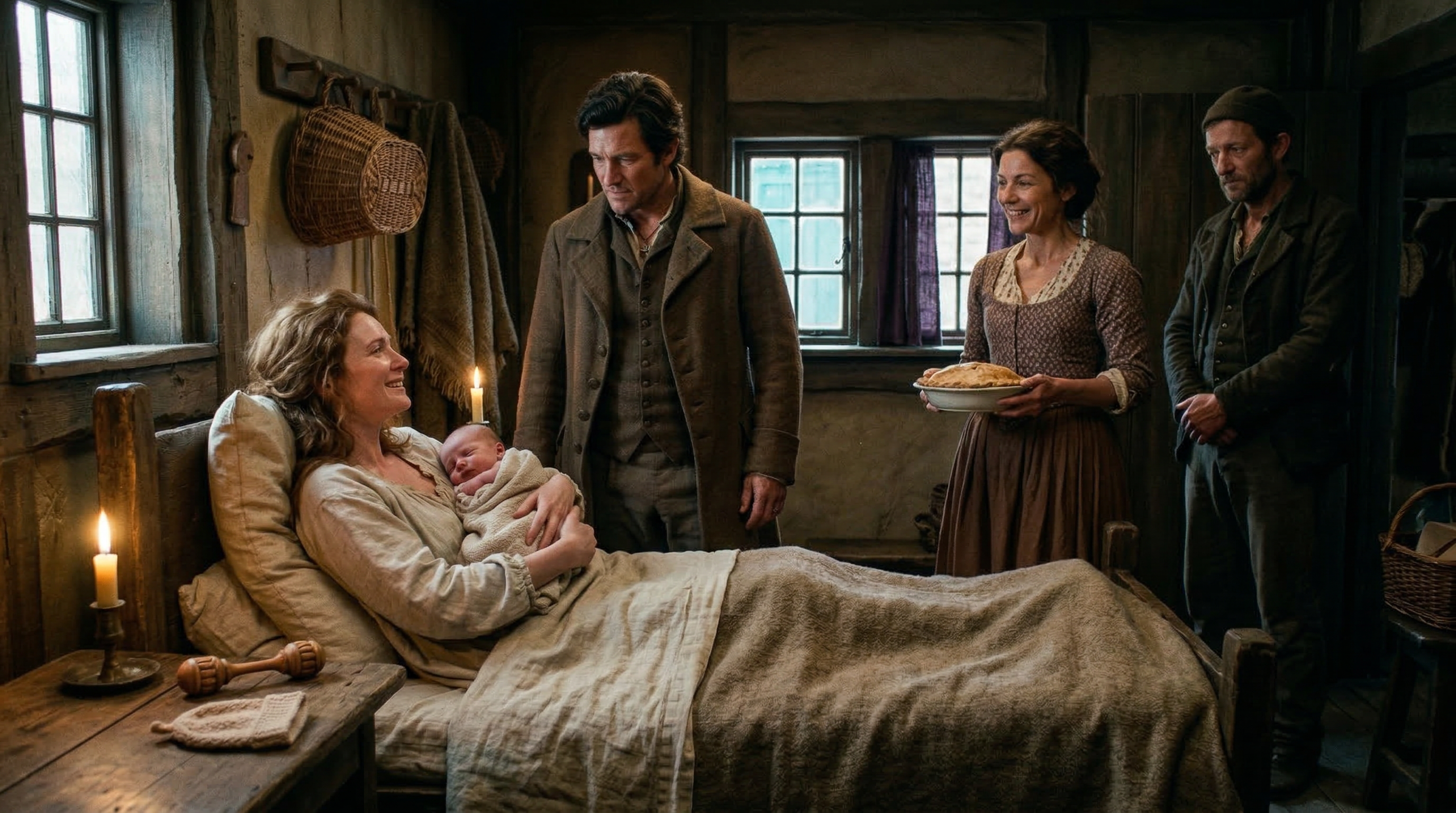
As news of William's birth spreads through Hanover Street, a procession of neighbours arrives bearing humble offerings—meat pies, hand-me-down clothes, and a carved wooden rattle—whilst a parish priest delivers a blessing that sounds uncomfortably like prophecy, and Edward begins to understand that the greatest inheritance he can leave his son cannot be measured in coin.
"We've little enough to spare, but what we have, we share. That's what neighbours do."— Abigail Pritchard
News travelled fast in Portsmouth.
By early afternoon, it seemed half of Hanover Street had heard that Elizabeth Jeffries had been safely delivered of a son. The intelligence spread from house to house in the manner of all such tidings—passed over garden walls, exchanged at the water pump, murmured between neighbours hanging their washing in the thin spring sunshine. By the time the church bells struck two, a steady procession of well-wishers had begun to make their way to the modest Jeffries cottage.
Abigail Pritchard was among the first to arrive. She came bustling up the lane with a covered dish balanced in her arms and her husband Thomas trailing behind, his long frame stooped slightly as though apologising for taking up so much space in the world. Abigail was a woman of generous proportions and even more generous spirit, her round face perpetually flushed with the exertions of keeping house, raising four children of her own, and minding everyone else's business into the bargain.
"I've brought a meat pie," she announced as Edward opened the door, thrusting the dish into his hands before he could speak. "Made it fresh this morning—well, started it last night, truth be told, but finished it this morning when I heard the news. A new mother needs her strength, and I'll wager neither of you has had a proper meal since yesterday."
Edward accepted the pie with gratitude that bordered on reverence. The aroma rising from beneath the cloth—rich gravy, tender beef, herbs from Abigail's own garden—reminded him that he had not eaten since supper the previous evening. His stomach growled audibly, and Abigail beamed with satisfaction.
"There now, you see? I knew it. You men are hopeless when it comes to looking after yourselves. Now then—" She was already pushing past him into the cottage, Thomas following in her wake with an apologetic shrug. "Where is she? Where's the little one? Oh, I cannot wait to see him!"
Elizabeth was propped up in bed, William cradled in her arms. She looked exhausted—there was no disguising that—but her eyes were bright, and colour had returned to her cheeks. When Abigail appeared in the bedroom doorway, she smiled.
"Mrs Pritchard. How good of you to come."
"As if I could stay away!" Abigail crossed to the bedside in three quick strides, her eyes fixed on the bundle in Elizabeth's arms. "Oh, would you look at him. Would you just look at him! He's the very image of his father, isn't he? That chin—I'd know it anywhere. And such a fine head of hair already!"
William, disturbed by the commotion, screwed up his face and let out a thin wail of protest. Elizabeth rocked him gently, murmuring nonsense words, and after a moment he subsided, his tiny fist finding its way back to his mouth.
"Strong lungs," Abigail observed with approval. "That's a good sign. A quiet baby is a worrying baby, my mother always said. The ones who make themselves heard are the ones who thrive."
Thomas had edged into the room behind his wife, looking faintly uncomfortable in the way men often did when confronted with the aftermath of childbirth. He nodded at Edward, who had followed them in.
"Congratulations, Ed," he said, his gruff voice warm with genuine feeling. "You're a father now. How does it sit with you?"
Edward shook his head slowly. "I hardly know, Tom. I keep expecting to wake up and find it was all a dream. But then I look at him—" He glanced at the bed, at Elizabeth and William, and his voice caught. "Then I look at him, and I know it's real. More real than anything has ever been."
Thomas clapped him on the shoulder. "It only gets more real from here, my friend. Wait until he's keeping you up all night with his crying. Wait until he takes his first steps and you spend every moment terrified he'll dash his brains out on the hearthstone. Wait until—" He caught his wife's warning look and fell silent, grinning sheepishly. "Well. You'll see soon enough."
Edward smiled, but his eyes remained on his son. "We've given him your name, Tom. For his middle name. William Thomas."
Thomas Pritchard, a man not given to displays of emotion, blinked rapidly several times. His weathered face worked through expressions he seemed unable to control. "You didn't have to do that, Ed," he said roughly.
"I know I didn't have to. I wanted to. You've been like a father to me these past ten years, Tom. More than that—you've been my friend. The best friend I could ask for. It seemed only right."
Thomas said nothing. He simply reached out and gripped Edward's arm, the gesture speaking volumes that words could not convey. Abigail, watching from the bedside, dabbed at her eyes with the corner of her apron.
The Pritchards were only the first. Throughout the afternoon, neighbours came and went in a steady stream, each bearing some small gift or offering. Old Mr Gideon from the end of the lane brought a wooden rattle he had carved himself. "Belonged to my own children, once upon a time," he said, pressing it into Edward's hands with trembling fingers. "They're all grown and gone now, scattered to the four winds. Seems right that it should have a new little one to amuse."
Mrs Cordell, the washerwoman, arrived with a bundle of baby clothes—simple things, patched and mended but scrupulously clean. "My youngest has outgrown them," she explained, "and I've no use for them now. Your boy might as well have the benefit."
Young Sally from the baker's shop on the corner came by with a small loaf of bread, still warm from the oven, and a pot of fresh butter. She blushed crimson when Edward thanked her, stammering something about her master sending his regards, and fled before he could say more.
Each visitor brought not only their gift but their good wishes, their advice, their stories of their own children and grandchildren. The small cottage, usually so quiet, hummed with voices and laughter. Elizabeth received them all from her bed, William sleeping peacefully through most of the commotion, occasionally waking to nurse or to register his displeasure at the noise before drifting off again.
Word had been sent to the Whitehall household, and late in the afternoon Elizabeth's mother arrived, flushed and breathless from hurrying across town. Mary Whitehall swept into the cottage with the particular authority of grandmothers, her sharp eyes taking in everything at once—her daughter's pallor, the baby's colour, the state of the bedding, the adequacy of the provisions.
"Let me see him," she said, and it was not a request.
Elizabeth smiled and shifted William so her mother could see his face. Mary gazed down at her first grandchild, and for a long moment she did not speak. Then she reached out and touched his cheek with one work-roughened finger, her expression softening into something almost reverent.
"He looks like your grandfather," she said quietly. "Around the eyes. The same shape." She looked up at Elizabeth. "William, you said? After my father?"
"Yes, Mama. I hope you don't mind."
Mary shook her head, and Elizabeth saw tears glistening in her mother's eyes—a rare sight, for Mary Whitehall was not a woman given to easy weeping. "Mind? Oh, my girl. He would have been so proud. So very proud." She bent and kissed Elizabeth's forehead, then straightened and turned to Edward with a brisk nod. "You've done well, son. Both of you have. Now—" She was already rolling up her sleeves. "Where do you keep your pots? This household needs a proper meal, and I daresay you haven't the first idea how to provide one."
Edward watched his mother-in-law take command of his kitchen with a mixture of relief and bemusement. He had always found Mary Whitehall slightly intimidating—a woman of firm opinions and firmer expectations—but he knew her brusqueness concealed a fierce love for her daughter. And now, it seemed, for her grandson as well.
He thought of his own mother, Martha, who had sent word that she would come tomorrow when her bones ached less from the damp. She had wept when Edward told her Elizabeth was in labour, had pressed coins into his hands that he knew she could not spare, had made him promise to send news the moment the child arrived. The two grandmothers would meet soon enough, and Edward found himself hoping they would get along. They were different women—Mary brisk and practical, Martha gentler and more worn down by life—but they shared a common devotion to their children that might form the foundation of friendship.
Edward stood by the window, watching the stream of visitors come and go, and found himself thinking about the nature of community. He had lived in Portsmouth all his life, had known many of these people since childhood, yet he had never fully appreciated until now the bonds that held them together. These were not wealthy folk. Most of them had little enough to spare, and yet they gave what they could—their time, their treasures, their wisdom—because that was what neighbours did. That was what it meant to belong.
He thought of the years after his father's death, when his mother had struggled to keep them housed and fed on the wages Edward earned alone. He had been nineteen, still learning the work, not yet commanding a full grown man's pay. There had been weeks when they lived on little more than bread and dripping, months when the rent fell due and they had not the coin to cover it. He remembered the neighbours who had helped them then—the women who had brought soup when Martha was too grief-stricken to cook, the men who had spoken to foremen on Edward's behalf, the small kindnesses that had kept them from the workhouse when all seemed lost.
Perhaps this was how debts were repaid—not to those who had incurred them, but to those who came after. Perhaps the kindness shown to him and his mother lived on now in the kindness being shown to his own family, an endless chain of small generosities stretching back through the generations and forward into a future he could not see.
It was a comforting thought. Edward held it close as he thanked each visitor, as he accepted their gifts and their blessings, as he watched his wife and son receive the embrace of their community.
Late in the afternoon, when the stream of visitors had begun to thin and Mary Whitehall had departed with promises to return the following day, a different sort of caller arrived at the cottage door.
Father Nathaniel Blackwood was the parish priest of St Thomas's, a man whose reputation for kindness and learning had spread far beyond the bounds of his own congregation. He was tall and spare, with the stooped shoulders of a scholar and eyes that seemed to see rather more than most men's. His black cassock was worn at the cuffs and shiny at the elbows, testament to years of service among people who could not afford to keep their priest in finery.
Edward had never been a particularly devout man. He attended church when he could, said his prayers when he remembered, tried to live according to the teachings he had absorbed in childhood. But faith, for him, had always been more habit than conviction—something inherited rather than chosen, practised without much thought.
Yet when he opened the door and saw Father Blackwood standing there, prayer book in hand, he felt something loosen in his chest. Here was a man who had baptised Edward himself, over twenty years ago. A man who had buried Edward's father, had spoken words of comfort over Richard's grave when Edward had been too grief-stricken to speak at all. A man who represented something larger than any individual—a continuity that stretched back centuries and would continue long after they were all dust.
"Father." Edward's voice came out rougher than he intended. "Thank you for coming."
The priest smiled, the expression softening his austere features. "I heard the good news and thought I might offer a blessing for the child, if you and your wife are willing. It is customary to wait for the christening, of course, but I have always believed that God's grace need not stand on ceremony."
"We would be honoured, Father. Please—come in."
The cottage, which had been full of chatter all afternoon, fell quiet as Father Blackwood entered. The few remaining visitors—the Pritchards, old Mr Gideon, Mrs Cordell—drew back respectfully, making way for the priest as he moved towards the bedroom. Even William seemed to sense the change in atmosphere; he stirred in Elizabeth's arms, his unfocused eyes turning towards the doorway as though seeking the source of this new presence.
Father Blackwood approached the bed and looked down at mother and child, his expression gentle. "Mrs Jeffries. I am glad to see you well. Childbirth is a perilous passage, and many do not survive it. God has been merciful."
"He has, Father." Elizabeth's voice was soft. "I felt His presence with me through the worst of it. I truly did."
The priest nodded, as though this were only to be expected. "And this is the child. William, I am told."
"Yes, Father. William Thomas. After my grandfather and after Mr Pritchard, who has been so good to us."
"A fine name. A name with weight to it." Father Blackwood reached out and touched William's forehead with one long finger, the gesture impossibly gentle. The baby blinked up at him, silent for once, as though recognising the solemnity of the moment. "He has a strong spirit, this one. I can see it in his eyes. He will need that strength, I think, for the life ahead of him."
Edward felt a chill run down his spine at the priest's words. There was something in Father Blackwood's tone—not quite prophecy, but something close to it—that made him uneasy. But before he could speak, the priest had turned to address the small gathering.
"Let us pray," Father Blackwood said, and the room fell utterly still.
He raised his hands over the child, his eyes closing, his voice taking on the resonant quality of one accustomed to filling churches with the Word of God.
"Almighty God, Creator of all life, we thank Thee for the safe delivery of this child into the world. We thank Thee for sparing his mother, for granting her the strength to endure the trial of labour, for bringing both through the shadow of death into the light of this new day."
Edward bowed his head, feeling the words wash over him. Beside him, he heard Abigail Pritchard sniffle quietly.
"We ask Thy blessing upon this child, William Thomas, son of Edward and Elizabeth. May he grow in wisdom and in grace. May he know the love of his parents and the fellowship of his neighbours. May he walk always in Thy light, and may Thy hand guide him through whatever trials and tribulations lie ahead."
The priest paused, and when he spoke again, his voice was lower, more intimate, as though addressing the child directly.
"The world into which you have been born is not an easy one, little William. There will be hardship. There will be sorrow. There will be moments when you doubt yourself, when you doubt the goodness of God and man alike. But know this: you are loved. You are loved by your parents, who have sacrificed much to bring you into this world. You are loved by this community, who will watch over you as you grow. And you are loved by God, who knew you before you were formed in your mother's womb, who has numbered every hair on your head, who will never abandon you no matter how far you stray."
Father Blackwood opened his eyes and looked at Edward and Elizabeth in turn.
"Raise him well," he said simply. "Teach him to be honest. Teach him to be kind. Teach him that true worth lies not in wealth or station, but in the content of a man's character. Do this, and you will have given him a foundation that no misfortune can shake."
"We will, Father." Edward's voice was hoarse. "We swear it."
The priest smiled, and the solemnity of the moment softened into something warmer. "I know you will. I have known you since you were a child yourself, Edward, and I have watched you grow into a good man despite all the hardships life has placed before you. If anyone can raise a son to walk the righteous path, it is you and your wife."
He made the sign of the cross over William, then over Elizabeth, then over Edward. "May the Lord bless you and keep you. May He make His face to shine upon you and be gracious unto you. May He lift up His countenance upon you and give you peace. Amen."
"Amen," the gathering echoed, and the word seemed to hang in the air like incense, filling the small room with its ancient power.
Evening came softly to Portsmouth.
The visitors had all departed, taking their good wishes with them, leaving behind a cottage that seemed somehow larger in the silence. The gifts they had brought were arrayed on the kitchen table—the meat pie, half-eaten now; the bread and butter; the baby clothes; the wooden rattle; a dozen other small kindnesses. Edward stood looking at them for a long moment, overwhelmed by the generosity of people who had so little to give.
In the bedroom, Elizabeth was nursing William by the light of a single candle. The baby suckled contentedly, his tiny fingers curled against the swell of her breast, his eyes half-closed in drowsy satisfaction. She looked up when Edward entered, and her smile—tired, radiant, utterly at peace—made his heart ache with love.
"How are you feeling?" he asked, settling onto the edge of the bed beside her.
"Tired," she admitted. "Sore. Happy. Terrified." She laughed softly. "All of those things at once. Is that possible?"
"I think it must be. I feel the same way." Edward reached out and stroked William's downy head with one finger, marvelling anew at the softness of him, the impossible fragility. "He's so small, Lizzy. So helpless. What if we do something wrong? What if we fail him somehow?"
Elizabeth was quiet for a moment, considering the question. When she spoke, her voice was thoughtful.
"We will do things wrong," she said. "We'll make mistakes. Every parent does. My mother told me once that raising a child is like feeling your way through a dark room—you stumble, you knock things over, you stub your toe on furniture you didn't know was there. But you keep going. You learn. And eventually, if you're lucky, you find your way to the other side."
"Your mother is a wise woman."
"She is." Elizabeth smiled. "Did you see her face when she held him? I don't think I've ever seen her so... soft. She tries to hide it, but underneath all that briskness, she feels things very deeply."
"I think William will have more grandmother than he knows what to do with," Edward said. "Between your mother and mine, he'll be spoilt rotten before he can walk."
"There are worse fates." Elizabeth shifted William to her shoulder and patted his back gently until he produced a small, satisfied burp. Then she cradled him in her arms again, gazing down at his face. "What do you think he'll become? When he's grown, I mean. What sort of man will he be?"
It was a question Edward had been asking himself all day, though he had no answer for it. What could he offer this child? What future awaited the son of a dockworker, born into poverty, with nothing to inherit but his father's calloused hands and his mother's stubborn pride?
And yet—was that truly nothing? Edward thought of all he had learned in his twenty-three years of life. How to work hard and never complain. How to treat others with respect, regardless of their station. How to love fiercely and forgive freely. How to get back up when life knocked you down, again and again and again, until getting up became as natural as breathing.
These were not things that could be bought with money or bestowed by birth. These were things that had to be learned, earned, forged in the fires of experience. And if he could teach them to William—if he could give his son even a fraction of the resilience and determination that had carried him through his own hard life—then perhaps that would be enough.
"I don't know what he'll become," Edward said at last. "But I know what I hope for him. I hope he'll be honest. I hope he'll be brave. I hope he'll find something in this world worth fighting for, and someone worth fighting alongside. Beyond that—" He shrugged, a gesture of surrender to forces beyond his control. "Beyond that, it's in God's hands. And his own."
Elizabeth nodded slowly. "That's enough," she said. "That's more than enough."
Outside, the last light was fading from the sky, the rooftops of Portsmouth silhouetted against a wash of purple and gold. Somewhere in the harbour, a ship's bell rang, marking the changing of the watch. The sounds of the town—voices, footsteps, the creak of carts and the cry of gulls—were muted now, settling into the quieter rhythms of evening.
Edward rose and crossed to the window, looking out at the world his son had been born into. It was not a gentle world. He knew that better than most. There would be hunger and cold, sickness and loss, the grinding weight of poverty that crushed so many before they had a chance to rise. There would be dangers he could not foresee, challenges that would test William in ways Edward could not imagine.
But there would also be love. There would be friendship and community, the warmth of neighbours who shared what little they had. There would be moments of joy so pure they made all the suffering worthwhile—a child's first smile, a wife's embrace, the simple pleasure of sitting down to a meal with those you loved.
Edward turned back to the bed, where Elizabeth had begun to doze, William sleeping peacefully in her arms. He stood there for a long moment, watching them breathe, memorising the scene. This was his family. This was his life. This was everything he had ever wanted, everything he had ever worked for, given form and substance in the two people before him.
Carefully, so as not to wake them, he lifted William from Elizabeth's arms and carried him to the cradle he had built. The baby stirred but did not wake as Edward laid him down, tucking the blanket around his small body, brushing a kiss across his forehead.
"Sleep well, little one," he whispered. "Tomorrow is a new day. The first of many. And I will be here for all of them. I promise you that."
He blew out the candle and climbed into bed beside his wife, drawing her close. She murmured something in her sleep and nestled against him, and Edward closed his eyes, letting the weariness of the day finally claim him.
Outside, the stars emerged one by one, scattered across the heavens like diamonds on black velvet. The moon rose over the harbour, casting its silver light upon the ships at anchor, the rooftops of the town, the small cottage on Hanover Street where a new life had begun.
The twenty-second of April, 1785, drew to its close.
And in his cradle, William Thomas Jeffries slept on, dreaming dreams that no one would ever know, his whole life stretching out before him like an unwritten book—full of blank pages waiting to be filled with joy and sorrow, triumph and tragedy, choices that would shape not only his own destiny but the destinies of generations yet unborn.
The story had begun.






