Georgios Apostolos Papadopoulos
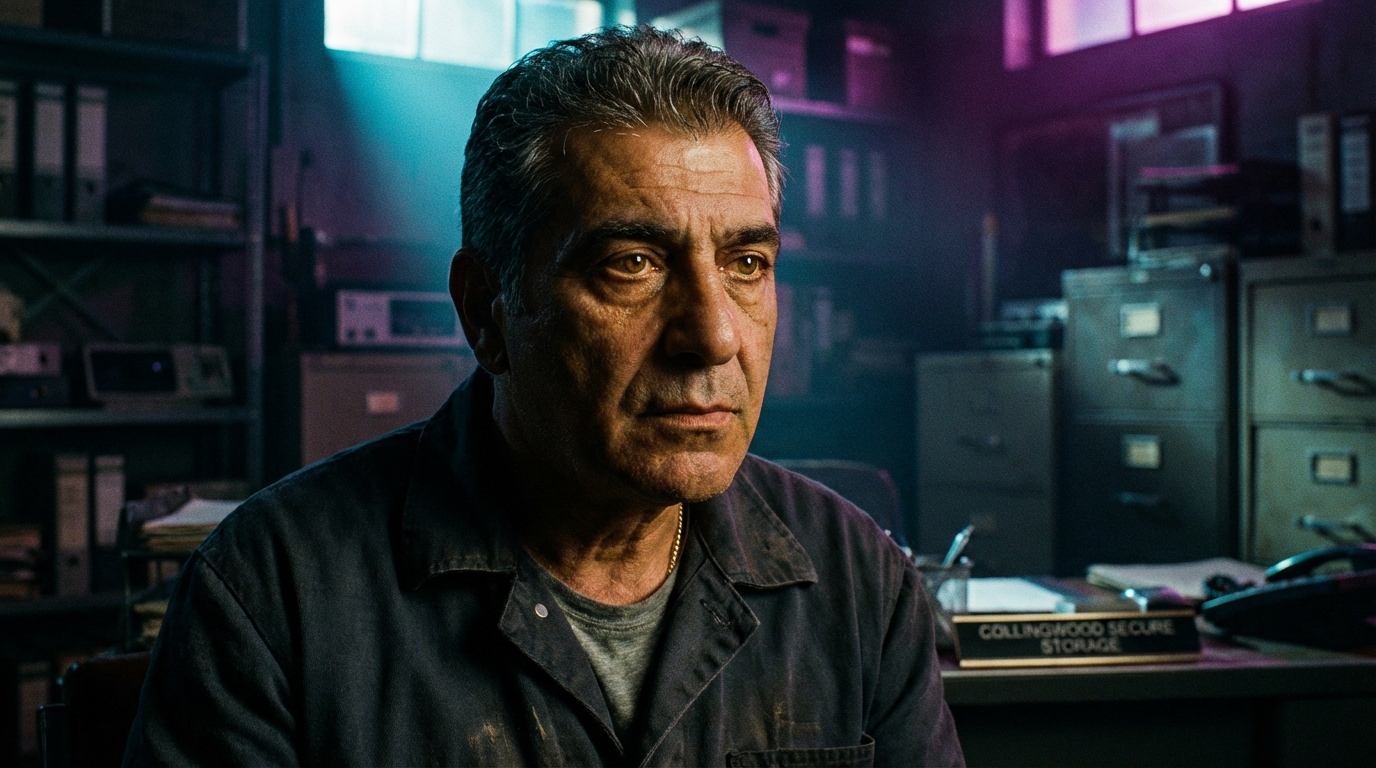
Georgios Apostolos Papadopoulos was born on 27th April 1962 in Thessaloniki, Greece, the third of five children raised in the working-class district of Ano Toumba during the years of military junta and economic stagnation that drove a generation to seek futures elsewhere. His immigration to Melbourne in 1985 and subsequent construction of Collingwood Secure Storage into the inner city's premier facility for art world clients represented thirty years of meticulous labour whose reputation was damaged in January 2023 when investigators discovered that one of his tenants had been using a climate-controlled unit to store materials connected to the murder of Naomi Simmons in Silverton, New South Wales.
Thessaloniki (1962–1985)
Georgios Apostolos Papadopoulos was born on 27th April 1962 in Thessaloniki's Ano Toumba district, the third of five children born to Apostolos Papadopoulos, who worked as a stevedore at the port, and his wife Maria, who supplemented the household income by taking in washing from families whose circumstances permitted them to pay others for labour their own did not. The family occupied a position within Thessaloniki's working class that was stable in its privations — food was adequate, shelter was reliable, and the children's futures were constrained by economic conditions whose improvement required either political transformation or geographical departure.
The military junta that governed Greece between 1967 and 1974 shaped Georgios's childhood with the particular education that authoritarian regimes provide to populations whose compliance they require but whose consent they do not seek. Curfews, disappearances, and the ambient dread that permeated daily life taught him, before he possessed the vocabulary to articulate the lesson, that authority was a force to be navigated rather than trusted, and that the relationship between a citizen and the state was governed by the state's requirements rather than the citizen's rights. The junta's collapse restored democratic governance without resolving the economic stagnation that had preceded it, and the youth unemployment that exceeded forty per cent during Georgios's adolescence ensured that the restoration of political freedom did not translate into the availability of meaningful work.
His education at the local technical school emphasised practical capability over academic distinction. He showed aptitude for electrical work, apprenticing with his uncle Dimitri, who maintained generators for shipping companies at the port. The work required the precision and patience that would characterise Georgios's professional life in Australia, but it offered limited prospects in an economy whose capacity to employ its young people had been exhausted by the combination of political instability and structural inadequacy that defined post-junta Greece.
His older brother Stavros had emigrated to Melbourne in the early 1980s, establishing himself within the Greek community through construction work and evening English classes. His letters described conditions that seemed impossible from Thessaloniki's perspective — steady employment, wages that permitted saving, and the predictability that allowed a man to plan beyond the coming week's meals. Georgios spent two years accumulating the airfare, teaching himself rudimentary English from borrowed textbooks, and preparing for a departure whose emotional dimensions — exile from family, language, landscape, and the particular quality of Aegean light that no Australian sky would replicate — he understood without permitting them to alter his decision.
He arrived at Tullamarine Airport on 23rd November 1985. Stavros collected him in a second-hand Toyota and drove through suburbs whose horizontal sprawl astonished someone raised in Thessaloniki's density. The Northcote flat they shared with three other Greek immigrants — its walls decorated with Orthodox icons and photographs of a homeland they would not afford to revisit — became the address from which Georgios began constructing the Australian life his Greek circumstances had denied him.
Melbourne (1985–1997)
The early years followed the patterns that immigrant experience had established for generations before Georgios's arrival and would continue establishing for generations after. Factory work at Nestlé's Campbellfield plant provided immediate income. Evening English classes at Preston Technical College gradually improved the communication skills upon which everything else depended. He anglicised his name to George for professional purposes, though fellow Greeks continued using Yiorgos, maintaining the linguistic boundary between the public identity his new country required and the private self his old one had formed.
His work ethic attracted supervisory attention within months. Unlike younger workers who treated factory shifts as temporary inconvenience, George approached chocolate production with the precision of someone whose technical training had been wasted on an economy that could not use it and who intended to ensure that the economy which had accepted him would have no grounds for similar waste. He memorised temperature tolerances, identified machinery faults before they caused stoppages, and volunteered for overtime that his colleagues avoided. Within eighteen months, he had been promoted to shift supervisor — the first Greek immigrant to achieve the position at Campbellfield — and the promotion confirmed what his uncle Dimitri's apprenticeship had suggested: that George's particular intelligence expressed itself through the mastery of systems whose reliability depended upon the attention paid to their maintenance.
Athena Kostas, daughter of established Richmond restaurateurs, met George at a church festival in 1988. Her Australian birth and education created initial scepticism within her family about this recent arrival whose English retained its accent and whose prospects remained unproven. But his ambition was visible to anyone who chose to assess it, and his courtesy — a quality whose expression in Greek culture carries weight that its Australian equivalent sometimes lacks — gradually converted her parents' reservations into the approval that Greek families require before marriages proceed. They married at St Eustathios Church in March 1990, the ceremony combining Orthodox tradition with Australian informality in proportions that reflected the life they intended to build together.
Their daughter Sophia arrived in 1991, and a son, Michael, followed in 1994. The children's births accelerated George's determination to establish the security that factory work provided in insufficient quantities. He had begun investigating business opportunities that required modest capital but promised growth, and the self-storage industry — then emerging to serve Melbourne's increasingly mobile population — attracted his attention. The model appeared straightforward: provide secure space, maintain the facilities to a standard that justified the rental, and build the reputation for reliability upon which repeat custom and referral depended.
His first venture, a partnership with Athena's cousin Nicholas to purchase a small Coburg warehouse in 1993, provided expensive education in the difference between a business model's theoretical appeal and its operational reality. The building required more renovation than their survey had anticipated, early customers proved unreliable with payments, and Nicholas's gambling debts introduced partnership tensions whose resolution consumed energy that the business's establishment demanded. George bought out his partner after eighteen months, refinancing through multiple sources, working twenty-hour days to keep the operation viable whilst maintaining his factory position. The Coburg experience taught him that the storage industry's apparent simplicity concealed complexities whose management required not merely technical competence but the kind of sustained personal attention that could not be delegated.
Collingwood Secure Storage (1997–2020)
The Johnston Street property that would become Collingwood Secure Storage appeared in classified advertisements in September 1995. The former textile warehouse, abandoned since the industry's collapse, occupied an inner-city location whose potential George recognised before the market confirmed his assessment. Collingwood was beginning the transformation from industrial dereliction to cultural precinct — artists and young professionals were arriving, galleries were opening, and the suburb's proximity to the city centre guaranteed that its current affordability would not persist. George understood that storage clients in this environment would value security for items of genuine worth rather than merely seeking overflow capacity for possessions they could not accommodate at home.
Securing finance required leveraging everything the family possessed — the Coburg property, their Reservoir home, Athena's inheritance from her grandmother. The Commonwealth Bank's lending officer expressed scepticism about an immigrant factory worker's capacity to manage commercial property, but George's business plan — its projections meticulous, its market analysis detailed, its assumptions conservative — eventually secured approval at interest rates whose severity reflected the institution's residual doubt rather than the proposal's deficiency.
He performed much of the renovation himself across two years, learning from library manuals and from tradesmen who appreciated his willingness to work alongside them. He installed climate control systems essential for storing artwork and documents, electronic security that exceeded the industry's prevailing standards, and fire suppression whose specification anticipated regulatory requirements that had not yet been imposed. Every decision prioritised the long-term reputation he intended to build over the short-term savings that compromising on quality would have permitted.
The facility opened in March 1997 with twelve of forty-eight units leased. George maintained his factory position, working nights and spending days attracting customers through visits to galleries, architectural firms, and antique dealers, explaining how proper storage could protect the investments their businesses depended upon. His accented but precise English, combined with technical knowledge whose depth exceeded what his competitors could match, gradually built the trust upon which the business's growth depended. By the end of the first year, occupancy had reached eighty per cent. By 2000, waiting lists had formed for the premium units.
The facility's development across the following two decades tracked Collingwood's transformation from bohemian margin to Melbourne's premier arts district. The dot-com boom attracted technology clients whose servers and digital archives required the climate control George had installed for artwork. The subsequent consolidation of Collingwood's cultural identity brought galleries, collectors, and artists whose storage needs aligned precisely with the facility's capabilities. George adapted continuously — adding viewing rooms where dealers could show stored pieces to prospective buyers, establishing documentation services for insurance purposes, maintaining relationships with conservators whose expertise his clients required. By 2015, nearly half his customers were connected to the art world, and his facility had become the storage provider that Melbourne's serious collectors trusted with items whose value — financial, artistic, sentimental — demanded the standard of care that George's temperament ensured.
His management philosophy remained personal despite the automation that the industry's evolution encouraged. He knew regular customers by name, remembered their requirements, and provided assistance beyond contractual obligation. When elderly collector Edmund Harrison died suddenly in 2003, George spent weeks helping the estate lawyer catalogue stored items, refusing additional payment on the grounds that Edmund had been a good customer and a good man, and that the distinction between the two assessments was not one George recognised.
Family and Community
Athena managed the facility's office during the establishment years, her Australian accent and professional manner reassuring customers whose initial encounters with George's accent might have generated hesitation their subsequent experience would have corrected. The partnership sustained the business through its vulnerable early phase and provided the children with a domestic model in which labour and commitment were presented as complementary rather than competing values.
Sophia graduated from the University of Melbourne's law school in 2013, joining a commercial firm specialising in property transactions whose professional knowledge would later prove directly useful to her father's business. Michael pursued engineering at RMIT, his technical capabilities contributing to the facility's ongoing modernisation. Neither child showed interest in assuming the business — they were pursuing careers that their father's labour had made possible, and George understood that the purpose of immigration was not to reproduce the limitations of the country one had left but to create the conditions in which one's children could choose futures whose range exceeded what one's own circumstances had permitted.
The Greek community provided the social infrastructure that sustained George through the decades in which professional obligation consumed most of his available energy. Church attendance, initially regular, became sporadic during the business's intensive growth years, though the relationships the community maintained — through festivals, family gatherings, and the informal networks that Greek Australians preserved with the particular determination of people whose cultural identity was too important to delegate to geography — remained constants whose value George would appreciate most fully when circumstances required support that professional success could not provide.
Julia Novak (2021–2023)
Julia Novak's arrival as a customer in March 2021 presented no features that distinguished her from the facility's established clientele. She was particular about climate conditions, concerned about security, willing to pay premium rates for a preferred unit, and her documentation was complete, her payments prompt, her interactions professional. George noticed that she visited frequently, sometimes spending hours in her unit, but attributed this to the artistic temperament that decades of serving the art world had taught him to accommodate without investigating.
The indicators that would acquire significance only in retrospect were subtle and individually unremarkable. Her questions about the facility's security arrangements were detailed but not unprecedented — valuable collections warranted thorough enquiry. Her interest in whether other customers stored works by the Finnish sculptor Teppo Jaskelain was unusual, but George deflected the enquiry with the discretion his business required and thought nothing further of it. The contents of her unit, glimpsed during her access, suggested active archival use rather than passive storage, but the distinction between the two was not one his lease agreements prohibited.
Other customers mentioned Julia occasionally — her presence at every significant gallery opening, her obsessive documentation of exhibitions, the intensity of her engagement with Melbourne's art world — and George listened without contributing, maintaining the neutrality that his professional position demanded and that his temperament preferred.
The Investigation (January 2023)
On the morning of 22nd January 2023 — nine days after Naomi Simmons had been found strangled in the sculpture garden of the John Dynon Gallery in Silverton, New South Wales — Detective Sergeant Wong arrived at Collingwood Secure Storage with a warrant authorising the search of Julia Novak's unit. George's cooperation was immediate, reflecting both the immigrant's learned relationship with authority and the businessman's understanding that resistance would damage reputation more comprehensively than compliance. He provided access codes, security footage, and customer records without requiring the legal compulsion the warrant would have permitted.
He watched investigators enter the unit and experienced the particular dread of discovering that his facility — constructed over decades as a sanctuary for valuable items entrusted to his care — had been harbouring materials connected to a murder investigation whose details he would learn from the media coverage that followed. The evidence bags, the methodical documentation, the grim professionalism of investigators whose demeanour indicated that what they were finding exceeded routine enquiry — these confirmed that Julia Novak's tenancy had served purposes George's professional courtesy had not equipped him to anticipate.
His cooperation extended beyond the warrant's requirements. He provided historical footage documenting Julia's access patterns, identified vehicles she had used, and recalled conversations whose details his memory for customer interactions had preserved with the accuracy that decades of personal service had developed. The information demonstrated his innocence whilst contributing to an investigation whose progress his facility's records materially assisted.
The media attention proved more damaging than the investigation itself. Journalists stationed outside the facility attempted to photograph anyone entering or leaving. Coverage describing "the secret storage unit where murder evidence was hidden" imposed upon his legitimate business associations with criminality that no amount of subsequent correction would fully erase. His children fielded questions from colleagues. The Greek community processed the news through the networks whose speed exceeded any media outlet's capacity.
Aftermath (2023–Present)
The investigation's consequences unfolded across dimensions whose management required skills George's immigration and entrepreneurship had not anticipated needing. He engaged a public relations consultant — an expense whose necessity measured the distance between the business he had built and the business the investigation had made it appear to be — to control the narrative about his facility's unwitting involvement. The message emphasised his cooperation, the facility's legitimacy, and the practical impossibility of monitoring every customer's stored materials without converting secure storage into surveillance, which would have destroyed the very discretion upon which the business depended.
He implemented additional screening procedures for new customers, though he acknowledged privately that none would have identified Julia Novak's intentions. Background checks, reference requirements, and detailed documentation of stored items balanced enhanced security with the privacy expectations that his remaining clients required. Occupancy dropped from ninety-two to seventy-one per cent in the six months following the investigation. New customer enquiries decreased by forty per cent. Several premium clients relocated to competitors whose names had not appeared in connection with criminal proceedings. George protected long-term employees by reducing his own compensation rather than their positions.
The prospect of testifying at Julia Novak's trial — explaining his business practices, defending his policies, submitting to cross-examination that might attempt to suggest negligence — represented a form of professional exposure whose stress his career had not previously generated. His lawyer advised thorough preparation. Sophia reviewed contracts and liability provisions. Michael upgraded the facility's security systems to exceed any standard that a prosecutor might cite as benchmark. The children's professional capabilities, developed through the education their father's labour had financed, were now deployed in the protection of the enterprise whose success had financed that education.
George Papadopoulos continues to arrive at Collingwood Secure Storage at seven each morning, checking climate systems, reviewing security footage, greeting the regular customers whose trust has survived the investigation's shadow. The facility operates, its units preserving items whose owners value the care he provides. But the awareness persists — in the quality of his attention to new enquiries, in the vigilance he applies to tenant behaviour he would previously have accommodated without question, in the particular weight that attaches to a reputation whose construction consumed thirty years and whose damage required nine days — that the discretion he built his business upon contained, within its own professional virtue, the vulnerability that circumstance exploited.
The Greek community's response evolved from initial alarm to eventual support, recognising George as a man whose misfortune reflected the limitations of good faith rather than the consequences of poor judgement. Church attendance, resumed with regularity that the business years had interrupted, provides the consolation that material success cannot — the reminder that integrity is assessed across the span of a life rather than by the crisis that tested it. He is sixty-three years old, and the retirement he had postponed during the growth years now requires reassessment against circumstances that his planning had not imagined and that his temperament — formed in Thessaloniki, tested in Melbourne, defined by the conviction that meticulous care could protect against misfortune — has not yet fully absorbed.







