George Nathaniel Parker
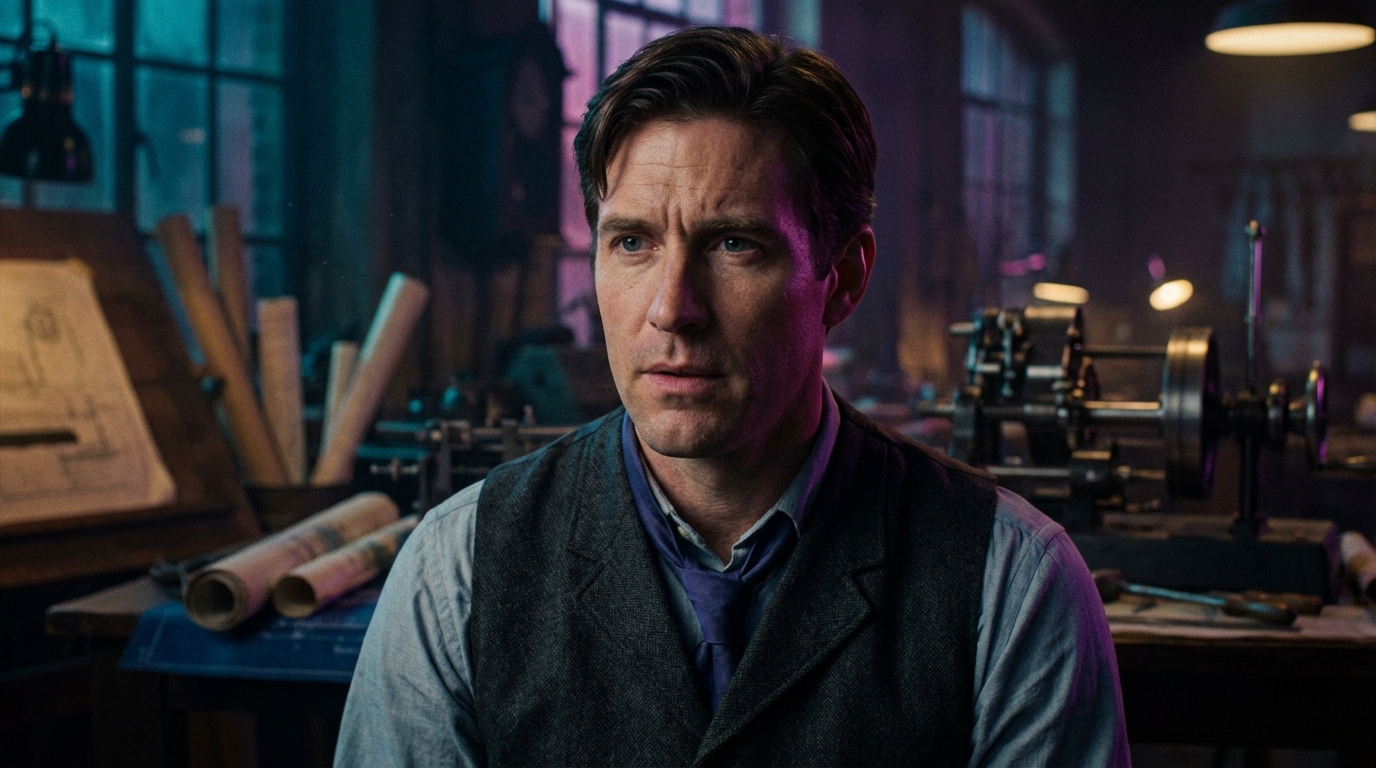
George Nathaniel Parker (1870–1946) was a Hobart-born engineer whose career in civil infrastructure helped shape Tasmania's physical landscape during the decades of its most rapid development. He married Evelyn Rose Blackwood in 1898, and the partnership they built — equitable, productive, and grounded in mutual respect for each other's professional lives — endured until the dementia that consumed his final decade removed him from it by degrees.
Early Life and Family
George Nathaniel Parker was born on 15 July 1870 in Hobart, Tasmania, the second of five children born to William Nathaniel Parker, a boatbuilder and marine carpenter who operated a small yard on the waterfront at Battery Point, and Agnes Parker, née Drummond, the daughter of a Huon Valley orchardist whose family had been in Tasmania since the 1830s. The Parker household occupied a narrow cottage on Hampden Road, close enough to the waterfront that the smell of pitch and sawdust permeated the rooms and the sound of hammering carried from the yard through the thin walls during working hours.
William Parker was a skilled craftsman whose reputation among Hobart's fishing and commercial fleet sustained a modest but reliable income. He built and repaired the smaller vessels that worked the Derwent estuary and the Channel — fishing boats, lighters, the shallow-draught craft that served the river settlements whose road access remained unreliable. He was not a wealthy man, and the distinction between his family's circumstances and those of the professional and mercantile families who constituted Hobart's upper class was one that George registered early and that informed, without distorting, his understanding of the social world he would eventually enter through marriage.
George's siblings reflected the varied trajectories that working families of the period produced. His elder brother, William James Parker, born in 1868, took over the boatbuilding yard after their father's retirement and operated it until the Depression rendered it unviable. His sister Alice Maud, born in 1872, married a schoolteacher and settled in Launceston. Twin brothers, Frederick and Harold, arrived in 1875 — Frederick became a carpenter and Harold a clerk in the Hobart customs house. The family was close without being demonstrative, its affections expressed through the practical support that working-class households provided as a matter of course rather than through the verbal and social rituals that wealthier families considered essential.
Agnes Parker was the household's organising intelligence — a capable, unsentimental woman who managed the family's finances with the tight-fisted precision that a boatbuilder's income demanded, ensured that all five children attended school regularly, and maintained domestic standards whose rigour reflected pride rather than aspiration. George inherited from her a capacity for methodical organisation that would prove as valuable in his engineering career as any technical skill, and a respect for competence — in whatever form it took and regardless of whose hands exercised it — that would shape his response to the formidable woman he eventually married.
Education and Early Career
George attended a local school in Hobart where he distinguished himself in mathematics and the practical sciences without attracting the kind of attention that wealthier boys' academic achievements generated. His teachers recognised his aptitude but lacked the resources to develop it beyond what the standard curriculum provided, and it was William Parker — whose own education had ended at twelve but whose craftsman's understanding of materials, forces, and structural integrity constituted a practical engineering education in all but name — who first identified in his son a capacity for thinking about how things were built that exceeded the requirements of the boatyard.
The decision to pursue further education required financial sacrifice that the Parker household managed through a combination of savings, the modest scholarship that George's examination results secured, and the particular determination of Agnes Parker, who regarded her son's intellectual potential as a resource that would be wasted if it were not properly invested. In 1888, at the age of eighteen, George enrolled at the University of Melbourne to study engineering — a decision that removed him from Tasmania for the first time in his life and placed him in an academic environment whose social assumptions bore little resemblance to the Battery Point waterfront.
The Melbourne years were formative and sometimes uncomfortable. George was academically capable — his mathematical skills were genuine and his grasp of structural principles reflected the intuitive understanding that growing up in a boatyard had provided — but he was socially out of place among students whose public school educations and professional family backgrounds created a shared vocabulary of reference and assumption that George could observe without participating in. He compensated by working harder than his peers, producing coursework of a thoroughness that his lecturers praised and that his fellow students occasionally resented, and maintaining the quiet self-containment that would become his most recognisable personal quality. He graduated with honours in 1892 and returned to Hobart with qualifications that his family's circumstances had not predicted and that the island's developing infrastructure urgently required.
George's early career was spent in the employ of the Tasmanian Public Works Department, where he contributed to the design and construction of the roads, bridges, and public buildings that the colony's growing population demanded. The work suited his temperament precisely: it was concrete, consequential, and governed by physical laws whose reliability he found reassuring after the social uncertainties of his university years. He developed a reputation for meticulous preparation, sound structural judgement, and the particular skill of translating ambitious architectural designs into structures that could actually be built within the constraints of available materials, labour, and budget. He was not a visionary engineer — he did not design bridges that redefined what bridges could be — but he was an exceptionally competent one, and the distinction between vision and competence mattered rather less to the communities whose roads remained passable and whose public buildings did not collapse than it did to the professional hierarchies that ranked engineers by the ambition of their designs rather than the reliability of their execution.
Marriage to Evelyn Rose Blackwood
George met Evelyn Rose Blackwood through the overlapping social networks that connected Hobart's professional institutions during the late 1890s — the public lectures, the civic meetings, the educational events at which a young engineer and a young headmistress might find themselves in the same room without the formal introduction that more stratified social settings would have required. The attraction was not immediate but it was genuine: George recognised in Evelyn an intelligence that operated with an intensity he had not previously encountered in anyone, male or female, and Evelyn recognised in George a steadiness of temperament and a willingness to take her seriously that the men of her own professional class — lawyers, academics, the sons of established families — had not reliably demonstrated.
The courtship navigated the social distance between the Blackwood family's professional establishment and the Parker family's working-class origins with less difficulty than either party had anticipated. Robert Cornelius Blackwood, Evelyn's father, assessed George with the cautious pragmatism of a man whose own father-in-law had been a Launceston merchant rather than a gentleman, and concluded that the young engineer's qualifications, character, and evident devotion to his daughter outweighed the social reservations that a more rigid assessment of family background might have produced. Clara, Evelyn's mother, perceived in George the practical competence and emotional reliability that she herself had brought to her marriage, and the recognition created an affinity between mother-in-law and son-in-law that would outlast many of the household's more obviously significant relationships.
George and Evelyn were married in 1898. He was twenty-eight, she twenty-four. The marriage that followed was unlike any other in the extended Blackwood family's history — not because it was perfect, but because it was equal. George did not subsume his identity within the Blackwood dynasty as Charles Harris had done, nor did he maintain the distant professional separateness that had characterised Thomas Erasmus Blackwood's relationship with his wife Emily. He occupied a position that the Blackwood family's previous marriages had not produced: a partner who was genuinely supportive of his wife's career, genuinely competent in his own right, and genuinely uninterested in the question of whose work was more important — a question that the family's history of male professional dominance had never required anyone to ask.
The household they established operated according to a distribution of responsibilities that reflected capability rather than convention. George cooked — adequately rather than brilliantly, but with the matter-of-fact approach of a man who regarded meal preparation as a practical task rather than a gendered obligation. He managed portions of the household accounts, maintained the house and garden with the structural competence his engineering training had provided, and adjusted his own domestic contributions to accommodate the varying demands that Evelyn's headmistress role imposed upon her time. The arrangement was not ideological for George in the way that it was for Evelyn; he did not cook because he believed in the equal distribution of domestic labour as a political principle, but because someone needed to cook and he was available and his wife was not. The pragmatism of his motivation did not diminish the significance of his practice, and Evelyn — who understood the difference between a man who shared housework because he had been persuaded it was right and a man who shared housework because it simply did not occur to him to do otherwise — valued the latter more than the former.
Children and Domestic Life
George and Evelyn had two surviving children. Lucy Ann Parker was born on 14 March 1900, and Robert George Parker on 8 September 1903. A third pregnancy, in the autumn of 1906, ended in miscarriage — a loss that George processed with a grief whose expression was characteristically practical, manifesting as increased attention to Evelyn's physical recovery and a period of intensified domestic activity that those who knew him recognised as his way of managing emotional disturbance through useful work.
As a father, George brought to his children the same qualities he brought to everything: steadiness, practical engagement, and an attention to their development that expressed itself through presence rather than instruction. He took Lucy and Robert to construction sites on weekends, explaining the principles behind the structures they were watching take shape with the patient detail of a man who believed that understanding how the world was built was a form of education as valuable as anything a school could provide. He attended their school events with the reliable regularity that working-class upbringings instilled and professional pressures sometimes threatened. He was not an imaginative parent — Evelyn provided the intellectual stimulation and the exposure to ideas that broadened the children's horizons beyond what George's more practically oriented mind would have offered — but he was a present one, and the combination of his steadiness and her ambition produced a household whose children grew up understanding that both qualities mattered.
Professional Career
George's engineering career through the early twentieth century paralleled Tasmania's own physical development. He contributed to the design and construction of bridges across the island's rivers, roads through its mountainous interior, and the public buildings — schools, government offices, municipal facilities — that the growing population required. His work was solid, practical, and largely anonymous in the way that civil engineering always is: the structures he helped create were used daily by people who did not know his name and whose lives were improved by his competence without their awareness of it.
He rose through the Public Works Department to positions of increasing responsibility, eventually overseeing projects whose scale and complexity exceeded what his Battery Point childhood might have predicted. The harbour facilities at Hobart, the expansion of road infrastructure in the northern districts, the reinforcement of bridges whose original construction had not anticipated the weight of motor traffic — these were the projects that occupied George's middle career and that constituted his most tangible professional legacy. He managed them with the meticulous attention to detail that his colleagues had come to expect and the refusal to cut corners that occasionally brought him into conflict with administrators whose budgetary priorities did not always align with his structural standards.
The Great War affected his work indirectly — redirecting public investment away from civilian infrastructure toward the war effort, reducing the availability of materials and skilled labour, and imposing upon the projects that continued a set of constraints that required the kind of creative problem-solving his pragmatic temperament was well-suited to provide. He was forty-four when the war began, too old for active service, and the guilt that some men of his generation felt about their non-combatant status was mitigated in George's case by the practical awareness that Tasmania's infrastructure required maintenance regardless of what was happening in France — a calculation that was entirely accurate and that provided less emotional satisfaction than accuracy might suggest.
The War's Domestic Cost
The war brought to the Parker household its most significant personal crisis when Evelyn's mother, Clara Winifred Blackwood, died of influenza on 14 August 1918. George had maintained a close relationship with Clara since his marriage — the affinity between them, grounded in shared practical temperaments and the mutual recognition that they each occupied support roles within a family defined by more conspicuous personalities, had deepened over two decades into something approaching genuine friendship. Her death struck George with a force that his own family's less demonstrative emotional culture did not equip him to express, and his grief was characteristically channelled into the practical tasks that bereavement generated — arranging funeral logistics, managing the immediate needs of the household, providing Robert Cornelius with the steady presence that the older man's own limited emotional vocabulary required.
Decline
George retired from engineering work in 1938, at the age of sixty-eight. The retirement was overdue by the assessment of colleagues who had observed the slowing of his cognitive processes over the preceding two or three years — the increased time required to review calculations he would once have completed in minutes, the repetition of instructions he had already given, the occasional confusion about project timelines that his meticulous record-keeping had previously made impossible. George resisted retirement with the stubbornness of a man whose identity was inseparable from his work, and the decision, when it came, was precipitated by an incident on a construction site in which he issued contradictory instructions to a foreman — a lapse whose professional consequences were minor but whose implications for his continued capacity to oversee public safety were not.
The dementia that followed his retirement progressed with the variable pace that the condition characteristically imposed. There were periods — weeks, sometimes months — during which George functioned adequately, maintaining household routines, recognising family members, and engaging in conversations whose coherence, if monitored over time, showed gradual but unmistakable deterioration. There were also episodes of confusion whose severity frightened Evelyn and the children — moments when George did not know where he was, could not identify the house he had lived in for forty years, or addressed his wife by his mother's name with a conviction that no correction could dislodge.
The war years accelerated the decline. By 1943, George required assistance with basic tasks that his engineering mind would once have managed without conscious thought — dressing, navigating the house, remembering whether he had eaten. Evelyn managed his care alongside her own diminishing professional responsibilities, the combination of demands exceeding what any single person could sustain without cost. She hired a nurse for the afternoons, maintained George's morning routines herself, and bore the particular grief of watching a man whose presence had been his defining quality become progressively absent from the life he continued, in the most limited biological sense, to inhabit.
The cruelty of the disease was not in the forgetting itself but in its selectiveness. George could describe, with precision that startled visitors, the engineering specifications of a bridge he had designed in 1911. He could not remember his daughter's married name. He could recall the exact proportions of a mortar mix he had used forty years earlier. He could not find his way from the bedroom to the kitchen without guidance. The memories that survived were professional — the technical knowledge that had constituted his working life — whilst the personal memories that had constituted his human life disappeared first, as though the disease recognised which portions of his mind he could most afford to lose and chose the opposite.
Death
George Nathaniel Parker died on 22 September 1946 in Hobart, at the age of seventy-six. The immediate cause was pneumonia, an infection that his weakened body — immobile, underweight, and compromised by years of progressive neurological deterioration — could not resist. He had been bedridden for the final months, his awareness of his surroundings reduced to responses that those attending him interpreted as recognition without being able to confirm. Evelyn was at his side. Lucy, who had travelled from Melbourne, arrived on the morning of his death. Robert George, who lived in Hobart, had been visiting daily.
He died in the house they had shared since their marriage — the house he had maintained, extended, and repaired with the structural competence that his career had provided and that the dementia had been the last thing to take from him. The garden he had kept was visible through the bedroom window, its order reflecting the attention of a man who believed that things should be built properly and maintained carefully and that the effort required to do so was not a burden but a form of respect for the materials and the people who depended upon them.







