George Henry Whitmore
George Henry Whitmore (1778–1850) was a Somerset-born master vintner and one of Brierly's five founding Guardians. The second son of a winemaking family, he made his name salvaging ice wine from a killing frost before Jonathan Blackwood recruited him to plant vines in a world that had none. Crossing in 1810, he turned barren Clivilian soil into flourishing vineyards, giving the settlement its defining craft, its wine, and its harvest traditions. He died among his vines in 1850, the first of the Guardians to pass, his wife Emma following him a year later.
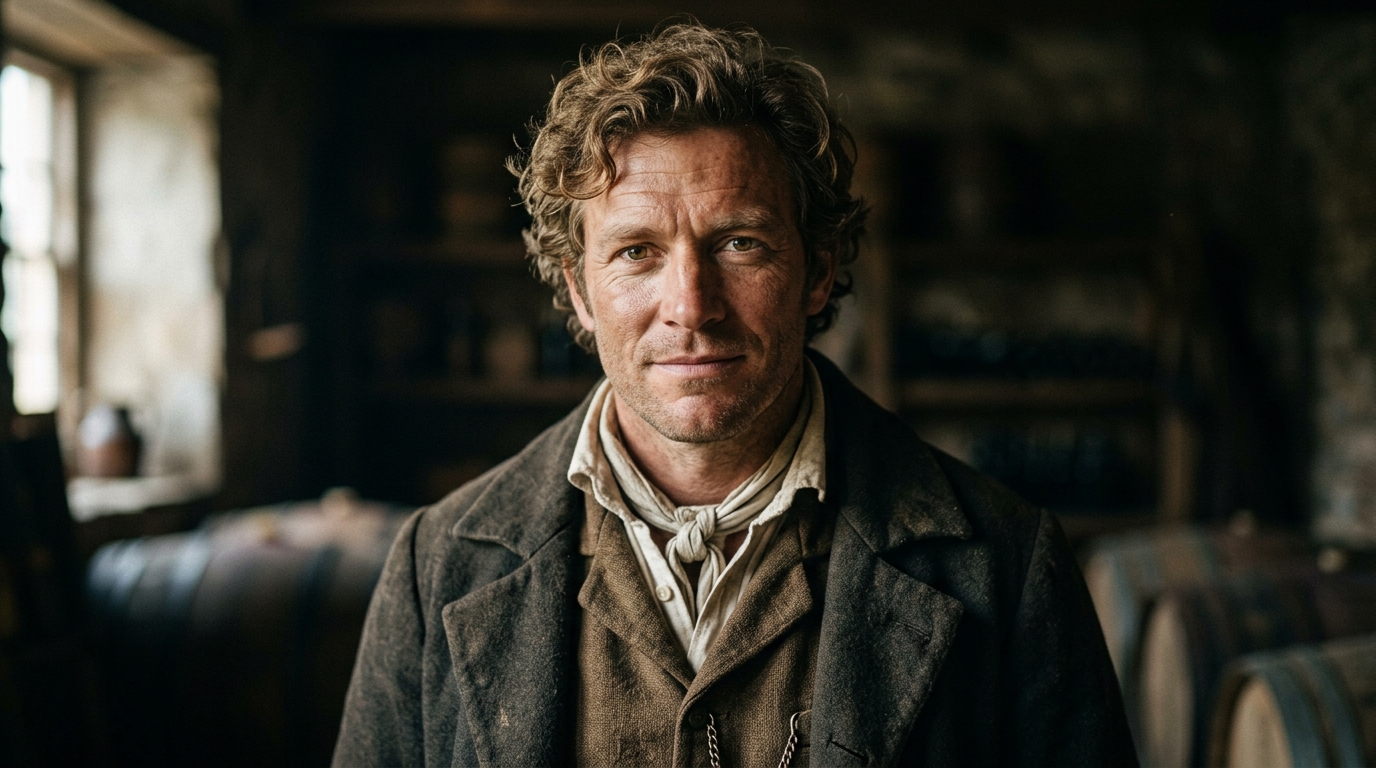
Second Son of the Vineyard
George Henry Whitmore was born on 5 October 1778, during the grape harvest, at the family vineyard near Shepton Mallet in Somerset. His father, Thomas Whitmore, was the third generation of Whitmores to make wine on that ground, and his mother, Sarah Whitmore née Pemberton, brought with her the Bristol merchant connections that kept the family's casks moving to steady markets. The limestone hills around the estate gave the Cabernet Sauvignon and Merlot their character, and the vineyard, established in 1732, had built its modest reputation on patience and craft rather than scale.
As the second son, George began life with uncertain prospects. His elder brother, Edward, stood to inherit, and might have crowded George out of the trade altogether had the two not wanted such different things from it. Edward loved the ledger and the sale, the counting-houses of Bristol far more than the muddy rows of Somerset; George loved the vine itself. Their father, seeing the divide clearly, split the work along it, setting Edward to the selling and George to the growing, and so each son got the half he wanted.
George's education ran on two tracks at once. At Wells Cathedral School he took to natural science and mathematics, and in the vineyard he turned those disciplines on the work itself, treating fermentation as chemistry and the harvest as a problem in yield. The notebooks he kept as a young man — later carried with him across worlds — recorded the effect of temperature on fermentation, the way soil amendments shifted the flavour of a grape, and his own experiments in training the vines for more sun. He was, even young, a man who believed wine was something to be understood and not merely made.
Family Tree
The Frost of 1796
The vineyard nearly failed when George was eighteen. An unseasonable frost in 1796 killed most of the vines just before the picking, and the family faced ruin with a year's income frozen on the stem. George's response made his name. Rather than write the crop off, he salvaged the damaged grapes for ice wine, a technique he had only read about in the work of German vintners, and the small quantity he produced commanded such a price that it carried the family through.
It was the defining episode of his young life, and it taught him the lesson he would carry to Clivilius: that disaster, met with knowledge rather than despair, could be turned into something finer than the harvest it replaced. The frost wine became a quiet legend in the district, and the Whitmore name acquired a reputation for ingenuity that outran the size of the estate.
Emma Clark
George met Emma Clark at the Shepton Mallet harvest fair in September 1798, where she was helping her father, the blacksmith James Clark, demonstrate a new pattern of pruning tools at his stall. George had come looking to replace a pair of secateurs and stayed to argue about them; their talk moved from the tools to the relationship between a clean cut and a good yield, and he came away struck by a woman who understood metal, edges, and growing things all at once.
The match met resistance from the Whitmores, who had hoped George would marry into one of the established vintner families and strengthen the business through the union. A blacksmith's daughter was not the alliance they had imagined. But George's quiet stubbornness was equal to his mother's ambition, and Emma proved herself on her own terms, reading the same technical papers George pored over until no one could pretend she was anything but his equal in the work. They married on 23 April 1799 at St Peter's Church in Shepton Mallet, during the dormant season so as not to interrupt the vines, and her dowry came in the form of specialised tools her father had forged — implements that would prove worth far more than coin in a world where nothing could be easily replaced.
Their first son, John Thomas, was born on 14 June 1801, during the summer pruning, and George came in from the rows to find Emma with the child amid baskets of leaves she had been sorting. Henry followed on 8 November 1804, arriving with that year's exceptional harvest, an omen George chose to read as a promise for the boy's future among the vines.
Blackwood's Proposition
It was George's published work that drew Jonathan Blackwood's eye. After the frost wine, George had written for the Agricultural Magazine on his experiments with indigenous yeast strains and the character they gave a wine, papers that revealed not just technical skill but a whole philosophy — winemaking as a collaboration with nature rather than a conquest of it. Blackwood approached him at an agricultural lecture in Bath in December 1809, opening with praise for those papers and moving, by careful degrees, to hypothetical questions about planting vineyards in virgin ground.
Over dinner at Bath's White Hart Inn, Blackwood laid out the truth behind the questions: a settlement in Clivilius, a world without vines. George's scepticism held until Blackwood produced soil samples whose mineral composition matched nothing on Earth and yet read, to George's trained eye, as near-perfect for the grape. The prospect of making wine from wholly new ground, with no inherited tradition to constrain what he might try, spoke to the experimenter in him more powerfully than caution could answer.
The decision cost him a hard winter. To go meant abandoning the Somerset ground his family had worked for the better part of a century. Edward backed the venture readily enough, seeing his own path to sole inheritance in it; their parents could not understand the throwing-over of proven success for an unknown world, and Sarah wept at the loss of her grandchildren to a place she would never see. It was Emma who settled it. She had watched George's innovations strain against everything the old vineyards would permit, and she understood before he did that Clivilius was not a risk to his craft but the only room left for it to grow.
A Blank Canvas
George crossed into Clivilius with the founding party on 10 May 1810, among the Guardians and first settlers who opened Brierly's ground. The passage left him reeling, and the country he stepped into challenged every assumption he carried: no vines, no native yeasts, no established soil life, no pests and no predators to balance them — a blank canvas that was at once a vintner's dream and his nightmare.
He did not plant that first season. George understood that wine begins in living soil rather than mere dirt, and he spent his early months coaxing into the new ground the beneficial bacteria and fungi he had carried from Somerset, tracking their spread with a microscope he had insisted on bringing through despite every argument about weight. His fellow Guardians, impatient to see something in the earth, questioned the delay, but his patience was vindicated when his prepared plots took far better than bare planting could have managed.
The vines themselves were the distilled inheritance of the Whitmore vineyard, cuttings taken from its best stock rather than seeds, since George wanted no unwanted variation creeping in through a generation of chance. Each cutting travelled individually wrapped in damp hessian, packed in cases built to hold their moisture through the portal. Of three hundred, two hundred and seventeen took root in Clivilian soil — a remarkable survival, and the genetic foundation of every vine Brierly would ever grow.
The Vines Take
Building the vineyard tested George's ingenuity as much as his craft. As a Guardian he kept his access to Earth and could bring back a loaded cart or a string of pack-horses on a supply run, but every journey had to be planned around the need for secrecy, and he could hardly order materials by the wagonload without explaining where they were bound. He worked with Robert Aldridge, the settlement's builder, on the trellising — timber imported at first, then stone and fired clay as George pushed towards methods that would not depend forever on Earth. He made his fermentation vessels from local clay, fired in kilns fed with English coal, even as he taught himself to do without the coal in time.
Emma and the boys followed in 1812, their crossing timed for the early spring and the vineyard's first real expansion. George had prepared the ground for them as carefully as for his vines, raising a house with Somerset touches to soften the strangeness, laying in vegetable gardens, marking out where the children could safely roam. The reunion shook them all: two years had leaned George down and sharpened him, given Emma a harder independence, and turned the boys into near-strangers grown tall. John, eleven now, took to the vines at once; seven-year-old Henry was drawn instead to the settlement's building works, though both would learn the wine in time.
Emma's coming turned cultivation into a household and a vineyard into an enterprise. She built the routines that let agricultural demand and family life share a roof, made the social ties that knit the Whitmores into Brierly, and brought her own order to the work, devising a system for tracking the performance of individual vines and a weather journal that became, over the years, an irreplaceable record of Clivilius's unfamiliar seasons.
The first true vintage came in 1815, and it vindicated everything — a wine unlike any Somerset had made, its mineral depth beyond anything of Earth's, its long growing season pushing the grapes to sugars George had to master his fermentation to tame. For the casks he had thought ahead, importing oak saplings in 1813 to raise a grove that would not yield usable timber for decades, and in the meantime ageing his wine in stone and clay after the fashion of the ancient Romans — a makeshift that gave the early Brierly vintages a character so distinct he kept the method even once his oaks matured.
Water and Disease
George took a leading hand in the Brierly aqueduct, completed in 1819, understanding better than most that great wine depended on the command of water. He had seen how drought could concentrate a grape's flavour and how too much rain could thin it, and the aqueduct gave him the means to control that stress deliberately. His contribution went past labour into design: he reckoned the flow each part of the vineyard needed against its soil and the age of its vines, and worked out a system of distribution gates that let him water one section while sparing another, a refinement well ahead of its day.
Disease came in 1824, a fungal blight most likely carried in on contaminated Earth materials, and with no ready supply of fungicide George had to invent his defence. He found it in a set of Clivilian minerals that Charles Sinclair had identified as hostile to fungal growth, and built from them a treatment that held the infection back — though only with the constant vigilance that became, from then on, part of the discipline the Whitmore vines demanded.
The Harvest Table
From the first harvests Emma set a table, gathering the settler families who came to help bring in the grapes around food that made use of everything the vines gave — verjuice-soured meats, sweetnesses drawn from grape molasses. Those harvest meals were modest at first, a working household feeding its neighbours, but they planted the seed of something larger; when Brierly's Harvest Festival took shape in later years, George's wine stood at the centre of it, and the table Emma had first laid was remembered as one of its quiet beginnings.
George brought music to the same gatherings. He had learned the violin as a boy in Somerset, his mother insisting on some refinement to set beside the dirt under his nails, and in Clivilius the instrument became a thread that bound the community together. He played classical pieces from his youth and folk tunes to set people dancing, and he composed his own airs as well, among them a "Vintage Waltz" that Brierly took for its own. When his strings wore out beyond replacing, he learned to make new ones from Clivilian materials, and their slightly altered voice gave the settlement's music a sound subtly unlike Earth's.
Two Sons
George's two sons divided much as he and Edward once had. John took to the vines with a natural feel that delighted his father, who began training him in earnest at fourteen and came to treat him less as an apprentice than as a partner; the boy's own ideas, especially on pruning for Clivilius's longer season, earned genuine respect rather than mere paternal indulgence. Henry's gifts ran the other way, towards construction and mechanism, and he spent his time with Robert Aldridge learning the principles of building. George's early attempts to force the boy towards the vines bred a friction that only Emma's good sense could ease; she made George see that Henry's skills were no betrayal of the family trade but a necessity to it, for someone had to build and maintain the increasingly intricate machinery the vineyard relied on.
That recognition made the loss, when it came, the harder to bear. In 1835 Henry was killed in a construction accident, crushed by a collapsing beam while raising new fermentation buildings, and George turned the blame inward, certain he had pushed the boy towards the work that killed him. The grief hardened into an anxious, over-careful love for John that bred its own tensions as the surviving son sought room to live his own life and court Catherine Birkett, whom he had met during a spell of trade between settlements.
Emma's Long Decline
The household met another kind of crisis in 1828, when a severe illness confined Emma to her bed for three months and forced George to carry both home and vineyard alone. The ordeal taught him, late, how much she had always held together; the boys rose to it, John effectively running the vines while Henry managed the house, but Emma's recovery was slow and never complete. She never regained her old vigour, and George reshaped his expectations and his working life around her diminished strength, the partnership of their marriage shifting into a gentler, more deliberate thing as they aged.
In those years the competitive edge of George's nature mellowed. The man who had wrung ice wine from a killing frost learned to measure his life less by what he could force from the ground and more by what he could tend and keep — his vines, his surviving son, and the wife whose quiet judgement had shaped every good decision he had ever made.
The Last Vintage
The 1847 vintage was George's last great triumph, a wine of a quality that set the seal on his life's work, and the celebration of it turned bittersweet when he announced that he meant to hand the vineyard gradually to John. He was sixty-nine, slowed by old injuries and bound closer to home by Emma's failing health, and the transfer went smoothly, a measure of how well he had prepared his heir and how clearly he saw when his time to step back had come.
He spent his final years as Brierly's elder statesman of the vine, consulted on the decisions that mattered but freed from the daily labour, keeping a small experimental plot because he could not quite stop testing and trying. Young vintners came to him for counsel, and in answering them he passed on not just his methods but the philosophy beneath them, so that the way he made wine would outlast the man.
Emma and George
By the close of the 1840s George was an old man, slowed by accumulated injury and bound close to home by Emma's long-failing health, the vigour that had wrung ice wine from a killing frost spent at last. He kept to his small experimental plot and his evening counsel, content to let John carry the vineyard, and asked little more of his days than the wine, his violin, and the wife whose quiet judgement had shaped every good decision he had ever made across more than fifty years of marriage.
He died on 19 February 1850. John found him collapsed in the original vineyard plot, felled by a stroke as he inspected the dormant vines; he died without waking, his last act, like so much of his life, carried out among the rows. He was seventy-one. His funeral was the largest gathering Brierly had yet seen, and every household gave wine from its own reserve for a single collective toast. John's eulogy found the heart of him — that he had given the settlement not merely wine but an identity, a tradition, and the proof that excellence could be coaxed from any soil if it were tended with devotion enough.
Emma outlived him by less than a year, long enough to see the vineyard's passage to John made smooth before she followed in January 1851. They were buried together in the plot above the vineyard, their headstones cut from the same limestone that gave Brierly's wine its mineral edge. George's was the first of the Guardians' deaths to come, and with Elizabeth Carrington's to follow before the year of 1850 was out, the settlement would soon find its portal held by Mary Fairchild alone.







