4344.34 · February 3, 2024 AD
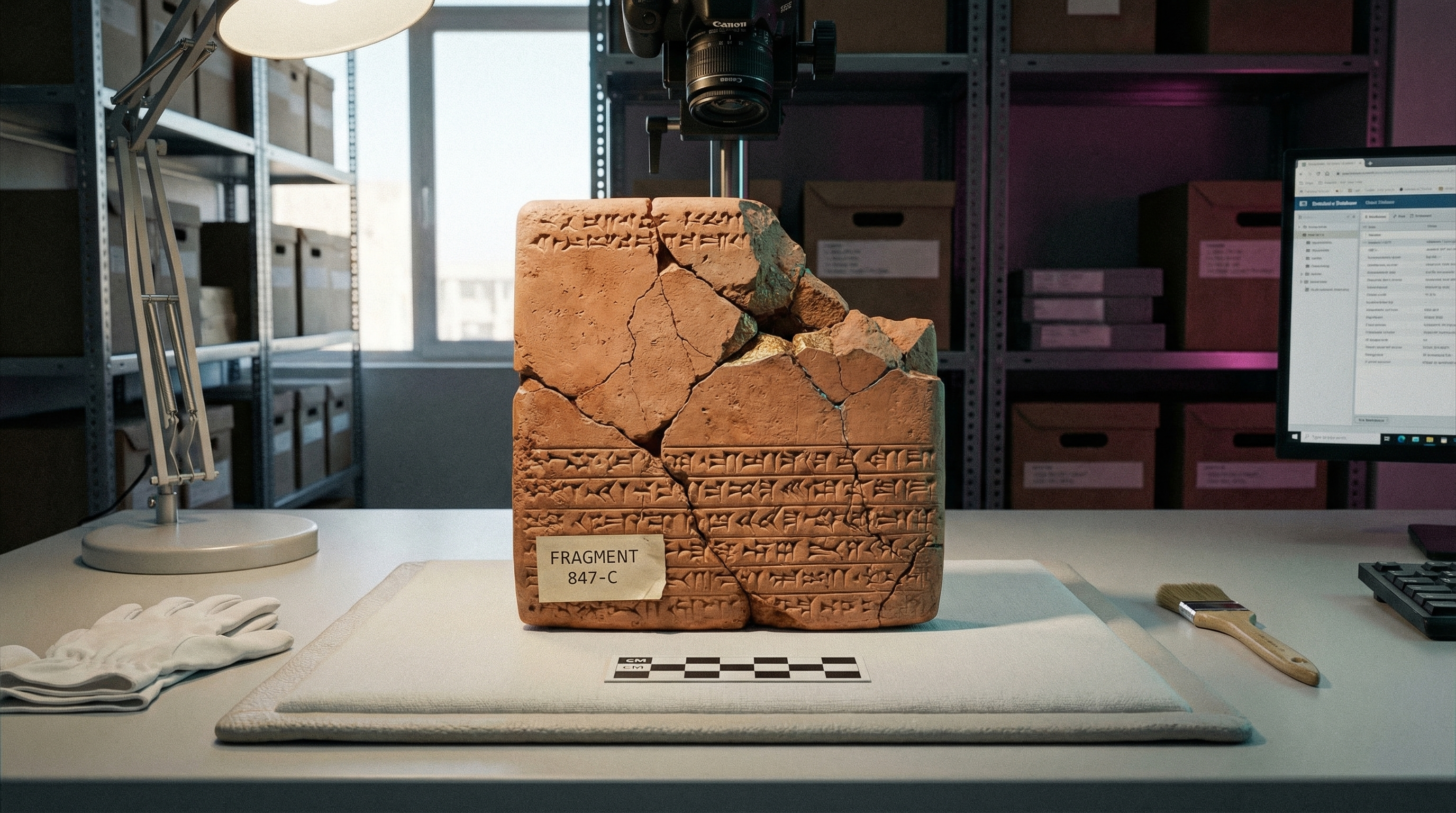
Fragment 847-C
Three weeks after the Kisura discovery, the systematic cross-referencing of Preservation archives worldwide produces a second potential thread. A sparse entry in the Cairo facility's half-digitised catalogue — a damaged Akkadian bill of sale from Larsa, stylistically dated to the precise century of Azariel's wandering years, documenting a slave transaction recorded by an unnamed scribe — prompts a cautious query to the facility's senior Archive Keeper. The fragment has sat in Cairo storage for decades under a classification that dismissed it as historically insignificant. It may yet prove to be anything but.
The Preservation's seventeen major archive facilities had never operated as a unified system. They had accreted across millennia — each established in response to local circumstances, each organised according to the conventions of whichever generation of Archive Keepers had built its cataloguing infrastructure, each carrying the particular idiosyncrasies of the culture and era in which it had taken root. The Karaköy facility in Istanbul used Ottoman-era box numbering overlaid with Byzantine-period cross-referencing. The facility outside São Paulo employed a hybrid digital system designed in the 1990s. The Cairo facility — older and larger than either — operated through a catalogue whose digitisation had been attempted decades earlier and abandoned roughly halfway through, leaving a database that lurched between proper entries, scanned images of handwritten index cards, and notes of such casual imprecision that they communicated almost nothing beyond confirmation that a given box existed and contained something broadly Mesopotamian.
This was not incompetence. It was the inevitable consequence of an organisation that had been preserving documents since before the concept of standardised cataloguing existed. Each facility had been built by individuals working within the intellectual and technological constraints of their time, and the systems they created had been inherited by successors who found it easier to layer new conventions over old ones than to dismantle and rebuild from foundations. The result, across the global network, was an archival landscape of extraordinary richness and maddening inconsistency — a collection spanning four thousand years in which a single fragment might be catalogued under three different classification systems, cross-referenced in a fourth, and effectively invisible to anyone who approached it through a fifth.
The digital preservation project that The Preservation's leadership had authorised was designed to address exactly this problem. Every document in every facility was to be photographed, catalogued according to a unified standard, and entered into a central database that would allow cross-referencing across the entire network for the first time in the organisation's history. The project was years from completion. Some facilities had progressed further than others. Some had barely begun. The Cairo facility, with its abandoned half-digitisation and its handwritten index cards and its notes that said things like "Box 34, Mesopotamian, check later," represented one of the more challenging cases.
It was through this imperfect digital window into Cairo's holdings that the second potential thread emerged.
The entry was terse. Fragment 847-C: a bill of sale in Akkadian, undated but stylistically placed between 2500 and 2400 BCE. A slave transaction involving multiple individuals. The seller identified only as a merchant of Larsa. The fragment described as heavily damaged, with partial names visible. The cataloguer's assessment: no historical significance.
Those three words — no historical significance — represented a judgement that had been rendered decades earlier by someone working through Cairo's Mesopotamian holdings with the particular efficiency of a scholar who had thousands of fragments to process and no reason to linger over any single one. Slave transactions from the third millennium BCE were not uncommon in Mesopotamian archives. Larsa was a known city. Damaged fragments with partial names offered little to conventional scholarship. The assessment was reasonable by any standard that did not account for the possibility that this particular bill of sale, from this particular city, in this particular century, might connect to a name that an organisation spanning six continents had been searching for across four millennia.
The date range was what arrested attention. Between 2500 and 2400 BCE — the span that encompassed Azariel Tiberius Voshtar's departure from his village of Amar-Sin and his arrival in Ur two decades later to deliver the speech that would found Fordingrad. The wandering years. The blank space in The Preservation's knowledge that the Kisura contract had begun, three weeks earlier, to fill.
Larsa compounded the significance. A major Mesopotamian city whose markets and administrative infrastructure would have drawn itinerant scribes seeking employment — the kind of city where a young man with training in cuneiform and a need to earn his passage might have found work documenting exactly the kind of transactions that Fragment 847-C recorded. Grain distribution in Kisura. Slave sales in Larsa. The mundane commercial activity of Bronze Age civilisation, conducted by merchants who required literate functionaries to render their dealings into the permanent record that clay tablets provided.
And the nature of the transaction itself carried weight that extended beyond the archival. Azariel's legacy — the city he would eventually build, the principles he would articulate, the civilisation he would establish in a dimension beyond Earth — rested on a rejection of slavery so fundamental that Fordingrad was constructed without it. Something during those wandering years had crystallised his conviction that human beings were not commodities, that a civilisation built on forced labour was a civilisation built on rot. The historical record offered no evidence of when or where this conviction had formed. Fragment 847-C, if it connected to Azariel at all, might represent a document from the very market where the founder of Fordingrad had stood and watched human beings sold like grain.
Bills of sale required scribes. Someone had to record the terms, identify the parties, render the transaction into the legal permanence that clay provided. If the footer section of Fragment 847-C survived — if enough of the scribe's identification remained legible — then comparison with the Kisura contract's scribal hand might reveal whether the same person had documented both transactions. Cuneiform scribes developed individual characteristics in their letter formation, spacing, and stylistic choices that functioned as a kind of signature, recognisable to anyone who had studied a given hand closely enough to distinguish its particular qualities from the generic conventions of the period.
Three weeks of study had made the Kisura contract's scribal hand as familiar as a living person's handwriting. Every formation, every spacing decision, every idiosyncrasy of the hand that had pressed reed into wet clay in a forgotten Mesopotamian town had been photographed, transcribed, and examined under conditions that ranged from archival-grade LED lighting to the improvised lamp arrangements of a Cihangir flat whose dining table had not seen an actual meal in weeks.
The Cairo facility's senior Archive Keeper, Tariq al-Rashid, had managed those holdings for longer than most of his counterparts at other facilities. The Preservation's informal network of operatives — connected through encrypted channels that the organisation had maintained for decades — knew him as methodical, unhurried, and possessed of the particular patience that archival work in a facility as disorganised as Cairo's demanded. He would understand why a damaged bill of sale from Larsa might warrant high-resolution photography. He would not require elaborate justification. The request needed only to be made.
The email that crossed from Istanbul to Cairo was brief — a few lines of professional courtesy framing a request for images of a fragment that the sender suspected might matter and the recipient had no reason to prioritise. Archival research operated on exactly this kind of speculative communication: tentative queries sent across continents, each one representing a thread that might connect to something or might dissolve into another dead end in a search that generated far more dead ends than connections. The ratio was understood by everyone who did the work. Most leads failed. The ones that didn't justified the hundreds that had.
The message disappeared into the encrypted infrastructure that carried Preservation communications between facilities. Its arrival in Cairo would depend on the rhythms of Tariq al-Rashid's working day, on the accessibility of Fragment 847-C within whatever storage system the Cairo facility employed, on the availability of photographic equipment suitable for documenting damaged cuneiform at the resolution required for scribal comparison. Days might pass before a response arrived. Weeks, possibly, if the fragment was stored in a section of the facility that required special access or if the damage was severe enough to require conservation handling before photography could proceed.
The probability that Fragment 847-C contained any trace of Azariel's hand was, by any rational assessment, negligible. Mesopotamia in the third millennium BCE had supported thousands of scribes across dozens of cities. Any bill of sale could have been documented by any of them. The coincidence of date range and geographic plausibility did not constitute evidence — it constituted a hypothesis so thin that conventional scholarship would not have dignified it with investigation.
But The Preservation had never operated by the standards of conventional scholarship. Its entire existence rested on the premise that connections invisible to mainstream academic assessment could be identified by those who knew what to look for — that names dismissed as insignificant, transactions classified as mundane, fragments catalogued as historically worthless might contain precisely the information that four thousand years of searching had failed to produce. The organisation's methodology was patience applied at civilisational scale: the systematic examination of everything, the refusal to accept that any fragment was too damaged or too ordinary to matter, the understanding that the most consequential discoveries often hid behind the most dismissive catalogue entries.
Fragment 847-C sat in a Cairo storeroom, its damage obscuring whatever names its surface still held, its classification consigning it to the particular limbo of objects that institutions possess but do not value. Somewhere in its broken Akkadian text, partial names waited to be read by someone who knew which name to look for. The fragment had survived — through whatever chain of transmission had carried it from a Larsa scribe's workshop to an Egyptian archive facility — and survival, in The Preservation's operational philosophy, was never accidental. Things survived because someone, at some point in the chain, had judged them worth preserving. The question was whether that ancient judgement and the modern search had converged on the same object.
The February wind off the Bosphorus carried salt and diesel through the streets of Cihangir, pressing against the windows of flats where Istanbul's residents conducted their Saturday lives. The encrypted email moved through servers whose locations The Preservation did not publicly acknowledge, carrying a query about a damaged clay fragment from one Archive Keeper to another, from one city layered in millennia of accumulated history to another city layered in millennia of its own. The request was modest. The implications, if the fragment yielded what the date range and subject matter suggested it might, were not.
The Kisura contract had demonstrated that the wandering years were not documentarily extinct. One fragment had survived. The question that now travelled from Istanbul to Cairo — encoded in the professional language of archival enquiry, stripped of the urgency that the sender felt but knew better than to display — was whether the answer to that question was singular or plural. Whether one survival was a miracle or a pattern. Whether the trail that began in a forgotten town called Kisura might continue through the slave markets of Larsa, through whatever other cities and transactions had marked Azariel's passage across Mesopotamia in the decades before he stood in Ur and changed everything.







