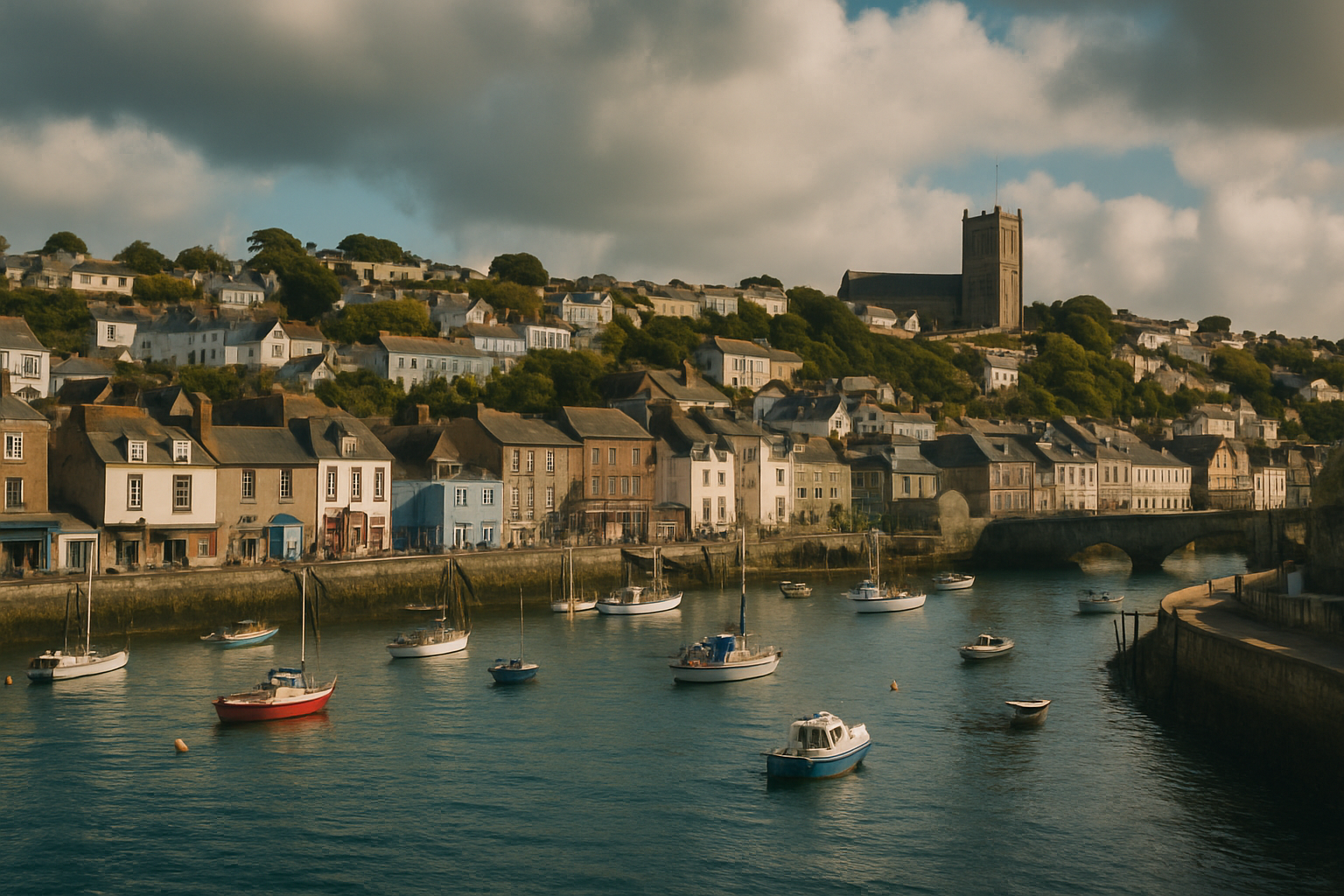
Falmouth, Cornwall, England
Falmouth — Cornwall's great deepwater harbour town — grew from a handful of fishermen's cottages and an Elizabethan manor house into one of Britain's most strategically important seaports in little more than a generation. Founded in 1613 by Sir John Killigrew on land adjacent to Henry VIII's Pendennis Castle, the town received its royal charter from Charles II in 1661 and was transformed by the establishment of the Royal Mail Packet Service in 1688, which for over a hundred and sixty years connected this Cornish harbour to destinations across the globe. The harbour itself — together with the adjoining Carrick Roads, the third deepest natural harbour in the world and the deepest in Western Europe — has sheltered everything from Tudor warships to Napoleonic frigates, from the schooner that carried the news of Trafalgar to the Beagle that returned Charles Darwin to England. It is a town built to serve the sea, and despite the decline of its packet and naval heyday, it remains shaped by the maritime industries, the international outlook, and the salt-air pragmatism that have defined its character since the first alehouse opened on the waterfront.
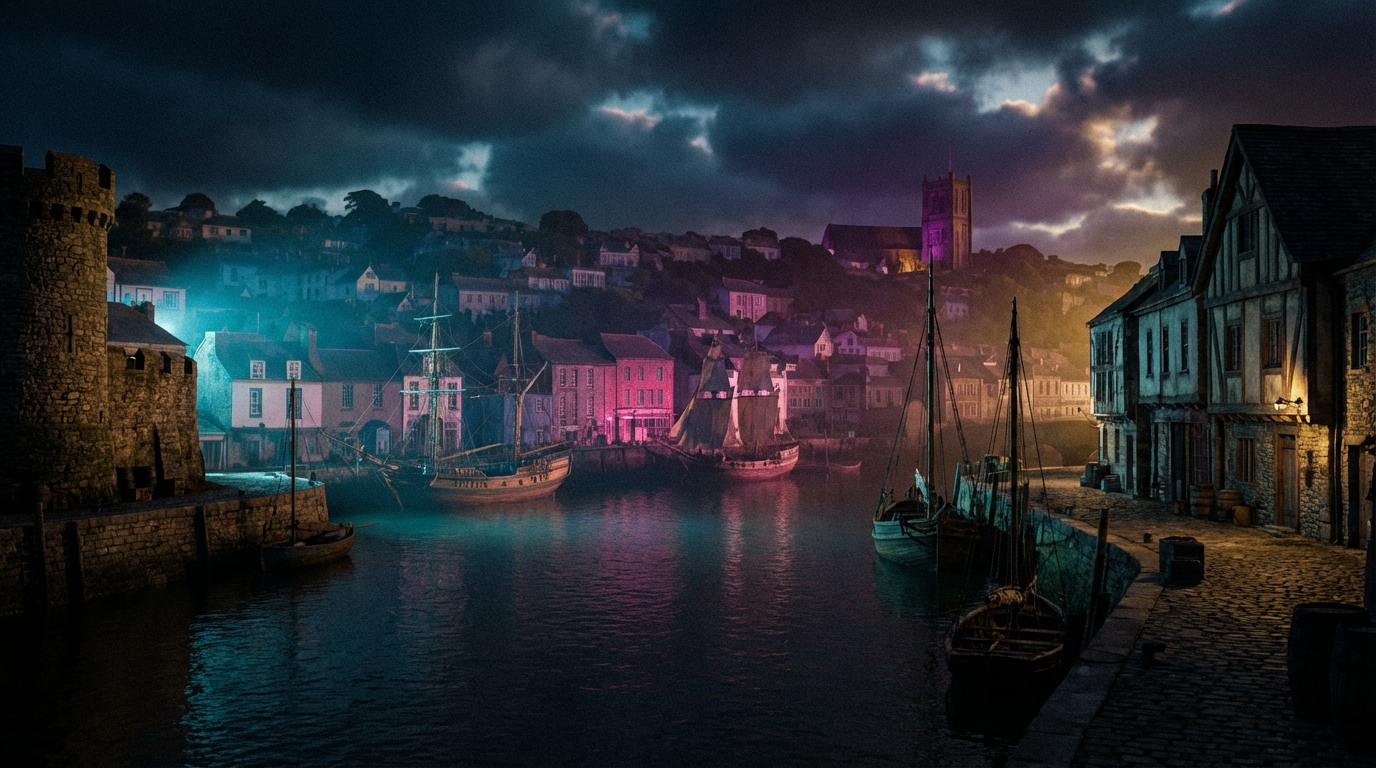
Arwenack and the Killigrews
Before Falmouth existed as a town, there was Arwenack. The manor house, the oldest building still standing in Falmouth, was built in 1385 and served as the seat of the Killigrew family for sixteen generations. The Killigrews were a dynasty of considerable influence and occasionally questionable reputation — privateers, courtiers, members of Parliament, and occasional pirates whose fortunes were inseparable from the sea that lapped at their estate. When Sir Walter Raleigh stayed with Sir John Killigrew at Arwenack in 1598, he was so struck by the geographical potential of the site — a deep natural harbour at the mouth of the River Fal, sheltered by headlands on either side — that he recommended it be developed as a major port. The area at that time was sparsely settled, known variously as Smithick and Penny-come-quick, while the established town in the district was Penryn, two miles upriver, a market town since the thirteenth century. A local rhyme preserved the relationship: "Penryn was a flourishing town, when Falmouth was a furzy down."
In 1613, Sir John Killigrew acted on Raleigh's observation, constructing houses, a quay, and basic infrastructure to attract merchants and sailors to the site. The development was opposed by the established towns of Penryn, Helston, and Truro, all of which feared the competition, but the Killigrews' influence prevailed and the settlement grew rapidly. By the time John Ray visited in 1662, he described it as "a great place" that "consists chiefly of alehouses" — a characterisation that reflected not moral deficiency but commercial vitality, for the abundance of alehouses was a measure of how busy the port had already become.
Pendennis, the Civil War, and the Charter
The strategic importance of the harbour had been recognised long before the Killigrews built their town. In 1540, Henry VIII ordered the construction of Pendennis Castle at the entrance to the Fal estuary as part of his programme of coastal defences against the threat of French and Spanish invasion. The castle — a central gun tower surrounded by angular bastions designed for artillery — was paired with St Mawes Castle on the opposite bank, the two fortifications creating a crossfire that commanded the entrance to Carrick Roads. Pendennis would prove its worth during the English Civil War, when it became one of the last Royalist strongholds in the country, enduring a five-month siege by Parliamentary forces before finally surrendering in August 1646. Prince Charles had taken refuge there in 1642, and Queen Henrietta Maria had sheltered within its walls in 1644 on her way to exile in France.
The Killigrews' loyalty to the Crown during the Civil War — Sir Peter Killigrew, known as "Peter the Post," had served as a dedicated courier for Charles I — was repaid after the Restoration. On 5 October 1661, Charles II granted a royal charter that formally transformed the hamlet of Smithwick into the town of Falmouth, awarding it rights of self-government and the authority to elect a mayor, seven aldermen, twelve burgesses, a recorder, and a town clerk. The first mayor was William Elliot. As a condition of the charter, the Killigrews gave land for the construction of a parish church dedicated to Charles I — the Church of King Charles the Martyr, consecrated in 1665, one of the rarest dedications in England and a permanent monument to the town's Royalist origins. By 1664, two hundred houses clustered around the church; by 1750, nearly six hundred.
The Packet Service: Falmouth and the World
The event that transformed Falmouth from a promising young port into a town of genuinely international significance was its designation in 1688 as the base for the Royal Mail Packet Service. The Packet Service was a branch of the General Post Office responsible for carrying mail, government dispatches, passengers, and valuables to and from Britain's expanding empire. Falmouth's position — the most south-westerly good harbour in Great Britain, and therefore the last landfall for ships heading into the Atlantic and the first for those returning — made it the natural choice.
For over a hundred and sixty years, packet ships sailed from Falmouth to Lisbon, the Mediterranean, Egypt, the Caribbean, and the Americas. By 1763, the service had expanded to include trans-Atlantic routes from Halifax to Surinam. At its peak during the Napoleonic Wars, as many as thirty-nine packet vessels operated from the harbour. The town's maritime infrastructure grew to serve them: customs houses, chandlers, ropewalks, sail lofts, cooperages, and the waterfront taverns that catered to a population of sailors, merchants, and tradesmen whose livelihoods depended upon the coming and going of the packets. The cosmopolitan atmosphere was unlike anything else in Cornwall — a town where mail from colonial governors, dispatches from distant battlefields, and passengers from every corner of the British world arrived and departed on the tide.
The Packet Service wrote Falmouth into the national story at moments of high drama. In 1805, the news of Britain's victory at Trafalgar — and of Admiral Nelson's death — was landed at the steps of Fishstrand Quay from the schooner HMS Pickle and carried to London by stagecoach in thirty-eight hours, a journey that normally took a week. In 1809, Lord Byron sailed from Falmouth to Lisbon aboard the packet ship Princess Elizabeth, staying at Wynn's Hotel before his departure. And on 2 October 1836, HMS Beagle anchored in Falmouth harbour at the end of its famous survey voyage around the world, and Charles Darwin stepped ashore to begin the journey home to Shrewsbury — a quiet moment whose scientific consequences would reshape humanity's understanding of itself.
The end of the Packet Service came in 1851, when the efficiency of steamships and the centralisation of mail routes to Southampton rendered the sailing packets obsolete. The blow to Falmouth's economy was severe. Many maritime workers left, and the prosperity that had sustained the town for over a century and a half contracted sharply. Falmouth had been built to boom on the packets; without them, it had to find new reasons to exist.
Naval Power and the Napoleonic Era
Even before the Packet Service's decline, Falmouth's harbour had served as a base for the Royal Navy. Being the nearest large harbour to the entrance of the English Channel, two naval squadrons were permanently stationed there during the French Revolutionary and Napoleonic Wars. In the 1790s, one squadron was commanded by Sir Edward Pellew, later Viscount Exmouth, aboard HMS Indefatigable; the other by Sir John Borlase Warren in HMS Révolutionnaire. Each squadron comprised five frigates, and the harbour was continually busy with warships arriving with prizes taken from French vessels and prisoners of war, who were held in camps near Penryn. The town's waterfront during the Napoleonic period — mail coaches clattering over the pavement, packet crews loading provisions, naval frigates at anchor, prisoners being marched ashore — would have been among the most crowded and cosmopolitan scenes in provincial England.
Docks, Railway, and the Twentieth Century
Falmouth's recovery from the loss of the Packet Service was gradual and incomplete, but it was real. The development of Falmouth Docks from 1858 provided a new industrial foundation, and the arrival of the Cornwall Railway on 24 August 1863 connected the town to the national rail network, opening new possibilities for both trade and tourism. The Royal National Lifeboat Institution opened Falmouth Lifeboat Station in 1867, and the Falmouth Harbour Commissioners were established under the Falmouth Harbour Order of 1870 to administer the port. Ship repair, marine engineering, and fuel bunkering replaced the packet trade as the harbour's primary commercial activities, and the town's Georgian houses began to attract visitors drawn by the mild climate and the five sandy beaches — Castle, Tunnel, Gyllyngvase, Swanpool, and Maenporth — that stretch along the coast toward the Helford River.
During the Second World War, Falmouth was once again a front-line port. German bombing raids killed thirty-one people and left scars on the town centre and dockyard areas. An anti-submarine net was laid from Pendennis to St Mawes to prevent U-boats entering the harbour, and the town served as the launching point for the commando raid on the dry dock at St Nazaire — one of the most daring operations of the war. The post-war decades saw the shipbuilding industry contract, but smaller dockyards and marine engineering firms sustained the harbour's working character, and by the late twentieth century Falmouth had developed a significant superyacht refit industry alongside its traditional maritime trades.
Heritage, Education, and the Modern Town
The opening of the National Maritime Museum Cornwall in 2003 — occupying a striking waterfront building near the harbour — gave institutional expression to the maritime heritage that has defined the town since the Killigrews first built their quay. The museum's collection and exhibitions tell the story of how the sea has shaped the lives, culture, and economy of Cornwall and the wider world. Falmouth University, with its campus in the town, has brought a new generation of students, artists, and designers, adding a creative dimension to a community whose identity had been overwhelmingly industrial and maritime. Falmouth Art Gallery, on The Moor, houses one of the most important art collections in Cornwall.
The former synagogue on the high street, built in 1816 and one of the earliest surviving synagogue buildings in England, is a reminder of the diversity that the Packet Service brought to this Cornish port — a community where Jewish merchants, international sailors, colonial administrators, and Cornish tradesmen coexisted in a town whose business was the world. The harbour remains active, increasingly oriented toward leisure, cruise vessels, and the round-the-world voyages for which Falmouth has become a celebrated start and finish point — Sir Francis Chichester, Robin Knox-Johnston, and Dame Ellen MacArthur among those who have chosen this harbour to begin or end their crossings.
The tensions of the modern town — rising property costs, seasonal rental pressure, the balance between tourism and residential life, the environmental concerns around dredging and marina expansion — are familiar across coastal Cornwall but carry a particular edge in Falmouth, where the community's sense of itself as a working port sits uneasily alongside its growing identity as a leisure destination. The population at the 2021 census stood at 24,032, making Falmouth one of the larger towns in Cornwall, but its character remains defined less by its size than by the harbour that created it and the maritime outlook that four centuries of packet ships, naval squadrons, and ocean-going vessels have instilled in its people.
Henry Trelawney
Among the mariners whose lives began on Falmouth's waterfront was Henry Trelawney, born on 15 August 1771 into a community whose young men were as likely to learn their trade aboard ship as in any schoolroom. Trelawney spent most of his life at sea, mastering rigging and discipline aboard foreign vessels in an age when the skills of a Cornish sailor were valued across the world's merchant and naval fleets. He eventually jumped ship in Van Diemen's Land, disappearing into the whaling trade off the southern coast of Australia and building a life far from the harbour where he had been raised. He died on 8 March 1845, at the age of seventy-three — one of countless Cornish seamen whose maritime upbringing in Falmouth carried them to the furthest reaches of the globe and whose stories, told and retold in the waterfront taverns of Custom House Quay, became part of the town's collective memory of itself as a place that has always looked outward, beyond the horizon, toward whatever the sea has to offer.







