4338.10 · January 10, 2018 AD
Express Post to the Impossible
A padded envelope containing a Portal Key enters the Australian postal system at a Hobart branch office, processed by a clerk whose end-of-shift fatigue precludes any curiosity about the parcel's contents. The transaction costs thirty-four dollars. The device inside — thumb-sized, constructed from materials that predate recorded civilisation — is sorted into a plastic bin marked EXPRESS alongside birthday cards and utility bills, beginning a journey to Broken Hill that no logistics network was designed to accommodate.
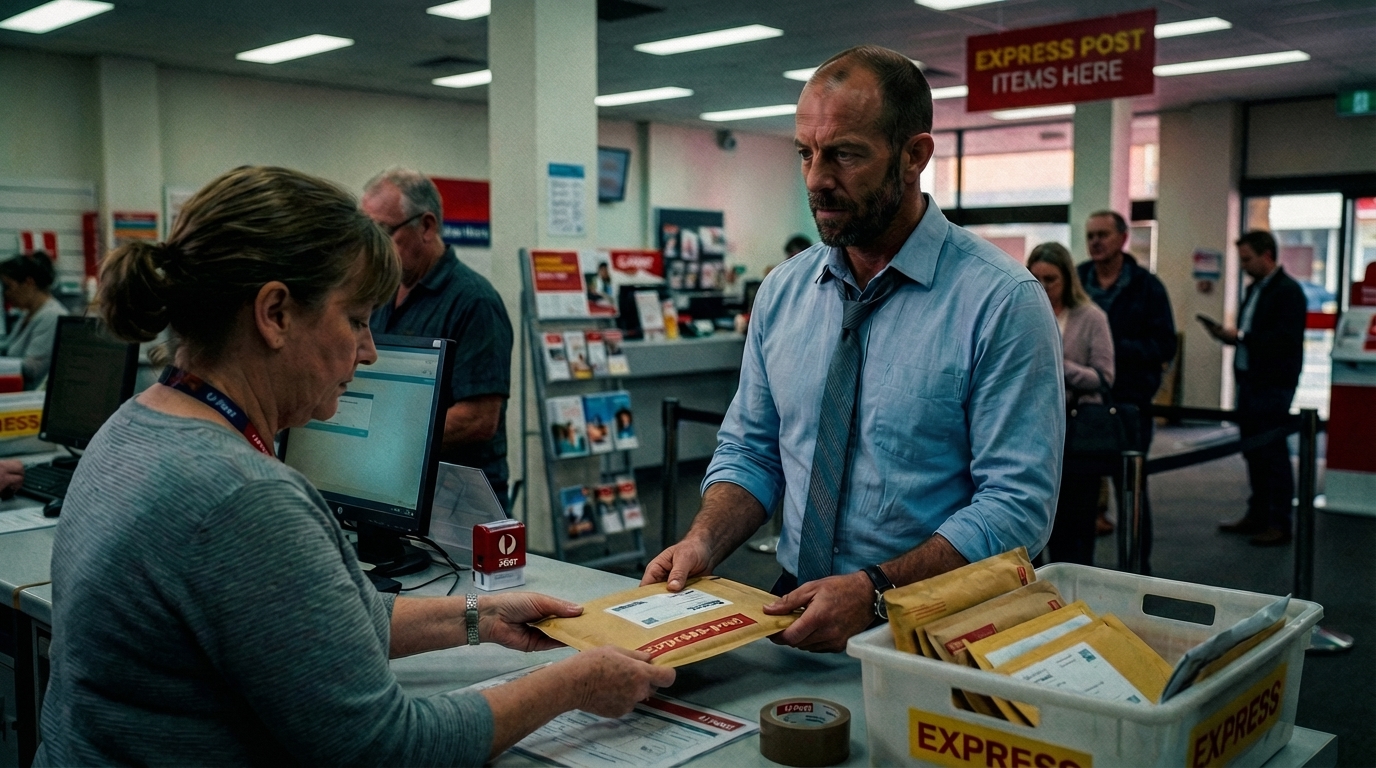
The Hobart post office operated with the particular indifference that government retail outlets cultivate as a matter of institutional identity. Fluorescent tubes cast their flat, shadowless light across linoleum floors scuffed by decades of foot traffic. Brochures for river cruises and packaging supplies occupied their allocated racks with the resigned patience of marketing materials that knew they would not be read. The queue advanced at the speed that queues advance in post offices — incrementally, grudgingly, as though the act of processing mail required a ceremonial acknowledgment of time's passage that efficiency would have rendered disrespectful.
Nathan Cowdrey stood in this queue with a padded express post envelope in his bag and perspiration on his palms that had nothing to do with the January heat. The envelope had been sealed in the office twenty minutes earlier, its contents wrapped in multiple layers of bubble wrap with the compulsive thoroughness of someone who understood that the object inside could not be replaced and could not be explained to anyone who might intercept it. The bubble wrap enclosed a single Portal Key — thumb-sized, matte grey, constructed from a material that no postal regulation had been written to classify.
Around him, the post office conducted its ordinary commerce with serene indifference to the nature of his errand. A child dropped a set of keys, the metallic clatter on linoleum producing a sound disproportionate to its cause. An elderly man studied a customs declaration form with the baffled intensity of someone encountering bureaucratic language for the first time. A woman in activewear collected a parcel notification slip from her handbag and checked the number against the screen above the counter, her lips moving silently as she counted her place in the queue.
The clerk who processed the transaction possessed the particular efficiency of someone who had handled ten thousand identical interactions and would handle ten thousand more. The envelope was weighed, the destination confirmed, the postage calculated and paid. Then dropped into a plastic sorting bin marked EXPRESS with the unremarkable finality of an object entering a system designed to process it without curiosity. It settled among other parcels — other people's correspondence, other people's obligations, packages whose contents bore some rational relationship to the infrastructure tasked with delivering them.
The system that would carry it — the trucks, the planes, the distribution centres, the delivery routes refined across decades of operational logistics — had been engineered to move objects from one address to another with reliable efficiency. It had not been engineered to assess the significance of what it moved. A love letter and a legal summons travelled the same conveyor belts, occupied the same cargo holds, arrived in the same delivery vehicles. The postal network's genius lay in its indiscrimination, its principled refusal to distinguish between the mundane and the consequential.
Nathan left the post office and stepped into the late-afternoon heat, the transaction complete, the envelope irretrievable. The act had taken less than three minutes. The clerk was already processing the next customer before the door closed. The sorting bin would be collected within the hour, its contents transferred to the next stage of a journey that would deposit a piece of ancient, inter-dimensional technology on a doorstep in Broken Hill within forty-eight hours, singled out from the day's mail by nothing more remarkable than a handwritten address and a prepaid express sticker.







