4338.207 · July 26, 2018 AD
Every Corner
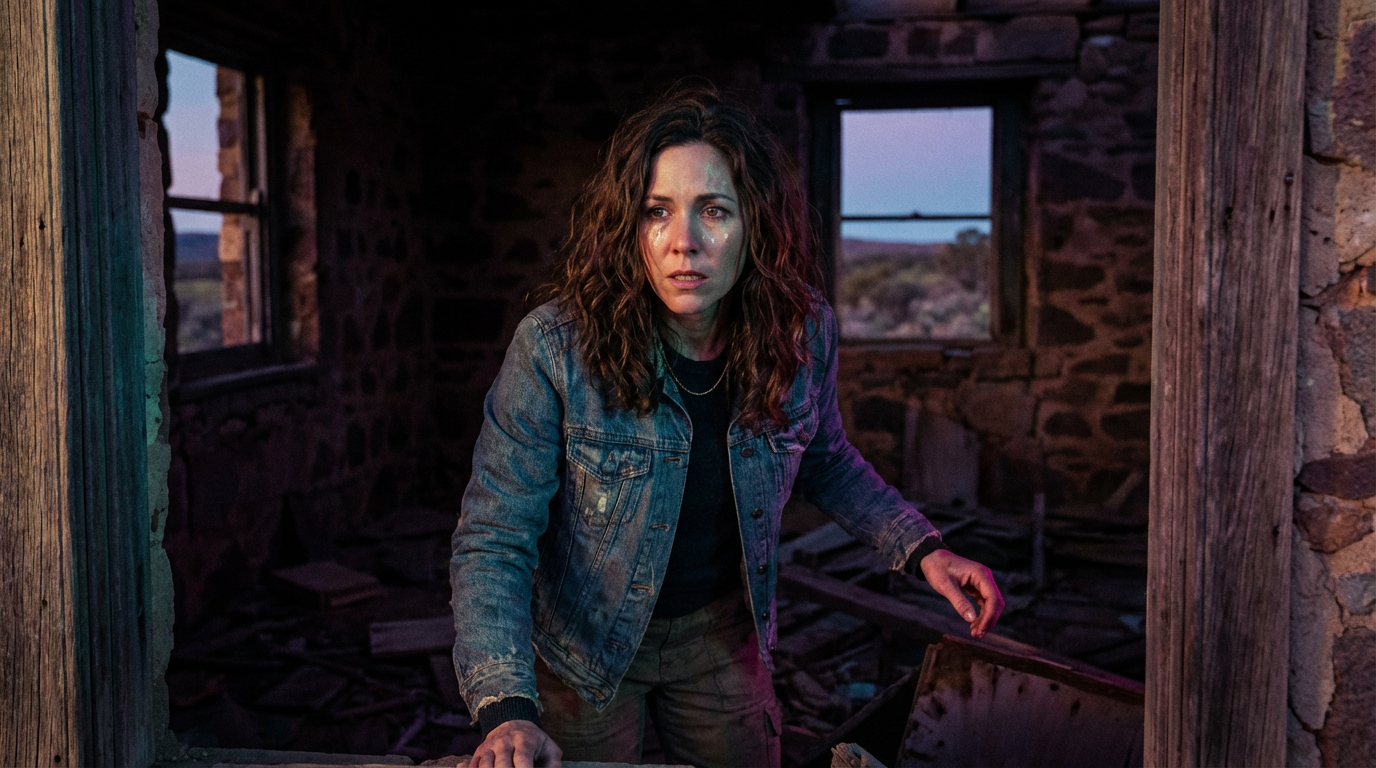
Claire hits the doorway at a sprint, her children's names tearing out of her before her eyes have adjusted to the dark. What follows is a search that takes her through every room, under every surface, and out into the scrub beyond the fence — a mother dismantling an abandoned property piece by piece while the afternoon turns to dusk.
"A dancer learns to read a room the moment she enters it. The dust, the stillness, the way the air sits. Sometimes the room tells you everything before you’ve taken a single step."
"MACK! ROSE! IT’S MUM! I’M HERE!"
My voice filled the building and died there. Hit the stone walls and the packed earth floor and the collapsed section of roof and came back to me stripped of everything—hope, force, meaning—reduced to the flat acoustic fact of sound meeting solid surfaces and having nowhere else to go.
I was inside before the echo faded. My eyes adjusting—the shift from grey afternoon light to the dim interior taking seconds I didn’t have, seconds my children couldn’t afford, my pupils opening wide and pulling detail from the shadows the way a drowning person pulls at anything within reach.
A room. The main room. Larger than I’d expected—the stone walls enclosing a space maybe four metres by five, the ceiling open where the corrugated iron had peeled away, letting in slats of grey sky. A fireplace against the far wall, the stonework blackened with soot, the mantel cracked and tilted. A wooden bench built into the wall to the right, its surface thick with dust and droppings—mouse, probably, or rat, small dark pellets scattered like punctuation across the grey wood.
I scanned every inch of it in the time it took to cross the room. The corners. The shadows behind the fireplace. The space beneath the bench where a child might curl up, might hide, might press themselves into the darkness and wait for a voice they recognised.
Nothing.
"Mack?"
Quieter now. Not a shout—a question. Asked of the room itself, of the dust and the droppings and the cobwebs that stretched between the bench and the wall in elaborate silver architectures that no one had disturbed. No one had walked through those cobwebs. No child had brushed past them, breaking the threads, leaving the telltale gaps and tatters that would mean someone was here, someone came through, someone is close.
The webs were intact. Perfect. Undisturbed.
I went through to the second room anyway.
A doorway without a door, the hinges still attached to the frame, orange with rust, holding nothing. The second room was smaller, meaner. Less of the roof remained here—a single sheet of iron hanging at an angle, creating a low canopy over one corner. The floor was worse. Fallen roofing material, chunks of stone dislodged from the walls, a drift of dead leaves that had blown in through the gaps and accumulated in a dry, rustling pile against the far wall.
I got on my hands and knees.
The earth was cold through my trousers, cold and hard, and my palms pressed into grit and debris as I lowered myself to look under the hanging sheet of iron, into the dark triangular space it created against the wall. The space where a child might shelter from wind, from cold, from the enormity of being left alone in a place they didn’t know. I put my face close to the ground and peered in.
Dirt. A spider, fat-bodied and unhurried, moving across the earth with the proprietary confidence of something that owned this space and had owned it for a long time. The remains of a nest—bird, from the look of it, straw and feathers and a single blue-grey shell, cracked but still cupped, still holding its shape. Beautiful, in the way things are beautiful when you can’t afford to notice them.
No children.
I pulled myself up. My hands were filthy now—the blood and the dirt combining into a dark paste that caked in the creases of my fingers. I wiped them on my trousers and immediately wished I hadn’t, the smear they left visible even in the dim light, a record of everywhere I’d been and everything I’d touched.
Back through to the main room. I stood in the centre and turned a slow circle, forcing myself to look again, to look properly, to see past the panic and the desperation to the physical reality of this space. Had anyone been here recently? Any sign at all—a footprint, a disturbance in the dust, a mark on the floor, anything that would tell me my mother hadn’t sent me to the wrong place?
The dust on the bench was uniform. Even. A layer of grey that had been settling for months, maybe years, accumulating grain by grain in the still air. If someone had touched it—leaned on it, set something down, brushed against it while passing—there would be a mark. A gap. A line of clean wood where the dust had been displaced.
There was no mark.
The floor. Packed earth, hard enough that my own shoes were leaving only the faintest impressions. But children were lighter than adults—Rose especially, Rose who weighed nothing, who you could lift with one arm, whose feet barely made a sound on the wooden floors at home. Even Mack, who was growing, who’d put on centimetres this year and whose shoes were suddenly too small again—even Mack might not leave prints on earth this hard.
I crouched. Studied the floor in the light coming through the broken roof. Turned my head, changed the angle, tried to catch shadows that might reveal depressions too shallow to see straight on. A technique I’d learned—where? Somewhere. A documentary, maybe. Or one of Mack’s books about tracking and bushcraft that he left scattered around the house, the books I’d stepped over without reading, the knowledge I’d dismissed as childish obsession and now needed more desperately than anything I’d ever learned.
The floor showed nothing. Or everything—a chaos of marks that could have been anything, that could have been made by animals or weather or the slow geological patience of earth settling into itself. Nothing that said child. Nothing that said Mack or Rose or here or today.
I stood up too fast. The blood rushed from my head and the room tilted and I grabbed at the bench to steady myself, my hand pressing into the dust, leaving a print—five fingers, clear and sharp, the lines of my palm visible in the grey film. Evidence. My evidence, on top of the absence of theirs.
Outside.
The cold hit me again. The wind had picked up, coming from the west, carrying the smell of rain that might or might not arrive—the outback’s favourite trick, promising water and delivering nothing. I stood in front of the building and scanned the clearing, the fence line, the dead gums. Everything looked the same as it had five minutes ago, ten minutes ago, however long I’d been inside. The car was where I’d left it, the driver’s door still hanging open, the interior light fading as the battery decided how much longer it could sustain this particular demand.
The shed. Thirty metres to the right, partially obscured by scrub that had grown up around it. Corrugated iron, smaller than the house, leaning badly to one side like a drunk trying to maintain dignity. I ran to it.
The door was a sheet of iron on a wire hinge, and it shrieked when I pulled it—a sound so loud and so sharp in the silence that I gasped, my heart jolting hard. The space inside was barely two metres square. Dirt floor. Rusted tools hanging from nails driven into a wooden frame—a pickaxe head without a handle, a coil of wire, something that might once have been shears. A tin bucket with no bottom. A wooden crate, overturned, its slats broken and grey.
I lifted the crate. Shifted the tools. Got on my knees again and looked into every corner, every shadow, running my hands along the base of the walls where the iron met the earth, feeling for gaps, for spaces, for anything a child might fit through or into.
Dirt. Rust. A spider web across my face that I tore away with a sound that was half gasp and half sob.
"MACK! ROSE!"
I was outside again, the shout directed at the landscape itself—at the scrub, at the mullock heaps, at the sky. At anything that might be listening. At anything that might answer.
The scrub listened. The mullock heaps listened. The sky listened.
None of them answered.
The collapsed structure. Beyond the shed, on the far side of the clearing—a heap of timber and iron and stone that had once been something and was now nothing, sinking into the earth under the weight of its own decay. I circled it. Pulled at a sheet of corrugated iron, the edges sharp and ragged, catching the skin of my palm and opening a line of bright red across the heel of my hand. I barely felt it. Barely noticed the blood—mine this time, not Dawn’s—welling up and spilling down my wrist. I pulled the iron aside and revealed nothing but dirt and insects and a tangle of roots that had grown through the debris, patient and indifferent, reclaiming what had been taken from them.
I pulled at more iron. More timber. My hands working without instruction from my brain, tearing at the structure with a ferocity that I recognised distantly as irrational—no child could be under this, no child would crawl into this ruin, it had been collapsing for decades—but rationality had left me somewhere on the drive here, somewhere between the second wrong turn and the third, and what remained was something more basic. A body searching. A mother’s body, doing the only thing it knew how to do, which was to keep looking, keep moving, keep turning over every object and looking behind every wall until the universe yielded what it had taken from her.
The debris pile gave me nothing.
I was bleeding. Both hands now—Dawn’s blood and my own, mixed together, indistinguishable. My trousers were torn at one knee from crawling. My hair had come loose from its ponytail, strands falling across my face, catching on my lips. I pushed them back and left a smear of dirt across my forehead that I could feel but couldn’t see.
I walked the perimeter of the clearing. Slowly at first, studying the ground, the scrub line, looking for any sign of passage—a broken branch, a footprint in softer earth near the fence posts, a thread caught on wire, a sweet wrapper, a hair tie, anything. The fence itself was more absence than presence—wire sagged to the ground, posts tilted or fallen entirely, the boundary it described more conceptual than physical. A child could walk through it without noticing it was there.
Which direction would they go?
If they were here. If Dawn had brought them here and left them and they’d decided to walk—which way? Towards town? But they wouldn’t know which direction town was. Towards the road? But which road—there were half a dozen tracks out here and none of them were signposted and all of them looked the same. Would Mack try to navigate? He read those books, those bushcraft books. Did any of them teach you how to find your way when you were eight years old and alone in mining country with your six-year-old sister?
I walked wider. Past the fence line, into the scrub. The vegetation was sparse—saltbush mostly, low and grey-green, interspersed with the dead mulga and the occasional clump of something thorny that grabbed at my ankles as I pushed through. The ground here was different—softer, sandier, more likely to hold a print. I scanned it as I walked, zigzagging back and forth like a bloodhound working a scent, covering as much ground as I could while keeping the property in sight behind me.
A mark in the sand. My heart stopped. A depression, roughly oval, the right size for—
An animal. A kangaroo, from the shape. The deep gouge of a tail drag beside it. I stared at it for too long, willing it to be something else, willing the shape to rearrange itself into a child’s shoe print, a small foot, evidence of a boy or a girl walking through this exact spot today.
It remained a kangaroo print. The outback does not negotiate.
I kept walking. The property was getting smaller behind me—the stone walls and the red roof shrinking with distance, becoming less real, less solid, until it looked like something from a photograph rather than a place I could touch. I stopped. If I went much further I’d lose sight of it entirely, and the thought of being lost out here on top of everything else was enough to turn my stomach.
"MACK!"
The shout left me with less force than before. My throat was raw—physically raw, the tissues abraded by volume and cold air and the particular strain of screaming the same two words over and over into a landscape that had no interest in returning them. I swallowed and it hurt. Tried again.
"ROSE! CAN YOU HEAR ME? PLEASE! PLEASE, IF YOU CAN HEAR ME—"
My voice cracked on the please. Split apart like wood along the grain, the two halves falling away from each other, and what was left wasn’t a word at all but a sound—a high, thin, keening sound that the wind picked up and carried away before it reached the scrub line, before it reached anywhere, before it reached anyone.
I turned back towards the property. Walked to the house. Went inside again.
Searched it again.
Every corner. Every shadow. The fireplace—I put my head into the cavity and looked up, as though a child might have climbed up inside the chimney, as though this were a fairy tale and my children were sweep’s boys hiding in the flue. I saw sky through the top, a small grey circle, and soot, and a bird’s nest wedged into a gap in the stonework. I pulled my head out and my hair was black with soot and I didn’t care.
The bench. I got underneath it this time, lying flat on my back on the cold earth, looking up at the underside of the wooden planks. Nothing. Dust falling into my eyes, making them water, making them sting.
The second room again. The hanging iron, the leaf pile, the spider who had moved half a metre since my last visit and was now positioned on the wall with the stillness of something that had learned patience from the landscape itself.
I pushed at the leaf pile. Dug into it with my hands. Dead leaves crumbling between my fingers, releasing a smell of dust and tannin and something faintly sweet—decay, the slow breakdown of organic matter into earth. The pile was shallow. A few centimetres deep. Beneath it, more packed dirt. More nothing.
I sat in the second room with my back against the stone wall and my knees drawn up and my bloodied, dirty, torn hands resting in my lap and I looked at the doorway to the main room and the doorway beyond that to the outside and the grey light that was visibly changing now, darkening, the afternoon tilting towards evening with the unhurried certainty of a planet that would keep turning regardless of what happened on its surface.
They weren’t here.
I’d known it from the cobwebs. From the undisturbed dust on the bench. From the moment I’d walked through the doorway and the silence had answered me instead of their voices. I’d known, and I’d searched anyway, because knowing and accepting are separated by a distance far greater than the space between the words.
They weren’t here. They had never been here. No child had set foot in this building today, or yesterday, or for years before that. The dust said so. The cobwebs said so. The spider said so, sitting on her wall with the calm authority of the only living witness.
Dawn had said the old property. Dawn had said it with clarity, with conviction, with the focused urgency of a woman spending her last words on something that mattered. She hadn’t been lying. She hadn’t been confused. She had believed—with the total, unshakeable belief of a dying mother—that her grandchildren were here.
But she was wrong.
She’d driven them somewhere this morning. That much I could hold on to—she’d put them in the car and driven them out of town and told them to go to the old property. But Dawn hadn’t been out here in decades. Dawn’s memory of this place was older than mine—a childhood memory, shaped by the distortions of time and sentiment, the roads and tracks altered by years of mining and weather and disuse. She could have taken a different route. Could have stopped at a different fork. Could have pointed the children towards a landmark she remembered that no longer existed, a track that had been swallowed by scrub, a turning that led somewhere other than where she thought.
The children could have walked. Could have tried to follow Dawn’s directions and taken a wrong turn—another wrong turn, in a landscape made entirely of wrong turns—and ended up somewhere else. Another building. Another ruin. Another shelter in this endless maze of abandoned mining infrastructure, all of it identical, all of it collapsing, all of it invisible from any road.
They could be a hundred metres from where I was sitting. They could be a kilometre. They could be five. In this landscape, the difference between salvation and catastrophe was a single wrong turn, a single misremembered direction, a single fork taken left instead of right.
I pressed my palms against my eyes. Saw red—not darkness, red—the blood on my hands colouring even this, even the inside of my own eyelids.
Get up.
The voice in my head was not my own. It was Dawn’s. Dawn’s voice, the one she’d used my entire life—firm, practical, impatient with self-pity. Get up, Claire. You’re not helping anyone sitting on a floor feeling sorry for yourself.
I opened my eyes. The room was darker than it had been. The grey light through the broken roof had taken on a bluish quality, the colour of approaching dusk, of the short window between afternoon and evening when the outback holds its breath before the temperature drops and the night things begin to stir.
How long had I been here? An hour? Two? The light said two. The light said I’d spent two hours searching a building my children had never entered, while they were somewhere else, somewhere out there in the gathering cold, waiting for someone to come.
I stood up. My knees ached. My back ached. My hands burned where the corrugated iron had cut them and ached where the cold had stiffened the joints and throbbed where Dawn’s blood had dried tight against the skin, pulling at it with each movement like a second layer that didn’t quite fit.
Outside. The clearing was different in this light—the shadows longer, the dead gums throwing dark lines across the ground like prison bars. The temperature had dropped noticeably. I could feel it in my lungs with each inhale—a sharpness that hadn’t been there an hour ago, a crystalline edge to the air that said frost tonight, ice on the windscreen in the morning, temperatures that a child in pyjamas would not survive.
Were they in pyjamas? Had Dawn woken them and bundled them into the car in whatever they’d been wearing to bed? Or had she dressed them? Packed coats? I tried to remember what I’d seen in the spare room at Dawn’s house—the unmade beds, the pillows dented—but the image was contaminated now, overlaid with everything that had come after, with the lounge room and the gun and the blood, and I couldn’t separate what I’d seen from what I was imagining.
Mack’s jacket. Had he been wearing a jacket when Dawn took them? He had a good one—the puffer jacket, the blue one, warm enough for Broken Hill winters. If he had that, he’d be all right. He’d be cold but he’d be all right. And Rose—Rose had the purple blanket. It wasn’t in the spare room. I’d noticed that. Hadn’t I? The purple blanket wasn’t on the bed, which meant Rose had it, which meant she’d have something to wrap around herself when the temperature dropped, something familiar, something that smelled like home.
You’re bargaining. You’re standing in a clearing in the middle of nowhere bargaining with the universe about blankets and jackets while your children are lost.
I walked back to the car. The interior light came on when I opened the door, feeble and yellow, illuminating the back seat—the suitcases, the children’s bags, the tote of snacks. I stared at the snacks. Crackers. Muesli bars. Juice boxes. Food I’d packed for a road trip to Brisbane, for the car journey, for small hands reaching from the back seat saying Mum, I’m hungry. My children were hungry right now. Right now, wherever they were, they were hungry and thirsty and cold and I was standing beside a car full of food I couldn’t give them.
The nausea came without warning. A violent surge that bent me sideways, my hand bracing against the car’s roof, my body heaving. Nothing came up—I hadn’t eaten since... when? I couldn’t remember. This morning? Yesterday? The spasm wrung me out and left me gasping, my forehead resting against the cold metal of the car, saliva stringing from my lower lip.
You have to leave.
No.
You have to leave. You can’t search in the dark. You’ll get lost. You’ll drive off a track. You’ll become another problem instead of a solution.
I can’t leave them.
They’re not here. You’ve searched. They’re not here and staying achieves nothing except—
I can’t leave them. I can’t drive away from this place. I can’t point this car towards town and put kilometres between me and the last place anyone saw my children. I can’t do it. A mother doesn’t do that. A mother stays. A mother sits in the dark and the cold and waits, because that’s what mothers do, that’s the whole point of being a mother—you don’t leave, you don’t go, you stay and you wait and you are there when they need you.
You stayed at Dawn’s house for your entire childhood and look how that turned out.
The thought was so vicious, so precise in its cruelty, that it actually made me laugh. A single, broken sound that came out of my mouth and hung in the cold air like a visible thing before the wind took it.
I got in the car. Sat behind the wheel. Didn’t start the engine.
Through the windscreen, the property was fading. The stone walls going grey, the rust-red roof darkening to brown, the whole structure losing its edges as the dusk absorbed it. In another twenty minutes it would be gone. In another twenty minutes the darkness would be total and the temperature would be falling and my children would be out there somewhere in it and I would be sitting in a car that could take me to them if only I knew which direction to point it.
I could stay. Sleep in the car. Be here at first light if they came back, if they found their way.
But they wouldn’t come back. They’d never been here to come back to.
I could drive the tracks. Search with headlights. Cover more ground.
But the tracks were a maze and I’d already proven I couldn’t navigate them in daylight, let alone in darkness, and the risk of getting the car bogged or damaged or stuck was too high and then I’d have nothing—no vehicle, no way to search, no way to reach them even if I worked out where they were.
I could go home. Clean up. Think. Plan. Come back tomorrow with daylight and water and a clear head and search properly—systematically, methodically, the way the practical part of my brain kept insisting I should, the part that had got me through the hospital assessment, that had performed for Dr Price and Karen Walsh, that had maintained the façade for Gertrude. The part that operated on logic when everything else ran on terror.
The practical part of my brain said go home.
Every other part said stay.







