Evelyn Rose Whitmore (née Blackwood)
Evelyn Rose Whitmore, née Blackwood, born on 19 August 1967 in Melbourne, was the only child of Maxwell Alastair Blackwood and Evelyn Rose Blackwood née Harris. Her father died under unexplained circumstances when she was six years old. She was raised by her mother alone, studied medicine and public health, and entered the Obsidian Healthcare Group — the organisation her grandfather had founded and that her mother had spent four decades maintaining a careful distance from.
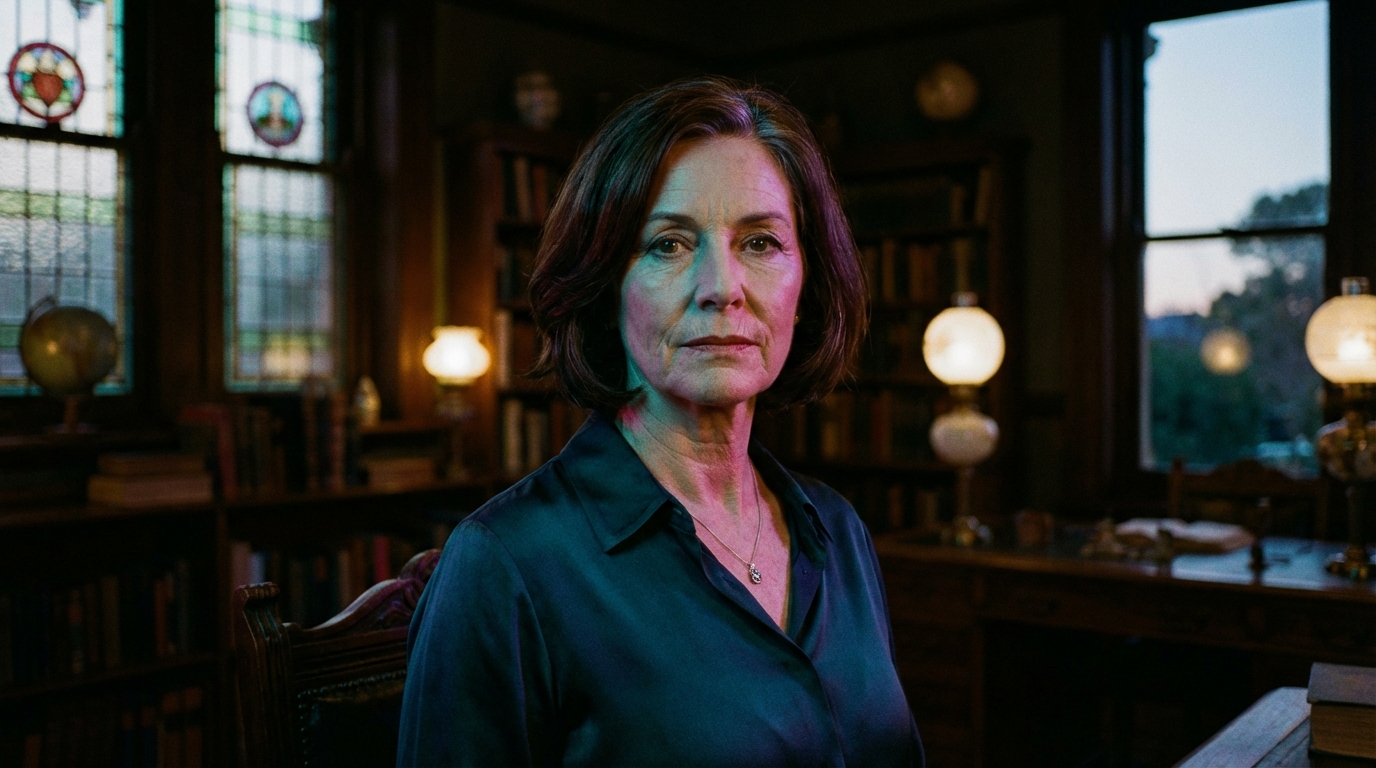
The Daughter of the Dead Man
Evelyn Rose Blackwood was born on 19 August 1967 in Melbourne, the only child of Maxwell Alastair Blackwood, who was then Director of Operations at the Obsidian Healthcare Group, and Evelyn Rose Blackwood, née Harris, a Sydney-born graduate in English literature whose literary ambitions had been deferred by marriage into a family whose institutional demands consumed the margins in which personal pursuits might otherwise have flourished. The younger Evelyn — distinguished throughout her life by the surname she would eventually acquire through marriage, though for the first thirty-five years she shared her mother's name in a doubling that reflected less the family's limited imagination than its particular habit of repeating patterns — arrived into a household whose domestic warmth was genuine and whose relationship to the wider Blackwood institutional architecture was, in 1967, still manageable.
She was six years old when her father died on 3 May 1974 in Sydney. The death was sudden. The circumstances were not explained. The official record provided a cause that satisfied legal requirements without satisfying the questions that the death generated, and Evelyn was too young to formulate the questions that the adults around her were too constrained — by grief, by institutional pressure, by the particular silence that the Blackwood family maintained as a matter of inherited practice — to ask on her behalf. She grew up knowing that her father had died young, that the death had been unexpected, and that the subject was not discussed in her household with the specificity that her developing intelligence increasingly required. The absence of explanation became, over time, as formative as any explanation might have been — the space where the facts should have been filling itself with the particular combination of loyalty, anxiety, and unresolved suspicion that children develop when the adults responsible for their safety manage grief through concealment rather than disclosure.
Childhood and Education
Evelyn's mother raised her alone, in a Melbourne whose geographical and social distance from the Blackwood institutional centre her mother maintained with a quiet deliberateness that the child perceived without understanding. The household was literary, warm, and governed by a woman whose resilience expressed itself through productivity — the novels, the philanthropy, the domestic routines whose consistency provided the stability that a fatherless childhood required. Evelyn grew up surrounded by books, by her mother's writing, and by the particular atmosphere of a home in which intelligence was valued and emotional directness was practised within the domestic sphere even as it was suppressed in relation to the family history that the household's independence was designed to manage.
She attended Melbourne Girls Grammar School, where she demonstrated academic capabilities that her teachers identified as exceptional and that Evelyn herself experienced as the consequence of having grown up in a household where intellectual engagement was the primary mode of communication. She excelled in the sciences — an orientation that diverged from her mother's literary interests and that connected her, through channels whose significance she may or may not have consciously registered, to the medical tradition that ran through the Blackwood family from Edward through Alexander and back, through Alastair, to the origins of the institution whose shadow her mother had spent years managing.
Medicine and Public Health
In 1985, Evelyn enrolled at the University of Melbourne to study medicine. The decision was not presented to her mother as a step toward Obsidian — it was presented, and may genuinely have been experienced, as a vocational choice whose motivations derived from the desire to understand and to heal that medical careers, at their best, expressed. She completed her medical degree with honours in 1991 and travelled to London, where she obtained a Master of Public Health at the London School of Hygiene and Tropical Medicine. Her research focused on global health initiatives and the development of sustainable healthcare systems in underserved regions — work whose systemic orientation suggested that Evelyn's intelligence, like her grandfather Alastair's, operated most naturally at the level of institutions and populations rather than individual patients, though the comparison would have been unwelcome and the resemblance was not one that Evelyn, at that stage of her career, was positioned to recognise.
The London years provided distance — from Melbourne, from the Blackwood name, from the questions about her father's death that her mother's silence had cultivated without resolving — and the distance afforded a perspective whose clarity would prove both valuable and, in certain respects, dangerous. Evelyn returned to Australia in 1994 with qualifications, ambitions, and a framework for understanding healthcare systems that made the organisation her grandfather had founded appear, from the outside, like exactly the kind of institution whose capabilities she was trained to improve.
Obsidian
Evelyn joined the Obsidian Healthcare Group in 1994 as a junior executive. Her mother's response to the decision was not recorded in any form that survives, though the elder Evelyn's subsequent forty-six years of careful distance from the organisation and her persistent reticence about the Blackwood family's institutional history suggest that the response encompassed dimensions that the daughter's professional enthusiasm could not accommodate. The mother had spent twenty years protecting her child from the questions surrounding Maxwell's death. The child, now an adult with medical qualifications and a public health perspective that valued institutional capability over institutional suspicion, entered the very architecture from which the protection had been designed to shelter her.
Evelyn's early years at Obsidian were spent absorbing the organisation's operational structure — patient care, administrative systems, the network of facilities and partnerships that constituted Obsidian's public infrastructure. By 1999, her innovative approach to healthcare delivery and her commitment to expanding access earned her promotion to Director of Public Health Initiatives. In this role, she spearheaded projects whose genuine value was not diminished by the institutional context within which they were conducted — mobile clinics for rural and remote communities, partnerships with international health organisations, and programmes that extended Obsidian's reach into underserved populations whose healthcare needs the public system had not adequately addressed.
The work was real. The improvements were measurable. The question of whether genuine public health achievement within an organisation whose deeper operations remained opaque constituted complicity or redemption was one that Evelyn's professional position did not require her to resolve and that her family history made impossible to avoid entirely. She worked within Obsidian's visible infrastructure, contributed to its legitimate healthcare mission, and maintained — whether by choice, by institutional management, or by the particular blindness that competent people develop toward the aspects of their organisations that competence alone cannot address — a relationship with the organisation's restricted dimensions that replicated, in professional form, the relationship her mother had maintained in domestic form: aware that there was more than the surface showed, uncertain about the nature of what lay beneath it, and disinclined to investigate with the thoroughness that investigation would have required.
Marriage and Family
Evelyn married Charles Andrew Whitmore, a medical professional, in 2002. The marriage brought the change of surname that distinguished her, finally, from the mother whose name she had shared for thirty-five years — a distinction that was practical and that carried, for those attentive to the family's naming patterns, a symbolic dimension as well: the younger Evelyn becoming a Whitmore, stepping out from beneath the doubled Blackwood-Harris identity into a name that was entirely her own.
They had two children — Amanda Sheree Whitmore, born in 2004, and Jonathan Maxwell Whitmore, born in 2007. The second child's middle name — Maxwell — constituted the most explicit acknowledgment that Evelyn made of the father whose death had shaped her childhood and whose memory her mother had maintained through silence rather than narration. The marriage was functional, ambitious, and ultimately insufficient — the demands of Evelyn's career at Obsidian competing with the domestic requirements of a young family in ways that echoed, without replicating exactly, the institutional consumption that had characterised Blackwood marriages across multiple generations. Evelyn and Charles divorced amicably in 2012, establishing a co-parenting arrangement whose civilised competence reflected the professional capabilities both parties brought to the management of personal difficulty.
Sebastian and the Question of Leadership
Sebastian Charles Blackwood's assumption of the Obsidian Chief Executive role in 2010 placed Evelyn in a position whose complexity reflected the family's tangled institutional geography. Sebastian was her father's first cousin once removed — the grandson of Edward Thomas Blackwood, who was the brother of Evelyn's grandfather Alastair. The familial connection was distant enough to prevent the appointment from constituting straightforward nepotism and close enough to ensure that the family dynamics surrounding it were more complicated than the organisational chart suggested.
Evelyn had been a credible candidate for the role herself. Her qualifications, her institutional knowledge, and her public health credentials positioned her as a plausible alternative to Sebastian's administrative approach. She chose not to pursue the appointment — a decision whose motivations she did not discuss publicly and that those who knew the family's history interpreted variously as strategic patience, institutional self-preservation, or the particular caution of a woman whose father had assumed Obsidian's leadership and had not survived the consequences. Whether any of these interpretations captured the actual reasoning, or whether the reasoning encompassed dimensions that the interpretations could not access, Evelyn did not clarify.
She continued as Director of Public Health Initiatives under Sebastian's leadership, her work remaining central to Obsidian's legitimate healthcare mission whilst the organisation's broader operations expanded under a Chief Executive whose institutional inheritance derived from the other branch of the Blackwood family — the branch whose relationship with Obsidian had been consultative rather than foundational, distant rather than intimate, and uncomplicated by the death that Evelyn's branch carried as its defining inheritance.
The Mother's Death
Evelyn Rose Blackwood née Harris — the mother, the author, the woman who had spent forty-six years managing the silence that Maxwell's death had imposed — died on 12 October 2020 in Melbourne, during the extended lockdown that the COVID-19 pandemic had imposed upon the city. The younger Evelyn was unable to be present in the manner that the relationship warranted, the pandemic's restrictions compressing the farewell into the diminished forms that the period's conditions allowed.
Her mother's death removed from Evelyn's life the person who had constructed the protective architecture within which her childhood had been conducted — the silence, the independence from Obsidian, the literary career that functioned as sublimated testimony. The relationship between mother and daughter had achieved, in its final years, an equilibrium whose basis was mutual respect rather than mutual comprehension: the mother understanding that her daughter's institutional choices were made with information and agency that the mother's own circumstances in 1974 had not provided, the daughter understanding that her mother's reticence reflected experience rather than prejudice. The understanding did not resolve the tension between them. It merely provided a framework within which the tension could be held without requiring either woman to abandon the position that her life had produced.
Evelyn Rose Whitmore, née Blackwood, was the granddaughter of the man who founded the Obsidian Healthcare Group and the daughter of the man who died leading it. She was raised by a mother who chose silence to protect her and who watched, across the decades that followed, as the daughter entered the institution from which the silence was supposed to protect. She built a career within that institution whose public health achievements were genuine, whose institutional context was ambiguous, and whose relationship to the questions that her family's history generated was managed with the same combination of competence and avoidance that the Blackwood family had employed, across six generations and two centuries, as a substitute for the honesty that might have changed everything and that no one — not the lawyers, not the doctors, not the administrators, not the wives, and not the daughters — had ever been willing to risk.







