Eva Ludmila Novak (née Dvořáková)
Eva Novak, born Eva Dvořáková in Ostrava in 1950, was a Czech seamstress of fragile health—the warm, quick-witted heart of a quiet household. The daughter of a coal miner, weakened by childhood rheumatic fever, she became the prized dressmaker of her district, married the reserved Vítkovice fitter Pavel Novak in 1973, and poured her whole tenderness into their only son, Stefan. A gastric cancer she long ignored took her in the spring of 1985, at thirty-four.
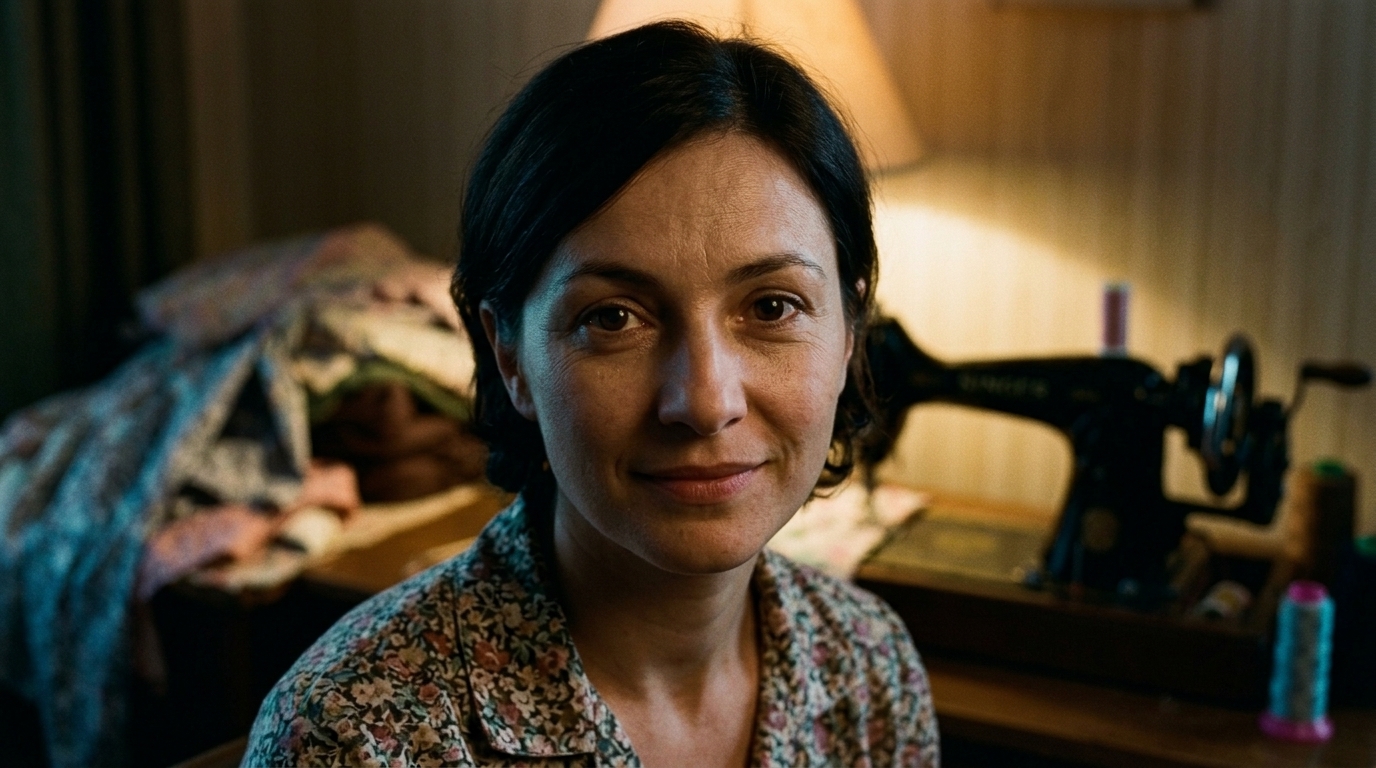
The Delicate Daughter
Eva Ludmila Novak was born Eva Ludmila Dvořáková on the 19th of October 1950 in Ostrava, the coal city of the Moravian-Silesian north of Czechoslovakia, where the pit-head wheels turned through the night and a fine black dust settled on the washing if a woman left it on the line too long. She was the middle child and elder daughter of Jaroslav Dvořák, a miner of the Ostrava-Karviná coalfield, and his wife Anna (née Horáková), who worked the long benches of a garment factory and carried her needlework home with her. Her middle name, Ludmila, had been her grandmother's, and behind it, like so many names in that part of the world, stood a saint the state preferred its children not to learn—the grandmother of Bohemia herself, kept alive in a family that went to Mass quietly and did not advertise the fact.
The Dvořáks lived in a brick tenement in a miners' quarter on the smoke-stained edge of the city, four rooms and a shared yard, the men leaving for the pits in the dark and the women holding the daylight together. It was a hard, ordinary, soot-coloured world, and Eva would never know any other; she lived the whole of her life within a few tram stops of the room she was born in.
She was not a strong child, and a bout of rheumatic fever in her eighth winter saw to it that she never would be. The illness left a murmur in her heart and a shortness in her breath that shadowed her the rest of her days, and it marked her, in the family's eyes, as the one to be watched—kept in when the others ran out, wrapped against the cold, spared the heavy work. She grew up a little apart from the rough physical life of the street, on the inside of windows, and the apartness might have soured another child.
It did not sour Eva. What grew in her instead was warmth. Denied the playground, she became first a watcher and a listener and then, as she found her feet, a talker—quick, funny, tender, with a knack for drawing people out and a laugh that came easily and often. Her brother Tomáš, two years older and built for the pit like their father, was devoted to her; her little sister Hana trailed her everywhere. Where her body was frail her spirit was anything but, and the household came to understand that the delicate daughter was, in her undemonstrative way, the one who held its warmth together.
Her father was the unlikely tenderness of her early life. Jaroslav Dvořák was a big, coal-blackened, taciturn man who came home grey with the pit and short of patience, and who softened, against all expectation, only for his middle child. He would not let the others see it, but he carried Eva on his shoulders when her chest was bad, brought her ribbons and oddments from the town, and sat with her on the evenings she could not sleep for the labouring of her heart. From him, perhaps, she learned that the gruffest men were often only frightened of their own softness—a lesson that served her well when, years later, she married one.
Family Tree
Her Mother's Machine
The needle was the one inheritance her mother had to give, and it became the making of her. Anna had sat Eva at the old black treadle machine almost before the girl could reach the pedal, and the fine, patient, sedentary work suited a child who could not run about—it asked nothing of her heart and everything of her hands and her eye, and she had both in abundance. By fourteen she could turn a collar, set a sleeve, and copy a dress from a magazine photograph that no shop in the republic would ever stock.
She trained at a vocational school and took her place, as nearly everyone of her sort did, on the line of a state clothing enterprise, sewing the same seam ten thousand times against a quota. The factory paid her wage and bored her, and was not where she truly lived. Her real work happened in the evenings, at her mother's machine in the corner of the flat, where the women of the district came to her—because in a country whose shops offered everything in grey and nothing in her size, a woman who could make a wedding dress, take in a coat, or run a christening gown up from a remnant was worth more than gold and a great deal easier to find.
She became, by her early twenties, the dressmaker of her quarter, and with the work came a second role she had not sought: confidante. A dressmaker heard things. Standing with a mouthful of pins while a customer turned before the glass, she was told of the bad marriages and the new babies and the small disgraces of half the street, and Eva—warm, discreet enough, and not above the pleasure of a confidence—became a quiet repository of her district's secrets.
She was good company and good with people, and the fittings were as much visits as transactions. If she was a little vain about her work, she had earned the right to be; the dresses she made were the finest a working woman in that city was ever likely to wear, and she knew it, and took an honest pride in it that was nearly the only pride she ever allowed herself.
The work was never entirely safe. Private enterprise of any kind sat awkwardly with the state, and a woman taking in dressmaking for cash of an evening did so in a grey margin the authorities chose mostly to overlook and could choose, on a bad day, not to. Eva navigated it the way her whole quarter navigated such things—quietly, in kind as often as in cash, a dress for a favour, a hem for a sack of potatoes—and she was careful, and she was never once troubled over it. The commission she was proudest of was a wedding dress for a neighbour's daughter, a confection of borrowed lace and improvised cleverness that turned a poor girl luminous for a single afternoon and was talked about on the estate for years.
The Quiet Man at the Dance
She met Pavel Novak in the winter of 1971, at a dance got up by the Vítkovice ironworks where he was a young fitter. He was a serious, broad-shouldered, close-mouthed man two years her senior, the sort who stood at the edge of a room and watched, and most girls would have written him off as dull inside the hour. Eva, who had spent her own childhood on the inside of windows watching, recognised something in the watching—and she had, besides, the gift of drawing the quiet out of people. She made him laugh before the evening was through, which she gathered did not happen to him often, and she decided more or less on the spot that she liked him.
What she saw in Pavel, and went on seeing, was steadiness. He was no man for words or for flowers, but he was kind in the things he did rather than the things he said, and Eva—who had grown up valued chiefly for being decorative and frail—found that she wanted precisely that: someone who would simply be there, plainly and permanently, and let her supply the warmth for the both of them.
They married in the spring of 1973, in a registry office as the times preferred, though Eva slipped into a church afterwards on her own to have the thing blessed, telling no one but God and her mother. The two-room flat they were allotted in a panelák block on the edge of the city was bare and identical to ten thousand others, and she made it a home through sheer force of warmth—curtains run up overnight, a cloth on the table, a pot of something always going, the radio and her own singing filling the small rooms.
She loved Pavel and was, in the main, happy with him, though she carried all her life a small and private wish that he might once in a while say aloud what he so plainly felt. She had decided early that this was simply the shape of him, and that a woman could either break herself against a man's silence or supply the words herself; and Eva, characteristically, supplied the words.
The brightest weeks of her year were spent out of the city altogether. Like many families of their kind the Dvořáks had the use of a small weekend chata—a one-roomed timber cottage with a vegetable patch, an hour out of Ostrava on the train—and it was there, among the trees and the clean air, that Eva was at her happiest and her healthiest. She sat out the long light evenings with her parents and her brother and sister, podding peas and laughing, her chest easier than it ever was in the soot of the estate, while Pavel dug the garden in his shirtsleeves and said almost nothing and was, in his quiet way, content. Those weeks were the green heart of her short life.
She was fierce, too, in his defence. There was an elder brother, Mikhail, gone to Prague and a surgeon's training, a polished and ambitious man whose every advancement seemed to shrink Pavel a little further in his own eyes. Eva had no patience for it. She thought her husband—honest, skilled, unshowy, dependable to the bone—worth ten of his clever brother, and said so, often and warmly, and if she could not cure Pavel of the wound the comparison opened in him, she could at least stand squarely on his side of it. Pavel, who could never have told her what that loyalty meant to him, leaned on it harder than either of them ever said.
Her One Boy
Their son was born on the 9th of May 1975, and the having of him very nearly finished her. Eva's weak heart bore the pregnancy badly, and the birth itself was long and frightening, and the doctors told her plainly afterwards what she had half known going in: that another would likely kill her, and that this boy would have to be enough. So Stefan was an only child, and into that single channel his mother poured everything she had.
She was a doting, demonstrative, faintly indulgent mother, the warm pole of a household whose other pole was her husband's silence. She sang to the boy—the Moravian folk songs her own mother had sung over her—and told him stories, and sewed him small fine clothes that the other children on the estate envied, and smothered his ordinary scrapes in rather more fuss than they warranted. Whatever capacity for tenderness Stefan carried out of that childhood, he had from her; it was the one thing his father could not give, and his mother gave it without stinting.
The thing the boy would keep longest was the singing. On the evenings his father worked a late shift, Eva would have Stefan in to her while she worked the treadle, and she would sing the old Moravian songs low beneath the rhythm of the machine until he fell asleep on the spare bed in the corner amid the offcuts and the pins. It was a small, ordinary, irreplaceable thing, the kind that, once it was gone, left a silence a child could spend the rest of his life trying to name.
Beneath the devotion ran a fear she seldom let herself look at directly. A woman told since girlhood that her heart was weak did not take her own future for granted, and Eva, watching her son grow, was visited now and then by the cold thought of how much of him she might not live to see. She put it away each time it came.
She had the boy baptised quietly, against the grain of the godless state, the way she did most things that mattered to her—without fuss, without announcement, and with a small, stubborn certainty that some things were worth the quiet risk. It was of a piece with the rest of her: the faith kept in a drawer, the church slipped into alone, the warmth practised in a country that had no official use for it.
What She Would Not Trouble Anyone With
The illness that took her began, as such things do, as something she did not think worth mentioning. It was her one real failing, the underside of all that warmth: that a woman so attentive to everyone else's aches was careless to the point of recklessness about her own. The pain came into her stomach in the autumn of 1984, and she put it down to her nerves, to something she had eaten, to the ordinary indignities of a body she had never trusted in the first place. She dosed it with bicarbonate, told no one, and carried on—fitting dresses, minding Stefan, keeping the house—for months longer than she should have.
By the time she let Pavel take her to a doctor, in the deep cold of that winter, the thing in her stomach had grown past anything the hospitals of the region could do for it. The diagnosis was brief and final: a cancer of the stomach, caught far too late, of the kind the smoke-and-soot country around Ostrava saw more of than most. There was little to be done, and little was done, and Eva came home to the panelák flat to spend what was left of her time in the small bright bedroom she had made.
What frightened her in those last months was not, in the end, her own dying; it was the leaving. She lay and looked out at a future she would not be in, and the whole of her dread gathered itself around a nine-year-old boy and the gentle, mute man who would be left to raise him. She knew exactly what Pavel could not give—the words, the warmth, the easy tenderness—and she knew that she had been the one supplying it, and she could not for the life of her see who would supply it once she was gone.
She tried, in her quiet way, to teach him the words before she went. It was the one thing she ever asked of Pavel that he could not manage, even then, even for her.
The Cold Spring
Eva Novak died in the panelák flat in April 1985, a few weeks short of her son's tenth birthday. She was thirty-four years old.
She was buried on a raw, grey morning with the last of the winter still hanging in the air, and the boy would remember the day chiefly as cold, and as the only time he ever saw his father weep—briefly, and almost in anger, before folding the grief away into a place from which it never afterwards emerged. With Eva went the warmth of that household, and it did not come back. The flat that her singing and her fussing and her endless cups of something had made into a home reverted, after her, to the bare and silent box it had always been underneath.
What she left behind her, besides the boy and the broken man, was her work. For a long time Pavel could not bring himself to give away the clothes she had made—the good winter coat, the shirts cut to outlast their cloth, the small garments sewn for Stefan that the boy outgrew and that were folded into a drawer and kept regardless. They were the nearest thing to her handwriting, those straight and patient seams: the evidence of a frail woman who had never had much to give but warmth and skill, and had given both without measure, to the very end of a life that was far too short.







