
Eva Marguerite Harrison
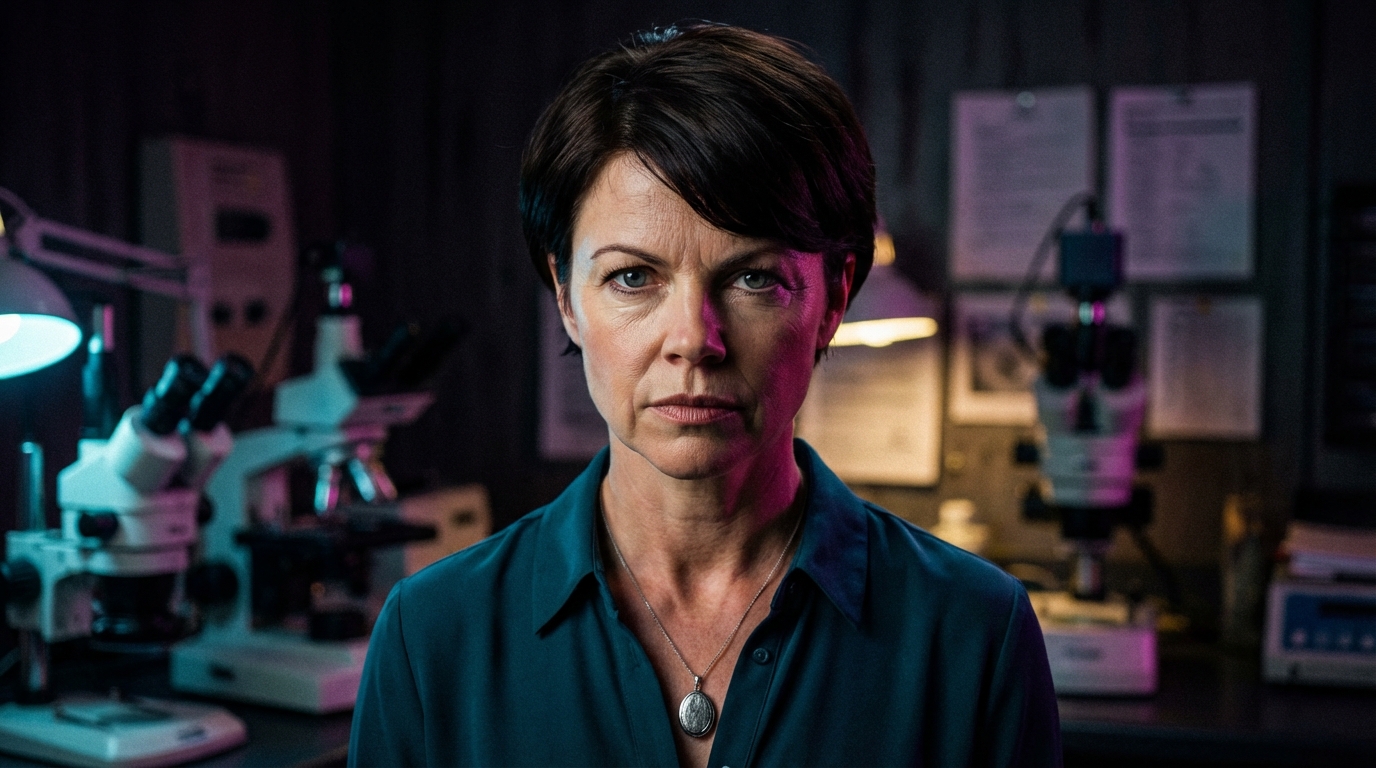
Born in Hobart in 1985, Eva Marguerite Harrison followed her father's footsteps into the world of criminal investigation, though her path led to the laboratory rather than the lecture hall. A senior forensic analyst with the Forensic Science Service Tasmania, Eva built a reputation for meticulous evidence processing and clear-headed court testimony across a decade of increasingly complex casework. The events of August 2018 — the Cody Jennings murder, the forensic sweep of Jeffries Manor, and the disappearance of Detective Karl Jenkins — tested the limits of her discipline and exacted a personal cost that her professional composure could not entirely conceal.
Early Life in Hobart
Eva Marguerite Harrison was born on 11 August 1985 at the Royal Hobart Hospital, the only child of Albert Victor Harrison, a criminologist who lectured at the University of Tasmania, and Lorraine Frances Harrison (née Beaumont), a secondary school teacher at Elizabeth College. The family lived in a brick Federation house on Fitzroy Crescent in the suburb of Dynnyrne, on the lower slopes of kunanyi/Mount Wellington, where the morning light came late over the ridgeline and the evenings cooled quickly in the mountain's shadow.
The Harrison household was shaped by the particular atmosphere that two educated, articulate parents and a single child could create — intellectually rich, conversationally dense, and sometimes quieter than Eva might have preferred. Albert was a thoughtful, somewhat reserved man whose academic work in criminology had earned him a modest reputation within Australian forensic circles but whose greatest talent, as far as his daughter was concerned, was the ability to explain complex ideas with patience and without condescension. He brought his work home in the way academics do — not through case files spread across the kitchen table, but through dinner-table discussions about human behaviour, the reliability of eyewitness testimony, and the philosophical questions that crime posed about society and individual responsibility. Eva absorbed these conversations with the attentiveness of a child who had no siblings to compete with for parental attention and who discovered early that asking the right question earned more approval than providing the expected answer.
Lorraine provided a different kind of influence — warmer, more practically grounded, and possessed of the particular resilience that secondary school teaching demanded. She taught English and History at Elizabeth College, where she dealt daily with the unpredictable emotional landscape of adolescence, and she brought to her parenting the same combination of firmness and compassion that made her effective in the classroom. Where Albert encouraged Eva's analytical instincts, Lorraine fostered the emotional awareness and creative sensibility that would later find expression in unexpected ways. The tension between these two parental influences — the rational and the intuitive, the analytical and the expressive — produced in Eva a temperament that was both her greatest professional asset and her most persistent personal challenge.
Eva was, by her own later admission, a serious child. She read voraciously, preferred puzzles and mysteries to the outdoor adventures that Hobart's proximity to bushland and waterfront might have encouraged, and developed the habit of close observation that her father recognised and quietly cultivated. She was not withdrawn — she had friends, attended birthday parties, participated in the rituals of suburban childhood — but she operated with a self-contained intensity that set her apart from peers who moved through the world with more obvious ease. The fascination with how things worked, with what evidence revealed and what it concealed, was present long before she had the vocabulary to describe it as forensic interest.
St. Mary's College and the Formation of Purpose
Eva attended St. Mary's College in Hobart from 2000 to 2003, a Catholic girls' school whose academic standards and emphasis on discipline suited her temperament more comfortably than she had expected. She was not a Catholic — Albert was agnostic and Lorraine's Anglicanism was more cultural than devout — but the school had been chosen for its academic reputation and its proximity to the family home, and Eva navigated the religious framework with the pragmatic tolerance of someone who recognised that the institution's values and her own overlapped in the areas that mattered.
She excelled in science, mathematics, and psychology, subjects that rewarded the precise, methodical thinking she had been practising since childhood. Her teachers noted her capacity for sustained concentration and her unwillingness to accept approximation where accuracy was possible — qualities that occasionally manifested as inflexibility but more often produced work of exceptional standard. She participated in academic competitions with the quiet competitiveness of someone who measured herself against internal benchmarks rather than the performance of classmates.
By her final year, the career direction had crystallised. Forensic science offered the intersection of disciplines that Eva found most compelling — the rigour of chemistry and biology applied to the human complexities her father's work had illuminated, the opportunity to transform physical evidence into narrative, to extract truth from materials that could not lie or dissemble in the ways that witnesses and suspects could. She graduated from St. Mary's College in 2003 with results that placed her comfortably within the requirements of the programme she had identified at the University of Tasmania.
The University of Tasmania and Professional Training
Eva enrolled in a Bachelor of Forensic Science at the University of Tasmania in 2004, specialising in forensic chemistry and toxicology. The programme combined laboratory science with the legal and procedural frameworks that governed forensic evidence — chain of custody, admissibility standards, the translation of scientific findings into courtroom testimony — and Eva approached it with the focused determination of someone who had spent years preparing for precisely this. She was not the most naturally brilliant student in her cohort — there were others with sharper instincts for the intuitive leaps that chemistry sometimes demanded — but she was among the most disciplined, and in forensic science, discipline outweighed brilliance almost every time.
Her final-year thesis on the forensic applications of trace evidence earned distinction and the attention of both her academic supervisors and the Forensic Science Service Tasmania, the state institution responsible for providing scientific support to the criminal justice system. The thesis demonstrated Eva's particular strength: the ability to synthesise large volumes of analytical data into coherent, defensible conclusions that could withstand the adversarial scrutiny of courtroom cross-examination. It was, in miniature, the skill that would define her career.
The FSST offered Eva an internship upon her graduation in 2007, providing hands-on experience in crime scene analysis, DNA profiling, fibre comparison, and toxicological testing that her university training had addressed in theoretical terms. She worked under senior analysts whose decades of casework had produced the kind of practical wisdom that no curriculum could replicate — the ability to read a crime scene not just as a collection of evidence points but as a story with sequence, motivation, and consequence. Eva proved an attentive student of this applied education, absorbing methodologies and institutional knowledge with the thoroughness that characterised everything she undertook.
Building a Career at the FSST
Eva joined the Forensic Science Service Tasmania as a Junior Forensic Analyst in 2008, beginning the formal career that would occupy the next decade and beyond. The early years provided the education that training alone could not — the reality of evidence that arrived contaminated, degraded, or insufficient; the frustration of inconclusive results in cases where police investigators needed certainty; the emotional weight of processing materials connected to violent crimes against people whose suffering was rendered tangible through the physical traces they left behind.
She developed expertise across the FSST's core disciplines — forensic biology, chemistry, and toxicology — whilst building a particular reputation for trace evidence analysis. The work demanded patience that bordered on obsessiveness: examining fibres under microscopy, comparing soil samples across databases, extracting usable DNA from materials that appeared, to the untrained eye, to contain nothing of value. Eva possessed the temperament for this work in ways that many of her colleagues did not. The solitary concentration of laboratory analysis suited her self-contained nature, and the requirement for absolute precision aligned with the internal standards she had been applying to herself since childhood.
Her collaboration with law enforcement agencies across Tasmania grew as her reputation solidified. Detectives who worked with Eva learnt to expect reports that were thorough to the point of exhaustive, testimony that was clear and unshakeable under cross-examination, and a professional manner that combined approachability with the unmistakable authority of someone who knew exactly what her evidence demonstrated and, equally important, what it did not. She was not the analyst who offered investigators the conclusions they wanted; she was the analyst who offered them the conclusions the evidence supported, regardless of whether those conclusions were convenient.
Her promotion to Senior Forensic Analyst in 2015 expanded her responsibilities to include team management, case oversight, and the training of junior analysts. She approached the supervisory dimensions of the role with the same methodical precision she brought to laboratory work, though she discovered — not entirely comfortably — that managing people required a different kind of attention than managing evidence. People were inconsistent, emotional, and resistant to the controlled conditions that laboratory science demanded. Eva adapted, drawing on the interpersonal skills her mother had modelled and her own developing understanding that effectiveness in a team environment required flexibility she did not always find natural.
August 2018: The Jennings Case and the Jenkins Investigation
The events of August 2018 compressed into a single week the kinds of cases that ordinarily arrived separated by months or years. The murder of Cody Jennings in Berriedale — a killing that generated intense public attention and media scrutiny — placed Eva at the centre of one of Tasmania's most high-profile criminal investigations. Her examination of blood spatter patterns, fibre evidence, and trace materials at the Jennings crime scene provided law enforcement with critical insights into the nature and sequence of the attack, evidence that proved instrumental in constructing the prosecution's narrative. The work was technically demanding and emotionally punishing in equal measure; the Jennings case involved details of violence that tested the professional detachment Eva had spent a decade cultivating.
Simultaneously, the disappearance of Detective Karl Jenkins from Jeffries Manor on 2 August drew Eva into a parallel investigation that would prove even more unsettling. On 3 August, she led the forensic team deployed to the manor as part of the comprehensive sweep authorised by Detective Sergeant Alexander Stout. The day began with the methodical rigour that Eva's team was known for — convoys of vehicles, white-suited analysts, warrants supported by two centuries of architectural plans — and it deteriorated into confusion as the forensic examination produced anomaly after anomaly. By mid-morning, as the chapter "Seven Anomalies by Ten" would later record, every team working the property was encountering the same fundamental problem from a different angle: the more rigorously they examined Jeffries Manor, the less it resembled what it was supposed to be.
Eva processed the physical evidence with her characteristic precision — trace materials, surface samples, environmental readings — but the results defied the logical frameworks she relied upon. Evidence that should have been present was absent; materials that had no business being where they were found appeared with a consistency that suggested not contamination but something her training had no category for. Her reports to Stout reflected this tension — meticulously documented findings accompanied by a professional honesty about the limits of what those findings could explain.
The political complications that descended upon the investigation — the phone call that halted Stout's authorisation, the institutional pressures that constrained the scope of forensic inquiry — left Eva grappling with the particular frustration of an analyst whose evidence was being rendered irrelevant not by scientific inadequacy but by forces operating beyond the laboratory's jurisdiction. She had built her career on the principle that physical evidence, properly collected and competently analysed, told the truth regardless of who found that truth inconvenient. The Jenkins investigation challenged that principle not by disproving it but by demonstrating how effectively institutional power could prevent the truth from reaching the people who needed it.
The Weight of Evidence
The cumulative effect of the 2018 cases — the Jennings murder, the Jeffries Manor anomalies, the Jenkins disappearance, and the political interference that complicated every aspect of the investigation — marked a turning point in Eva's relationship with her work. She had always understood, intellectually, that forensic science operated within a human system subject to human failings. The events of August 2018 transformed that intellectual understanding into lived experience, and the transformation was not painless.
The emotional toll manifested in ways Eva recognised but could not always control — disrupted sleep, a hypervigilance that followed her home from the laboratory, a tendency to review case details compulsively long after the professional requirement to do so had passed. She was not unique in this; the forensic and law enforcement communities across Hobart carried the weight of 2018 in various forms, and the institutional support structures — counselling services, welfare programmes, peer networks — addressed the symptoms with varying degrees of effectiveness. Eva engaged with these resources with the same disciplined compliance she brought to every professional obligation, though she remained privately uncertain whether the processes designed to help her were adequate to the specific nature of what she had experienced.
It was during this period that painting — a childhood interest that had lain dormant through the demands of university, training, and professional advancement — re-emerged as something more than idle recreation. Eva began producing abstract works that drew on colour, texture, and form to express states that her analytical vocabulary could not accommodate. The paintings were not illustrative; they did not depict crime scenes or evidence or the specific images that lodged in her professional memory. They were, instead, attempts to process through a different kind of intelligence — intuitive, emotional, ungoverned by the evidentiary standards that defined her working life. Her mother, Lorraine, recognised in the paintings something she had always hoped for her daughter: a channel for the emotional depth that Eva's professional discipline held in careful containment.
Personal Life and Relationships
Eva's personal life reflected the temperament and priorities that shaped her professional one. She maintained a small circle of close friends — several drawn from the forensic and law enforcement communities who understood the demands of the work without requiring explanation, others from outside those worlds who provided the perspective that insularity could erode. She did not form attachments easily, and the relationships she did form were characterised by a loyalty and attentiveness that sometimes surprised people who mistook her reserve for indifference.
Her relationship with Albert remained the most intellectually sustaining connection in her life. Father and daughter shared the particular bond of people who occupied adjacent positions in the same field — Albert's academic criminology and Eva's applied forensic science overlapped in ways that produced conversations of a depth and specificity neither could replicate with anyone else. His retirement from the University of Tasmania had not diminished his engagement with the discipline, and he followed his daughter's career with a pride that expressed itself through the precise, analytical interest that was the Harrison family's native emotional language. They discussed cases — within the boundaries that Eva's professional obligations permitted — with the collaborative intensity of colleagues as much as parent and child.
Lorraine's influence operated differently but no less significantly. Her advocacy for work-life balance was a recurring theme between mother and daughter, pursued with the gentle persistence of someone who understood that her child's dedication, whilst admirable, carried risks that Eva herself was not always willing to acknowledge. The conversations sometimes produced friction — Eva found it difficult to accept that the boundaries Lorraine recommended were necessary rather than optional — but the underlying affection was never in question. Lorraine saw in her daughter the consequences of a life organised around demanding intellectual work, and she advocated for the creative, social, and restorative dimensions of existence that Eva's professional focus sometimes crowded out.
Eva lived alone in a terraced cottage in North Hobart, a decision that reflected both her self-contained temperament and the practical reality that her work hours — irregular, sometimes extending through nights when urgent cases demanded immediate processing — made cohabitation challenging. The cottage suited her: small enough to maintain without effort, close enough to the FSST laboratory to make early-morning callouts manageable, and possessed of the particular quiet that a person who spent her working hours in concentrated analysis required when the analysis was done.
Her interest in psychology — distinct from her father's criminological perspective — provided an additional framework for understanding the human dimensions of her work. She read widely in the field, attending public lectures and maintaining a familiarity with research developments that exceeded recreational interest without quite constituting formal study. The psychology informed her forensic practice in subtle but consequential ways — her understanding of perpetrator behaviour enhanced her ability to interpret crime scenes, and her awareness of cognitive biases helped her guard against the interpretive errors that even experienced analysts could make when evidence pointed in directions that seemed emotionally compelling but were not scientifically supported.
Those who worked alongside Eva Harrison described a woman whose precision was matched by her integrity, whose reserve concealed rather than replaced warmth, and whose commitment to the truth — the specific, material, evidence-based truth that physical science could establish — had survived intact through a career that repeatedly demonstrated how uncomfortable the truth could be. She was not the most gregarious presence in the FSST laboratory, nor the most immediately approachable. But she was the analyst that detectives requested by name when the evidence was ambiguous, when the stakes were high, and when the difference between a conviction and an acquittal rested on the quality of the science and the credibility of the person presenting it.







