Ettore Majorana
Ettore Majorana (1906–1975) was a Sicilian physicist whose groundbreaking work in quantum mechanics made him one of the most brilliant scientific minds of his generation. His mysterious disappearance during a boat voyage in March 1938 became one of history's great unsolved cases—the truth being that Majorana was kidnapped by agents working for the Portal Pirates and transported to Clivilius. Held initially against his will in the settlement of Xolldo, Majorana spent thirty-seven years developing the technology that would bear his name. What began as coerced labour, driven by fear and desperate hope of escape, gradually transformed into genuine obsession. By the time his Majorana System achieved full functionality, the physicist had long abandoned any desire to return to the world he had lost. He died in Xolldo on 12 April 1975, aged sixty-eight, having given the Portal Pirates the means to challenge Guardian dominance across both dimensions.
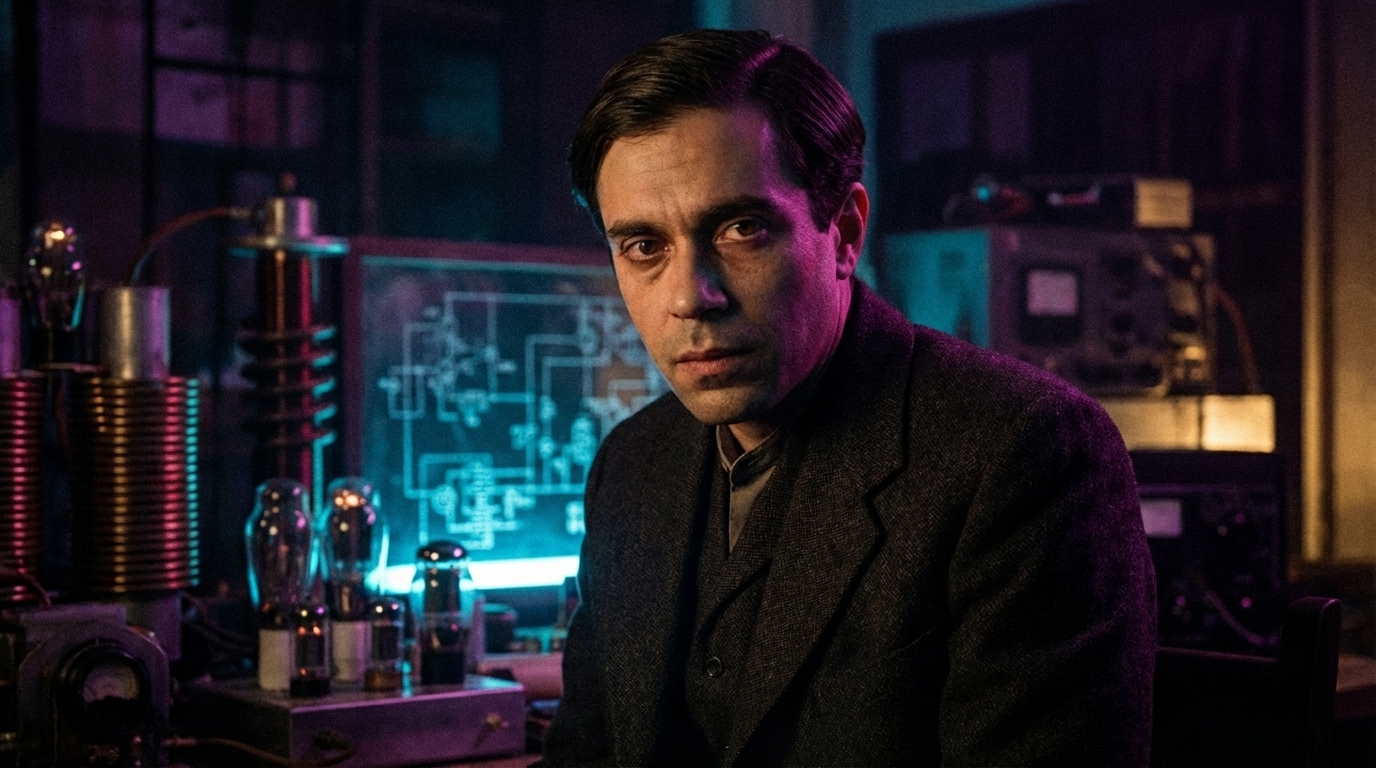
Early Life and Education
Ettore Majorana was born on 5 August 1906 in Catania, Sicily, into a family of considerable intellectual distinction. His father, Fabio Majorana, was a respected engineer, whilst his mother, Dorina Corso, brought a passion for literature and the arts to the household. The family valued education and intellectual curiosity above all else, and young Ettore demonstrated exceptional aptitude for mathematics and science from an early age.
Majorana pursued higher education at the University of Rome, where he came under the tutelage of Enrico Fermi, one of the foremost physicists of the era. Within Fermi's circle, Majorana quickly distinguished himself as a theorist of rare brilliance. His mind worked differently from his peers—he would solve complex problems through intuition and insight whilst others laboured through conventional methodology. Fermi himself reportedly considered Majorana's talents comparable to those of Galileo and Newton.
By his mid-twenties, Majorana had made significant contributions to quantum mechanics, particularly in understanding atomic particles and nuclear structures. His work on what would later be called Majorana particles—fermions that act as their own antiparticle—represented a theoretical breakthrough whose implications extended far beyond what contemporary physics could appreciate. His papers gained international recognition, establishing him as one of the most promising minds of his generation.
Yet Majorana was not a comfortable public figure. He was intensely private, prone to periods of depression and withdrawal, and increasingly ambivalent about the direction of theoretical physics. Those who knew him sensed a man wrestling with questions that extended beyond equations—questions about purpose, meaning, and whether his work would ultimately benefit or harm humanity.
The Disappearance
In late March 1938, Ettore Majorana boarded a ship in Palermo bound for Naples. He never arrived.
The official investigation found no evidence of accident or suicide, though both were considered. Majorana had withdrawn his salary shortly before departure, suggesting premeditation of some kind, but his intentions remained opaque. Over the following decades, theories proliferated: that he had entered a monastery, fled to Argentina, or simply chosen to vanish from a world he found increasingly unbearable. His disappearance became one of the twentieth century's enduring mysteries.
The truth was far stranger than any theory proposed.
Majorana's kidnapping was orchestrated by a network that spanned both Earth and Clivilius. At its centre was a corrupted Guardian—a figure who had betrayed their sacred responsibility for reasons that remain unclear. This Guardian had cultivated contacts on Earth: individuals willing to conduct criminal operations in exchange for access to resources and opportunities that only dimensional travel could provide. Through these networks, the Guardian had become aware of Majorana's work on exotic particle physics, recognising implications that Earth's scientific establishment had not yet grasped.
The kidnapping itself was swift and professional. Majorana was taken from the ship before it reached Naples, transferred through a series of locations, and ultimately brought to an active portal. He passed through into Clivilius—a dimension he had not known existed moments before—and was transported to Xolldo, the hidden capital of the Portal Pirates.
He would never see Earth again.
Arrival in Xolldo
Majorana's first weeks in Xolldo were defined by terror and disorientation.
He had been torn from everything familiar—his work, his family, his world—and deposited in a settlement of outlaws who viewed him not as a person but as a resource. The Portal Pirates who governed Xolldo explained his situation with brutal clarity: he possessed knowledge they required, and he would provide it. The alternative was left unspoken but unmistakable.
The pirates wanted what had eluded them for nine centuries: independent access to portals. They understood that Guardian technology could not simply be stolen or copied—it was bound by blood to Azariel's lineage, and no amount of theft would change that fundamental constraint. What they needed was an entirely new approach, built from different principles. They believed Majorana's theoretical work on exotic particles might provide the foundation for such technology.
Majorana initially resisted. He was a theoretical physicist, not an engineer. He had never built anything in his life. The problems the pirates described—capturing dimensional coordinates, generating exotic particles outside laboratory conditions, establishing stable portals without Guardian infrastructure—seemed impossibly beyond his capabilities. He told them as much, hoping they might release him if they concluded he was useless.
They did not release him. Instead, they gave him resources: workshops, materials, assistants who could translate his theoretical concepts into physical prototypes. They gave him time, making clear that their patience, whilst not infinite, extended far beyond what Majorana might hope. And they gave him motivation, reminding him periodically what happened to those who failed to deliver value to Xolldo.
Fear proved an effective catalyst. Majorana began working.
The Long Development
What Majorana initially approached as coerced labour gradually transformed into something more complex.
The problems the pirates had set before him were genuinely fascinating. No institution on Earth would have funded research into practical applications of Majorana particles—the theoretical framework was too abstract, the engineering challenges too speculative, the potential applications too far beyond conventional understanding. But here in Xolldo, freed from academic politics and funding constraints, Majorana could pursue questions that had lingered at the edges of his consciousness for years.
The work consumed him. Days blurred into weeks, weeks into months. He barely noticed the passage of time, so absorbed was he in the cascade of problems that each solution revealed. Generating Majorana particles required solving fundamental engineering challenges. Transmitting them across dimensional boundaries required understanding portal physics from first principles. Capturing and storing location coordinates required innovations in data architecture that had no Earth equivalent.
During the early years, Majorana sustained himself with the belief that completing his work might earn his freedom. If he delivered what the pirates wanted, perhaps they would allow him to return to Earth. He imagined reuniting with his family, resuming his academic career, publishing discoveries that would revolutionise physics—carefully edited, of course, to omit the circumstances of their development.
This hope faded gradually rather than suddenly. As years accumulated, Majorana recognised that the pirates would never release someone who understood their technology so intimately. More significantly, he recognised that he no longer wished to leave. His family had surely mourned him and moved on. His academic colleagues had built careers during his absence. The Ettore Majorana who had boarded a ship in Palermo no longer existed—that man had been replaced by someone whose identity was inseparable from the work that filled his days.
By the time two decades had passed, Majorana had stopped thinking about escape entirely. Xolldo had become home. The pirates who had kidnapped him had become, if not friends, then at least familiar presences whose company he preferred to the strangers he would encounter anywhere else. His work had become his world.
Breakthrough and Prototype
The Majorana System did not emerge as a single breakthrough but as a series of interconnected innovations developed across decades.
The Majorana Particle Generator came first—a device capable of producing the exotic particles that would make everything else possible. Early prototypes were unstable and unreliable, prone to failures that set the project back months at a time. Majorana persisted, refining his designs through countless iterations until he achieved consistent generation outside laboratory conditions.
The Majorana Twins emerged from Majorana's insight that capturing portal coordinates required simultaneous measurement at both endpoints of an active gateway. The paired devices—deliberately given an ambiguous name that might refer to people rather than equipment—represented years of development, their apparent simplicity concealing extraordinary technical sophistication.
The Eigenstate Archive required solutions to data storage problems that Earth technology of the era could not have addressed. Majorana developed novel approaches to recording and retrieving dimensional coordinates, creating a system that could grow indefinitely as new locations were captured.
The Conjugate, the activation device that opened portals to archived locations, proved the most challenging component. Majorana spent years on approaches that ultimately failed before finding a viable path. When he finally achieved reliable activation, he reportedly sat alone in his workshop for hours, staring at the device that represented his life's work.
The fully functional prototype was completed in the early 1970s. Majorana was in his mid-sixties, his health declining, his energies largely exhausted. But he had delivered what the pirates had demanded more than three decades earlier: independent portal access that owed nothing to Guardian technology or bloodline restrictions.
Final Years
Majorana's final years were spent refining and documenting his system rather than pursuing new innovations.
He worked closely with Xolldo's technicians, training the next generation to manufacture, maintain, and improve the technology he had created. He was a demanding teacher, intolerant of shortcuts and insistent on understanding principles rather than merely following procedures. Those who studied under him recalled a man whose brilliance remained undimmed even as his body failed—sharp, precise, and utterly dedicated to ensuring his work would outlast him.
Majorana also compiled extensive documentation: theoretical foundations, engineering specifications, maintenance protocols, and notes on possibilities his prototype had not yet achieved. These documents, preserved in Xolldo's archives, continue to inform development of the Majorana System decades after his death. Some passages suggest capabilities that remain unrealised—directions future generations might pursue when technology and understanding advance sufficiently.
Whether Majorana experienced regret in his final years remains unknown. He rarely spoke of his life before Xolldo, and those who knew him learned not to ask. Occasionally, when working late or lost in thought, he would murmur in Italian—fragments that might have been memories or might have been nothing at all. Whatever he felt about the path his life had taken, he kept it to himself.
Ettore Majorana died in Xolldo on 12 April 1975, aged sixty-eight. He had spent thirty-seven years in the settlement—longer than he had lived on Earth before his kidnapping. He was buried in Xolldo's cemetery, his grave marked with a simple stone bearing his name and dates. No mention was made of his origins, his former life, or the circumstances that had brought him to Clivilius.
On Earth, the mystery of his disappearance endured. Theories continued to circulate, investigations periodically reopened, and his scientific legacy grew as physics gradually caught up with insights he had published before vanishing. None who speculated about his fate imagined the truth: that Majorana had spent nearly four decades in another dimension, building technology that would reshape the balance of power between worlds.







