Ethan James Mitchell
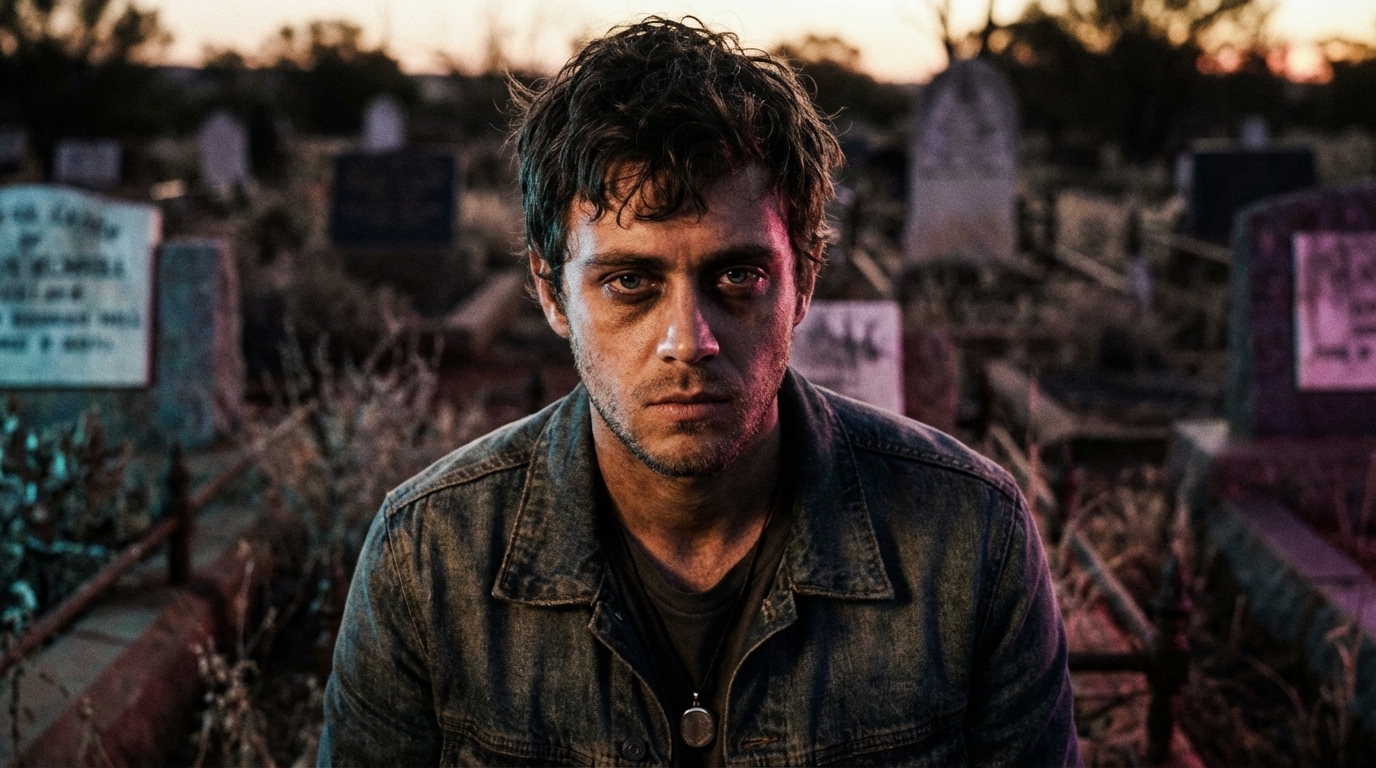
Ethan James Mitchell (b. 1968) is Broken Hill's enigmatic "ghost whisperer"—a man caught between worlds since his grandmother's death awakened his ability to hear the voices of the dead. Born into a mining family that dismissed his gifts as madness, he found solace in cemeteries and folklore, becoming the town's reluctant keeper of supernatural history. His secret romance with sixteen-year-old Violet Dallow in 1988 ended in tragedy when she was murdered by the Silverton Strangler just days after he warned her to abandon her investigation. Consumed by grief and guilt, he remains a solitary figure, forever listening for whispers that came too late.
Early Life and Family Background
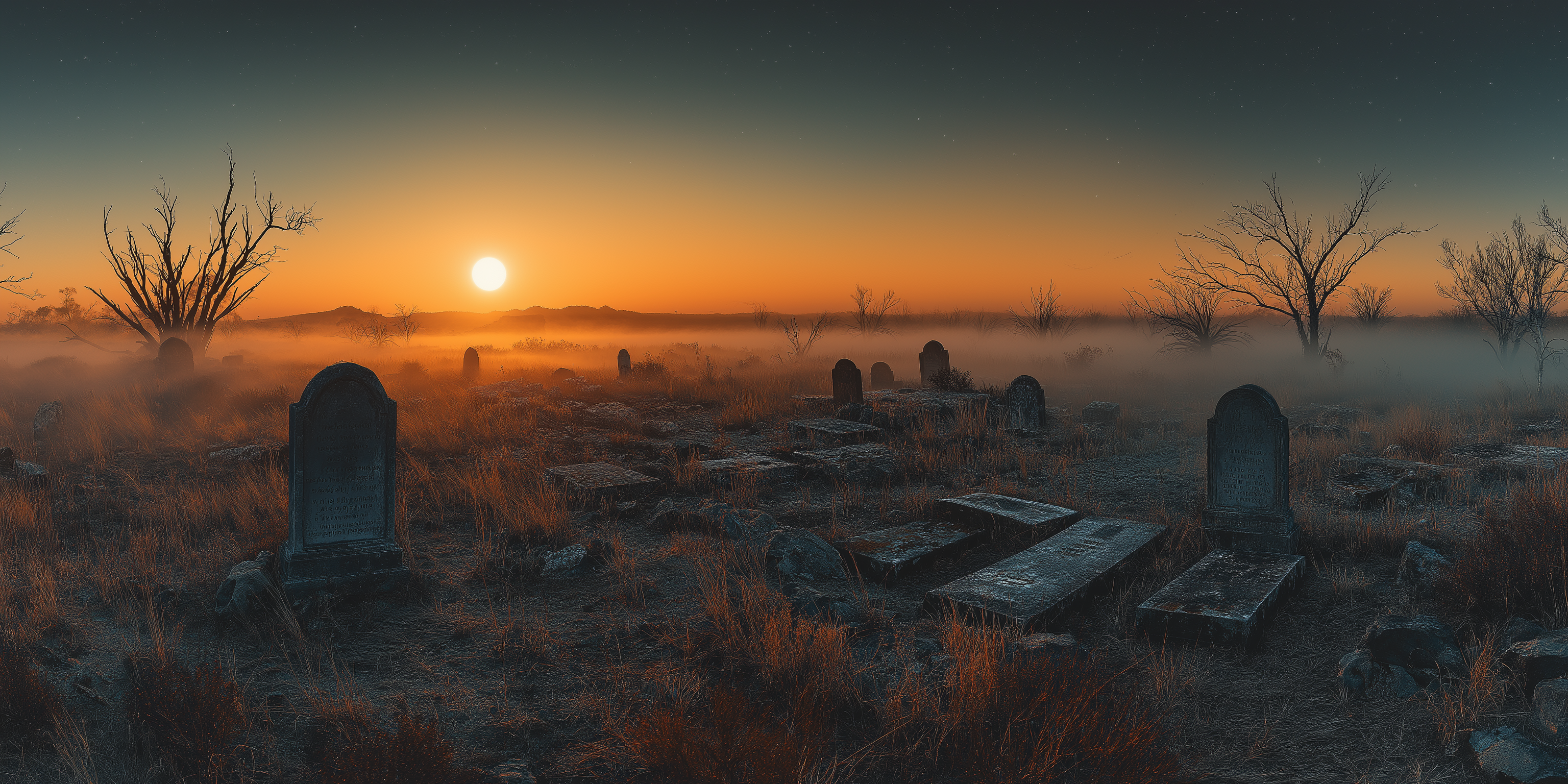
Ethan James Mitchell was born on 14 February 1968 at Broken Hill District Hospital in New South Wales, the youngest of three children in a family whose roots ran deep into the red earth of the mining town. His arrival on Valentine's Day would prove ironically fitting for a life marked by both profound love and devastating loss. The Mitchell family home, a weathered Federation-style house on Garnet Street on the outskirts of Broken Hill, stood surrounded by dusty roads and the skeletal remains of old mining infrastructure—a landscape that seemed to whisper of secrets buried beneath its surface.
His father, Richard Mitchell, was a foreman at the Broken Hill mines, a practical and disciplined man whose hands knew the weight of ore and whose worldview permitted no room for superstition or abstract speculation. Richard had married Margaret Lawson in 1958, drawn to her warmth and creativity despite—or perhaps because of—her dreamier temperament. He worked long hours underground, returning home each evening coated in the fine dust that seemed to permeate everything in the mining town, expecting his children to embrace the same stoic work ethic that had sustained generations of Mitchell men.
Margaret Mitchell, née Lawson, brought an entirely different energy to the household. A schoolteacher with a vivid imagination and a passion for storytelling, she had grown up surrounded by folklore, myths, and local legends passed down through her own family. Where Richard saw only rock and ore, Margaret perceived layers of narrative—stories embedded in the landscape, waiting to be uncovered. She filled the Mitchell home with books, encouraged questions, and wove together true events with whispered mysteries in ways that captivated her youngest child above all others.
Ethan had two older siblings whose paths diverged sharply from his own. William "Bill" Mitchell, born in 1960, was the dutiful eldest son who followed Richard into the mining industry, eventually becoming an engineer. Pragmatic and hardworking, Bill had little patience for Ethan's unconventional interests, dismissing his younger brother's talk of whispers and spirits as attention-seeking nonsense at best, mental instability at worst. The eight-year gap between them might as well have been a chasm; they shared blood but little else.
Sarah Mitchell, born in 1963, occupied the middle ground in more ways than one. Warm and protective, she became a nurse at Broken Hill District Hospital, her healing instincts extending to emotional as well as physical wounds. Though she didn't fully understand Ethan's sensitivity to the unseen, she never dismissed him outright. Sarah recognised that her youngest brother experienced the world differently, and she offered quiet acceptance where Bill offered only scorn. In a family divided between the practical and the mystical, Sarah served as a gentle bridge—never quite crossing to Ethan's side but never abandoning him either.
The Grandmother Who Heard Whispers
The most formative relationship of Ethan's childhood was not with his parents or siblings but with his paternal grandmother, Alice Mitchell. Born in 1905 in Broken Hill, Alice had lived through the town's transformation from rough mining camp to established community, and she carried within her a vast repository of local folklore, ghost stories, and esoteric knowledge that most residents preferred to forget.
Alice was known throughout Broken Hill as a healer and keeper of old traditions—a woman to whom neighbours turned when conventional medicine failed or when strange occurrences demanded explanation beyond the rational. She practised folk remedies passed down through generations, knew which herbs could cure ailments and which could ward off darker influences, and spoke of the dead as though they were merely neighbours who had moved to a different street rather than departed entirely. Richard, her son, had long since rejected her beliefs as superstitious nonsense, but he tolerated her influence on his children out of filial duty rather than respect.
From his earliest years, Ethan was drawn to Alice in ways his siblings were not. While Bill and Sarah politely endured their grandmother's stories before escaping to more conventional pursuits, Ethan sat transfixed, absorbing every tale of unexplained disappearances, haunted mine shafts, and restless spirits who wandered the Outback after dark. Alice recognised something in her youngest grandchild—a sensitivity, a receptiveness to the unseen that she had possessed herself since childhood and had learned to both nurture and conceal.
"You have the old knowing," she told him once, when he was perhaps seven or eight, her weathered hand resting on his small one. "The same as me. The same as my mother before me. It skips generations sometimes, hides in the blood until it finds someone ready to carry it. You'll hear things others can't, Ethan. See things they refuse to see. It will be lonely, but it will also be a gift."
Throughout his childhood, Alice served as Ethan's guide into liminal spaces—the boundaries between the living and the dead, the seen and the unseen, the rational and the inexplicable. She taught him about the residual energy that certain places retained, how traumatic events could leave imprints on the land itself, and why some spirits lingered while others moved on. She shared stories of Broken Hill's hidden history: the miners who had died in collapsed shafts and whose voices could still be heard on quiet nights, the Aboriginal sacred sites that Europeans had desecrated and that carried curses ever after, the pattern of disappearances that stretched back decades and that no one in authority seemed willing to acknowledge.
Most importantly, Alice taught Ethan that he was not mad. In a world that would increasingly treat his sensitivity as a symptom of mental illness, she provided the framework to understand it as something else entirely—a connection to forces beyond ordinary perception, a responsibility as much as a burden.
The Night the Whispers Found Their Voice
Alice Mitchell died on 3 October 1981, when Ethan was thirteen years old. The cancer that claimed her had moved swiftly, compressing what should have been months of decline into mere weeks. Ethan spent her final afternoon at her bedside, holding her papery hand while she drifted between consciousness and something deeper, her eyes occasionally focusing on corners of the room where nothing visible stood.
"They're waiting for me," she murmured once, her gaze fixed on a point beyond Ethan's shoulder. "All of them. Everyone I've ever helped cross over. They've come to show me the way."
She died that evening, surrounded by family, her passing peaceful in a way that seemed almost rehearsed—as though she had known exactly when and how her departure would occur. Richard stood stoic and dry-eyed. Margaret wept quietly. Bill and Sarah offered the appropriate words of comfort. But Ethan felt something shift in the air itself, a change in pressure that made his ears ring and his vision blur at the edges.
That night, alone in his bedroom while the house filled with the hushed movements of grieving relatives, Ethan heard his grandmother's voice for the first time since her death.
It rose not from memory but from somewhere beneath—through the floorboards, through the foundations, through the very earth that had already begun to claim her body. The words were clear, unmistakable, and utterly impossible.
I'm still here, boy. And now you can hear me. You'll hear all of us, in time.
Ethan did not sleep that night. He sat rigid in his bed, listening as other voices joined his grandmother's—fragments and whispers, names and warnings, a chorus of the dead speaking in overlapping waves that threatened to drown his thoughts entirely. By morning, he understood that something fundamental had changed. The sensitivity Alice had always promised would awaken had done so with her death, as though her passing had torn a veil that could never be repaired.
He tried to explain to his mother, choosing his words carefully, hoping Margaret's own appreciation for folklore might create a bridge of understanding. But Margaret, consumed by grief for her mother-in-law and perhaps frightened by the intensity in her son's eyes, responded with concern rather than comprehension. She took him to doctors. She suggested counselling. She watched him with the wary attention of a mother who fears her child is slipping away.
Richard's response was simpler and more brutal: dismissal. He refused to discuss the matter, treating Ethan's claims as either lies designed for attention or symptoms of a disturbed mind that would be best ignored into submission. The distance between father and son, already considerable, became unbridgeable.
Only Sarah offered anything resembling acceptance. "I don't understand what you're going through," she told him quietly, a few weeks after Alice's death. "But I believe you're not making it up. Just... be careful who you tell, Ethan. People don't like things they can't explain."
Education and Isolation
Ethan's years at Broken Hill High School were marked by academic excellence in subjects that captured his imagination and profound social isolation from peers who sensed his difference even when they couldn't name it. He excelled in literature and history, drawn to narratives that explored forgotten stories, unsolved mysteries, and the persistence of the past into the present. Mathematics and sciences held little interest unless they could be connected to larger questions of meaning and mystery.
The school library became his sanctuary. He spent lunch hours and free periods poring over local historical records, old newspapers, and any books he could find about folklore, the supernatural, and unexplained phenomena. His teachers recognised his intelligence but worried about his intensity, his preference for solitude, and the unsettling quality of his gaze—as though he were always looking at something just beyond the visible world.
His peers were less diplomatic in their assessment. By his mid-teens, Ethan had acquired a reputation as Broken Hill's "ghost whisperer"—a title offered sometimes with mocking derision, sometimes with genuine unease. Stories circulated about his habit of visiting cemeteries at odd hours, his claims to communicate with spirits, and his uncanny knowledge of deaths and disappearances that most townspeople preferred to forget. Some students avoided him entirely. Others sought him out for the thrill of proximity to something strange, treating him as a curiosity rather than a person.
Ethan learned to wear his isolation as armour. He cultivated an air of mystery that served both as protection and as honest reflection of his inner life. He spoke little, observed much, and developed the quiet intensity that would characterise him into adulthood—a presence that made people uncomfortable without quite knowing why.
The Inheritance in the Tin
The years following Alice's death were the most difficult of Ethan's young life. The whispers that had awakened with her passing grew neither quieter nor clearer—they remained a constant cacophony of overlapping voices, fragmentary warnings, and names of dead he didn't recognise. Sleep became elusive. Concentration faltered. There were days when the boundary between the living and the dead seemed so thin that Ethan couldn't be certain which world he was inhabiting.
His salvation came from an unexpected source: Ronald Whelan, a family friend who had worked the freight lines for decades and who had known Alice Mitchell since childhood. Ronald had been present at many of the same esoteric gatherings Alice attended, had witnessed her work with spirits and folk healing, and understood dimensions of Broken Hill's hidden history that most residents never glimpsed.
On 14 February 1984—Ethan's sixteenth birthday—Ronald arrived at the Mitchell home with a small gift wrapped in brown paper. He waited until the family celebration had concluded and the others had drifted away before pressing a small tin into Ethan's hands with a look that demanded secrecy.
"Your grandmother would have wanted you to have this," Ronald said quietly. "She used them herself, when the voices became too much. When she needed to hear clearly instead of drowning in noise."
Inside the tin, Ethan found dried fungi—twisted grey-brown forms with patches of blue-green that released a sharp, bitter scent when disturbed. Ronald explained their origin: they grew in the damp places near Silverton, in abandoned mine shafts where sunlight never penetrated, in locations the First Peoples had known about for thousands of years before Europeans arrived.
"The miners found them decades ago," Ronald continued. "Took them when they needed to see beyond what their eyes allowed. Your grandmother learned about them from an Aboriginal woman who trusted her enough to share the knowledge. They don't create the whispers, Ethan. They just make the veil thin enough to understand them."
Ethan took the fungi that night, alone in his room, half-expecting nothing and half-terrified of everything. What followed was unlike any experience he had known—a clarity that cut through the chaos of overlapping voices, a sense of the earth itself speaking in coherent sentences rather than fractured fragments. For the first time since Alice's death, he understood what the whispers were trying to tell him.
He used the fungi sparingly in the years that followed, never becoming dependent but returning to them when the noise grew unbearable or when he needed to hear something specific. Ronald became a mentor of sorts, sharing stories of what he had witnessed during his years on the freight lines—sealed carriages that appeared on no manifests, shipments that vanished without record, the shadow economy that moved through Broken Hill's industrial infrastructure like blood through hidden veins.
The Ghost Whisperer of Broken Hill
By his late teens, Ethan had fully embraced his role as Broken Hill's resident mystic and keeper of supernatural history. He spent his nights in cemeteries—not from morbidity but because the dead spoke most clearly where their bodies rested. He investigated allegedly haunted locations, collected folklore from elderly residents who remembered stories their parents had told, and built a comprehensive understanding of the town's hidden history that no official archive contained.
His reputation grew in contradictory directions. To some, he was a harmless eccentric, perhaps slightly disturbed but essentially benign—the sort of character every small town seems to produce. To others, he was genuinely unsettling, a young man whose intense blue eyes seemed to perceive things that shouldn't be visible, whose knowledge of deaths and disappearances felt inappropriately intimate. A few sought him out for guidance when conventional explanations failed—when houses seemed haunted, when grief refused to heal, when something felt wrong in ways that defied rational analysis.
Ethan helped where he could, offering comfort to those who mourned and warnings to those who ventured too close to dangerous places. He charged nothing for his assistance, viewing his gift as a responsibility rather than a commodity. The work was lonely, often misunderstood, and occasionally frightening even to him. But it was also, in its way, a calling—the fulfilment of the potential Alice had recognised in him since childhood.
He never pursued conventional employment beyond occasional work at the Broken Hill Historical Society, where his knowledge of local folklore proved valuable despite the discomfort his presence caused some members. He lived simply, first in his parents' home and later in a small cottage on the edge of town, supported by modest inheritance from Alice and occasional payments from those who sought his services. Material ambition held no appeal for a man whose attention was perpetually divided between the visible world and the realm that lay beyond it.
Connection with Violet Dallow
In the winter of 1988, Ethan's solitary existence was interrupted by an encounter that would define the rest of his life. Violet Dallow, a sixteen-year-old student at Broken Hill High School, appeared in the cemetery one afternoon while Ethan was conducting one of his regular surveys of the graves. She had come to research a historical figure for a school project, but something about the young man standing amongst the headstones captured her attention in ways she couldn't immediately explain.
Violet was everything Ethan was not: vibrant, fearless, surrounded by friends, engaged with the living world in all its messy complexity. Yet she shared his fascination with mysteries and the supernatural, his conviction that the official narratives of history concealed darker truths, his willingness to venture into spaces that others avoided. Where most people recoiled from Ethan's intensity, Violet leaned closer, asking questions with genuine curiosity rather than morbid fascination.
Their connection developed gradually through shared conversations in the cemetery, joint investigations of abandoned buildings, and long discussions about the nature of death, memory, and the persistence of the past. Ethan found himself drawn to Violet's fierce intelligence and unflinching courage. Violet found in Ethan someone who took her interests seriously, who possessed knowledge and perspectives unavailable anywhere else, and who saw her as an equal rather than a child to be protected or dismissed.
The age difference—four years, with Ethan at twenty and Violet at sixteen—made the relationship controversial by the standards of small-town morality. They kept it hidden, meeting in secret at locations unlikely to attract observation: the cemetery at night, abandoned buildings during daylight hours, the edges of town where the Outback began. Only Michelle Richards, Violet's closest confidante, knew the truth, and she worried constantly about both the impropriety and the potential danger of Violet's attachment to such an unconventional figure.
For Ethan, the relationship was transformative in ways he had never anticipated. Violet's presence brought warmth to a life that had grown cold with isolation, purpose to gifts that had often felt more like curses, and hope that connection with another human being was possible despite everything that set him apart. He loved her with an intensity that frightened him—not because he doubted its authenticity but because he understood, perhaps better than anyone, how fragile life could be and how quickly those we love could be taken from us.
The Final Warning
As September 1988 progressed, Ethan's whispers grew increasingly urgent. Voices that had previously offered fragments and impressions began speaking with terrible clarity about danger approaching, about patterns repeating, about a girl who walked too close to truths that had swallowed others before her. Violet's name surfaced repeatedly, spoken by the dead with the same tone they used for those who would soon join them.
On 22 September, Ethan met Violet in their usual spot beneath the ancient gum tree in the Broken Hill Cemetery. The moon hung low, casting silver light across the weathered headstones, and the air carried the sharp scent of eucalyptus mixed with something older, something that made Ethan's skin prickle with warning.
He told her everything: about the whispers that spoke her name, about the patterns of disappearance stretching back decades, about his uncle's revelations concerning sealed freight and uniforms that looked the other way. He begged her to abandon her investigation into Sally Harlow and Emily Sullivan, to step back from the edge of something that had consumed better hunters than her.
Violet listened. She held his hand. She kissed him with a tenderness that broke his heart. And then she refused.
"I can't stop now," she said, her eyes bright with the fearlessness that had drawn him to her. "The journal, the map—it's all leading somewhere. If I don't follow it, then who will?"
Their final meeting occurred on the morning of 30 September 1988, hours before Violet departed for the Girl Guides camp at Penrose Park in Silverton. Ethan's pleas had grown desperate by then, his visions more explicit—shadows gathering, something ancient and hungry circling closer. But Violet remained resolute, convinced that she was on the verge of a breakthrough that would expose truths buried for generations.
"I'll be careful," she promised, pressing her forehead against his. "And I'll come back. I always come back."
She didn't.
The Aftermath of Violet's Death
Violet Dallow vanished from the Girl Guides camp on the night of 30 September 1988. Her body was discovered in early October, strangled and posed in a manner consistent with the other victims attributed to the Silverton Strangler. The investigation that followed was extensive but ultimately unsuccessful; no arrest was ever made, and Violet's murder joined the growing list of unsolved crimes that haunted the Outback.
For Ethan, the news arrived like a physical blow—a confirmation of everything the whispers had warned him about, delivered too late to prevent the tragedy. He had known. He had seen. And he had been powerless to save her.
The days following Violet's disappearance and the weeks after her body's discovery blurred together in a haze of grief, guilt, and something approaching madness. Ethan stopped eating, stopped sleeping, stopped responding to the concerns of family members who had never understood him and couldn't possibly understand this. He spent hours in the cemetery, not investigating or listening but simply sitting beside the grave where Violet would eventually be laid to rest, waiting for her voice to join the chorus of the dead.
The police questioned him, of course. His relationship with Violet—though hidden—had not remained entirely secret, and his reputation as the town's ghost whisperer made him an obvious person of interest. Ethan cooperated fully, too numb with grief to feel anything as mundane as fear of accusation. He told them about the warnings, about the whispers, about his certainty that something dark stalked the region. They listened with the patient scepticism of professionals trained to distinguish useful information from the ravings of disturbed minds.
He was never charged. There was no evidence connecting him to the crime, and his alibi—confirmed by multiple witnesses—placed him far from Silverton on the night of Violet's abduction. But the shadow of suspicion lingered in some quarters of Broken Hill, adding another layer of isolation to a life already defined by separation from ordinary human experience.
The Decades of Solitude
In the years following Violet's death, Ethan withdrew more completely into the world of spirits and mysteries that had always been his true home. He continued his work as Broken Hill's unofficial paranormal consultant, helping those who sought him out while avoiding those who would rather forget he existed. He conducted investigations into unexplained occurrences, compiled extensive files on local disappearances and supernatural phenomena, and maintained his regular vigils in the cemetery where Violet now rested.
He never married. Never pursued romantic relationships. The love he had found with Violet—brief, intense, ultimately tragic—seemed to have exhausted his capacity for that particular form of connection. There were occasional companions over the years: fellow researchers who shared his interests, grieving families who became friends after he helped them find closure, eccentric souls who moved in the same liminal spaces he inhabited. But no one replaced Violet. No one came close.
His parents died in the years that followed—Richard in 2002, Margaret in 2015—and Ethan attended their funerals with the same quiet detachment he brought to most interactions with the living world. Bill inherited the family home and maintained only minimal contact with his strange youngest brother. Sarah kept closer ties, checking in periodically and offering the same gentle acceptance she had provided since childhood.
In 1995, Ethan contributed to a cold case review of the Silverton Strangler investigation, offering insights that the official report acknowledged as "potentially valuable" while stopping short of endorsing the supernatural framework in which they were presented. The review produced no new leads, no arrests, no resolution. The strangler remained at large—or perhaps had died without ever being identified. The whispers offered no clarity on that particular question.
The Present Day
Now in his late fifties, Ethan James Mitchell remains a fixture of Broken Hill's landscape—physically present but existing at a slight remove from the ordinary flow of community life. He still visits Violet's grave regularly, still listens to the whispers that have never ceased their endless commentary on the affairs of the living and the dead, still helps those who seek him out with supernatural troubles they cannot resolve alone.
His reputation has softened somewhat with age. The disturbing intensity of his youth has mellowed into something more resembling eccentric wisdom. Younger residents of Broken Hill know him primarily as a local character, a source of ghost stories and historical curiosities, a harmless oddity to be pointed out to visitors. Older residents remember more—remember Violet, remember the suspicion that briefly surrounded him, remember a young man whose gifts or delusions set him apart from his peers in ways that seemed dangerous.
In January 2023, the murder of Naomi Simmons near Silverton reopened old wounds and old investigations. The similarities to the 1988 killings were unmistakable, and Detective Inspector Jeremy Harding consulted with Ethan as part of his review of historical cases. Ethan shared what he knew, what the whispers had told him over decades of listening, what patterns he had perceived in the darkness. Whether any of it proved useful remains unclear; the investigation continues.
He still keeps the tin of fungi that Ronald Whelan gave him on his sixteenth birthday, though he rarely needs them anymore. The veil thinned permanently that night in 1981 when Alice died, and subsequent years have only made it thinner. Sometimes Ethan wonders if there will come a day when the boundary dissolves entirely—when he will simply step across into the realm where Violet waits, where his grandmother still speaks, where the endless chorus of the dead will finally welcome him as one of their own.
Until then, he listens. He watches. He remembers.
And sometimes, in the quiet hours before dawn when the cemetery is empty of visitors and the gum trees whisper secrets in the wind, he still feels Violet's presence beside him—a warmth that transcends death, a connection that even the grave cannot sever.
The ghost whisperer of Broken Hill keeps faith with his ghosts.







