Ethan Charles Turner
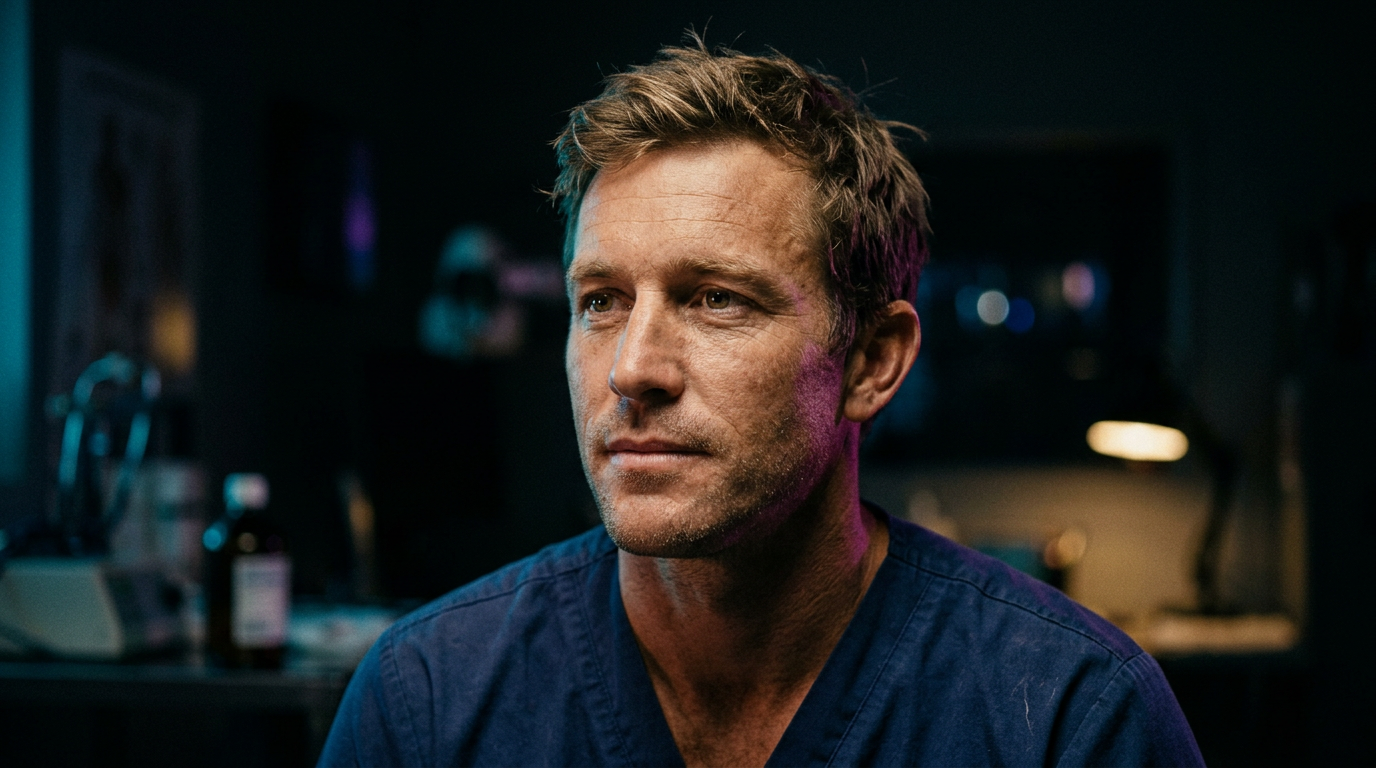
Dr Ethan Charles Turner was a South Australian veterinarian born in Adelaide in 1974 and raised in the Stirling hills, who built his career across Melbourne and Glenelg before taking over the Craigmore Animal Care Centre in 2014 as its principal vet. A general-practice clinician with a particular interest in canine neurology, he became the quiet anchor of a working-class suburban practice through the 2010s and into the mid-2020s — a careful, overbooked, chronically undercharging community vet with a bad back, a pre-pandemic beard, and a marriage held together across long absences.
Stirling Boy
Ethan Charles Turner was born on 14 March 1974 at the Queen Elizabeth Hospital in Adelaide, the second of three children to George Turner, a secondary school science teacher, and Margaret Turner née Daly, a primary school teacher. Within six months of his birth the family had settled into a small weatherboard house on one of the quieter lanes behind the Stirling township, at the edge of the Adelaide Hills, where his parents would remain for the next four decades and where Ethan would spend the whole of his childhood.
His older brother Benjamin, three years his senior, was the active one — climbed things, ran fast, argued at the dinner table. His younger sister Emily, who arrived in 1977, was the verbal one, having developed an opinion in her infancy and never really put it down. Ethan, settled between them, was the one who watched. He watched the kookaburras that nested in the stringybark behind the house. He watched the neighbour's dog limp. He watched the blood gradually re-enter the wing of a magpie his mother had splinted. Of the three children he was the slowest to speak, not because his thinking ran slow but because his thinking ran through observation first, and he would sooner come to a conclusion than mention one.
The Turner household was bookish in the Stirling manner of the period — not performatively so, but a house in which adults read at night, the television was used sparingly, and the shelves carried a mixture of lesson plans, nature guides, and the sort of paperbacks that teachers tended to acquire at school fundraisers and read guiltily in retirement. George kept a field-guide to South Australian birds on the kitchen shelf and was happy to fetch it down mid-meal if a question arose. Margaret maintained a kitchen garden out the back that produced tomatoes, silverbeet, and a persistent complaint about possums. The children were expected to help and mostly did.
Ethan's relationship with animals was apparent before he could adequately describe it. By the age of seven he had a running list of the injured creatures he had found, nursed, failed to save, and occasionally saved — mostly birds, the occasional blue-tongue, one unfortunately memorable possum joey whose mother had been hit on Mount Barker Road. His parents, recognising the disposition for what it was, quietly enrolled him in a weekend wildlife carers programme at Cleland when he was nine, and drove him up the hill to attend it for three years.
Roseworthy
He attended Stirling East Primary through the mid-1980s before moving to Urrbrae Agricultural High School, one of the state's specialist agricultural secondary schools, where he completed Years 8 through 12 between 1987 and 1991. Urrbrae's character suited him — the combination of conventional academic work with practical placements on the school's own farm gave him space to learn without performing. He was not a spectacular student in the sense that his reports might have suggested to a stranger. He worked steadily, got high marks in the sciences without spectacular flourishes, and allowed other students to take the prize-giving pedestals at the end of each year with what his mother suspected was relief.
Year 12 in 1991 ended with marks that easily qualified him for a veterinary science track. He deferred a year, worked on a shearing shed north of Burra for a winter, stayed too long in the Riverland fruit-picking circuit for the following summer, and turned up at the Roseworthy Campus of the University of Adelaide in February 1993 both browner and less sentimental than the eighteen-year-old he had been the previous November.
Roseworthy was hard in the way such programmes were. The long hours, the combination of theoretical coursework with large-animal practicals conducted in Adelaide's full summer heat, the awareness throughout that the work would only intensify once he was qualified — all of it shaped him in ways he did not entirely notice at the time. He developed the steady capacity for concentration that would later define his consultation style. He also developed, through a series of badly-lifted calves and one misjudged bull, the lower-back problem that would carry through his life.
He graduated with first-class honours in 1997. His honours project, supervised by a staff member whose research sat at the intersection of veterinary and human neurology, had concerned seizure presentations in domestic dogs — a topic he had chosen partly because a classmate's spaniel had died of uncontrolled epilepsy in his second year, and partly because his supervisor had suggested it. The project had been well received. It did not lead, as these things often did not, to any particular follow-up. But it planted an interest.
Melbourne
After graduation Ethan took a twelve-month locum position with a rural mixed practice near Bendigo — work he had arranged through a family friend of George's — and moved to Victoria in early 1998. The locum stretched into a junior associate role at the practice that hired him in 2001, a general-medicine clinic called Paws and Claws on the edge of South Melbourne. It was at Paws and Claws that he met Claire Hollingsworth, who had brought in her landlord's elderly schnauzer on a Tuesday morning in the winter of 2001 and had quietly refused to leave the consult room until Ethan had explained, in terms she actually understood, why the dog's liver enzymes mattered.
Claire was a marine biologist, then twenty-nine and working on her PhD through the University of Melbourne, with her field sites split between the Great Australian Bight and Port Phillip Bay. She was lean, sun-damaged in the way that field biologists were at that career stage, and held strong opinions about bycatch, state fisheries policy, and pasta. They had their first proper meal together six weeks after the schnauzer appointment, and within a year they were sharing a small flat in Prahran.
They married in a small ceremony at her parents' property in Torquay in late 2002. Ethan continued at Paws and Claws through 2005 and then moved to a larger suburban practice, South Melbourne Veterinary Hospital, as a senior associate. At South Melbourne he took the neurology cases that came through reception by default — partly because the other vets did not particularly want them, and partly because his honours background gave him just enough confidence to feel he knew what to do. Olivia arrived in March 2005, and Lucas followed in July 2008.
He continued at South Melbourne through 2010, by which point the combination of a city mortgage, Claire's fieldwork calendar, and the logistics of parenting two small children on his own during her extended absences had made the case for returning to Adelaide increasingly hard to argue against. The Glenelg Veterinary Centre position came up in late 2010. He took it in January 2011. The family packed the house in Prahran and drove west in the February of that year, stopping twice along the Great Ocean Road and once in the Coorong — a detail Claire would later remember more vividly than Ethan, who had been at the wheel.
Homeward
The Glenelg Veterinary Centre was a larger, more corporate-feeling clinic than he had previously worked in, staffed by seven vets on rotating rosters and built around a high-throughput model that Ethan found subtly alienating from the first week. The work itself was fine. The pay was good. But the clinic ran on productivity metrics that he felt diminished the actual practice of medicine, and he spent three years slowly coming to terms with the fact that he had taken the job for the geography rather than for the professional fit.
Claire had transferred to a research position at the South Australian Research and Development Institute and had settled into a pattern of long fieldwork stints out of Port Lincoln punctuated by intense periods at home. The kids adapted. Olivia, then school-aged, spent more time with Ethan than with Claire across those years, a distribution that shaped their relationship permanently. Lucas, still small during the move, attached himself to his mother in the particular way that small children attach themselves to parents who appear intermittently. He would cry when she left and cling when she returned, and Ethan, who understood the dynamic perfectly well, nevertheless found himself feeling occasional quiet hurt that the boy did not cling to him the same way.
By late 2012 Ethan had begun to entertain the question of whether he wanted to continue at Glenelg at all. His back was getting worse. The commute down from Blackwood, where the family had settled, was a forty-minute drive in morning traffic and considerably longer in afternoons. The Glenelg model continued to chafe. In early 2013 he met Harold Bennett at a professional development day at the Adelaide Showgrounds, and by the end of the day had given the older vet his phone number with the genuine interest he rarely displayed in first meetings.
Bennett's Chair
The Craigmore arrangement came together across 2013. Ethan joined the clinic in February 2014 and formally took it over at the end of that year. The family moved from Blackwood to a larger house in Craigmore itself, across the other side of Adelaide from the Hills of his childhood. Claire had objected, mildly, to the geography — she had preferred Blackwood, which sat closer to the sea and further from the shopping-centre plate glass of the suburbs she associated with sprawl. Ethan, for once, had held his ground.
The early years at the clinic were settling years. He changed little deliberately, allowing himself to learn Bennett's patterns before imposing any of his own, and spent the first twelve months quietly observing what Harold had built. In 2016 he hired Sophie Rennell as a second nurse. In 2017 he brought in Dr Hannah Maitland as a part-time associate. In early 2018 he took on Ava Martin at reception, and by late that year the shape of the clinic under his tenure had more or less settled into what it would remain for the next several years.
The neurology interest he had nursed since his honours year continued to find him cases without him seeking them out. He did not advertise. He wrote no papers. He attended one short course at the University of Melbourne's veterinary school in 2016 that updated his diagnostic protocols, and otherwise kept his knowledge current through reading. Over the decade other local clinics came to know, in an informal way, that the Craigmore vet was the one to ring if you had a seizing patient and your first round of phenobarbitone wasn't holding. The referrals arrived one dog at a time and were never, over ten years, more than perhaps thirty or forty cases.
One of those cases, in 2018, was a Border Collie named Millie Smith, whose young owner Jerome was a quietly-spoken zoology student with a particular attentiveness to small changes in animal behaviour. Ethan had taken the case on in early 2018 after Millie's first presenting seizure and had followed her across the subsequent months. In late July of that year the dog had presented with an episode severe enough to warrant overnight observation at the clinic.
The family never collected her the following morning, and the calls the clinic made across the next several days went unanswered. The dog was eventually collected by a woman who presented herself as a family friend, settled the outstanding account, and left without providing anything that explained where the Smiths had gone. Ethan thought about the case for a long time afterwards — not because it was medically complicated, but because its ending had not been one.
Small Failures
He ran late chronically. This had always been true but became more pronounced as the clinic's caseload steadied in the mid-2010s. He preferred to give patients and their owners the time he felt the case required, and he was constitutionally unable to cut conversations short when he ought to, so the three o'clock consult routinely began at three-twenty and the five o'clock finished at seven. Claire found this more difficult to accept than the clients did. The clients had largely made their peace with it. They knew, going in, that the wait would be what it was, and they came anyway.
He undercharged. This too was chronic and — like the punctuality — impervious to the advice of people he paid to give him advice on such matters. He knew the going rate for his services. He also knew the shape of his clientele's incomes, and he had privately decided, somewhere in the first two years of running the clinic, that he would rather take less money than hear the particular tone in a pensioner's voice when she asked whether she could pay the bill in two halves. Dorothy Pender made her position on this subject clear approximately annually.
He avoided end-of-life conversations by pre-empting them. When a beloved animal reached the point where the kindest outcome was euthanasia, Ethan had learned — partly from Harold Bennett's example, partly from his own — to take the weight of the decision onto himself and deliver the recommendation plainly, without leaving the owner to manufacture it out of grief and partial information. Some of his colleagues thought this bordered on the paternalistic. He thought it was kind. He was aware the distinction mattered less to him than it probably should have.
His administration was poor. Bills went out late. Some went out months late. A small number, across the first five years, went out not at all. Ava, once she had found her feet, took over progressively more of the billing side, to both of their relief. He was not organised about professional development requirements and routinely submitted his continuing-education paperwork a week before the deadline. He lost receipts. He kept his year in a small spiral-bound appointment book that only he could read, alongside a digital calendar that neither he nor Ava entirely trusted.
The Pandemic and After
The pandemic years were the hardest years of his career. The March 2020 lockdown had caught him mid-shift, and the logistics of converting the clinic to kerbside consultation within a week had fallen squarely on him — Hannah was home with her two young children and could not reasonably be asked to absorb more of the operational load. He worked sixty-hour weeks for most of 2020 and 2021, saw demand climb through 2022 to a level he had never previously encountered, and emerged from the whole period twelve kilograms heavier and looking, by his own private assessment in the bathroom mirror, ten years older than he had gone in.
Claire's fieldwork had been interrupted during the first eighteen months of the pandemic — border closures and vessel restrictions had kept her at home more than she had been in twenty years — and the forced proximity, for both of them, had been a mixed inheritance. They had not especially enjoyed living together full-time after a marriage built around frequent absence. Olivia, sixteen in 2020, had borne the brunt of her parents' adjustment through that period with a wariness that only afterwards, in her early adulthood, resolved into the closeness that she and Ethan had long assumed would simply continue. Lucas, twelve in 2020, had retreated into gaming and had not entirely come out.
By 2023 Olivia had begun studying veterinary science at Roseworthy — a choice Ethan had held carefully-neutral opinions about for the eighteen months before she had made it, and had subsequently been unable to entirely hide his pleasure over. Lucas, then fifteen, had taken up drawing with a focus that surprised everyone and was not especially interested in his father's career. Claire had returned to her pre-pandemic fieldwork calendar with something close to relief.
Fifty-Two
By early 2026 Ethan was fifty-two, reduced to four days a week at the clinic on Dorothy Pender's strong and repeated recommendation, and finally — after two years of her quiet persistence — charging something closer to the going rate for his work. His back was no better. The beard he had grown during the first lockdown and kept out of inertia was almost wholly grey. He had begun talking, in conversations with Claire and in none with anyone else, about what succession might look like for the clinic eventually, without having any particular answer for that question yet.
Hannah, now forty-three and with her children entering their mid-teens, continued to carry three days a week. Sophie Rennell's physiotherapy business had grown enough that she was at the clinic only two mornings a week, and the arrangement suited everyone. Karen Dobson, sixty-two in 2026, had threatened retirement approximately sixty times without retiring. Ava Martin, at thirty-one, had settled into what both of them now recognised as a proper career at the front desk, and had become in ways that neither of them quite acknowledged the second-most-important person in the operation.
Olivia was in her third year at Roseworthy. Lucas had recently begun dating someone. Ethan had taken to driving to the hills at the weekend, when his back permitted, to walk slowly through the bush behind his parents' old house — Margaret had died in 2019, George had gone in 2012, and the house had been sold and rebuilt, but the paths through the stringybark were still the paths they had been in the 1980s, and the birds remained. He read, in the evenings, not the journals he had always preferred but novels at last. Claire, when she was home, read them alongside him, sometimes finishing his copies before he did.







