Emma Jane Whitmore (née Clark)
Emma Jane Whitmore (née Clark) (1780–1851) was a Shepton Mallet blacksmith's daughter whose practical genius helped build Brierly. Meeting the vintner George Whitmore over a stall of pruning tools, she married above her station and carried a craftsman's knowledge of metal across worlds, keeping the settlement's irreplaceable tools alive, teaching its children, and turning rough structures into homes. Mother of John and Henry, she steadied George's restless invention for fifty-one years, outlived him by eleven months, and died planning a spring planting she would not see.
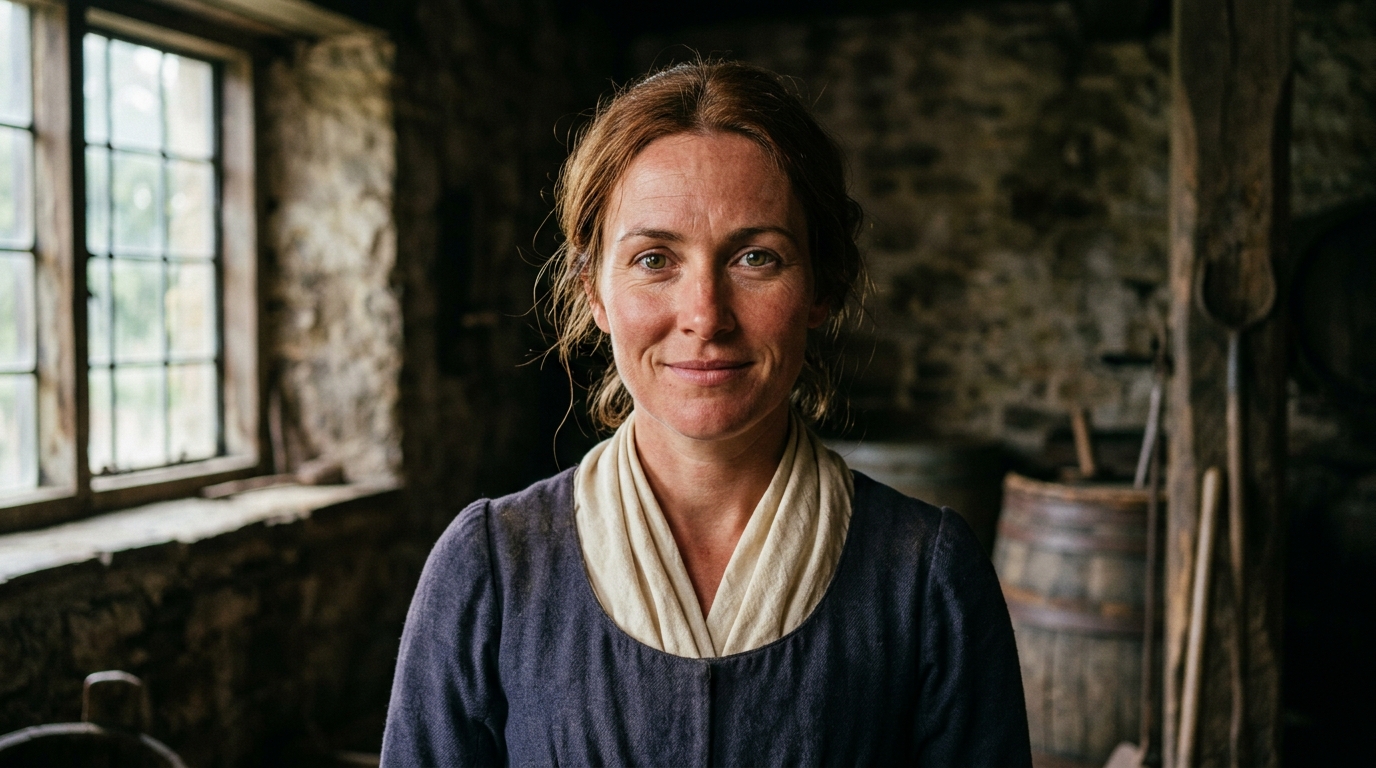
The Forge on the Hill
Emma Jane Clark was born on 15 March 1780, the second daughter of James Clark, the most skilled blacksmith in Shepton Mallet, and Martha Clark née Hobson, who kept the household above the forge. The ring of hammer on anvil was the rhythm of her childhood, set against the hiss of quenched metal and the low roar of the fire, and she grew up understanding a workshop the way other girls understood a parlour.
A blacksmith's daughter occupied an unusual rung — above the labourers in the fields, below the merchant families in the town — and the in-between of it gave Emma a freedom neither station would have allowed. She learned her letters at the local dame school, but her truer education came at her father's side. James, having no sons, let her work the bellows, sort nails, and keep the tools, and from this she absorbed a craftsman's knowledge that no one had set out to teach her.
She came to read metal as others read a page. She could tell its quality by the note it gave when struck, judge its heat by the colour creeping through the iron, and understand how the carbon in a bar made the difference between brittle and true. It was knowledge altogether unusual for a woman of her position, and it would, decades later and a world away, keep a vineyard's tools alive long after the last forge was beyond reach.
Her elder sister, Margaret, married a Bristol merchant in 1796 and climbed gratefully into respectability, urging Emma to seek the same. But Emma found the affected refinement of the merchant classes airless. She preferred the honesty of the forge, where problems yielded to skill and persistence rather than to manoeuvring, and where a thing was either well made or it was not.
Family Tree
The Harvest Fair
The Shepton Mallet harvest fair of September 1798 turned her life onto a course she could not have predicted. James had forged a new pattern of pruning tools with a clever spring mechanism, and Emma kept the family stall, arranging the display with her usual practicality — each tool set out for easy handling, the prices plainly marked, a few cut vines showing what the blades could do.
George Whitmore came by in the late afternoon, his dress marking him a vintner of some standing. What began as a request for replacement secateurs turned into a long technical conversation, Emma explaining the carbon in a blade's edge, the angle that made for a clean cut, the way different temperings changed how long a tool would last. His questions held genuine interest rather than the polite condescension she was used to from his sort, and she answered them as an equal because he treated her as one.
They talked until the neighbouring stalls were being taken down around them. George returned the next morning and bought tools he plainly did not need, and Emma saw through the excuse and was warmed by it all the same — here was a man who valued what she knew enough to invent a reason to hear more of it. By the fair's end they had arranged to write to one another about modifying tools for the particular work of the vine.
A Blacksmith's Daughter Weds a Vintner
The correspondence that followed proved the two of them well matched in mind, whatever the gap in station. George wrote out the problems of his pruning; Emma replied with solutions and modifications, and by degrees the letters warmed, his accounts of good harvests answered by her tales of the forge mishaps that had taught or amused her. Ink did the work that proximity could not, and a friendship became something more.
George's formal request to court her, made in December 1798, caused the upheaval everyone might have predicted. The Whitmores had looked for him to marry into one of the established vintner families, not to take up a blacksmith's daughter, and Emma's own people were no less uneasy — James proud but afraid of seeing her enter a world that might never accept her, Martha fearful of losing her to airs and disappointments. Emma weighed all of it and chose George.
She spent the courtship preparing with her characteristic thoroughness, reading every text on winemaking she could find, corresponding with other vintners' wives about the running of such a household, and learning the social graces her new position would demand. Yet she would not be made over entirely; she still went down to the forge when her father needed a hand, unwilling to pretend she had been born to anything other than work.
They married on 23 April 1799 at St Peter's Church in Shepton Mallet, the ceremony a compromise between two worlds — vintner society and working craftsmen in the same pews, the distinctions blurring later over shared wine in the Whitmore cellars. Emma wore her mother's wedding dress, taken in by her own hand, and carried spring flowers cut from the vineyard that was about to become her home.
Two Sons in Somerset
John Thomas was born on 14 June 1801, in the thick of the summer pruning. Emma laboured with only a midwife to help while George directed the work in the fields, and she told him afterwards that she had timed her last efforts to the sound of his voice carrying across the rows, drawing what strength she could from his nearness even in his absence. It was a small thing, and entirely like her, to make use even of that.
Motherhood took nothing from her practical command of the household. She built systems that bent around the vineyard's seasons, worked out ways to preserve a surplus harvest, set the rhythms of domestic and agricultural labour so that neither starved the other. The discipline she had learned at the forge served her as well in a vintner's house as it ever had over an anvil.
Henry came on 8 November 1804, during the harvest, and made his own kind of difficulty. Emma oversaw the sorting of grapes through the early hours of her labour, refusing to halt a process that could not wait, and delivered him only in the evening once the day's pick was safely fermenting. George found her hours later nursing their second son with one hand and reviewing the fermentation temperatures with the other — the doubled attention that would mark the whole of their partnership.
When George carried his Portal Key into Clivilius in 1810, it fell to Emma to hold Somerset together in his absence. For two years she ran the vineyard and raised the boys alone, keeping production steady while she made ready for a departure with no return, and the observations she sent him in that time — equipment that failed, problems she had solved — shaped the preparations he made on the other side.
The Crossing
When George first laid Blackwood's proposition before her in January 1810, Emma's answer surprised him. In place of the resistance he had braced for, she gave him a reckoning: what they could carry, what they would have to build, which of their skills would survive the crossing into a world without forge or foundry. Where another might have seen only the risk, the blacksmith's daughter saw a problem that could be worked.
Through February and March she prepared with a method that bordered on the military. She chose tools for their versatility and their irreplaceability, knowing that in a world without smiths every implement of metal would be worth more than its weight in coin, and her packing lists — kept long after in the family's papers — show a foresight that reached past winemaking entirely, to the woodworking tools they would need to fabricate whatever Clivilius could not provide.
That she let George go ahead while she stayed two years more with the boys was pragmatism of the plainest kind: the settlement had to be made fit to receive a family before the family followed. She brought John and Henry through the portal in the spring of 1812, into a place George had made survivable and which she would now make liveable.
Making a Home of It
George had raised the bones of a settlement; Emma gave it a heart. She turned his functional structures into a home, building furniture from whatever lay to hand with carpentry she had picked up watching her father's woodworking friends, conjuring familiar comforts out of an unfamiliar land. What had been shelter became, under her hand, somewhere a family could live.
Her first months were given to a careful audit of what they had. With no metal tools beyond those they had carried, she built the habits of conservation that would carry the settlement for decades — protocols for sharing tools, schedules for their upkeep, ways of making and mending from local stuff. Her trick of reinforcing wooden joints with clay became standard practice in early Brierly, one of a hundred small inventions born of going without.
The boys grew up steadied by her. She kept their lessons going through every frontier disruption, teaching letters and figures while folding in the practical skills the place demanded, so that John learned his arithmetic by reckoning fermentation rates and Henry his writing by keeping his mother's inventory of tools. She taught, always, by making the learning useful.
Iron and Clay
Emma's hand in the vineyard reached well past the household. Her knowledge of metal proved vital as the road back to Earth slowly closed, and the settlement's irreplaceable tools came to depend on her for their survival. She found ways to stretch the life of a blade, ground whetstones from the Clivilian minerals Charles Sinclair had identified, and shaped replacement parts from a carefully hoarded store of metal scraps.
Out of that same foresight came her ceramic-edged tools in 1815. Seeing that metal pruning blades would one day wear past saving, she worked the local clay into sharp-edged implements that, for all they fell short of steel, could be replaced at will — insurance that the vineyard would go on cutting and pruning whether or not Earth ever sent another tool. It was the same instinct that drove George's clay fermentation vessels, the two of them building a world that would not need the old one.
Her record-keeping was the quiet twin of George's invention. She set down every part of the vineyard's working — the yields, the weather, the tools that failed and the fixes that held — in a clear, plain hand, and those books became reference works for the vintners who came after her, a memory the settlement could consult long after the people in them were gone.
The Heart of the Settlement
Emma's reach extended through the whole of Brierly. In 1813 she began gathering the settler children for their first lessons, teaching them their letters in her own home while their parents worked, her teaching as practical as everything else she did — arithmetic learned through the harvest's reckonings, writing practised on the season's observations. It was an informal beginning, years before the settlement raised a proper schoolhouse of its own, but it was a beginning, and it was hers.
The women's circle she drew together in 1816 became a piece of the settlement's quiet machinery. Meeting each week, the women traded skills, pooled what they knew, and held one another's spirits up against the long pressure of isolation; Emma taught them the care of tools, the building of furniture, the plain engineering that lifted the whole community closer to self-sufficiency. Knowledge, in her hands, was never hoarded.
She had a gift, too, for turning labour into fellowship. When the harvests came in she set a table for the families who worked them, coordinating the food, arranging the rotations so that everyone had a place whatever their age or strength, and the harvest meals she laid grew into one of the settlement's dearest traditions — a forerunner, in time, of the festival Brierly would come to hold. The Somerset harvest songs she carried over, fitted with new verses for a new world, were still sung in the settlement long after her death.
Henry
Henry's death in 1835 tested the composure she was famous for. The beam that killed him fell while she was teaching the settlement's children, and she finished the lesson before she answered the summons, knowing that panic would help no one. What followed — the funeral arranged, George supported through his guilt, the household held to its routines — showed a strength that steadied the whole settlement when it might have come apart.
In the months after, she turned her grief into work, as she turned most things. She drew up Brierly's first safety rules for building work, set down procedures for when things went wrong, and trained the settlers in the rudiments of medicine that Alice Turner had taught her — preparations that spared other families the blow that had fallen on hers, even as they could not bring Henry back.
Her bond with John deepened in the same season. Seeing that George's frightened, hovering love might smother the son they had left, Emma quietly made room for John to court Catherine Birkett, opening the way for the young pair while she managed her husband's fears. Her careful navigation of that delicate time preserved both her son's independence and her husband's peace, and asked no credit for either.
Iron Wearing Thin
As she came into her sixties her body began to set conditions her will did not. Arthritis, the wages of decades of manual work, took the fine work from her hands and forced her to change how she was useful. She moved from doing to teaching, passing her skills to younger settlers and keeping her place in the settlement through what she knew rather than what she could still make.
Around 1842 she set herself to gathering the settlement's records — the technical notes and personal papers, the agricultural accounts, the recipes and remedies scattered across the settler families — and to ordering them so that what each household knew would outlast the household itself. It was the archivist's version of the conservation she had practised all her life: nothing useful thrown away, everything kept against the day it would be needed.
Her evenings with George became, in these years, a settled pleasure. Over wine from vines the two of them had planted, their talk ran from the practical to the reflective and back, her steadiness anchoring his restless invention as it had for half a century. They had built a life out of the meeting of his ideas and her iron sense, and in age they had the rare grace of knowing it.
Without George
George's death on 19 February 1850 left her suddenly adrift. They had been married fifty-one years, partners in the fullest meaning of the word, and she was the one who found him fallen among the vines, struck down by the seizure that took him in the place he had loved best. She handled his funeral with her usual composure, made the practical decisions about who would carry the vineyard forward, and let almost no one see how deep beneath the competence the grief ran.
She outlived him by less than a year, and gave the time to setting things in order. She saw the vineyard's passage to John made smooth, set down the accumulated knowledge of decades so none of it would be lost with her, and parted with her possessions in the plain, deliberate way she had done everything. Even her grief she put to use, spending it on the living rather than the dead.
The Late Frost
Emma Jane Whitmore died peacefully on 15 January 1851, found by Catherine at dawn, having slipped away in her sleep. She was seventy. She had spent her last evening going over seed catalogues with John, planning a spring planting she must have known she would not see, and her final words, spoken to her daughter-in-law, were of a piece with the whole of her life: the late frost was coming, and the young vines must be covered.
Her funeral drew every soul in Brierly, and they came carrying things — a tool she had mended, a chair she had built, a skill she had taught them — so that the whole settlement seemed to file past with her work in its hands. They buried her beside George in the plot above the vineyard, beneath headstones she had chosen years before from Clivilian granite, plain and hard-wearing and meant to last, as everything she made was meant to last.







