4134.314 · November 10, 1814 AD
Emerald and Amber
Six years have carved away the frightened Portsmouth youth, leaving something harder in his place—but when a merchant's daughter steps down from a carriage at Campbell Cove and looks at a convict checker as though he were worth speaking to, William Jeffries allows himself to want something that every careful calculation tells him he cannot have.
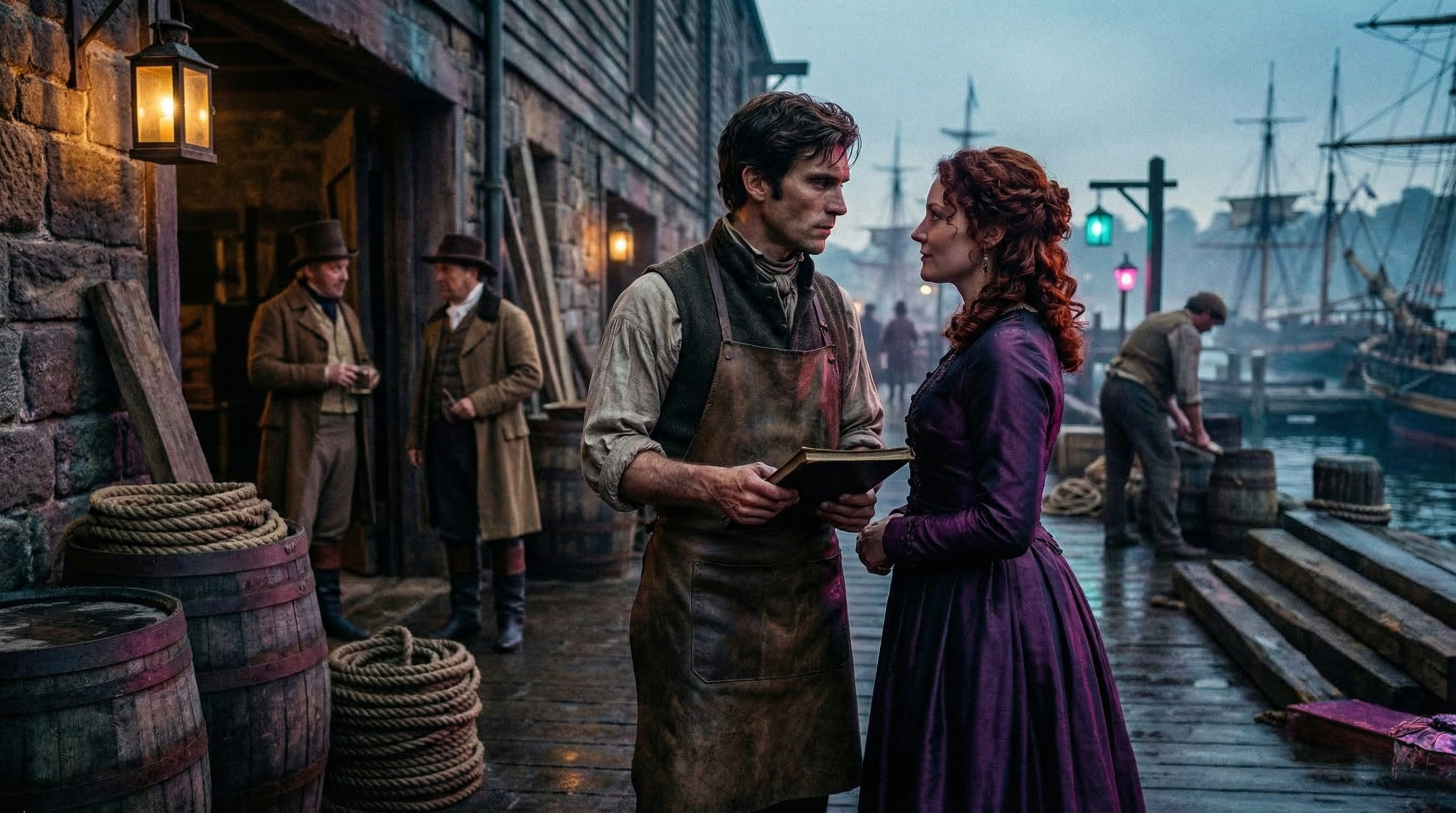
"Seven years I've been here, and I'm still hauling other men's goods. At least back in Ireland, I was just poor. Here, I'm poor and damned besides."— Danny Byrne
The man who stood on the commercial wharves at Campbell Cove that November morning bore little resemblance to the frightened youth who had stumbled down the Resolution's gangplank six years before. William Jeffries had been remade by the colony—tempered by labour and sun and the particular education that survival in New South Wales demanded. The soft edges of his Portsmouth youth had been carved away, replaced by something harder, leaner, altogether more dangerous.
He was twenty-nine years old, though the weathering of his skin might have suggested more. His frame, always solid, had been sculpted by years of physical work into something that commanded attention without demanding it. He moved through the chaos of the docks with an economy of motion that spoke of a man who had learned never to waste energy, never to draw unnecessary notice, never to reveal more than circumstances required. His eyes, once open and trusting, had acquired a quality of assessment that made lesser men uncomfortable beneath his gaze.
The ticket of leave in his pocket—that precious document he had earned through five years of model behaviour at Parramatta—granted him freedoms that most convicts could only dream of. He could work for wages now, could move about Sydney without a guard at his elbow, could almost pretend to be a free man if he squinted hard enough at his circumstances. The ticket did not erase his past, could not wash the convict stain from his record, but it permitted him to build something from the wreckage of his former life. That was enough. For now, it had to be enough.
He had been working the docks for eighteen months, having parlayed his Parramatta experience into a position that suited his particular talents. The harbour master's office employed him as a checker—a man who tallied cargo against manifests, who could spot discrepancies that others missed, who understood the complex dance of goods and money that kept the colony breathing. It was not glamorous work, but it placed him at the intersection of commerce and opportunity, and William had learned to recognise the value of such positions.
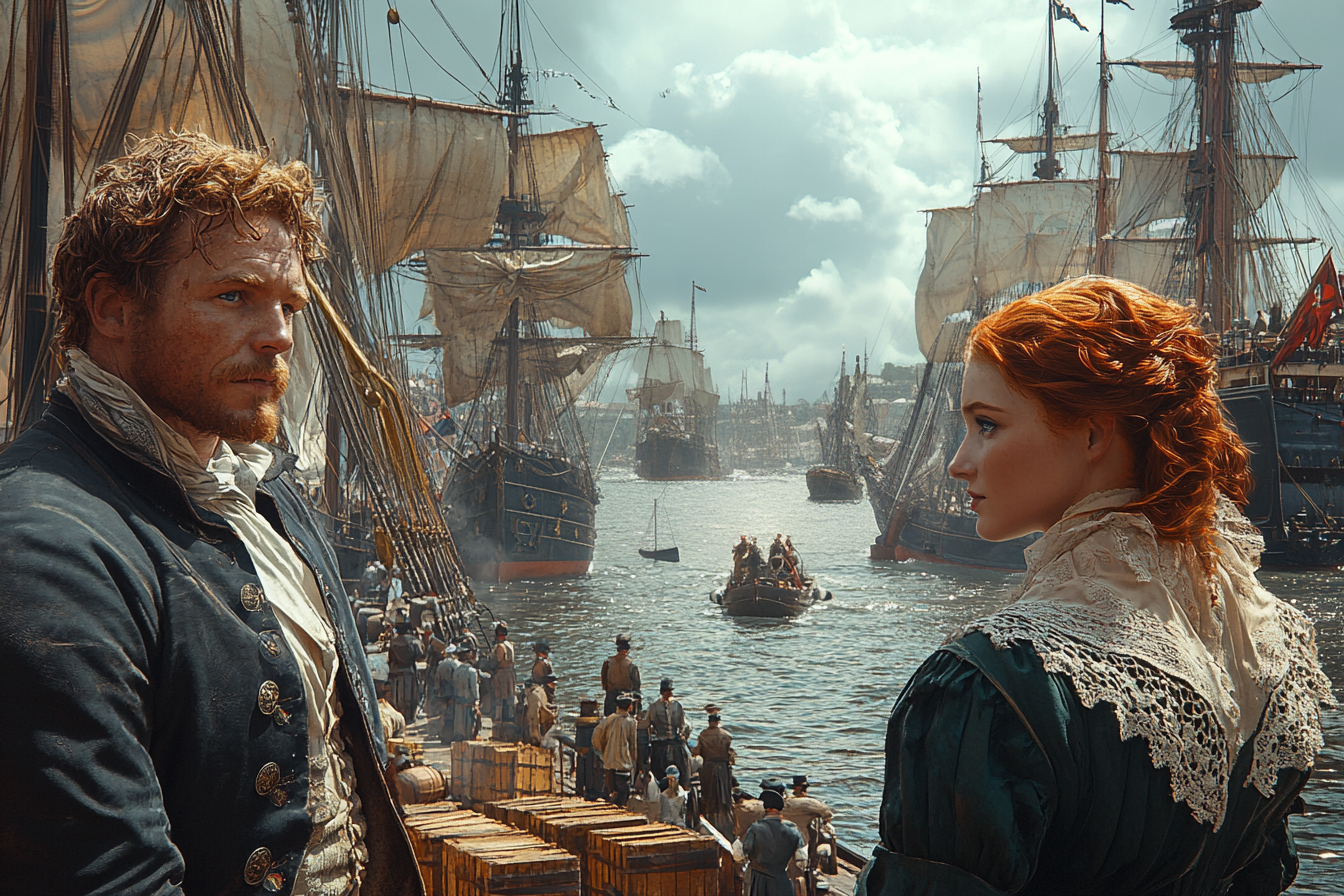
Campbell Cove bustled with the frenetic energy of a colony that had outgrown its convict origins without entirely escaping them. Ships crowded the harbour—merchant vessels from England and India, whalers returning from southern waters, coastal traders plying the routes between Sydney and the settlements that had begun to dot the Australian coastline. Their masts created a forest of timber against the morning sky, their rigging a web of lines that caught the light and threw it back in fragments.
The waterfront itself was a study in controlled chaos. Labourers swarmed over the docks, hauling crates and barrels with the rhythm of men whose bodies had long since memorised the movements. Merchants haggled with captains over prices and quantities. Officials in their dark coats moved between ships and warehouses, their ledgers tucked beneath their arms like talismans of authority. The air rang with shouts and curses, with the creak of crane and winch, with the thousand small sounds that composed the symphony of commerce.
William stood near Warehouse Three, his own ledger open before him, checking a shipment of tea that had arrived the previous evening from Canton. The work required attention—merchants were not above bribing dockworkers to falsify counts, and captains had been known to offload cargo quietly before reaching the official inspection points—but it had become routine enough that part of his mind could wander whilst his hands and eyes performed their duties.
He watched the men working around him with the detached interest of a naturalist observing specimens. There was Danny Byrne, the Irish labourer who had become something like a friend over the past year—a ticket-of-leave man himself, transported for stealing bread during the famines, now rebuilding his life one backbreaking day at a time. There was Simmons, the free settler's son who lorded his status over the convict workers with a pettiness that would have been amusing if it weren't so tedious. There was the harbour master himself, a corpulent man named Whitfield whose primary talent lay in knowing when to look away and how much such blindness should cost.
This was William's world now—a landscape of labour and calculation, of small advantages seized and larger ones cultivated. He had learned to read men the way scholars read books, to identify their weaknesses and their wants, to position himself where opportunity might find him when it came calling. The naive young dockworker who had accepted a stolen watch from a stranger's hand seemed like a different person entirely, a character from a story he had once heard rather than the man he had actually been.
"Oi, Jeffries!" Danny's voice cut through William's contemplation, the Irish lilt still strong despite a decade in the colony. "Stop yer woolgathering and give us a hand with this bloody crate. Feels like it's full of cannonballs."
William tucked his ledger beneath his arm and crossed to where Danny was struggling with a crate that had been poorly loaded onto the dock. The wood was splintering at one corner, threatening to spill whatever lay within across the salt-stained planks.
"What's in it?" William asked, gripping the opposite end and taking his share of the weight.
"China, if you'd believe it. Finest porcelain from the Orient, bound for some merchant's drawing room." Danny grunted as they heaved the crate onto a waiting cart. "Seems a waste, don't it? Half the colony's still living in bark huts, and these bastards are importing fancy dishes to eat off of."
"The bastards with fancy dishes are the ones who pay our wages," William observed, not without a certain dry amusement. "I'd not complain too loudly if I were you."
Danny wiped his brow with a forearm that glistened with sweat despite the morning's relative coolness. "Aye, you're right enough. Still sticks in the craw sometimes, is all. Seven years I've been here, and I'm still hauling other men's goods whilst they sit in their fine houses counting their coin."
"Seven years isn't forever," William said. "Your ticket comes up for review next spring. Play it right and you could have your certificate of freedom by summer."
"And then what? I'm still a transported man, ain't I? Still got that mark on me that no amount of good behaviour can erase." Danny's expression had turned bitter, a look William recognised from his own darker moments. "At least back in Ireland, I was just poor. Here, I'm poor and damned besides."
William considered this. It was a complaint he had heard countless times, had voiced himself in the early years when the weight of his circumstances had seemed unbearable. But something had shifted in him during his time at Parramatta, some understanding that bitterness was a luxury men in their position could not afford.
"The colony's changing," he said quietly. "Twenty years ago, everyone here was either a convict or a guard. Now look around—free settlers arriving every month, businesses opening, land grants being made to men who can prove they're worth the investment. The stain fades, Danny. Not quickly, not easily, but it fades. The question is whether you'll be ready when it does."
Danny opened his mouth to respond, but whatever he intended to say was lost to the clatter of hooves and wheels on cobblestone. Both men turned toward the sound, as did half the workers on the dock—a private carriage was an unusual sight in this part of the waterfront, where commerce was conducted in shirt sleeves and honest sweat rather than silk and ceremony.
The carriage was handsome without being ostentatious, its black lacquer finish gleaming in the morning light, its brass fittings polished to a shine that spoke of household servants with time enough to attend to such details. The horse that drew it was a bay of good breeding, its coat brushed to a lustre that the working animals of the docks could only envy. Whoever owned this equipage had money enough to maintain appearances but taste enough to avoid vulgar display.
The driver brought the carriage to a halt near the entrance to Warehouse Three, and for a moment nothing happened. The dockworkers who had paused to observe the arrival began to return to their labours, dismissing the interruption as none of their concern. William, too, turned back toward his duties—but something made him hesitate, some instinct honed by years of watching and waiting that told him this moment might matter.
The carriage door opened.
She stepped down with a grace that seemed to belong to a different world entirely—a world of drawing rooms and formal gardens, of afternoon teas and evening balls, of everything William had been excluded from since the moment a stolen watch had been pressed into his unsuspecting hand. Her gown was a deep emerald green, its silk catching the light in ways that made it seem almost alive. A parasol of cream-coloured lace shielded her face from the morning sun, but even in that shade, William could see enough to know that she was beautiful in a manner that went beyond mere arrangement of features.
Her hair was the colour of autumn leaves—not the simple red that the word suggested, but a complex weave of copper and gold and deeper auburn that seemed to shift with each movement. It had been arranged in some elaborate style that William could not have named, pinned and curled in ways that must have required a lady's maid and considerable time. Yet there was nothing artificial about the effect; if anything, the formality of her coiffure served to emphasise the naturalness of her bearing, the easy confidence with which she surveyed her surroundings.
William found himself staring, and could not quite bring himself to stop.
It was not simply that she was beautiful, though she undeniably was. It was something in the way she held herself, some quality of presence that commanded attention without seeming to demand it. She looked around the dock with eyes that were taking everything in—the labourers at their work, the goods being loaded and unloaded, the chaotic dance of commerce that most ladies of her evident station would have dismissed as beneath their notice. There was curiosity in her gaze, and intelligence, and something else William could not quite identify.
"Close your mouth, Jeffries," Danny murmured, amusement threading through his voice. "You'll catch flies."
William ignored him, his attention fixed on the woman as she consulted briefly with her driver, then began making her way along the dock. She moved with purpose, clearly knowing where she was headed, yet her eyes continued to catalogue her surroundings with that unsettling attentiveness. When her gaze swept across William, he felt the impact of it somewhere in his chest—a physical sensation, as though he had been struck.
"That'll be Miss Donnelly," Danny said, pitching his voice low. "The merchant's daughter. Old Reginald Donnelly—owns half the warehouses on this stretch, or near enough. She comes down sometimes to check on his shipments. Doesn't trust the clerks to do it properly, or so I've heard."
"She checks the shipments herself?" William asked, surprised despite himself. Such hands-on involvement was unusual for a woman of obvious breeding, particularly in matters of commerce.
"Aye, and does a proper job of it too. Caught one of Whitfield's men skimming last autumn—had him dismissed before the week was out." Danny's tone held a note of grudging admiration. "Sharp as a tack, that one. And way out of our league, so don't go getting ideas."
William said nothing. He watched as Eliza Donnelly made her way toward Warehouse Three, where her father's goods were evidently stored, and felt something stir in his chest that he had not experienced in years—something that felt dangerously like hope.
The crate of china that had caused Danny such difficulty was, as it transpired, part of the Donnelly shipment. William realised this only when Eliza Donnelly approached the stack of goods he had been cataloguing, her manifest in hand, her eyes already scanning the inventory with professional attention.
She looked up as William stepped forward, and their eyes met for the first time at close range. Hers were green—not the pale, watery green that the word often described, but a deep, vivid emerald that seemed to hold light within it rather than merely reflecting it. Intelligence gleamed there, and assessment, and something that might have been surprise at finding herself face to face with a man who did not immediately lower his gaze.
For a moment, neither spoke. The noise of the docks seemed to recede, the shouts and crashes fading to a distant murmur as the space between them acquired a weight and texture all its own. William was acutely aware of his own appearance—the working clothes that marked him as a labourer regardless of his position as checker, the calluses on his hands, the convict past that might as well have been branded on his forehead for all that it could be concealed.
Yet he did not look away. Something in her gaze held him, challenged him to stand his ground rather than retreating into the deference that men of his station were expected to display. He met her eyes and waited, curious to see what she would make of a convict who did not know his place.
"You're the checker for this section?" Her voice was clear and direct, carrying none of the artificial sweetness that some women of her class affected. It was the voice of a woman accustomed to conducting business, to asking questions and expecting honest answers.
"I am, miss. William Jeffries." He inclined his head slightly—enough to acknowledge her station without surrendering his own dignity. "The Donnelly shipment arrived last evening. I've been verifying the counts against the captain's manifest."
"And?" One elegant eyebrow arched, inviting him to continue.
"Three crates of tea short of what was declared at departure. Either the captain helped himself during the voyage, or the count was falsified before loading. I'd lean toward the latter—the discrepancy's too neat to be pilferage." William paused, wondering if he had overstepped by offering analysis rather than simple facts. "But that's just my observation, miss. The manifest discrepancy is documented for your father's review."
Something shifted in Eliza Donnelly's expression—a quickening of interest that she did not entirely conceal. She looked at William with renewed attention, her gaze travelling across his features as though she were reading a text written in an unfamiliar language.
"You noticed the pattern," she said. "That's more than the last checker managed. He simply reported the shortage and left it at that."
"With respect, miss, a checker who doesn't notice patterns isn't much use to anyone. The numbers tell stories, if you know how to read them."
The words came out before William could consider whether they were wise. He was not accustomed to speaking so freely with those above his station—the colony had taught him the value of circumspection, of keeping his thoughts to himself until he understood the terrain. But something about this woman invited candour, made him want to show her the mind that years of labour had not managed to dull.
Eliza studied him for a long moment. Whatever she saw in his face seemed to intrigue rather than offend her. "You have experience with trade, Mr Jeffries? Before your current position?"
The question hung in the air between them, freighted with implications they both understood. She was asking, without quite asking, about his past. About how a man who spoke like William, who observed like William, who carried himself like William, had come to be working the docks as a checker.
"I worked the Portsmouth docks as a boy," William said carefully. "Loading and unloading, mostly, but you learn things when you pay attention. Then I spent some years at the Parramatta government farm." He let the statement sit, watching her face for the reaction it would produce. There was no point in dissembling; the convict registers were available to anyone with cause to consult them. "I found that agriculture teaches similar lessons about patterns and discrepancies. What comes in, what goes out, what goes missing in between."
Eliza absorbed this without any visible change in her demeanour. If she was shocked to find herself conversing with a convict—or former convict, as his ticket of leave technically made him—she gave no sign. Instead, she nodded slowly, as though he had confirmed something she had already suspected.
"The farm at Parramatta has a reputation for producing capable men," she observed. "My father has hired several of them over the years. He says they work harder than free settlers because they understand what they have to lose."
"Your father sounds like a practical man."
"He is. Practical enough to judge men by their abilities rather than their circumstances." Her eyes held his, and William felt again that strange sensation in his chest—that dangerous stirring of something he could not afford to feel. "A rare quality in this colony, I've found."
Whatever might have followed was interrupted by the arrival of Whitfield, the harbour master, his corpulent frame moving with surprising speed across the dock. His face wore the particular expression of anxious servility that he reserved for those with money and influence—a far cry from the casual contempt he directed at his workers.
"Miss Donnelly!" he exclaimed, slightly breathless from his exertion. "I had no idea you were visiting today. If I'd known, I would have made arrangements—"
"That's precisely why I didn't send word, Mr Whitfield." Eliza's voice had acquired a cooler edge, the warmth that had coloured her conversation with William replaced by something more formal. "I prefer to see the operation as it actually functions, not as it performs for inspection."
Whitfield's face reddened, though whether from embarrassment or the heat was difficult to determine. "Of course, of course. Quite right. Is there anything I can assist you with? Any concerns about your father's shipments?"
"Mr Jeffries here has already been most helpful." Eliza gestured toward William, and he felt Whitfield's gaze land upon him with sudden, calculating attention. "He noticed a discrepancy in the tea shipment that your office apparently overlooked."
The harbour master's expression flickered—annoyance at having his competence questioned warring with the need to maintain his obsequious facade. "Did he indeed? Well, Jeffries is thorough, I'll grant him that. One of our better checkers." The praise was grudging, delivered through teeth that wanted to clench. "Though of course any discrepancy would have been caught during our secondary review."
"Of course," Eliza agreed, in a tone that suggested she believed nothing of the sort. She turned back to William, and something passed between them—an acknowledgment, perhaps, of the small theatre they had just witnessed. "Thank you for your diligence, Mr Jeffries. I shall mention it to my father."
"Miss." William inclined his head again, the same measured gesture as before—respect without servility, acknowledgment without surrender. He watched as Whitfield escorted her away toward the warehouse, his unctuous voice carrying back in fragments as he attempted to redirect her attention to matters more flattering to his administration.
Danny materialised at William's elbow the moment the harbour master was out of earshot. "Christ, Jeffries. What was that about?"
"Nothing," William said, though the word felt inadequate. "She had questions about her father's shipment. I answered them."
"Answered them? You were practically having a conversation, man. With a merchant's daughter." Danny's voice held equal parts admiration and alarm. "Whitfield noticed, too. You'll want to watch yourself—that one doesn't forget when someone shows him up in front of the quality."
William knew Danny was right. The harbour master was petty enough to make trouble for a convict who had drawn favourable attention from an important client. There would be consequences for today's encounter—unpleasant duties, perhaps, or convenient oversights in his work records that might jeopardise his ticket of leave. The colony's hierarchies did not tolerate those who forgot their place, and William had just demonstrated a dangerous tendency toward forgetting.
Yet he could not bring himself to regret it.
He returned to his ledger, his hands performing the familiar motions of checking and counting whilst his mind remained fixed on the woman who had just departed. Eliza Donnelly. The merchant's daughter who checked her own shipments, who had looked at a convict and seen a man worth speaking to, who had defended his competence to the harbour master without a moment's hesitation.
She was everything he should not want—wealthy, respectable, born to a world that would never accept a man with his history. The gulf between them was vast enough to be nearly comic, a chasm that no amount of hard work or good behaviour could hope to bridge. Whatever had passed between them on the dock—that strange moment of connection, of mutual recognition—was an aberration, a momentary breach in the walls that separated their respective stations.
William knew all this. He catalogued the obstacles with the same thoroughness he brought to inventorying cargo, listed the impossibilities with the same attention to detail that made him valuable as a checker. He understood, with the clarity of a man who had learned to see the world as it was rather than as he wished it to be, that pursuing Eliza Donnelly would be folly of the highest order.
And yet.
The afternoon sun had begun its descent toward the harbour, painting the water in shades of gold and amber, when William finally set aside his ledger for the day. The docks were quieting as the evening shift prepared to take over, the frantic pace of midday commerce giving way to the slower rhythms of twilight. He stood for a moment at the water's edge, watching a merchant vessel navigate toward open sea, its sails catching the last of the light.
He thought of the voyage that had brought him here—the Resolution and her cargo of the condemned, the endless weeks of confinement, the moment when Australian soil had first pressed against the soles of his bleeding feet. He thought of Parramatta, of the government farm where he had broken his body and forged something new from the pieces. He thought of Old Tom, long dead in the quarries at Castle Hill, and Jeremiah Flint, whose wisdom had helped him survive those first terrible months.
He thought of Jack Hawley, and the cold fire that had burned in his chest for six years without ever truly dimming.
And now, into the careful architecture of survival and ambition that he had constructed, a new element had been introduced. A woman with copper hair and emerald eyes, who looked at convicts and saw men, who spoke of her father's practicality as though it were a virtue rather than merely good business. A woman who had no place in William's calculations, who threatened to upset the careful balance he had achieved through years of discipline and denial.
He should put her from his mind. He should return to his lodgings, eat his evening meal, review his accounts, and prepare for tomorrow's labour. He should remember what he was and what she was and the impossible distance between those two facts. He should be sensible, practical, realistic about his prospects and his limitations.
Instead, he found himself wondering when Eliza Donnelly might next visit the docks to check on her father's shipments.
The harbour master's clock struck five, its chimes carrying across the water with the particular clarity of evening air. William turned from the harbour's edge and began walking toward his lodgings, his steps slower than usual, his mind occupied with thoughts that had no business being there.
Something had kindled in him today—something he had thought extinguished by years of hardship and the deliberate suppression of hope. It was dangerous, this feeling. It threatened everything he had built, every careful plan he had laid for his eventual advancement. It was foolish and impractical and almost certainly doomed to disappointment.
William Jeffries walked through the Sydney evening, and for the first time in six years, he allowed himself to want something he knew he could not have.







