Elspeth Morag Stewart
Born in Edinburgh on 17 May 1738 to blacksmith Angus Stewart and seamstress Morag MacKenzie, Elspeth Stewart shouldered family responsibilities following her father's death in 1754, apprenticing at Moira MacKenzie's Emporium of Fashion. Recruited by Guardian Lizbeth Wilson in 1762, she received a Portal Key and founded New Edinburgh in Clivilius, leading her sisters Effie, Katrina, and Violet as fellow Guardians. Her pragmatic leadership—including alliance with William Brodie's thieves—established institutions that shaped New Edinburgh's governance for generations. Inaugurated as First Guardian in 1775, she died on 8 November 1801, aged sixty-three, leaving a thriving civilisation as her legacy.

A Blacksmith's Daughter
Elspeth Morag Stewart entered the world at 11:11 in the evening on 17 May 1738, the first child of Angus Callum Stewart and his wife Morag née MacKenzie. The birth followed two miscarriages that had tested the young couple's hopes, and when the midwife placed the healthy infant into her parents' arms, the relief was palpable. Those who attended the delivery noted an unusual circular birthmark upon the child—a detail that seemed unremarkable at the time but which certain observers, watching from a greater distance, recognised as significant.
The Stewart household occupied modest but respectable quarters near Edinburgh's Grassmarket, close enough to the forge where Angus practised his craft that the rhythms of hammer on anvil formed the constant percussion of Elspeth's childhood. Her father was a blacksmith of uncommon skill, a man whose work transcended mere function to achieve something approaching artistry. From him, Elspeth absorbed lessons that would prove far more valuable than she understood at the time: the importance of precision, the patience required to shape resistant materials, the understanding that strength properly applied could transform raw potential into lasting purpose.
Her mother Morag brought different gifts to her daughter's education. A skilled seamstress whose needlework was sought by families of considerably higher station than her own, Morag taught Elspeth the fundamentals of her craft—threading needles, selecting fabrics, executing stitches with the patience that distinguished adequate work from excellence. But beyond these practical skills, Morag modelled a particular kind of quiet resilience, a capacity to maintain composure and dignity regardless of circumstance. These were Highland qualities, inherited from MacKenzie ancestors who had endured centuries of hardship in Glenfinnan, and they would serve Elspeth well in the extraordinary life that awaited her.
Sisters
The arrival of siblings transformed Elspeth's position within the household. Euphemia—Effie—was born on 3 November 1742, a golden-haired infant whose beauty became apparent almost immediately. Katrina followed on 12 February 1744, a quiet child whose serious demeanour and determined jaw reminded observers of her father. Violet, the youngest, arrived on 8 August 1746, fragile and perpetually curious, her questions about the world around her seemingly endless.
As eldest daughter, Elspeth assumed responsibilities that extended beyond her years. She helped with household tasks, assisted with the younger children's care, and served as her mother's most reliable support in the daily business of managing a household on limited means. The bond between the four sisters strengthened with each passing year—four distinct temperaments unified by blood, circumstance, and genuine affection. Elspeth's protective instincts toward her younger siblings became defining characteristics, the foundation upon which her later leadership would be built.
The Watchful Stranger
On 8 September 1750, twelve-year-old Elspeth witnessed a scene that would recur in her memory throughout her life, though its full significance remained hidden for years. In the bustling chaos of the Grassmarket, she observed a young boy—thin and desperate—snatch an apple from a merchant's stall. The seller's outraged pursuit caught the child easily, and the punishment being contemplated would have been severe.
Without conscious deliberation, Elspeth intervened. She stepped between the merchant and his quarry, produced coins from her own meagre allowance, and paid for the stolen fruit. The act was simple, spontaneous, driven by nothing more complex than the conviction that a hungry child should not suffer violence for trying to feed himself. She did not notice the elderly woman watching from the edge of the crowd, observing the scene with eyes that seemed to perceive far more than the surface events unfolding before her.
Lizbeth Wilson had been watching Elspeth Stewart since her birth, part of a patient surveillance that Guardian networks maintained over individuals of potential significance. The Grassmarket incident confirmed what years of observation had suggested: this blacksmith's daughter possessed the instinctive moral clarity, the courage that translated immediately into action, which marked those suited for Guardian service. From that day forward, Lizbeth's attention to the Stewart family intensified, though it would be another twelve years before she revealed herself and the purpose she represented.
The Forge Falls Silent
The catastrophe that reshaped Elspeth's life arrived without warning on 21 June 1754. She was sixteen years old, approaching the threshold of adulthood, when messengers came to the Stewart household bearing news that no amount of preparation could have softened. There had been an accident at the smithy—something had gone terribly wrong, details remained unclear, but the outcome was beyond question. Angus Callum Stewart was dead at thirty-nine, killed by the very trade that had defined and sustained him.
The weeks that followed blurred together in Elspeth's memory: her mother's keening that echoed through their home for days; funeral arrangements made in the numb efficiency of shock; the gradual, terrible comprehension of what her father's death truly meant. Angus had been more than husband, father, and provider—he had been the household's foundation, the steady presence around which their modest prosperity had been organised. Without him, everything threatened to collapse.
Worse revelations followed. As Morag began sorting through her husband's affairs, debts emerged that Angus had concealed during his lifetime. The careful respectability the Stewart family had maintained proved more fragile than any of them had understood. Creditors appeared with claims that consumed savings and threatened possessions. The household that had been comfortable, if not wealthy, found itself sliding toward genuine poverty—genteel in its external appearance, perhaps, but precarious nonetheless.
For Elspeth, her father's death marked a transformation that went beyond grief. The girl who had assisted with household duties became the young woman who shouldered responsibilities properly belonging to adults twice her age. She watched her mother fade under the weight of widowhood, saw the worry etching itself into features that had once been vibrant. She heard muffled sobs through walls that could not contain such sounds, felt the change in atmosphere from warmth and laughter to something quieter, more fragile. Steel was being forged in the crucible of that grief—steel she did not yet recognise in herself, but which others would come to depend upon.
The Emporium
Necessity drove Elspeth to seek employment that could contribute to her family's survival. On 14 April 1755, not quite seventeen years old, she walked through the grey and blustery streets of Edinburgh toward Moira MacKenzie's Emporium of Fashion, the establishment whose reputation had reached her ears long before she had seen its Georgian façade. Her best dress—dark green wool, modest but carefully maintained—her worn boots, her threadbare cloak: these spoke eloquently of the circumstances that had brought her to this threshold. But if her clothing revealed poverty, her bearing did not. She lifted her chin against the scrutiny of passersby, spine straightening with the defiance of one who had learned that dignity was a choice rather than a circumstance.
The Emporium itself proved everything rumour had promised and more. Within its walls, silks shimmered like captured jewels, lace veils lay delicate as morning dew on spider's webs, and the scent of lavender, beeswax, and exotic spices spoke of worlds far beyond Edinburgh's familiar streets. At the centre of this temple of fashion stood Moira MacKenzie herself—tall, poised, raven-haired, with storm-grey eyes that seemed to perceive everything and reveal nothing. She was every bit as formidable as the whispers had suggested.
What Elspeth could not have known, what remained hidden for reasons Moira never fully explained, was that this meeting had been arranged long before either of them appeared to make decisions. Moira and Morag Stewart were first cousins—their fathers Angus and Hamish MacKenzie had been brothers in Glenfinnan before circumstances scattered the family across Scotland. Moira had maintained correspondence with her beloved childhood companion throughout the years, following Morag's life from distance. When word came of Angus Stewart's death, of debts that had surfaced, of genteel poverty that threatened to consume the household, Moira knew exactly who would walk through her door seeking apprenticeship. This was family, though only one of them understood it. Moira chose not to reveal the connection, for reasons rooted in the habits of discretion that had preserved her through dangerous times—and perhaps in the sense that Elspeth needed to prove herself on her own merits, unaware of any safety net beneath her.
Agnes Fraser
The workroom behind the Emporium's showroom became Elspeth's classroom, and Agnes Fraser became her most constant instructor. A middle-aged woman with kind eyes the colour of honey and hands roughened by decades of dedicated labour, Agnes embodied practical wisdom without pretension. Where Moira inspired something approaching fear in her employees—watchful, assessing, never quite satisfied—Agnes offered warmth that recalled Elspeth's mother before grief had reshaped her.
The relationship that developed between them transcended ordinary workplace mentorship. Agnes recognised in this serious young woman qualities that deserved nurturing: intelligence that absorbed instruction quickly, determination that transformed difficulty into motivation, compassion that manifested in small kindnesses toward fellow seamstresses struggling with their own burdens. In return, Elspeth found in Agnes a steadying presence, someone who balanced Moira's demanding tutelage with patient encouragement.
The skills Elspeth acquired during her years at the Emporium extended far beyond needlework. She learned to observe without appearing to watch, to remember details that others overlooked, to navigate the complex social hierarchies that determined whose whispers mattered and whose could be safely ignored. She learned that information was currency, that discretion was power, and that the most significant events often occurred not in grand pronouncements but in quiet exchanges half-heard through velvet curtains. These lessons would prove invaluable in contexts Moira and Agnes could never have imagined.
Balcarres House
In March 1758, Moira extended an opportunity that transformed Elspeth's trajectory in ways neither mentor nor apprentice fully anticipated. An invitation to attend a soirée at Balcarres House—a grand gathering where Edinburgh's elite displayed themselves amid candlelight and champagne—was offered as professional advancement, a chance for a promising seamstress to observe the clientele she might one day serve. Elspeth was nineteen, accomplished enough to warrant such exposure, poised enough to navigate society's scrutiny without embarrassing herself or her employer.
The evening of 12 March brought her into contact with William Brodie. He was sixteen, the son of a respected cabinetmaker, already displaying the dual nature that would define his remarkable and troubled life. Their conversation flowed with unexpected ease—two young people of craft backgrounds finding common ground amid the pretensions of their social superiors. Elspeth recognised in William an intelligence that matched her own, a restlessness that seemed to chafe against the constraints of conventional expectation. What began as polite discourse about woodworking and textiles evolved into something deeper, a connection that would prove significant in ways neither could have predicted.
The evening at Balcarres House planted seeds that would not flower for years. William's path would lead him toward darker pursuits—respectability by day, thievery by night—while Elspeth's continued toward destinies beyond either Earth or conventional understanding. But the connection forged in candlelit conversation remained, waiting to be rekindled when circumstances demanded unconventional alliances.
The Portal Key
In April 1762, Lizbeth Wilson finally revealed herself fully to the young woman she had watched for twenty-four years. Elspeth was summoned to a meeting that bore little resemblance to anything her Edinburgh experience had prepared her for. The elderly woman who had observed her in the Grassmarket so many years before now explained what Guardians were, what they did, the responsibilities they carried and the sacrifices they made. She offered Elspeth a choice that echoed through Guardian history: ordinary life or extraordinary purpose.
On 23 April 1762, Lizbeth placed a Portal Key into Elspeth's hands—an artefact of ancient power that granted access between Earth and the realm called Clivilius. The transformation it represented was both immediate and gradual. Elspeth Stewart, blacksmith's daughter, seamstress, eldest sister, became something else entirely: a Guardian charged with responsibilities that spanned two worlds.
The following day, she crossed through the Portal for the first time. The realm that awaited her bore no resemblance to Edinburgh's familiar streets and towering tenements. Clivilius stretched before her raw and unformed, its potential waiting to be shaped by hands capable of vision and determination. Armed with her father's understanding of transformation, her mother's patience with difficult materials, and seven years of education in observation and discretion acquired at Moira's Emporium, Elspeth surveyed territory that would become her greatest work.
Founding New Edinburgh
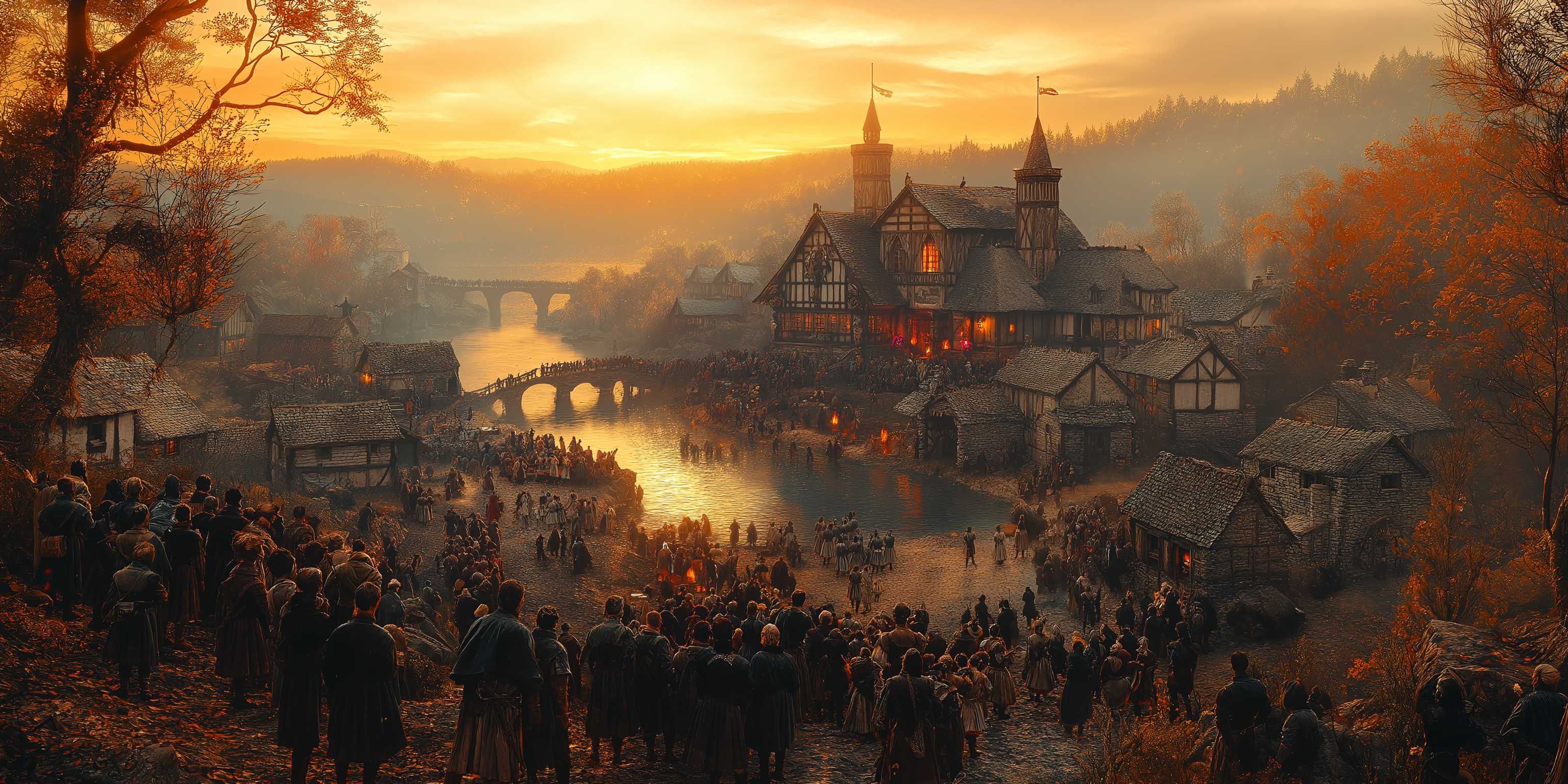
On 22 May 1762, Elspeth formally established the settlement she named New Edinburgh—a tribute to the city that had shaped her, carried across realms as both homage and promise. The act of founding represented more than administrative declaration; it was the application of everything she had learned to the challenge of building civilisation from nothing but vision and will.
The early months tested her beyond anything previous experience had prepared her for. The land was harsh, resources scarce, and the challenges of survival consumed energies that might otherwise have been devoted to longer-term development. Elspeth discovered capacities she had not known she possessed—leadership that commanded respect without demanding submission, pragmatism that bent principle without breaking it, determination that outlasted setbacks which would have defeated less resilient souls.
The Sisters Follow
Within weeks of Elspeth's transformation, her sisters joined her in Guardian service. Effie received her Portal Key on 28 April 1762, Katrina on 19 May, Violet on 21 May. Each ceremony marked the continuation of something begun in their modest Edinburgh household—four sisters whose combined talents exceeded any individual contribution, whose different temperaments complemented rather than conflicted.
Effie brought diplomatic gifts that smoothed relationships Elspeth's directness sometimes strained. Katrina's agricultural knowledge proved essential as New Edinburgh struggled to feed its growing population. Violet's architectural imagination shaped the physical structures that transformed scattered shelters into coherent community. Together, the Stewart sisters embodied leadership distributed according to capability rather than concentrated in single authority—a model that would influence New Edinburgh's governance for generations.
Unconventional Alliances
By early June 1762, New Edinburgh's survival hung by threads too thin for conventional solutions. Supplies were desperately needed, but legitimate channels could not provide them quickly enough to prevent catastrophe. Elspeth made a decision that would have horrified the respectable Edinburgh society she had navigated during her years at the Emporium: she sought out William Brodie.
The young man she had met at Balcarres House had descended into the criminal underworld, leading a band of thieves whose skills at acquiring materials from unwilling owners were considerable. Elspeth proposed an arrangement that transformed moral boundaries when survival demanded it—the blacksmith's daughter, raised on honest craft and virtue, chose to dance with shadows rather than watch her settlement starve.
The alliance proved instrumental. Brodie's network provided supplies that kept New Edinburgh alive through its most desperate period. More significantly, the relationship with these unlikely partners evolved beyond mere transaction. On 9 July 1762, William Brodie himself became a Guardian—an unconventional choice that some questioned but which Lizbeth Wilson supported, recognising patterns that others could not perceive.
Chewbathia
The military dimension of New Edinburgh's security took form in 1763, when Elspeth and William Brodie scouted locations for a defensive settlement. Construction began on 23 May 1763 and concluded on 11 June 1765 with the completion of Chewbathia—a fortress whose very name whispered of Culloden, that fateful Scottish battlefield whose shadow had fallen across Elspeth's childhood. Within its walls, the Chewbathian Hunters would develop into an elite force whose tartan and bagpipes carried Highland tradition across dimensional boundaries.
The establishment of Chewbathia demonstrated Elspeth's understanding that civilisation required protection as well as cultivation. The fortress embodied her father's lessons about strength properly applied—defensive capability that enabled peaceful development rather than aggression that provoked conflict.
The Directorate
By 1775, thirteen years of growth had transformed New Edinburgh from desperate survival into thriving community. The informal sisterly governance that had sustained early development could no longer contain a settlement's increasing complexity. On 15 August 1775, Elspeth established the Directorate—a formal governmental structure that codified relationships and responsibilities while preserving the collaborative spirit that had characterised Stewart leadership from the beginning.
The following day, 16 August 1775, Elspeth was inaugurated as First Guardian—a title that recognised her foundational role while establishing institutional frameworks that would outlast any individual. The ceremony marked her evolution from pioneering founder to constitutional architect, from leader by necessity to leader by acknowledged mandate.
Later Years
The decades that followed brought both achievement and loss. Moira MacKenzie died on 17 August 1780, taking with her the secret of her kinship to the Stewart family—whether she ever revealed the truth to Elspeth in their final conversations remains unknown. The relationship between mentor and apprentice had evolved into something approaching family, which it had always been, though perhaps only one of them had known it.
In September 1788, Morag Stewart finally joined her daughters in New Edinburgh. The widow who had faded under grief's weight in Edinburgh found renewal in the realm her children had built. For two years, mother and daughters shared the community Elspeth had founded, until Morag's death on 12 November 1790 closed that chapter of Stewart history.
Agnes Fraser had preceded Morag by two months, dying on 12 September 1790—the maternal mentor whose warmth had balanced Moira's demanding instruction, whose practical wisdom had helped shape a seamstress into something far greater.
Death
On 8 November 1801, Elspeth Stewart completed her final act of leadership—the release of authority she had held for thirty-nine years. She was sixty-three years old, and the settlement she had named after her beloved Edinburgh had grown beyond anything she could have imagined during those desperate early months when survival itself seemed uncertain.
Her sisters were present in her final hours—Effie, Katrina, and Violet, the women whose complementary gifts had helped transform Elspeth's vision into thriving reality. The Directorate she had established continued to function, governance structures she had created remained stable, the community she had built possessed foundations strong enough to endure without its founder's watchful presence.
What she left behind was not merely a settlement but an inheritance: institutions that preserved collaborative governance, alliances that maintained peaceful relationships with neighbouring communities, and a legacy of leadership that valued pragmatism over rigidity, compassion over severity, unconventional solutions over conventional failure. The blacksmith's daughter who had walked through Edinburgh's grey streets in threadbare cloak and worn boots had built something that would endure for generations.







