Eloise Margaret Campbell (née Turner)
Born in Edinburgh on 14 May 1978, Eloise Margaret Turner built a quiet life around words—as book editor, literary scholar, and devoted keeper of stories both published and whispered. Her marriage to Daniel Campbell in 2002 drew her into a family whose secrets ran deeper than the manuscripts she so carefully preserved, though she never fully grasped what the greenhouses concealed. Three daughters inherited her gifts: Isla her analytical precision, Maeve her storytelling soul, Rowan her practical wisdom. When sudden illness claimed her on 19 November 2016, Eloise left behind a legacy woven into every page she had touched and every child she had shaped.
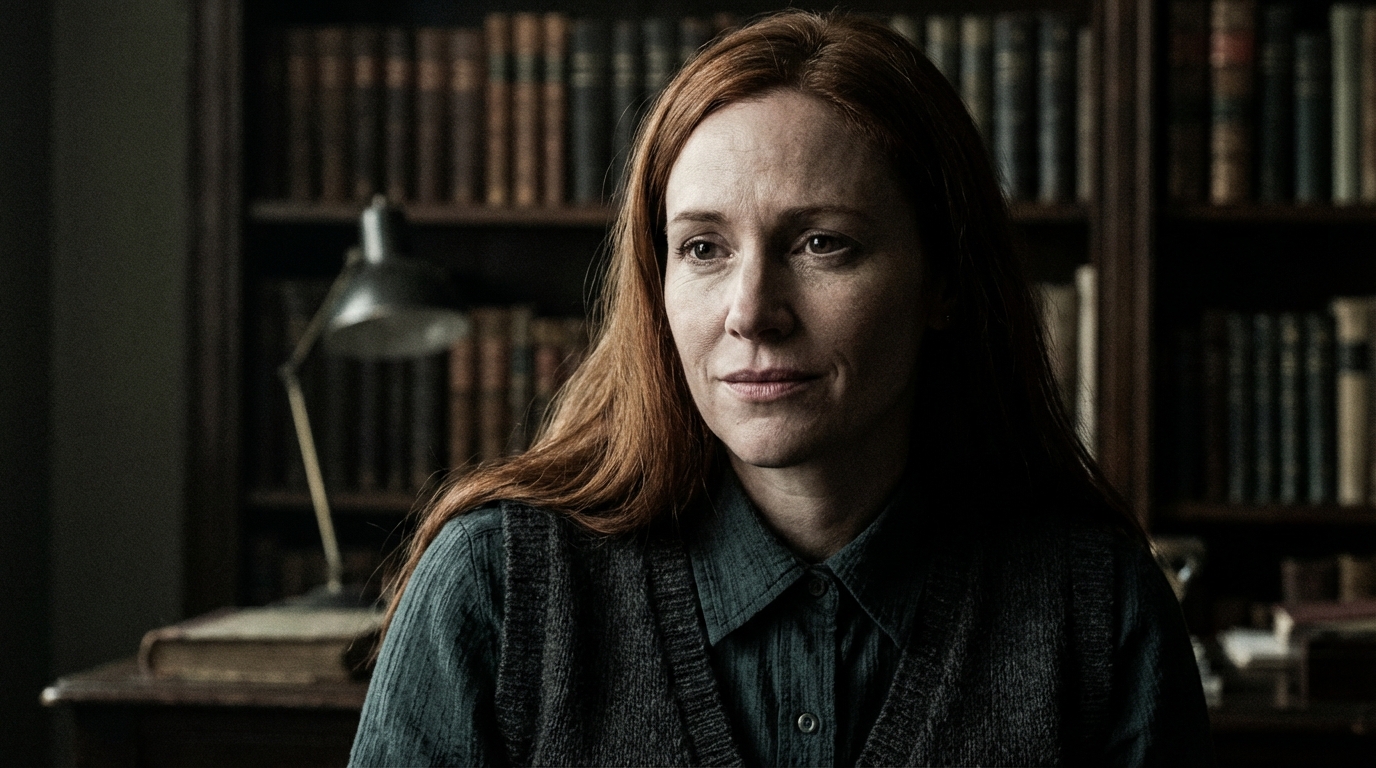
Early Life and a House of Books
Eloise Margaret Turner was born on 14 May 1978 at the Royal Infirmary of Edinburgh, the second child of Geoffrey William Turner and Catherine Anne Turner née Macleod. She arrived into a household where books lined every available wall, stacked on bedside tables and kitchen counters, accumulated in corners like sediment deposited by some literary tide. Her father, a lecturer in English Literature at the University of Edinburgh, had met her mother in the university library's medieval manuscripts room, and their courtship had proceeded through shared reading lists and marginalia exchanged in borrowed volumes.
The Turner family occupied a Victorian terraced house in Marchmont, close enough to the university for Geoffrey's daily walk to lectures, near enough to the Meadows for weekend excursions with children in tow. The house had been purchased in 1975, the year before Eloise's elder brother arrived, and it would remain the family home throughout her childhood—a constant backdrop of creaking floorboards, temperamental radiators, and the particular smell of old paper that Eloise would forever associate with safety.
Geoffrey Turner had built his academic career on Victorian literature, his particular expertise lying in the intersection of folklore and the novel—how oral traditions shaped written narrative, how stories mutated as they passed from telling to text. His lectures drew students who appreciated his habit of reading passages aloud, his voice shifting to capture different characters, his obvious pleasure in language well deployed. Catherine, who had abandoned her own doctoral research to raise children, channelled her scholarly instincts into freelance editing work that could be conducted from home, her red pen moving across manuscripts whilst children played nearby.
Eloise's brother, Andrew Geoffrey Turner, had arrived on 3 February 1976, his temperament establishing early the pattern of contrast that would define the siblings' relationship. Where Andrew proved boisterous and athletic, drawn to rugby pitches and playground competitions, Eloise emerged quiet and watchful, more comfortable observing than participating. She learned to read at four, teaching herself from the books surrounding her, and by six was working through her father's shelves with methodical determination—not understanding everything she encountered, but absorbing narrative structures and prose rhythms that would later inform her editorial instincts.
A younger sister completed the family. Margaret Catherine Turner arrived on 21 September 1982, named for both grandmothers in a gesture of familial diplomacy. Margaret inherited their mother's practical nature without her scholarly inclinations, growing into a girl who preferred making things to reading about them. The four-year gap between Eloise and Margaret created space for both closeness and distance—old enough to feel protective, young enough to occasionally play together, different enough in temperament that competition never truly developed between them.
The Turner household operated on rhythms shaped by academic calendars and publishing deadlines. Geoffrey's teaching schedule structured the year into terms and holidays, whilst Catherine's editing work created unpredictable bursts of intensity when manuscripts demanded concentrated attention. Meals often featured discussions of books—what Geoffrey was teaching, what Catherine was editing, what the children were reading. Eloise absorbed these conversations, learning to articulate responses to texts before she fully understood what criticism meant, developing the analytical habits that would define her professional life.
Education and the Discovery of Purpose
Eloise attended James Gillespie's Primary School, walking the short distance from Marchmont each morning with Andrew until he progressed to secondary school and she continued alone. She proved a capable student without being exceptional—her teachers noted her quiet attentiveness, her thoughtful written work, her tendency to lose herself in reading during any unstructured moment. She made friends carefully, maintaining a small circle of girls who shared her preference for library corners over playground games.
The transition to James Gillespie's High School in 1989 sharpened her academic focus. English became her strongest subject, her essays displaying the close reading skills absorbed from years of dinner-table literary discussion. History engaged her nearly as much—she found herself drawn to primary sources, to letters and diaries that preserved individual voices across centuries, to the detective work of reconstructing lives from fragmentary evidence. Her teachers encouraged her toward university study, recognising abilities that would flourish given appropriate scope.
Yet Eloise's education extended beyond classroom walls. Saturday mornings often found her accompanying her father to the university library, where she was permitted to sit quietly whilst he conducted research, absorbing the atmosphere of scholarly work—the rustle of pages, the scratch of pencils, the particular concentration of people engaged with texts. Geoffrey introduced her to the special collections, showing her medieval manuscripts whose illuminated pages seemed impossibly beautiful, explaining how scribes had copied and preserved knowledge across centuries when printing did not exist.
These experiences crystallised something in Eloise's understanding of herself. She recognised that her pleasure in books was not merely escapist—though she loved losing herself in stories—but connected to deeper satisfaction in the work of preservation, the careful attention that kept texts alive across generations. The editorial markings in her mother's manuscripts, the scholarly apparatus in her father's research, the conservation efforts protecting fragile documents from time's depredations—all of this represented a tradition she wished to join.
She enrolled at the University of Edinburgh in 1996, reading English Literature as her father had done, though her interests diverged from his Victorian focus toward medieval and early modern periods. The programme immersed her in textual scholarship—the comparison of manuscript variants, the reconstruction of authorial intention from imperfect witnesses, the archaeological patience required to understand how texts had been transmitted and transformed. Her tutors recognised her aptitude for this painstaking work, her willingness to attend to details that less careful students overlooked.
Eloise graduated in 2000 with First Class Honours, her dissertation examining folklore elements in sixteenth-century Scottish poetry. Her external examiner, a visiting scholar from St Andrews, noted both her rigorous methodology and her sensitivity to the material's emotional resonances—she understood not merely how texts worked but why they mattered to the communities that had created and preserved them.
The Editorial Life
The transition from university to professional work proved less straightforward than Eloise's academic success might have suggested. Publishing in Edinburgh operated on scales smaller than London's industry, opportunities fewer and competition correspondingly intense. She spent the months following graduation in uncertain employment—temporary positions at bookshops, freelance proofreading secured through her mother's contacts, the accumulation of experience without clear trajectory.
The position that would define her career emerged in early 2001. Blackwood & Hart, a small Edinburgh press specialising in Scottish history and literature, sought an editorial assistant with background in textual scholarship. The salary was modest, the premises cramped, the workload considerable—but the work itself engaged Eloise completely. She found herself handling manuscripts that connected to her academic training, applying skills developed in seminars to practical problems of preparing texts for publication.
Her colleagues recognised her abilities quickly. Within eighteen months, she had advanced from assistant to associate editor, her responsibilities expanding to include acquisition as well as production. She developed particular expertise in historical texts requiring careful annotation—works whose significance depended on contextual apparatus that made them accessible to contemporary readers. Authors appreciated her thoroughness, her diplomatic suggestions for improvement, her genuine investment in helping their work reach audiences.
The editorial life suited Eloise's temperament. The work demanded sustained concentration, careful attention to detail, the patience to read and reread until every element aligned properly. It provided structure without rigidity—manuscripts arrived according to their own schedules, creating rhythms of intensity and relative calm. And it connected her to Edinburgh's literary community, the network of scholars, writers, and book-lovers whose paths crossed at launches, readings, and the particular bookshops where such people congregated.
She supplemented her publishing work with freelance projects that pushed beyond Blackwood & Hart's focus. Private collectors sometimes sought assistance cataloguing libraries or assessing acquisitions; academics required help preparing critical editions; families discovered ancestral papers needing expert evaluation. This varied work brought Eloise into contact with materials her employer would never publish—personal correspondence, business records, the documentary detritus of lives lived and largely forgotten. She approached each project with the same careful attention, understanding that every text preserved something worth saving.
The Rare Bookshop and Daniel Campbell
The meeting that would reshape Eloise's life occurred in autumn 1999, during the uncertain months between graduation and employment. She had been visiting McAllister's, a rare bookshop tucked along one of Edinburgh's older streets, seeking distraction from anxieties about her future. The shop's proprietor had recently acquired a private collection requiring cataloguing assistance, and Eloise—known to him through years of browsing and occasional purchases—had been invited to help with the archival process.
Daniel Campbell entered the shop seeking historical botanical texts for research his mother was conducting. Eloise noticed him before they spoke—a man approximately her own age, serious in demeanour, handling the books with evident respect. Their first conversation circled around the volumes he was examining, Eloise's cataloguing work providing excuse for extended discussion of the collection's contents and provenance.
She found herself drawn to his groundedness, his evident connection to place and tradition. Daniel spoke of his family's estate with affection rather than pretension, describing greenhouses and archives with equal enthusiasm. He seemed rooted in ways Eloise recognised she was not—her parents' academic life had always felt somewhat provisional, ideas more permanent than locations, the mind's geography mattering more than the physical. Daniel offered something different: continuity across generations, responsibility to land and legacy, the weight of inheritance accepted rather than resisted.
Their courtship proceeded through the bookshops and libraries that had shaped both their lives. Daniel accompanied Eloise to manuscript viewings; she visited Campbell Estate, encountering for the first time the scope of what his family maintained. The greenhouses intrigued her without fully revealing their significance—she sensed that Daniel's parents guarded knowledge beyond what they openly shared, but she had been raised to respect scholarly reticence, the understanding that some information required preparation to receive.
What she could access, she engaged with completely. The estate's library contained materials spanning centuries, documents whose preservation testified to generations of careful stewardship. Eloise recognised her skills' potential application, offering to help organise and restore papers that time and handling had damaged. Daniel's parents welcomed her assistance, appreciating both her expertise and her evident respect for what they had accumulated.
The relationship deepened through shared work as much as shared leisure. Eloise and Daniel discovered complementary approaches to the past—his interest in how history shaped landscapes and living things, hers in how it persisted through written words. They could spend hours examining a single document, each noticing elements the other had missed, their different training creating richer understanding than either could achieve alone.
Marriage and the Morningside Years
Eloise Margaret Turner married Daniel Alistair Campbell on 7 September 2002, in a ceremony at Greyfriars Kirk that brought together Edinburgh's academic and literary communities with the quieter networks intersecting at Campbell Estate. Her father gave a reading; Daniel's mother provided flowers from the estate's gardens. The reception at a Marchmont hotel continued late into the evening, guests reluctant to conclude celebrations that had united two families whose values so clearly aligned.
The newlyweds established their home in Morningside, near enough to Daniel's café responsibilities and close enough to her parents' Marchmont house for easy visiting. The flat they rented—and later purchased—filled quickly with books, Eloise's professional accumulation merging with Daniel's historical interests to create a shared library that occupied every available surface. They developed routines accommodating both their work: Daniel's early mornings at the Leaf and Bean, Eloise's concentrated editing sessions whilst he was absent, evenings together reviewing manuscripts or planning weekend visits to Campbell Estate.
Eloise continued at Blackwood & Hart, her reputation growing as she developed expertise that attracted increasingly significant projects. She edited a critical edition of Robert Burns's correspondence that received scholarly praise; she shepherded a comprehensive history of Scottish printing through years of complex production; she worked with authors whose names carried weight in circles she had once observed only from outside. The work satisfied her completely—she had found her place within the tradition of textual preservation she had recognised as a child in her father's library.
Her relationship with Daniel's family deepened alongside her professional development. Moira Campbell welcomed Eloise's assistance with estate archives, sharing materials she judged appropriate whilst maintaining boundaries around the greenhouse operations Eloise observed but did not question. Alasdair appreciated her editorial eye when reviewing his own historical research. She became, gradually, not merely Daniel's wife but a contributor to Campbell stewardship—even if the full scope of what the family guarded remained beyond her knowledge.
The marriage brought contentment Eloise had not entirely anticipated. She had approached relationships cautiously throughout her life, her reserved nature creating distance that not everyone was willing to bridge. Daniel's patience matched her own; his comfort with silence, his willingness to share space without demanding constant interaction, his understanding that intimacy could be quiet—all of this allowed her to relax into partnership rather than performing it. They built a life together that felt sustainable, each pursuing individual purposes within shared commitment.
Motherhood and the Shape of Family
Isla Margaret Campbell arrived on 17 December 2006, transforming Eloise's carefully ordered life in ways she had intellectually anticipated but emotionally could not have prepared for. The exhaustion of early motherhood, the constant demands of an infant's needs, the reorganisation of identity around this small person who depended utterly on her care—Eloise navigated these challenges with the same methodical attention she brought to editorial work, though the manuscripts had never woken her at three in the morning.
She recognised herself in Isla almost immediately. The baby watched everything with focused intensity, processing information before responding, her temperament already suggesting the analytical mind she would develop. Eloise read to her daughter from the earliest weeks, not expecting comprehension but establishing rhythms of language and story that would become foundational. Daniel observed mother and daughter together with evident pleasure, seeing partnership replicated across generations.
Maeve Jane followed on 9 March 2008, her arrival expanding the family into new configurations. Where Isla had been watchful and serious, Maeve emerged expressive and imaginative, her personality contrasting with her sister's from the earliest months. Eloise found herself navigating different needs, different temperaments, the challenge of ensuring each daughter felt individually recognised whilst building collective family identity. She told stories to both girls, discovering that Isla preferred factual accounts whilst Maeve wanted invention, fantasy, narratives that exceeded the boundaries of the possible.
Rowan Eloise Campbell completed the family on 27 October 2010. The choice of middle name honoured Eloise herself, Daniel's suggestion that she found touching despite her usual resistance to sentiment. Rowan emerged practical and determined, her character establishing itself through actions rather than words or imaginings. The three sisters formed a constellation Eloise observed with wonder—each so distinct, yet connected through bonds she and Daniel had created, their differences complementing rather than conflicting.
Motherhood required adjustments to her professional life. She reduced her hours at Blackwood & Hart, eventually transitioning to freelance work that could be conducted from home whilst children napped or played nearby. The arrangement echoed her own mother's choices, editorial work accommodating family responsibilities as Catherine's had done decades earlier. Eloise accepted this compromise without resentment, understanding that seasons of life demanded different balances, that the intensive years of early childhood would eventually yield to greater freedom.
She invested heavily in her daughters' relationship with language. Reading aloud became daily ritual, stories selected to expand their understanding of the world and their own possibilities within it. She taught them to respect books as objects—how to hold them properly, how to turn pages without damage, how to treat even paperbacks with care that acknowledged the work they contained. The girls absorbed these lessons alongside the narratives, learning that stories mattered enough to warrant protection.
The Campbell Archives and Unspoken Boundaries
Throughout her marriage, Eloise contributed steadily to Campbell archival work without ever penetrating the family's deepest secrets. She restored letters whose ink had faded, stabilised documents whose paper had grown brittle, organised materials according to systems that made them accessible for research. Her editorial training proved invaluable—she could assess a document's condition, recommend appropriate preservation measures, identify connections between scattered materials that previous generations had not recognised.
The work brought her into close collaboration with Alasdair, whose historical expertise complemented her textual skills. They spent hours together in the estate library, examining manuscripts whose provenance stretched back centuries, discussing the Campbell family's role in Scottish history. Alasdair shared knowledge carefully calibrated to what Eloise was prepared to receive—he spoke of Jacobite connections, hidden passages, the tradition of stewardship that had shaped his family across generations. What he did not share, she did not press to know.
Eloise sensed boundaries without fully mapping them. The greenhouse operations remained peripheral to her involvement—she knew Moira cultivated specimens of unusual interest, that certain customers at the Leaf and Bean received items not publicly available, that the family's botanical work connected to their historical stewardship in ways no one explained completely. She respected these limits as she would have respected a colleague's unfinished research, understanding that some knowledge required initiation rather than mere curiosity.
Her contributions nonetheless proved significant. The materials she preserved, the connections she identified, the systematic organisation she imposed on previously chaotic collections—all of this would later prove vital when circumstances required rapid access to historical records. She created finding aids, cross-referenced documents, established preservation protocols that protected fragile materials from further deterioration. The archive she helped build would survive her by years, her careful work serving purposes she never anticipated.
The Illness and Its Swift Progression
The autumn of 2016 began ordinarily. Isla had started her final year of primary school; Maeve was thriving in Primary Four; Rowan had begun Primary Two with characteristic determination. Eloise balanced freelance projects with family logistics, her days structured around school runs and editorial deadlines, evening meals and bedtime stories. Daniel managed the café whilst maintaining estate responsibilities, their partnership functioning smoothly after fourteen years of practice.
The symptoms emerged gradually enough to seem unremarkable. Fatigue that Eloise attributed to the demands of three children. Headaches she blamed on too many hours examining manuscripts in insufficient light. A persistent cough that suggested autumn cold rather than anything more serious. She continued working, continued mothering, continued assuming that rest and time would restore her to normal function.
The deterioration accelerated in early November. The fatigue deepened into exhaustion that sleep could not resolve. The headaches intensified, becoming pain that over-the-counter remedies could not touch. New symptoms emerged—confusion that frightened her, weakness that made ordinary tasks difficult, the sense that her body was betraying her in ways she could not understand or control. Daniel insisted on medical consultation; Eloise, finally acknowledging that something was seriously wrong, agreed.
The diagnosis came too late for intervention. The illness—swift and merciless—had progressed beyond what treatment could reverse. Eloise received this information with the analytical clarity she had always brought to difficult texts, understanding the implications whilst struggling to accept them emotionally. She had weeks, perhaps, rather than the decades she had assumed lay ahead. Her daughters would grow up without her. Her work would remain unfinished. The life she had built with Daniel would continue in her absence, shaped by her contributions but proceeding without her presence.
The final days passed in hospital, surrounded by family who struggled to compress years of future love into hours of present attention. Daniel remained constantly, his café responsibilities delegated to staff who understood without being told. The girls visited as often as hospital protocols and their own emotional capacities permitted—Isla grave and watchful, Maeve tearful and expressive, Rowan confused by circumstances she was too young to fully comprehend. Alasdair and Moira came daily, their grief for their daughter-in-law genuine and deep. Eloise's parents and siblings maintained vigil alongside the Campbells, the two families united in helpless witness to an ending none had anticipated.
Eloise Margaret Campbell died on 19 November 2016, thirty-eight years old, her life concluded decades before anyone had imagined it might end. The illness that claimed her left questions medicine could not definitively answer—swift-progressing, resistant to intervention, unexplained by risk factors or family history. She departed leaving behind a husband whose world had shattered, three daughters who would carry her absence through every subsequent milestone, and work whose full significance would emerge only in circumstances she never knew existed.
Funeral and Remembrance
The funeral took place on 24 November 2016 at Morningside Cemetery, Edinburgh's autumn chill matching the grief of those gathered. The service reflected Eloise's character—quiet, literary, focused on words rather than spectacle. Geoffrey Turner, drawing on decades of teaching, read passages from authors his daughter had loved, his voice steady despite the impossible task of commemorating his child. Friends from Edinburgh's publishing community attended alongside academic colleagues, family members, and the wider network that had intersected with Eloise's life.
Daniel found himself unable to speak. The words he might have offered—about partnership and loss, about the life they had built and the future now foreclosed—remained trapped behind grief too fresh for articulation. Alasdair spoke on the family's behalf, his historian's voice lending dignity to tribute, his evident affection for his daughter-in-law transcending the formal words he had prepared. The girls sat with their grandparents, Isla holding Rowan's hand whilst Maeve wept openly, three sisters confronting an absence they would spend years learning to accommodate.
The burial followed in a plot Eloise would have chosen for its quiet setting, removed from the cemetery's busier sections, shaded by trees whose autumn leaves had mostly fallen. The headstone, installed in subsequent weeks, bore a quotation from Virginia Woolf that Eloise had loved, words about the perpetual present of reading that seemed appropriate for a woman who had devoted her life to texts. Daniel visited often in the months that followed, sometimes alone, sometimes with daughters who were learning to grieve, standing before granite that contained nothing of who Eloise had been whilst trying to maintain connection with what she had meant.
A gathering at the Leaf and Bean followed the burial, the café that had anchored Daniel and Eloise's shared life providing space for remembrance. Stories circulated—colleagues recalling her editorial precision, friends describing her quiet loyalty, family members sharing memories that might otherwise have been lost. The occasion marked not merely ending but transformation, the beginning of the long process through which grief would gradually become something bearable, Eloise's absence integrated into lives that would continue without her.







