Elizabeth Mary Harrington
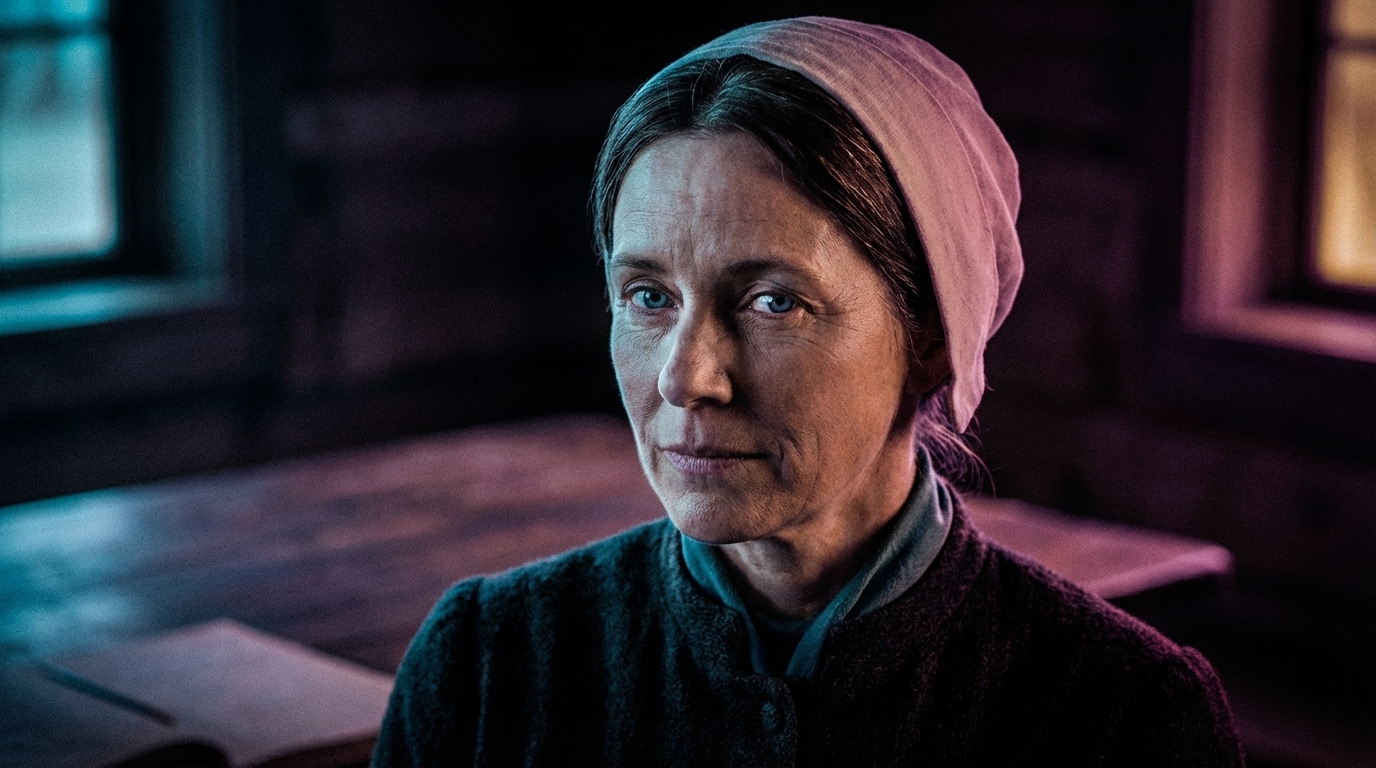
Elizabeth Mary Harrington, born in Clovelly, Devon, in 1783, transformed from a fisherman's daughter into the meticulous heart of Jeffries Manor. Emigrating to Van Diemen's Land in 1815, she brought thirty-five years of unwavering dedication to the estate, her detailed ledgers becoming the manor's living memory. Through William Sr.'s mysterious disappearance and decades of family transitions, Elizabeth remained the steadfast keeper whose quiet strength anchored Tasmania's most enigmatic household until her death in 1852.
Clovelly Foundations
Elizabeth Mary Harrington drew her first breath on 8 March 1783 in Clovelly, a coastal village clinging to the North Devon cliffs with the tenacity of the mussels that encrusted its harbour walls. The settlement's geography shaped every aspect of existence—the main street, known locally as Up-Along, plummeted from the wooded heights down to the working harbour in a gradient so severe that wheeled vehicles became impossible luxuries. Houses pressed against each other in tight succession, whitewashed cottages built directly into the slope where families developed legs like mountain goats from constant navigation of the endless stone paths.
Her father, Thomas Harrington, worked the fishing boats as his father and grandfather had done before him. The Atlantic governed every rhythm of Thomas's life—its tides dictated when he could launch, its moods determined whether his family ate well or went hungry, its dangers lurked in every squall that darkened the western horizon. He spent days and nights pursuing herring, mackerel, and the pilchards that swarmed unpredictably through Bristol Channel waters. His hands bore the permanent scars of his trade—rope burns from hauling nets, knife cuts from gutting fish, calluses so thick they seemed like leather grafted onto human flesh.
Mary Harrington née Fletcher, Elizabeth's mother, managed a household economy that required constant vigilance against poverty's ever-present threat. She mended nets with fingers that moved faster than thought, preserved fish in barrels of salt, tended a small kitchen garden clinging to the cliff's edge, and stretched Thomas's uncertain earnings across the needs of six hungry children. The cottage they inhabited consisted of three cramped rooms where privacy existed as concept rather than reality—sleeping, cooking, working, and living happened in spaces so confined that every family member knew every other's business whether they wished to or not.
Elizabeth, the eldest child, assumed responsibilities that would have crushed less resilient spirits. Before she reached ten years of age, she was managing her younger siblings—Anne, Margaret, Thomas Jr., Samuel, and little Catherine—with an authority that came naturally to someone who understood that survival required organisation. She changed Catherine's soiled linens, taught Samuel his letters, kept Margaret from wandering too near the cliff's edge, and helped Anne master the intricate techniques of net mending that every Clovelly girl needed to know.
The village itself existed in peculiar isolation despite its proximity to larger Devon towns. The steep terrain made casual visits nearly impossible, and most residents spent entire lives within Clovelly's boundaries. Social structures were rigid yet intimate—everyone knew everyone else's business, marriages typically united families already connected by generations of intertwined histories, and departures were rare enough to be remarkable. The Methodist chapel provided the village's spiritual centre, its austere theology matching the unforgiving landscape that shaped the congregation's daily existence.
Education in Clovelly meant sporadic attendance at a dame school where an elderly widow taught basic literacy to children whose families could spare them from labour. Elizabeth attended when Thomas's catches allowed such luxury, absorbing reading and writing skills that exceeded what most fishing families' daughters acquired. She possessed a quick mind that grasped concepts rapidly, a memory that retained details others forgot, and a hunger for knowledge that set her apart from girls content with the limited horizons Clovelly offered.
Yet even Elizabeth's unusual capabilities might have led nowhere had circumstances not intervened. In 1800, when she turned seventeen, Thomas Harrington drowned during a storm that caught his boat too far from harbour. The tragedy, whilst devastating, surprised no one—Clovelly claimed fishermen with such regularity that widows outnumbered wives, and children grew up understanding their fathers might simply not return one evening. Mary Harrington found herself responsible for five children with Thomas's death removing the family's primary income source.
The Devon Household
The necessity that followed Thomas's death propelled Elizabeth into service earlier than she might otherwise have entered that world. Through connections maintained by the Methodist chapel's network, Mary secured Elizabeth a position as a maid in the household of Sir Reginald Smythe, a landowner whose estate lay inland near Barnstaple. The arrangement benefited everyone—Elizabeth would earn wages to send home, reducing the burden on Mary's strained resources, whilst gaining experience that might lead to better positions elsewhere.
Sir Reginald's household operated on a scale that initially overwhelmed the girl from Clovelly's cramped cottages. The manor house contained more rooms than Elizabeth had imagined a single building could hold. The staff numbered a dozen people whose complex hierarchy and protocols seemed designed to confuse newcomers. And the sheer volume of possessions—furniture, silver, linens, china, books, ornaments—suggested wealth so vast that Elizabeth struggled to comprehend its implications.
She began at the lowest rung, performing the dirtiest and most physically demanding tasks. Rising before dawn, she lit fires throughout the house, carried endless buckets of water and coal, scrubbed floors on hands and knees until her back screamed protest, emptied chamber pots, cleaned grates, and executed whatever other duties senior servants delegated to the newest, youngest maid. The work exhausted her utterly, yet it also revealed capabilities she hadn't fully recognised in herself.
Elizabeth possessed an extraordinary eye for detail combined with systematic thinking that made household management almost intuitive. She noticed patterns others missed—which tasks required daily attention versus weekly, how to sequence cleaning to maximise efficiency, when supplies needed replenishing before they ran out. She memorised Sir Reginald's preferences and those of his family members, anticipating needs before they were voiced. And she developed a reputation for absolute reliability—tasks assigned to Elizabeth were completed thoroughly and on schedule without supervision or reminder.
The housekeeper, Mrs Dorothy Ashford, recognised in Elizabeth the qualities that distinguished superior servants from merely competent ones. Mrs Ashford had managed Sir Reginald's household for twenty years, her own rise from scullery maid to housekeeper providing template for ambitious young women willing to dedicate themselves to service. She took Elizabeth under her considerable wing, teaching her not just practical skills but the deeper wisdom that made great housekeepers invaluable.
Under Mrs Ashford's tutelage, Elizabeth learned household accounting—how to maintain ledgers tracking every expense, how to detect theft or waste through discrepancies in records, how to budget for seasonal needs and unexpected contingencies. She mastered the complexities of managing other servants—balancing firmness with fairness, maintaining discipline without creating resentment, earning respect through competence rather than demanding it through authority. She studied the intricate protocols governing upper-class households, understanding that service at the highest levels required knowledge of etiquette, cuisine, wines, and social customs that few working-class people ever encountered.
Mrs Ashford also shared harder wisdom about service's realities. Housekeepers who married typically had to resign their positions—few households would employ married women in senior roles. Personal life therefore required choosing between service and family, between the security of good positions and the pleasures of domestic intimacy. Mrs Ashford herself had made that choice, remaining unmarried through decades of service, her own life testimony to both the satisfactions and the sacrifices such dedication demanded.
The Colonial Decision
By 1815, at thirty-two years of age, Elizabeth had ascended to senior housekeeper position at Sir Reginald's estate, a role that brought both respect and comfortable security. She earned good wages, occupied pleasant rooms, commanded significant authority over junior staff, and enjoyed the satisfaction of managing a substantial household with recognised excellence. Most women in her position would have remained contentedly in such circumstances until retirement or death.
Yet Elizabeth felt restless in ways she couldn't fully articulate. Perhaps it was the memory of Clovelly's isolation and the determination to escape limited horizons that such small worlds imposed. Perhaps it was awareness that, despite her success, she would always remain fundamentally a servant in England's rigid hierarchies. Or perhaps it was simply that quality of adventurousness that had always set her apart—the curiosity about worlds beyond Devon's boundaries, the willingness to risk security for possibility.
When she heard discussions about Van Diemen's Land—the distant colony where enterprising people might forge new lives unconstrained by England's accumulated centuries of social stratification—something stirred in Elizabeth's practical heart. The colony required capable people to establish households, manage estates, create civilised domestic spaces in wilderness settings. Her skills would be valued there, perhaps more highly than in England where talented housekeepers competed for limited positions amongst established families.
The decision required courage that her Clovelly upbringing had instilled. Fishermen's daughters understood risk—every time Thomas Harrington had launched his boat, he had gambled life against livelihood. Elizabeth's gamble involved trading known security for unknown opportunity, abandoning everything familiar for a land she knew only through secondhand accounts. Yet she made the decision with characteristic directness, giving Sir Reginald appropriate notice, receiving glowing references attesting to her capabilities, and booking passage to Hobart Town on a vessel departing in autumn 1815.
The voyage tested every assumption Elizabeth held about her own resilience. Months confined to cramped quarters with strangers, constant seasickness that left her weak and miserable, storms that made even experienced sailors pray fervently, the relentless tedium of days that blurred into weeks that accumulated into months of enforced idleness. She endured through sheer determination, understanding that she had committed to this course and that retreat was impossible even had she desired it.
Establishing Colonial Credentials
Elizabeth arrived in Hobart Town in early 1816 to discover a settlement poised between frontier rawness and aspirational civilisation. The town possessed government buildings of surprising grandeur alongside structures barely qualifying as architecture. Convicts laboured under military guard whilst free settlers attempted to establish businesses and social structures modelled on English precedents. The entire colony seemed suspended between past and future, its ultimate character still forming, its possibilities both exciting and unsettling.
Her references from Sir Reginald's household opened doors immediately. Colonial society valued experienced English servants who understood proper household management and could impose order on domestic chaos. Within days of her arrival, Elizabeth received multiple employment offers from established families seeking housekeepers who combined competence with adaptability to colonial conditions' particular challenges.
She accepted a position with the Morrison family, wealthy merchants whose Hobart residence required systematic management it currently lacked. Elizabeth imposed order with efficiency that impressed even sceptical observers. She hired and trained staff, established protocols for daily operations, managed accounts with meticulous attention to detail, and transformed domestic chaos into smoothly functioning household within months. Her reputation spread through colonial society's surprisingly efficient networks—here was a housekeeper whose English training combined with willingness to adapt to colonial realities.
Through 1816 and into 1817, Elizabeth worked for several prominent families, each position adding to her growing reputation as Van Diemen's Land's finest housekeeper. She learned colonial society's particular dynamics—the complex relationships between free settlers and ex-convicts, the social hierarchies that mimicked yet subtly differed from English precedents, the practical challenges of managing households dependent on uncertain supply chains and imported goods.
Jeffries Manor Beckons
In late 1817, Elizabeth encountered Madelyn Jeffries under circumstances that would determine the remainder of her life. The meeting occurred at a social gathering hosted by one of Hobart's prominent families where Madelyn, newly arrived with her husband William, was being introduced to colonial society. Elizabeth attended as senior housekeeper to the hosting family, overseeing service with her characteristic unobtrusive excellence.
Madelyn observed Elizabeth throughout the evening with the assessing eye of someone who recognised quality when she encountered it. The housekeeper's command of the staff, her attention to detail, her ability to anticipate needs and resolve problems before they became visible to guests—all impressed Madelyn deeply. Here was someone who understood proper household management whilst possessing the adaptability that colonial circumstances demanded.
Their conversation, when it occurred, revealed immediate mutual respect. Madelyn explained that she and William were establishing a grand estate near Granton, that the manor house nearing completion would require exceptional household management, that she sought a housekeeper who could transform empty rooms into properly functioning domestic establishment. Elizabeth, intrigued by the challenge of creating rather than merely maintaining, expressed cautious interest. The terms Madelyn offered exceeded Elizabeth's current wages, the scope of responsibility promised satisfaction that her recent positions had lacked, and something in Madelyn's directness appealed to Elizabeth's own no-nonsense character.
Elizabeth accepted the position in December 1817, arriving at Jeffries Manor in early 1818 as the building's completion approached. The estate's scale initially daunted even her considerable confidence—the Georgian sandstone structure announced ambitions far exceeding typical colonial establishments. Yet the challenge excited her. Here she could implement everything Mrs Ashford had taught her whilst creating systems suited to this particular household's needs and Tasmania's specific conditions.
Creating Domestic Order
The transformation of Jeffries Manor from empty building into functioning household became Elizabeth's masterwork. She approached the task with systematic thoroughness that left nothing to chance. First came hiring appropriate staff—she interviewed dozens of candidates, assessing not merely skills but character, reliability, and capacity to meet the exacting standards she intended to impose. She selected carefully, building a team that combined competence with willingness to accept her authority.
Next came establishing protocols for every aspect of household operation. Elizabeth created detailed schedules governing cleaning, laundry, meal preparation, and maintenance. She instituted inventory systems tracking everything from linens to lamp oil, ensuring supplies never ran short through inattention. She designed efficient workflows that minimised wasted effort whilst ensuring thorough completion of all necessary tasks. And she documented everything in ledgers whose meticulous detail would later prove historically invaluable.
Her relationships with the other senior staff developed along clearly defined lines. Thomas Whitfield, the head butler, recognised in Elizabeth a kindred spirit—someone whose dedication to excellence matched his own, whose standards never wavered despite difficulties. They formed an effective partnership built on mutual respect and complementary capabilities. Thomas managed the formal service and male staff whilst Elizabeth governed domestic operations and female servants. Together, they established Jeffries Manor's reputation for household management rivalling anything in Hobart itself.
With Madelyn, Elizabeth's relationship evolved beyond typical mistress-servant formality. Madelyn valued competence and respected those who demonstrated it through action rather than mere claims. Elizabeth's transformation of the manor from chaos into order, her anticipation of needs, her resolution of problems before they required Madelyn's attention—all earned deep appreciation that transcended employment's usual boundaries. They would never be equals, yet they developed genuine mutual regard that made their decades-long association more partnership than mere service relationship.
The Accumulating Shadows
Through 1818, 1819, and 1820, Elizabeth presided over the manor's increasingly complex operations with undiminished excellence. Young William Jr.'s birth in November 1819 brought new demands—a nursery to establish, a wet-nurse to manage, additional staff to coordinate. Elizabeth handled everything with characteristic efficiency whilst noting details in her ledgers that captured not just expenses but the rhythms of family life.
Yet she observed with growing unease the shadows accumulating around William Sr. The master's moods grew increasingly erratic—periods of intense focus alternating with distracted anxiety, sudden rages followed by withdrawn silences. Strange visitors arrived at odd hours, ushered immediately to William's study. Mysterious deliveries came under circumstances suggesting secrecy rather than mere privacy. And William himself seemed to be struggling with burdens he refused to share, even with Madelyn.
Elizabeth's position gave her insights others lacked. As housekeeper, she moved through every part of the manor, noticed everything, heard conversations never intended for servant ears. She observed William's heated arguments with Madelyn, witnessed his late-night retreats to the basement, noted the peculiar correspondence that arrived bearing no return addresses. Her ledgers recorded oddities—unusually high purchases of certain supplies, unexplained expenses that William insisted she record without question, patterns suggesting activities she couldn't quite identify.
In August 1821, the tensions that had been building for months reached some invisible threshold. That morning of 9 August, Elizabeth delivered breakfast and noticed immediately that something had changed. William's agitation had intensified beyond anything she had previously observed. He barely touched his food, dismissed her curtly, and spent the day locked in his study. That evening, as Elizabeth supervised dinner preparations, she heard raised voices from the dining room—an argument between William and Madelyn whose specifics she couldn't distinguish but whose intensity suggested crisis.
The Night Everything Changed
Elizabeth retired late on 9 August after ensuring the household was properly secured for the night. She reached her comfortable rooms above the servants' wing near midnight, exhausted from the day's tensions and the additional work that emotional household crises always generated. She had barely fallen asleep when sounds woke her—movement below, voices raised in ways that suggested something beyond typical domestic disturbance.
She rose, threw a wrapper over her nightgown, and descended to investigate. The sounds came from the basement—an area of the manor where servants rarely ventured except when specific duties required it. Elizabeth approached the basement door, hearing male voices, sounds of struggle, something that made her increasingly alarmed. She hesitated, understanding that investigating might reveal things better left undiscovered, yet unable to simply return to bed whilst such disturbance continued.
Before she could decide, the sounds ceased abruptly. Silence fell so suddenly that it seemed almost louder than the previous noise. Elizabeth waited, heart racing, torn between duty to investigate and instinct to retreat. Then she heard footsteps ascending the basement stairs—several people moving quickly. She pressed herself into a doorway's shadows as figures emerged and rushed past—men she didn't recognise, moving with desperate urgency towards the manor's exits.
She waited until silence returned completely before emerging from concealment. The basement door stood open, light spilling up the stairs in a way that seemed wrong somehow, as if it originated from source other than ordinary lamps. Elizabeth descended part way, peering into the chamber below. What she glimpsed there—shadows and light moving in impossible ways, shapes that seemed to shift and waver, a sense of wrongness that defied rational explanation—froze her completely. She stood paralysed by incomprehension, unable to process what her eyes reported.
Then the light flickered and died, returning the basement to ordinary darkness. Elizabeth fled back upstairs, returning to her rooms where she sat trembling until dawn, trying to convince herself that exhaustion and stress had created hallucinations. Yet she knew what she had seen, even if she couldn't explain it. Something impossible had occurred in Jeffries Manor's basement, and William Sr.'s fate was somehow bound up in that impossibility.
The Morning's Terrible Discovery
At 6:00 AM on 10 August, Elizabeth began her usual morning rounds, checking rooms and rousing staff for the day ahead. When she reached William Sr.'s bedchamber, she found the bed empty and undisturbed—clearly not slept in during the previous night. The discovery, whilst alarming, wasn't immediately catastrophic. Perhaps William had fallen asleep in his study, or perhaps he had departed early for business in Hobart.
Yet combined with the previous night's disturbances, the empty bed took on more sinister implications. Elizabeth searched the house systematically—the study, the library, the drawing rooms, even the servants' quarters where William would never venture. Nothing. No sign of the master, no note explaining his absence, nothing but unsettling silence.
When Madelyn emerged and learned of William's absence, her immediate panic confirmed Elizabeth's growing dread. This wasn't ordinary absence. Something terrible had happened, and Elizabeth's midnight witness to basement impossibilities suggested dimensions to the crisis that she couldn't articulate without sounding mad.
The investigation that followed tested Elizabeth's composure and discretion in unprecedented ways. Constable Broadmoor questioned her extensively about the night's events, seeking any detail that might illuminate William's fate. Elizabeth answered with scrupulous honesty about observable facts whilst omitting the inexplicable—she had locked up the manor as usual, had been woken by disturbances she couldn't clearly identify, had found William's bed unslept in the following morning.
On 11 August, Broadmoor interviewed Elizabeth formally in her sitting room—a modest but comfortable space decorated in sage green and furnished with pieces acquired over her years of service. She recounted William's increasingly erratic behaviour over recent weeks, mentioned the strange visitors and mysterious correspondence, described the tensions between William and Madelyn. Yet she said nothing about her midnight glimpse into the basement, understanding that no one would believe testimony about impossible lights and reality-defying shadows.
Guardian Through Decades
In the weeks and months following William Sr.'s disappearance, Elizabeth became one of Madelyn's crucial supports through the crisis. Whilst investigators questioned and colonial society whispered, Elizabeth maintained the household's operations with redoubled dedication. Staff looked to her for reassurance, Madelyn relied on her for practical management that freed the grieving widow to handle legal and financial complications, and Elizabeth herself found solace in work's familiar rhythms.
Her relationship with Madelyn deepened through shared adversity. They were not friends in conventional sense—class barriers remained insurmountable despite everything. Yet they developed profound mutual reliance built on trust, respect, and the bonds that form between people who weather storms together. Elizabeth became more than housekeeper, evolving into confidante whose counsel Madelyn sought on matters extending beyond household management.
Through the 1820s, 1830s, and 1840s, Elizabeth presided over Jeffries Manor's daily life with unwavering dedication. She watched young William Jr. grow from infant to child to young man, her own affection for him transcending professional boundaries. She managed the household through successive family transitions and colonial Tasmania's evolving social landscape. And she maintained her meticulous ledgers, documenting every detail of manor life in records whose historical value she couldn't have imagined.
She never married, her devotion to Jeffries Manor precluding the personal life that might have been. Occasionally she wondered about roads not taken—returning to Devon and marrying some local man, accepting proposals from tradesmen who admired her capabilities, building family instead of serving someone else's. Yet regret rarely troubled her. She had chosen this life deliberately, had found satisfaction in excellence achieved, had created something lasting through decades of dedicated service.
The Final Chapter
Elizabeth Harrington died on 7 June 1852 at the age of sixty-nine. The end came gently—she had been feeling poorly for several weeks, her robust constitution finally succumbing to accumulated years and the wearying effects of chronic ailment that no physician could adequately treat. She passed away in her sitting room, in the chair by the window where she had spent countless hours managing accounts and planning household operations, her ledgers arranged neatly on the desk beside her.
The funeral drew attendance that honoured both Elizabeth's service and the respect she had earned across thirty-five years. Madelyn wept openly—the loss of not merely a housekeeper but a companion whose steady presence had anchored difficult decades. Staff past and present came to pay respects to the woman who had shaped their understanding of excellence and dedication. And representatives of colonial society attended, recognising that Elizabeth Harrington had been more than servant—she had been exemplar of what service performed with intelligence and integrity could achieve.
Her legacy endured in multiple forms. The household systems she had established continued long after her death, her methods becoming embedded in Jeffries Manor's operations. Her ledgers provided historians with invaluable records of colonial domestic life, their meticulous detail capturing rhythms and realities that official documents never recorded. And her example inspired successive generations of housekeepers who recognised in Elizabeth's life proof that dedication and competence possessed inherent dignity regardless of employment's nature.
The modest headstone marking her grave in Hobart's cemetery recorded essential facts: "Elizabeth Mary Harrington, 1783-1852, Faithful Housekeeper of Jeffries Manor." Those simple words captured a truth that elaborate eulogy couldn't improve—Elizabeth had served faithfully, had maintained standards through decades of challenge, had earned respect through demonstrated excellence rather than demanded deference. From Clovelly's cramped cottages to Tasmania's grandest colonial estate, she had travelled far and achieved much, her life proving that character and capability mattered more than birth in determining human worth.







