
Elizabeth Mary Croft (née Harding)
Elizabeth Mary Harding was born into Georgian Bath's genteel society, the daughter of a magistrate whose appointment to Van Diemen's Land would carry her to the opposite side of the world at twenty-three. There, in a raw colonial settlement that bore no resemblance to the elegant crescents of her childhood, she found both purpose and love. Her marriage to Silas Croft in 1816 united two of Hobart Town's rising families and produced a partnership of genuine affection and shared endeavour. Through decades of colonial life—raising three children, building a household, navigating the social complexities of a society still finding its shape—Elizabeth proved herself a woman of quiet resilience and practical intelligence. Her twenty-six years of widowhood following Silas's death in 1842 revealed the depth of that resilience, as she devoted herself to family, garden, and the charitable works that had always occupied her heart.
Early Life in Bath
Elizabeth Mary Harding was born on 12th August 1792 in Bath, Somerset, the only surviving child of William Harding and Catherine Harding (née Beaumont). Her father, not yet knighted, served as a magistrate in the city's legal apparatus, a position that afforded the family comfortable respectability without particular wealth. Her mother came from minor gentry in neighbouring Wiltshire, bringing to the marriage connections that slightly exceeded the Hardings' own standing and expectations that would shape Elizabeth's upbringing.
The Harding household occupied a modest but well-situated house in one of Bath's newer developments, close enough to the fashionable streets to claim proximity without the expense of residing upon them. Elizabeth grew up surrounded by the architecture that defined Georgian elegance—the sweeping crescents, the honey-coloured stone, the Assembly Rooms where Bath's visitors gathered to see and be seen. Yet she also witnessed her parents' careful economies, the calculations that allowed them to maintain appearances whilst living within means that did not always accommodate ambition.
Two siblings had preceded Elizabeth into the world; neither survived infancy. Catherine Harding's grief over these losses expressed itself in fierce protectiveness toward her surviving daughter, a determination that Elizabeth would be prepared for whatever life might bring. The household was loving but not indulgent, shaped by practical concerns and the understanding that a daughter's future depended upon the qualities she cultivated and the impression she made.
Elizabeth's education followed the pattern expected of young women in her position. A governess provided instruction in the accomplishments deemed essential: French, music, drawing, needlework, and sufficient arithmetic to manage a household. Catherine supplemented these lessons with her own teaching, ensuring that Elizabeth understood domestic economy in its practical dimensions—how to manage servants, maintain accounts, plan menus, and navigate the countless small decisions that determined whether a household ran smoothly or descended into chaos.
What distinguished Elizabeth from many of her contemporaries was the breadth of her reading and the independence of her mind. Her father's modest library provided access to volumes beyond the novels and conduct manuals typically prescribed for young ladies, and William Harding—perhaps missing the sons who might have shared his intellectual interests—encouraged his daughter's curiosity. She read history and natural philosophy alongside poetry and sermons, developing opinions she learned to express carefully in company that might not welcome them from a woman.
Her particular passion was botany, an interest that began with her mother's garden and expanded through correspondence with a cousin who had studied under William Curtis in London. The scientific classification of plants appealed to something in Elizabeth's orderly mind, whilst the beauty of flowers and foliage satisfied aesthetic sensibilities that Bath's elegant surroundings had cultivated. She maintained a collection of pressed specimens and botanical drawings that she would carry with her across the world.
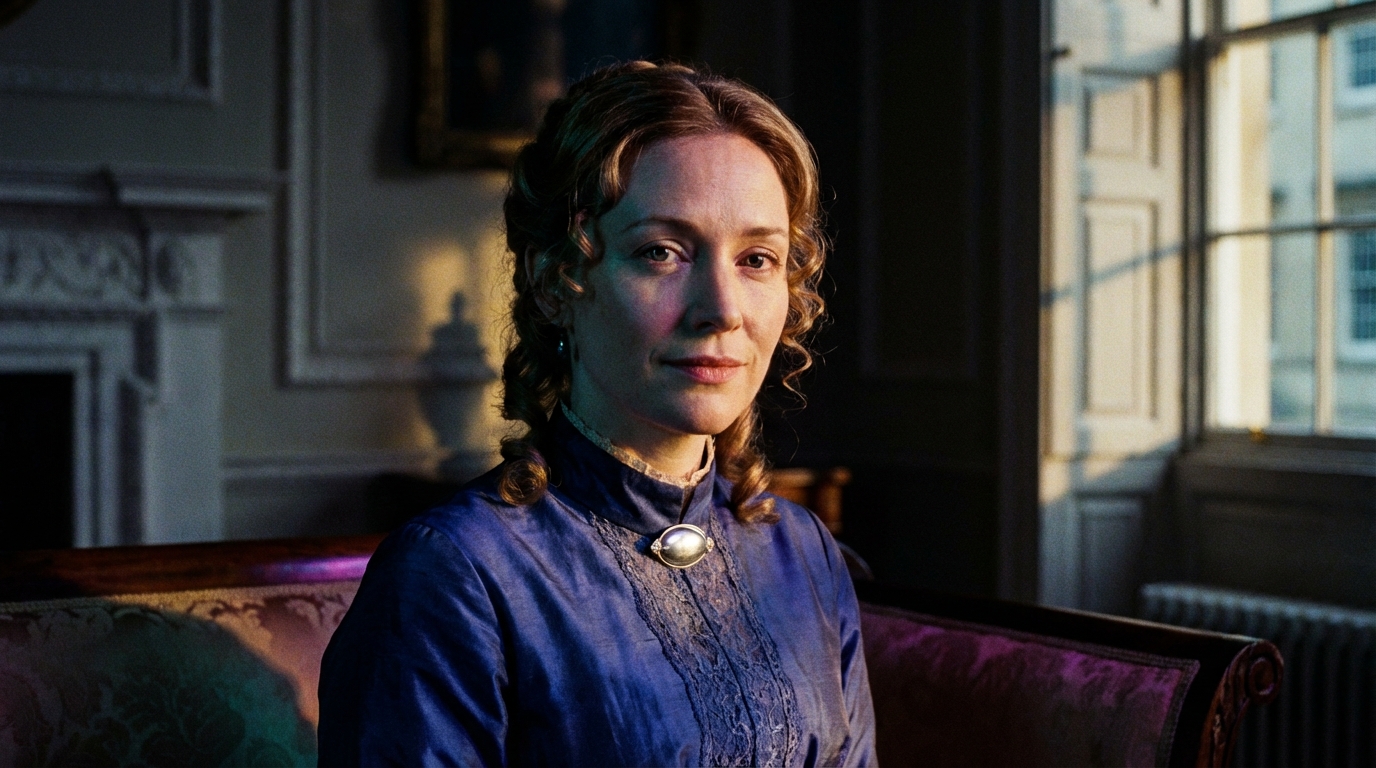
By her late teens, Elizabeth had developed into a young woman of quiet composure and watchful intelligence. She was pretty without being beautiful, her features pleasant rather than striking, her dark eyes her most notable quality—observers often remarked that they seemed to take in everything whilst revealing little. She moved through Bath's social occasions with practised grace, conversing easily without saying anything that might be remembered against her, charming without encouraging particular attention. It was a performance she had perfected through years of observation, understanding that a woman in her position could not afford the luxury of unguarded expression.
Her marriage prospects were respectable but not exciting. Several young men of appropriate standing showed interest over the years; none inspired feelings strong enough to overcome Elizabeth's reluctance to trade the familiar comforts of her parents' home for the uncertainties of matrimony. She was not opposed to marriage—she understood its necessity and even anticipated its satisfactions—but neither was she desperate enough to accept the first acceptable offer. By twenty-three, she remained unmarried, a circumstance that concerned her mother more than it troubled Elizabeth herself.
The Voyage to Van Diemen's Land
The appointment that would transform Elizabeth's life arrived in the spring of 1815. Sir William Harding—the knighthood had come with increased responsibilities in Bath's legal administration—received notification that he had been selected to oversee legal matters in Van Diemen's Land, a colonial posting that represented both honour and exile. The appointment came from London, reflecting the Colonial Office's desire to impose proper English legal standards upon a settlement that had developed its own rough-and-ready approaches to justice.
For Catherine Harding, the news was devastating. Her health had been declining for several years, and the prospect of a voyage to the opposite side of the world—months at sea, followed by life in a settlement she imagined as barely civilised—was more than she could contemplate. After much anguished discussion, the Hardings reached a decision that would prove permanent: Catherine would remain in Bath, living with her sister's family, whilst William took up his appointment alone.
The question of Elizabeth's future became suddenly urgent. At twenty-three, she was old enough to remain in England, to continue her quiet existence in Bath under her aunt's supervision. But the prospect held little appeal. Her mother's health made her an uncertain guardian; her aunt's household, already crowded with children, offered Elizabeth the position of permanent dependent rather than valued family member. And beneath these practical considerations lay something less easily articulated—a restlessness that Elizabeth had barely acknowledged to herself, a sense that the life awaiting her in Bath was a slow diminishment into spinsterhood and irrelevance.
She chose to accompany her father.
The Charlotte Anne departed Portsmouth in April 1815, carrying Sir William Harding, his daughter, and the household staff necessary to establish a proper magistrate's residence in the colony. The voyage tested Elizabeth in ways her Bath existence never had. The ship was cramped and uncomfortable, the food monotonous, the company limited to her father, servants who maintained careful distance, and fellow passengers whose conversation quickly exhausted its novelty. She spent long hours reading, longer hours staring at an ocean that seemed to extend forever in every direction, and discovered within herself reserves of patience she had not known she possessed.
She also discovered that she was stronger than she had imagined. The storms that terrified other passengers left her frightened but functional, able to comfort her maid whilst privately cataloguing the experience for later reflection. The tedium that drove some travellers to despair she endured with equanimity, finding small satisfactions in routine and the gradual marking of progress toward their destination. By the time the Charlotte Anne reached Van Diemen's Land, Elizabeth had learned something valuable about herself: she could adapt. Whatever the colony might demand of her, she would find ways to meet it.
The Charlotte Anne made harbour in Sullivan's Cove on 23rd August 1815. Elizabeth's first sight of her new home was not encouraging. Hobart Town sprawled along the waterfront beneath the looming mass of Mount Wellington, a collection of wooden buildings and muddy streets that bore no resemblance to Bath's elegant stone. The settlement looked raw, unfinished, as if it might be swept away by the next storm or abandoned when its inhabitants lost heart. The bush that surrounded it seemed to press inward, wild and alien, waiting to reclaim whatever temporary foothold civilisation had established.
Yet Elizabeth also noticed the light—clearer and sharper than any she had known in England—and the strange beauty of eucalypts whose leaves hung vertical rather than horizontal, and the extraordinary birds whose calls bore no relationship to anything in her experience. The natural philosopher in her stirred with curiosity even as the Bath-bred gentlewoman recoiled from the crudeness of colonial life. She resolved to approach her new situation as she approached botanical specimens: with careful observation, systematic study, and an openness to finding value in unfamiliar forms.
Colonial Society and Courtship
The Harding residence in Hobart Town, secured in advance through colonial administrators, proved more comfortable than Elizabeth had feared. It was no Bath townhouse, but it was solid and well-situated, with rooms enough for proper entertaining and a garden plot that immediately captured her attention. Within weeks of arrival, she had begun planning improvements, envisioning the English flowers and native specimens that might transform bare colonial dirt into something worthy of the name.
Her father's position guaranteed Elizabeth a place in what passed for Hobart Town's elite society. She received calls from the wives of government officials and successful merchants, women hungry for connection to the refinements of English life and eager to assess the newcomer who represented it. Elizabeth navigated these encounters with the skills Bath had taught her—gracious without being effusive, interested without being intrusive, revealing just enough of herself to satisfy curiosity without providing material for gossip.
The dinner her father hosted on 3rd September 1815 marked her formal introduction to colonial society. The evening brought together the settlement's most prominent figures: Lieutenant Governor Thomas Davey, whose reputation for unconventional behaviour preceded him; merchants and landowners whose wealth derived from sources Elizabeth learned not to examine too closely; and a handful of men whose positions, like her father's, represented the Colonial Office's efforts to impose order upon the frontier.
Among the guests was Silas Croft, a Bristol merchant who had established himself in the colony some years earlier. Elizabeth noticed him during the pre-dinner gathering—a tall, slender man with auburn hair and striking blue eyes, who carried himself with quiet confidence and spoke with evident intelligence. He was not the most distinguished guest present, nor the wealthiest, but something in his manner caught her attention. He seemed to observe the gathering with the same careful watchfulness she employed herself, assessing and cataloguing whilst revealing little of his own thoughts.
Their conversation that evening was brief and entirely proper—the sort of exchange that colonial etiquette demanded between a magistrate's daughter and a respectable merchant. Yet Elizabeth found herself remembering it in the days that followed, returning to small details that should not have mattered: the way his eyes crinkled when he smiled, the precision of his language, the impression he gave of genuine interest in her observations about the colony's flora.
She learned more about him in the weeks that followed, through the indirect channels that colonial gossip provided. He was a fourth son from Bristol, arrived in the colony in 1811, building a respectable if modest trading enterprise through hard work and fair dealing. He was known for integrity in a commercial environment where the quality was not universal, and for a quiet ambition that expressed itself in patient accumulation rather than flashy display. He was also, she discovered, a friend and business associate of William Jeffries, a former convict whose rise in colonial commerce had attracted considerable attention.
The association with Jeffries might have given Elizabeth pause—her father's position required careful attention to respectability—but she found herself intrigued rather than concerned. That Silas Croft maintained friendship with a man whose past should have made him socially impossible suggested either poor judgment or unusual depth of character. The more she observed him, the more she suspected the latter.
Their courtship proceeded with appropriate propriety through the colonial summer of 1815-1816. Silas called at the Harding residence on Sunday afternoons, escorted Elizabeth to church services, and attended the modest entertainments that Hobart Town's society arranged. Her father approved—cautiously at first, then with increasing warmth as he came to appreciate the young merchant's character. Sir William had feared his daughter might find no suitable match in the colonies; Silas Croft was not the titled gentleman Catherine Harding had once imagined for her daughter, but he was honest, capable, and evidently devoted.
For Elizabeth, the courtship revealed something she had not expected to find: genuine compatibility. Silas listened when she spoke, remembered what she said, and engaged with her ideas rather than merely tolerating them. He shared her interest in gardens and expressed enthusiasm for the botanical projects she was planning. He spoke of his business affairs with a candour unusual between unmarried people, treating her as someone capable of understanding and perhaps contributing to his thinking. She found herself, for the first time in her life, imagining a marriage that might be a partnership rather than merely an arrangement.
Silas proposed in April 1816. Elizabeth accepted without hesitation, surprising herself with the certainty of her response. They were married on 4th June 1816 at St David's Church, the ceremony performed by Reverend Robert Knopwood before the colony's leading families. Sir William gave his daughter away with evident emotion; Catherine Harding, still in Bath, received news of the wedding weeks later, her response a mixture of joy at her daughter's happiness and grief at the distance that prevented her from witnessing it.
Marriage and Motherhood
The early years of Elizabeth's marriage exceeded even her hopeful expectations. She and Silas established their household with shared purpose, combining his commercial acumen with her domestic capabilities to create something that reflected both their ambitions. The house they occupied was modest by English standards but comfortable, and Elizabeth set about transforming it into a proper home with the same systematic attention she brought to botanical study.
The garden became their joint passion. Elizabeth designed the plantings, drawing on her knowledge of both English horticulture and the native flora she was rapidly cataloguing. Silas provided the resources and, increasingly, his own labour—he discovered in gardening a satisfaction that commerce alone did not provide. Together they created something remarkable: a fusion of English formality and colonial adaptation, roses and lavender growing alongside native species that Elizabeth was among the first to cultivate for ornamental purposes. The garden became a gathering place for friends and family, a symbol of what thoughtful effort could achieve in the raw colonial environment.
Jonathan, their first child, arrived on 15th March 1818, a healthy boy whose birth Elizabeth survived with less difficulty than she had feared. Colonial medicine was primitive compared to what Bath might have offered, but the midwife who attended her proved competent, and Elizabeth's own constitution—stronger than her slight frame suggested—carried her through. She nursed the child herself, despite raised eyebrows from some colonial ladies who considered such intimacy beneath a woman of her standing. The bond she formed with Jonathan during those months of nursing would remain the template for her relationships with all her children: close, attentive, grounded in physical presence rather than distant supervision.
Amelia followed in 1820, a daughter whose arrival delighted Elizabeth in ways she had not anticipated. She had expected to want sons—the merchant's wife should produce heirs to continue the business—but holding her daughter for the first time, she felt a fierce protectiveness that transcended such calculations. Amelia would be educated as Elizabeth herself had been, prepared for independence of mind even within the constraints that society imposed on women.
Edward, born in 1822, completed their family. By then Elizabeth had established herself as a capable mother who balanced attention to her children with the demands of household management and the social obligations that Silas's growing success required. She hosted dinners that strengthened business relationships, maintained correspondence with women across the colony who shared her interests, and found time for the botanical studies that remained her private passion.
The household she created was not without tensions. Three young children in colonial conditions tested patience and resources; servants in Van Diemen's Land were often assigned convicts whose reliability varied and whose presence raised questions about appropriate boundaries. Elizabeth managed these challenges with the same systematic approach she brought to everything, establishing clear expectations and consistent routines that minimised friction whilst maximising the household's functioning.
Her relationship with Silas deepened through these years from romantic attraction into something more durable: a partnership grounded in mutual respect, shared values, and the accumulated intimacies of daily life. They disagreed at times—Elizabeth's opinions were not always convenient, and Silas occasionally retreated into masculine assumptions that she challenged—but their disagreements were productive rather than destructive, resolved through conversation rather than conflict. She knew herself fortunate; many marriages she observed offered far less.
The Shadow of Jeffries Manor
The friendship between Silas and William Jeffries continued through the years of Elizabeth's marriage, though she observed it from a certain distance. William's success had carried him far beyond the uncertain position he had occupied when she first arrived in the colony; by the time of his marriage to Madelyn Bally in 1818, he was one of Van Diemen's Land's wealthiest men, his enterprise—now operating as Jeffries Industries—rivalling any in the colony. Silas remained his partner in various ventures and his closest friend, a connection that brought the Crofts into regular contact with the Jeffries household.
Elizabeth found William Jeffries difficult to read. He was unfailingly courteous in their interactions, treating her with the respect due to his friend's wife, and his obvious affection for Silas spoke well of his character. Yet she sensed depths in him that courtesy did not reveal—shadows behind his eyes, a watchfulness that seemed to anticipate threats invisible to others. She knew the outline of his history, the transportation and subsequent rise that colonial society found both remarkable and faintly troubling. What she could not determine was whether the darkness she perceived was a remnant of that brutal past or something more present and active.
Madelyn Jeffries, by contrast, revealed herself more readily—or seemed to. Elizabeth recognised in her a fellow product of English merchant society, transplanted to colonial soil and adapting with varying degrees of success. The two women maintained cordial relations, attending each other's entertainments and exchanging the social courtesies that their husbands' friendship required. Yet Elizabeth never felt she truly knew Madelyn; the younger woman's charm seemed practised rather than spontaneous, her confidences carefully selected rather than genuinely revealing.
The disappearance of William Jeffries in August 1821 shattered whatever equilibrium the two families had maintained.
Elizabeth learned of it when Silas returned from Jeffries Manor, his face grey with shock and confusion. He had heard rumours, he explained—colonial gossip about constables at the manor, searches through the grounds—and had gone to offer assistance. Madelyn had received him politely but firmly discouraged involvement, explaining that Silas's presence would only complicate an already difficult situation. He should maintain his distance, she had suggested, until the matter resolved itself.
The advice bewildered Silas. His closest friend had vanished, and the friend's wife was counselling him to stay away. He wanted to organise searches, to question anyone who might have information, to do something rather than simply wait. Elizabeth, watching her husband's distress, found herself uncertain what counsel to offer. Madelyn's request seemed strange, but the circumstances were stranger still; perhaps there were reasons that would become clear in time.
In the weeks that followed, Elizabeth observed her husband struggling with a situation he could neither understand nor affect. Silas visited Jeffries Manor several times, always receiving the same gracious but firm discouragement. Madelyn was managing, she assured him; Martha Taylor was helping with the business; what she needed from Silas was patience rather than action. He complied because he had no alternative, but the compliance cost him. Elizabeth watched him grow quieter, more withdrawn, carrying a grief he could not properly express because its object had not definitively died.
The investigation eventually cleared Madelyn of suspicion, though it produced no explanation for William's disappearance. Colonial society whispered theories—murder, suicide, flight to escape unnamed difficulties—but no evidence supported any conclusion. William Jeffries had simply vanished, leaving behind a wife, an infant son, and questions that would never be answered.
Elizabeth noted, in the years that followed, how carefully Madelyn managed her relationship with Silas. She drew him into young William's life, asking him to serve as godfather and mentor, whilst maintaining firm boundaries around business matters and her own affairs. The arrangement seemed to satisfy some purpose Elizabeth could not quite identify—as if Madelyn were using Silas for something, though the something appeared benign. He emerged from his visits to the Jeffries household happier than before, satisfied that he was contributing meaningfully to his vanished friend's legacy.
Elizabeth said nothing of her observations. She had learned, through years of marriage, when to share her thoughts and when to keep them private. Silas found comfort in his role as godfather; young William clearly benefited from his steady presence; and whatever Madelyn's purposes might be, they seemed to produce good rather than harm. Some questions were better left unasked, particularly when the answers might disturb arrangements that served everyone's interests.
Later Years and Widowhood
The years following William Jeffries' disappearance brought both prosperity and sorrow to the Croft household. Silas's business continued to thrive, though he gradually withdrew from active commerce, delegating responsibilities to trusted employees whilst focusing on family and community. His health, never robust, began to decline in his late forties, a slow diminishment that Elizabeth observed with growing concern.
She nursed him through increasingly frequent illnesses, managing household, children, and her husband's care with the efficiency that had always characterised her. The garden they had built together became a refuge during difficult periods—a place where she could find peace amongst the plants they had cultivated, drawing strength from beauty they had created. She spent hours there during Silas's final years, thinking thoughts she shared with no one.
Silas Croft died on 8th September 1842, aged fifty-five. The cause was recorded as fever, though Elizabeth knew the true cause was accumulated exhaustion—a heart worn down by years of strain, a body that had simply reached its limits. She was with him at the end, holding his hand as she had held it through twenty-six years of marriage, feeling the life leave him with a quietness that seemed characteristic of the man himself.
The grief that followed was profound but private. Elizabeth had never been one for public displays of emotion, and widowhood did not change her essential character. She mourned her husband deeply, genuinely, but she mourned him in the garden they had built together, in the rooms where they had raised their children, in the quiet hours when memory was her only companion. She did not burden others with her sorrow; she carried it herself, as she had carried so much else throughout her life.
At fifty, Elizabeth faced a future she had never imagined during her Bath girlhood or her hopeful early marriage. Her children were grown or nearly so: Jonathan serious and capable, preparing to assume his father's business interests; Amelia pursuing the education that would make her one of Hobart Town's most respected teachers; Edward following his father's path into commerce with steady if unspectacular progress. They needed her less now, though she remained central to their lives—a source of counsel, a keeper of family memory, a presence that anchored them to their history.
She never considered remarriage. Offers came—she was still relatively young, still possessed of the composure and intelligence that had attracted Silas decades earlier—but she declined them without serious consideration. The marriage she had known was not something she wished to attempt to replicate with someone else; better to treasure what had been than to risk diminishing it through inadequate comparison.
Her widowhood stretched across twenty-six years, longer than her marriage itself. She filled the time with family, with the garden that remained her passion, and with the charitable work that had always occupied her but now expanded to fill the space that Silas's death had created. She contributed to schools and churches, supported efforts to improve conditions for the colony's less fortunate residents, and used what influence her position afforded to advocate for causes she believed in.
The garden she and Silas had created matured into something remarkable during these years—one of the finest private gardens in Tasmania, a living testament to what patient cultivation could achieve. She continued to add specimens, to experiment with native plants that others dismissed as weeds, to correspond with botanists in England and the other colonies. The work connected her to her younger self, the Bath girl who had pressed flowers and dreamed of scientific understanding; it also connected her to Silas, whose hands had helped shape every bed and border.
She watched the Jeffries family from a distance as the years passed, noting young William's growth into manhood, Madelyn's continued management of affairs that remained opaque to outside observation. The mystery of William Jeffries Sr.'s disappearance was never solved; it simply faded into colonial history, one more inexplicable event in a settlement that had seen so many. Elizabeth sometimes wondered what had really happened that August night in 1821, but she had learned long ago that some questions had no answers, and that peace came from accepting uncertainty rather than fighting it.
Death and Legacy
Elizabeth Mary Croft died on 14th October 1868, aged seventy-six, in the house she had shared with Silas for so many years. Her final illness was brief—a matter of weeks rather than months—and she faced it with the composure that had characterised her entire life. Her children gathered around her, grandchildren she had helped raise standing witness to the passing of an era.
She was buried beside Silas in St David's churchyard, her grave marked with a simple stone that recorded only her name, dates, and relationship: beloved wife of Silas Croft, devoted mother. She had requested simplicity; she had never sought attention in life and did not want it in death.
The garden she left behind would continue for generations, maintained by her descendants and eventually recognised as a site of botanical significance. Many of the native species she had cultivated from specimens collected in the bush proved to be among the first documented cultivations of their type, her careful records providing valuable information to later botanists. The scientific community she had corresponded with from such distance remembered her contributions long after her death.







