Elizabeth Anne Sinclair (née Carrington)
Elizabeth Anne Sinclair (née Carrington) (1779–1850) was a Sussex-born botanist and one of Brierly's five founding Guardians. Recruited by Jonathan Blackwood for her gift with growing things, she crossed into Clivilius in 1810 and made Earth's crops take root in alien soil, devising the selective-breeding methods and seed bank that secured the settlement's survival. With her husband Charles Sinclair she raised a family, founded Brierly's schoolhouse and botanical garden, and compiled the four-volume Flora Clivilia before her death.
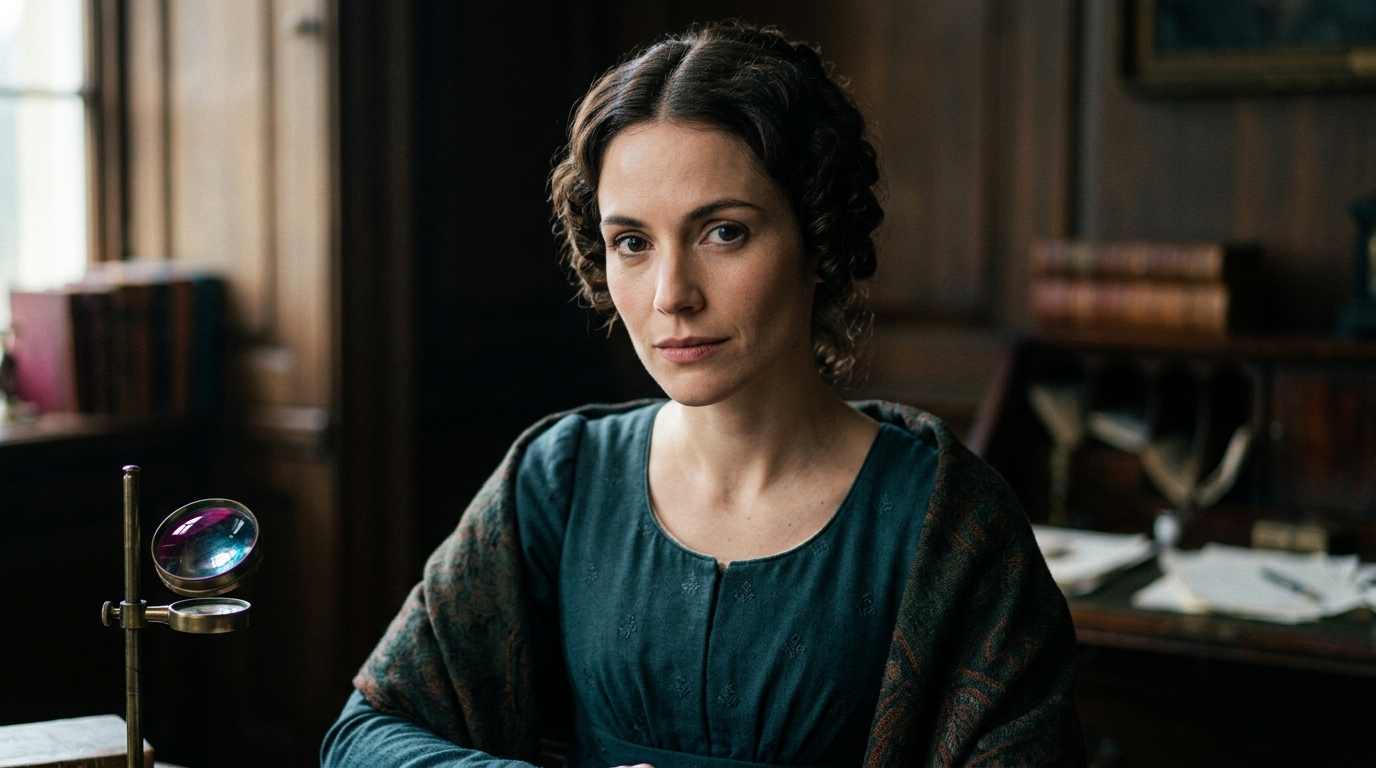
The Carrington Estate
Elizabeth Anne Carrington was born on 3 April 1779 at her family's estate near Chichester in Sussex, into a household where the study of growing things was treated as a serious calling rather than a gentlewoman's diversion. Her father, William Carrington, had inherited substantial lands and kept one of the region's finest private botanical collections; her mother, Amelia Carrington née Thornfield, was a gifted botanical illustrator who had trained under one of the founding members of the Royal Academy. Between them they gave Elizabeth a childhood steeped in observation.
The estate ran to some three hundred acres of varied ground — formal gardens, wild meadow, ancient woodland, and the experimental plots where William tried out the latest theories of the agricultural improvers. Elizabeth's earliest memories were of trailing her father through the morning dew, learning to tell one species from another by the shape of a leaf or the structure of a flower before she could properly write their Latin names. By the age of seven she kept her own herbarium, pressing and annotating specimens with a care that impressed the naturalists who visited the house.
From her mother she took something quieter than taxonomy: the discipline of drawing what she studied. Amelia set her to render each specimen by hand, insisting that the eye learned a plant only when the fingers were made to trace it, and the habit lodged so deeply that Elizabeth would draw all her life. It was an artist's training fused to a scientist's, and decades later, in another world, it would fill the shelves of a library with guides as beautiful as they were exact.
Her governess, Catherine Hartwell, encouraged the scientific bent, supplying the natural-philosophy texts usually reserved for boys, and Elizabeth devoured Linnaeus, copying out whole passages into notebooks she would one day carry to another world. Her position brought opportunities few women of her era enjoyed: she corresponded with the network around Kew, and when a celebrated patron of botany visited the estate in 1794, the fifteen-year-old engaged him in spirited debate over the classification of newly discovered Australian specimens. He left having arranged for journals to be sent to her, impressed by a mind that reasoned in systems.
Family Tree
The Highland Expedition
The death of her elder brother James in a riding accident in 1804 altered Elizabeth's position entirely. As the sole surviving child she inherited responsibilities ordinarily reserved for sons, including the management of the estate's agricultural interests. Rather than retreat into that unexpected authority, she pursued her botanical passions with greater intensity than before, as though the loss had freed her to become wholly what she already was.
Her expedition to the Scottish Highlands in 1805 was both a scientific ambition and a quiet act of rebellion. Accompanied by Mary Sinclair, she spent four months crossing some of the most inhospitable country in Britain and returned with more than two hundred specimens, among them several alpine flowers previously unknown to science. The journey demanded more than stamina. Innkeepers often refused two unchaperoned women a bed, and during a treacherous crossing of the Cairngorms Elizabeth fell through ice into a mountain stream and was pulled clear only by her companion, left afterwards with a cough that troubled her for months.
Their discoveries earned the notice of the learned botanical society in Edinburgh, though the recognition came with a galling condition. Women were barred from speaking at its meetings, and Elizabeth was made to watch from the gallery while a male colleague presented findings that were entirely her own. The experience hardened a resolve that would shape the rest of her life: to help build, somewhere, a place where scientific merit counted for more than social convention. She did not yet know how completely that somewhere would exceed her imagining.
Charles
Her acquaintance with Charles Sinclair began over the Scottish discoveries. Charles, an Edinburgh gentleman naturalist with a particular gift for geology, had read the society's published account and wrote to commend the rigour of her specimen work. Their letters, at first strictly scientific, gradually revealed two compatible minds, and the correspondence deepened into something neither was in a hurry to name.
He visited the Carrington estate in the autumn of 1806, ostensibly to examine William's collection and in truth to meet Elizabeth. Their first conversation, conducted over pressed specimens in the library, ran until dawn, and Charles wrote afterwards of having found a companion who turned his own observation into understanding. Their attachment scandalised the portion of Sussex society that judged a woman's interest in Latin and leaf structure unbecoming.
Elizabeth met such disapproval with a composure that became locally famous. When a society hostess declared at a Christmas ball that Miss Carrington would benefit from less Latin and more needlework, Elizabeth replied by calmly identifying the toxic berries woven into the woman's hair arrangement, and naming the dose at which they would prove fatal. It was the answer of a person who had long since decided that the good opinion of the ignorant was not worth the purchase of her silence.
The Impossible Commission
The invitation that changed everything came from Jonathan Blackwood, whose interest in her work had nothing to do with the drawing room. He had become a Guardian, and he moved within the Ladderman Organisation, the secretive Earth-side network that recruited and provisioned those who would cross between worlds. Charged with founding a settlement in Clivilius, a world reached through portals bound to the blood of those who held their keys, he understood that no settlement there would survive without someone who could coax Earth's plants from alien soil. He wanted Elizabeth among the five.
Their meeting in London in January 1810 tested her scientific rationalism to its limit. Blackwood's talk of parallel worlds and dimensional doorways sounded like delusion, until he produced the specimens: seeds that germinated in impossible timeframes, soil of no known mineral composition, pressed leaves belonging to no recognised order. The evidence overwhelmed her scepticism, and her scepticism, once overcome, became conviction. Here was the ultimate botanical problem — to establish life in a world with no ecosystem of its own — and she could no more refuse it than she could stop breathing.
Her father's death from pneumonia on 2 March 1810 nearly undid her plans, arriving as it did in the middle of her feverish preparations. William Carrington had championed his daughter's unconventional path, and his loss left her grieving even as it freed her of every filial obligation. She inherited the whole estate, placed it at once in the hands of trusted overseers, and turned its income to the purchase of supplies, choosing her seeds with deliberate care for genetic diversity and adaptability over any promise of immediate yield.
First Soil
Elizabeth activated her Portal Key and crossed into Clivilius with the first body of settlers on 10 May 1810, two months after Thomas Ainsworth had gone through ahead of them all to secure the ground. What met her there confounded every assumption she had carried from Sussex. The region around the infant settlement of Brierly held no plant life whatever, and with no native flora to study or adapt, the survival of the colony rested almost entirely on her ability to make Earth's species take root in unknown earth.
Her first act on arrival was to analyse the soil with the chemical testing kit she had insisted on bringing despite every restriction on weight. The results showed mineral compositions unknown on Earth and demanded amendment strategies no gardener had ever attempted. She laid out test plots across the site, documenting with merciless precision how each soil preparation altered germination and growth, and within the settlement's first month she had established a botanical garden built on a defensive design.
Its logic was survival. The central beds held the essential food crops — potatoes, carrots, cabbages — ringed by the medicinal herbs the settlement's healers would come to depend upon, with the experimental plots pushed to the margins, where the failure of an ornamental or an untried hybrid could not threaten the food supply. That first season both rewarded and punished her. Potatoes grew to extraordinary size in Brierly soil while wheat failed outright, and her unflinching record of both became the agricultural scripture the settlement's farmers would consult for generations.
Accelerated Adaptation
Elizabeth's most consequential contribution grew from a method she called accelerated adaptation: selective breeding programmes that compressed generations of change into single seasons. By controlling pollination with great patience and selecting hard for the traits that suited Brierly's conditions, she produced plant varieties fitted to the new world in years rather than decades, turning the slow work of evolution into something a single determined lifetime could direct.
Her partnership with the Bennett family, the settlement's principal farmers, proved decisive in the matter of grain. They brought the practical knowledge of the field; she brought the method that turned trial and error into systematic improvement, and together they bred the hardy hybrid known as Brierly wheat, which secured reliable bread by the settlement's third year. It was a marriage of craft and science that came to stand for how Brierly did things.
Strangest of all was her discovery that certain Earth plants developed enhanced properties in Clivilian soil: medicinal herbs grew more potent, vegetables more nourishing, flowers more vividly coloured. She theorised that the unfamiliar minerals of the new world were waking some dormant potential within the plants themselves, reaching, without the vocabulary to name it, toward an understanding later science would recognise. Foreseeing that the portals might one day close, she established Brierly's seed bank in 1815, preserving a line of every variety she had perfected — a foresight that would matter more than she could know.
The seed bank was no mere cupboard of jars. She had it built into chambers cut below ground, where the temperature held steady and the air stayed dry, and she set down protocols for the regular renewal of every line so that nothing in the collection should quietly die of neglect. It was the labour of a woman planning for a century she would never see, and when the last portal finally closed it would stand between Brierly and the slow attrition that had ended lesser settlements.
Hearth, School, and Festival
Elizabeth and Charles married on 15 June 1813 in the settlement, the ceremony conducted by Thomas Ainsworth in his role as the Guardians' leader, the bride in a plain muslin dress and carrying the first flowers successfully grown in Brierly soil. Their son, William Charles Sinclair, was born on 8 November 1815, and a daughter, Amelia Jane, followed on 22 March 1818. Amelia's recurring respiratory frailty drew Elizabeth deeper into medicinal botany. She worked closely with Mary Fairchild, the Guardian who held the settlement's medical authority, and with Alice Turner, the working healer and midwife who tended Brierly's households day to day, the three of them raising treatments that eased the child's breathing.
Her conviction that knowledge should belong to everyone found its fullest expression in the Brierly Schoolhouse, established on 12 September 1823. She built its natural-history curriculum herself and insisted that girls and boys alike receive a botanical education, pairing theory with work in the garden until a generation of Brierly children had grown up more fluent in plants than most Earth-trained naturalists. The gallery she had once been confined to in Edinburgh had taught her exactly what she did not wish her settlement to become.
She gave the same energy to the Harvest Festival, which the community had kept each year since its first celebration in 1820. Under her hand it grew into a showcase of horticultural achievement, settlers vying to bring forward the finest specimens while Elizabeth presided as chief judge, her assessments weighing scientific merit alongside beauty. Her illustrated botanical guides, drawn with the precision her mother had taught her, became treasured volumes in the settlement's library, valued for their accuracy and for the quiet pleasure of their making alike.
The Greenhouse Years
Not every innovation won easy approval. Her insistence on giving precious water to the ornamental gardens during the drought of 1832 drew sharp objection from those who held that survival left no room for beauty, and she answered with characteristic logic, demonstrating that her flowering plots served as pest indicators and drew the pollinators on which the food crops depended. Her long disagreement with George Whitmore, whose spreading vineyards she feared would crowd out genetic diversity, became known in settlement memory as the Wine and Wheat War, a clash of two essential visions that never quite curdled into enmity.
Tragedy reshaped her in 1837, when a rockslide in the local mountains crushed Charles's leg as he collected geological samples and forced its amputation below the knee. Elizabeth oversaw the care while Mary Fairchild performed the surgery, Alice Turner steady at her side, the two of them drawing on the very medicinal plants Elizabeth had bred to dull the pain. Charles survived but never regained his old vigour, and as a non-Guardian he had never held portal access of his own; thereafter Elizabeth gave up not only her botanical expeditions but her own increasingly difficult portal journeys, unwilling to risk leaving their children with no parent in Clivilius.
The years that followed turned her from experiment toward consolidation. When their son William left in 1840 to help found a satellite settlement, she pressed him by letter to keep his own botanical records, building a scientific dynasty against the day Brierly's last bridge to Earth would fall. In 1843 Charles designed a greenhouse of local materials, the first in the settlement, and it became her sanctuary as her strength declined. There she completed her four-volume masterwork, Flora Clivilia, distilling forty years of observation into a guide she meant to outlast her, preparing Brierly for the isolation she was certain would come.
Last Harvest
The cold seasons of those final years brought sickness to the settlement, and Elizabeth, already worn by decades of relentless work and never wholly free of the cough she had carried out of the Cairngorms, contracted influenza while tending stricken neighbours. Her own experimental remedies and the most determined care of Mary Fairchild and Alice Turner could not turn the illness, and she declined through the year despite every effort to hold her.
She spent her last months setting down the observations she had been too busy to record, dictating to Amelia from her bed when her strength allowed — cultivation techniques, untried hybrids, the proper timing for transplanting seedlings. She remained practical to the very end, more concerned with what the next gardener would need than with any reckoning of her own.
Elizabeth Anne Sinclair died at dawn on 12 October 1850, in her seventy-second year, among the plants she had raised from seeds carried between worlds. Her death came in the same year that took George Whitmore, leaving Mary Fairchild the last of the original Guardians, to carry the burden of the portal alone for the seven years that remained to it. Elizabeth died having done what she set out to do: the settlement she had fed would endure even after its final bridge to Earth was severed.
Her funeral, three days later, drew mourners from every settlement within reach, and they gathered in the botanical garden she had made. They laid seeds and cuttings upon her coffin, living tributes meant to carry her work onward, and buried her beneath an oak she had grown from an acorn brought out of her father's Sussex estate, a tree that stood as a bridge between the world she had left and the one she had helped raise from bare ground. Charles tended her greenhouse and her gardens for the eight years left to him, with a devotion in which scientific duty and private grief were no longer separable.







