
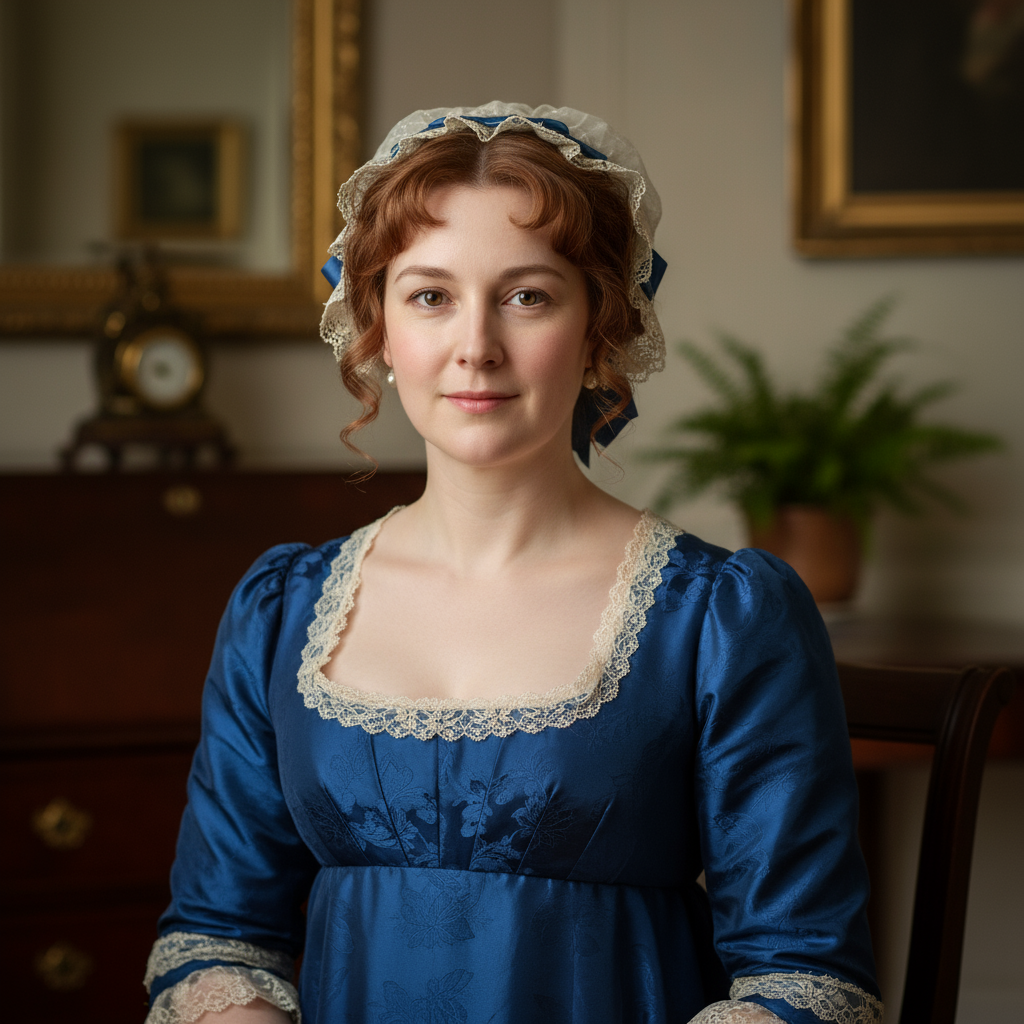
Elizabeth Anne Bally (née Spencer)
Born in London in 1770, Elizabeth Anne Spencer embodied Georgian refinement whilst possessing remarkable practical intelligence. Her 1790 marriage to Portsmouth merchant Thomas Henry Bally united two commercial dynasties, creating a partnership that weathered the Napoleonic Wars and raised four accomplished children. Founding the Portsmouth Ladies' Benevolent Society, she channelled her cultural sophistication into meaningful philanthropy. Her greatest trial came when daughter Madelyn's Tasmanian marriage brought scandal, testing a mother's resilience across impossible distances until her death in 1848.
London Beginnings
Elizabeth Anne Spencer entered the world on 5 May 1770 in London's Bloomsbury district, arriving into a household where commerce and culture existed in harmonious balance. Her father, Jonathan Spencer, had established himself as a prosperous merchant specialising in luxury goods—fine textiles, quality porcelain, elegant furnishings that adorned the homes of London's prosperous classes. His business required not merely capital and connections but cultivated taste, the ability to discern what the fashionable would desire before they quite knew themselves.
Her mother, Amelia Hartley before marriage, brought to the union qualities that complemented Jonathan's commercial acumen. Well-read and culturally sophisticated, Amelia had received the education that wealthy merchants increasingly provided their daughters—not merely accomplishments meant to attract suitable husbands, but genuine intellectual cultivation. She read widely in English and French literature, played the pianoforte with more than merely competent skill, and possessed the social graces that made the Spencer townhouse a gathering place for those who valued conversation alongside commerce.
The Bloomsbury residence where Elizabeth spent her formative years represented Georgian London at its most comfortable. Not quite the aristocratic grandeur of Mayfair, nor the bohemian energy that would later characterise the district, but solid, prosperous respectability. The Spencer household occupied a handsome townhouse whose interiors reflected Jonathan's business expertise—tastefully furnished with items that demonstrated quality without ostentation, cultured without pretension.
Elizabeth's childhood unfolded amidst this environment of cultured prosperity. She was the only daughter, the Spencer heir to a different sort of legacy than a son would have inherited. Where a son would have learned the mechanics of Jonathan's business, Elizabeth absorbed something subtler but equally valuable—the aesthetic judgment that recognised quality, the social intelligence that navigated complex interpersonal dynamics, the cultural literacy that could converse knowledgeably about literature, music, and art.
Her education reflected her parents' values and their position in London's prosperous merchant class. Private tutors taught her French and Italian—languages that signified cultural sophistication rather than practical necessity. She studied music seriously, her piano instruction emphasising not merely technical proficiency but genuine musical understanding. She read extensively from her mother's library, absorbing literature that ranged from classical authors to contemporary novels that explored the emotional and social complexities of Georgian life.
But Elizabeth's education extended beyond formal instruction to include the subtle lessons absorbed through observation. She watched her mother manage their household with efficiency that appeared effortless but required considerable skill. She observed how her parents navigated London society, cultivating relationships that combined genuine friendship with strategic advantage. She learned that refinement meant more than surface accomplishments—it required the intelligence to apply cultural knowledge to practical situations.
The Portsmouth Marriage
The year 1790 brought the defining transition of Elizabeth's life when, at twenty, she married Thomas Henry Bally and relocated from cosmopolitan London to the naval port of Portsmouth. The match represented both romantic attachment and strategic alliance—Thomas, at twenty-two, possessed solid prospects in Portsmouth's merchant community, whilst Elizabeth brought London connections and the cultural sophistication that provincial society found impressive.
Their courtship remains somewhat obscure in the surviving record, but one can reasonably infer its character. Thomas had likely encountered Elizabeth through the interconnected networks that bound London and Portsmouth merchants—perhaps through her father's business connections, perhaps through mutual acquaintances in the commercial world. He would have recognised in her not merely beauty and accomplishment but the particular qualities that would make her an ideal partner for an ambitious merchant building his career.
The wedding on 5 May 1790 united two merchant families whilst marking Elizabeth's farewell to the London life she had known. The transition from daughter in her parents' comfortable household to wife in a still-establishing merchant's home required significant adjustment. Portsmouth, whilst substantial and prosperous, lacked London's metropolitan sophistication. The social circles were narrower, the cultural offerings more limited, the overall atmosphere more provincial.
Yet Elizabeth approached this transition with characteristic grace and practical intelligence. She recognised that she could either lament what Portsmouth lacked or work to create what it needed. Her London upbringing had equipped her with advantages that could be strategically deployed—cultural knowledge that impressed Portsmouth society, social skills that could be applied to building useful relationships, and the confidence that came from knowing she possessed sophistication that the port city valued but could not quite replicate.
The early years of marriage brought both the joys and challenges common to establishing a household. Thomas's business, whilst promising, had not yet achieved the success that would come later. Resources required careful management, social obligations had to be balanced against financial constraints, and the practical realities of maintaining a household demanded skills that Elizabeth's privileged upbringing had not necessarily taught. She learned, adapted, and proved herself capable of managing domestic economy with the same efficiency her mother had demonstrated.
Building a Portsmouth Life
Elizabeth's transformation of the Bally household into a cultural centre represented deliberate strategy executed with apparent effortlessness. She understood that Portsmouth society, dominated by naval officers and prosperous merchants, hungered for cultural sophistication that reminded them of London whilst being accessible in their provincial setting. Her regular soirées, ostensibly devoted to music and literary discussion, functioned also as networking opportunities where useful connections could be cultivated in agreeable surroundings.
These gatherings showcased Elizabeth's particular talents. She could perform at the pianoforte with sufficient skill to impress without overshadowing guest performers. She could guide conversation towards topics that allowed participants to display their knowledge whilst avoiding controversial subjects that might create uncomfortable tensions. She could make each guest feel valued whilst subtly managing social dynamics to ensure that useful connections were made and strengthened.
The soirées served Thomas's business interests whilst satisfying Elizabeth's own cultural inclinations. A merchant whose home offered not merely commercial competence but also refined society possessed advantages in an era when business relationships rested upon personal connections. Wives who could create agreeable social environments where business could be discussed without appearing crudely commercial provided their husbands with invaluable assets. Elizabeth understood this dynamic and deployed her cultural sophistication accordingly.
But her Portsmouth life extended beyond social strategy to include genuine intellectual and cultural engagement. She maintained her love of reading, her piano playing, her appreciation for music and literature that transcended their instrumental value. In this, she provided a model for her children—that cultivation meant more than social performance, that genuine refinement required ongoing intellectual engagement, that culture possessed intrinsic value beyond its usefulness for advancing one's position.
Her involvement in charitable activities reflected both religious conviction and practical recognition that a healthy community benefited all who lived within it. The Portsmouth Ladies' Benevolent Society, which she helped found, aimed to provide education and support to impoverished women—a cause that combined fashionable philanthropy with meaningful assistance to those genuinely in need. Elizabeth approached charity with the same intelligence she brought to social entertaining, recognising that effective philanthropy required more than merely dispensing money.
Motherhood and Family
The arrival of children transformed Elizabeth's role from Thomas's partner to mother responsible for shaping the next generation. Madelyn Elizabeth, born 12 June 1795, arrived first, followed by Edward Thomas on 23 March 1798, Clara Margaret on 7 January 1801, and James Henry on 2 October 1803. Each child represented both joy and responsibility, a future to be guided through careful parenting and example.
Elizabeth approached motherhood with characteristic thoughtfulness. She understood that her children, particularly her daughters, would be judged by standards that reflected upon the entire family. They must possess the accomplishments expected of their social position whilst developing genuine character and intelligence. They must learn to navigate society's expectations whilst maintaining individual integrity. They must understand both the advantages their position provided and the responsibilities those advantages entailed.
Madelyn, as the eldest daughter, received particular attention from her mother. Elizabeth ensured she developed not merely the surface accomplishments that would make her an attractive marriage prospect but genuine cultural literacy and intellectual capability. She taught Madelyn to play the piano, to read French, to converse intelligently about literature and current events. But she also taught subtler lessons—how to assess character beneath social performance, how to maintain dignity under pressure, how to balance personal desires against family obligations.
The relationship between Elizabeth and Madelyn combined maternal affection with mutual respect born of shared intelligence. As Madelyn matured, Elizabeth increasingly treated her as confidante rather than merely dependent child. They discussed literature, social dynamics, the complexities of managing household and social obligations. Elizabeth recognised in her daughter a keen mind that deserved cultivation beyond mere preparation for marriage.
Edward, as the eldest son and heir to Thomas's business, received training appropriate to his future role, but Elizabeth ensured he also developed cultural refinement that would distinguish him from mere tradesmen. Clara demonstrated artistic inclinations that Elizabeth encouraged, understanding that patronage of the arts represented both cultural contribution and social positioning. James, the youngest, benefited from the accumulated wisdom of parents who had successfully raised three children before him.
The Napoleonic Challenge
The outbreak of the Napoleonic Wars in 1803 tested Elizabeth's resilience and practical capability in ways her comfortable upbringing had not prepared her for. The conflict disrupted Thomas's business, created economic uncertainty, and imposed stresses upon the family that no amount of cultural sophistication could entirely mitigate. Elizabeth's role evolved from gracious hostess to practical manager helping sustain the household through uncertain times.
Her response demonstrated that her refined exterior concealed considerable strength. She managed household economies with increased stringency without allowing the family to appear reduced in circumstances. She maintained social obligations despite the strain, recognising that retreating from society would only amplify perceptions of financial difficulty. She provided emotional support to Thomas as he navigated business challenges whilst managing her own anxieties about their family's security.
The war years also tested Elizabeth's relationship with her children, particularly as they matured into awareness of their family's vulnerabilities. She worked to maintain normalcy, to shield them from adult anxieties whilst preparing them to understand that prosperity required constant effort, that circumstances could change, that resilience mattered more than inherited advantage. Her example during these years taught lessons about maintaining dignity under pressure that would prove invaluable, particularly to Madelyn.
Elizabeth's charitable work continued through the war years, though necessarily modified by reduced resources. She understood that those genuinely impoverished suffered even more acutely during times of general economic difficulty. Her continued involvement with the Portsmouth Ladies' Benevolent Society, even when personal circumstances made such generosity more difficult, demonstrated the principle that privilege entailed obligations that persisted regardless of one's own challenges.
The Jeffries Complication
The arrival of William Thomas Jeffries Sr. in Portsmouth during early 1818 introduced complications that would test Elizabeth in ways no previous challenge had. This mysterious colonial entrepreneur, pursuing Madelyn with focused intensity, troubled Elizabeth in ways she struggled to articulate to her daughter. William possessed obvious wealth and spoke persuasively about Tasmanian opportunities, yet something about him felt incomplete, obscured.
Elizabeth's maternal instincts registered warning signals her intellect could not quite justify. William's manner combined charm with guardedness that suggested concealment. His background, when investigated as circumstances allowed, seemed legitimate yet somehow insubstantial. His obvious attraction to Madelyn appeared genuine, yet his evasiveness about certain subjects hinted at complexities he refused to address. Elizabeth found herself in the difficult position of sensing danger she could not definitively identify.
Her concerns found sympathetic hearing from Thomas, who shared her unease. Yet both recognised that parental authority had limits. Madelyn had reached an age where forbidding the match would merely embitter their relationship without preventing it. William's visible wealth and social position made outright rejection difficult to justify rationally. And perhaps both parents hoped their concerns reflected excessive caution rather than genuine prescience.
The wedding on 28 June 1818 brought Elizabeth both joy and sorrow. She celebrated her daughter's happiness whilst privately wrestling with foreboding she could not entirely suppress. When she embraced Madelyn in farewell before her departure for Tasmania, Elizabeth understood with maternal clarity that she might never see her daughter again. The distance was too vast, the journey too expensive and dangerous, for casual returns to England. She was not merely releasing her daughter to marriage but potentially losing her forever to the other side of the world.
The Long Correspondence
The years following Madelyn's departure brought Elizabeth the peculiar anguish of maintaining maternal connection across impossible distance. Letters became their only link, carried by ships that took months to complete their voyages. Elizabeth's correspondence reveals her struggle to provide guidance whilst recognising that Madelyn confronted circumstances beyond her experience or advice.
The early letters, when Madelyn described her new life at Jeffries Manor and the birth of William Jr., brought Elizabeth vicarious pleasure mixed with longing. She could imagine the grand estate, picture her grandson's features, share Madelyn's joy at motherhood. But even these happy communications carried undertones of concern—Madelyn's careful descriptions of William Sr.'s business dealings, her tactful mentions of rumours surrounding his wealth, her diplomatic silence about matters that troubled her.
The news of William Sr.'s mysterious disappearance in August 1821 reached Portsmouth months after the event, arriving with the impact of catastrophe simultaneously current and already resolved into whatever outcome had occurred. Elizabeth's response reveals both maternal anguish and practical intelligence. She could offer no immediate assistance across such distance, but her letters provided the steady counsel that helped Madelyn navigate scandal whilst managing the estate and protecting young William Jr.
These letters demonstrate Elizabeth's particular strengths—her ability to provide emotional support whilst offering practical advice, her capacity to understand complex social dynamics and suggest strategies for managing them, her talent for seeing beyond immediate crisis to longer possibilities. She counselled Madelyn to focus on protecting William Jr. and maintaining the estate's operations, to demonstrate through consistent behaviour that the Jeffries name stood for respectability despite the scandal, to recognise that resilience mattered more than immediate vindication.
The correspondence continued through decades, chronicling Madelyn's transformation from dependent wife to capable estate manager and philanthropist. Elizabeth's pride in her daughter's accomplishments mixed with sorrow that distance prevented her from witnessing them directly. She knew Madelyn only through words on paper—her grandson growing to manhood, her daughter establishing The Haven Home for Children, the Jeffries legacy secured through Madelyn's determination. Yet the essential connection between mother and daughter endured, sustained by letters that bridged half the world.
Later Years and Final Legacy
Elizabeth's later years brought the satisfactions and sorrows common to long life. She witnessed her other children establish their own families and careers—Edward successfully managing Bally & Co., Clara becoming a patron of Portsmouth's artistic community, James involving himself in the merchant guild that his father had helped establish. She maintained her charitable work, her cultural activities, her position as a respected figure in Portsmouth society.
Thomas's death on 14 September 1845 ended the partnership that had sustained her for fifty-five years. The loss devastated Elizabeth in ways that her public composure concealed. They had built a life together, weathered challenges together, raised children and built legacies together. His absence left a void that no amount of family attention or social engagement could fill. She had lost not merely her husband but her intellectual companion, her partner in all the endeavours that had defined her adult life.
The three years between Thomas's death and her own brought Elizabeth a kind of quiet preparation for her own ending. She settled affairs, ensured that her children understood her wishes, and wrote final letters to Madelyn that would not arrive in Tasmania until after her death. These letters reveal a woman reflecting upon her life with satisfaction tempered by acknowledgement of its limitations—she had accomplished much, influenced many, created legacies that would endure, yet the fundamental fact of Madelyn's permanent distance remained an unhealed wound.
Elizabeth Anne Bally passed away on 12 November 1848 at her Portsmouth home, aged seventy-eight. The funeral, held at St. Mary's Church, drew those who remembered her as a woman who had brought London sophistication to Portsmouth society, who had advanced charitable causes with intelligence and commitment, who had maintained grace and dignity through challenges that might have broken someone of lesser character.
She was buried beside Thomas in the family plot at St. Mary's Churchyard, their shared resting place representing the partnership that had endured from 1790 until Thomas's death in 1845. Their children and grandchildren gathered to honour a woman who had shaped their lives through example and instruction, recognising that the values she embodied—cultural refinement combined with practical intelligence, social grace paired with genuine compassion, strength concealed beneath gracious demeanour—represented ideals worth preserving.
Elizabeth's legacy extended beyond her immediate family to influence Portsmouth's social and charitable landscape. The Portsmouth Ladies' Benevolent Society continued her work of providing education and support to impoverished women. The cultural standards she had helped establish through her salons and gatherings influenced Portsmouth society's character well into the Victorian era. Her example demonstrated that refinement meant more than surface accomplishment, that privilege entailed responsibility, that grace under pressure constituted genuine nobility of character.
For Madelyn, receiving word of her mother's death months after it occurred, the loss brought particular anguish. She had known for years that she would likely never see her mother again, but hope's death proved more painful than its prolonged suspension. The final letters Elizabeth had written, arriving after her death with the poignancy of messages from beyond the grave, provided cold comfort. Madelyn had her mother's words but not her presence, her wisdom but not her embrace, her legacy but not her living companionship.
The woman who had been born Elizabeth Anne Spencer in London's Bloomsbury, who had married Thomas Henry Bally and transformed herself into a Portsmouth matron, who had raised four accomplished children whilst maintaining cultural standards and advancing charitable causes, who had provided steady counsel to a daughter facing scandal half a world away—this woman left a legacy that transcended the limitations of her era and gender. She demonstrated that intelligence and strength could coexist with grace and refinement, that one could navigate social expectations whilst maintaining individual integrity, that maternal love could sustain connection across impossible distances.







