Elizabeth Amelia Bennett (née Jeffries)
Elizabeth Amelia Jeffries (1849–1925) was the third child of William Edward Jeffries Jr. and Ellen Amelia Cross, born at Jeffries Manor in Granton, Tasmania. An accomplished watercolourist whose landscapes earned critical recognition across the colony, she married architect Charles Alfred Bennett in 1868 and settled in Battery Point, Hobart. Through decades of cultural patronage, charitable work, and artistic mentorship, she became one of Tasmania's most influential advocates for the arts and women's education.
Childhood at Jeffries Manor (1849–1862)
Elizabeth Amelia Jeffries was born on the afternoon of 13 September 1849 at Jeffries Manor in Granton, Tasmania, the third child and second daughter of William Edward Jeffries Jr. and Ellen Amelia Jeffries (née Cross). Her father, a Cambridge-educated lawyer turned industrialist, had spent a decade transforming the family's controversial fortune into a respected colonial enterprise. Her mother, the youngest daughter of Judge Abraham Isaac Cross and Elizabeth Harriet Cross (née Hawkins), had brought to Jeffries Manor an intellectual vibrancy and philanthropic conviction that profoundly shaped the household's character.
Elizabeth arrived into a family already taking definite form. Her elder sister Madelyn Elizabeth, nearly four years old at the time of her birth, had begun displaying the strong-willed temperament that would eventually make her a formidable philanthropist in her own right. Her brother William, two years her senior, was already exhibiting the competitive possessiveness that their mother noted with private concern. Two younger siblings would follow — Thomas Nathaniel in November 1851 and Edwin in March 1853 — completing the family of five children who would each, in their distinct ways, carry forward the Jeffries name.
Of all the Jeffries children, Elizabeth developed the closest bond with her mother. Ellen had yearned for a daughter who shared her aesthetic sensibilities, and in Elizabeth she found precisely that — a child whose response to the world was instinctively visual, who noticed the play of light across the Derwent River before she could articulate what she was seeing. Their connection deepened through shared artistic pursuits that began almost as soon as Elizabeth could hold a brush. Ellen, who had received her own artistic education under the instruction of governess Miss Margaret Thornbury and her elder sister Charlotte Cross, recognised her daughter's talent early and nurtured it with attentive patience.
The environment at Jeffries Manor during Elizabeth's formative years was one of cultivated refinement overlaid with unspoken tension. Her father's relentless business expansion and growing political involvement left him frequently absent, whilst the shadow of her grandfather's mysterious disappearance in 1821 — a subject never openly discussed yet somehow always present — lent the household an atmosphere of guarded secrecy that even a child could sense. Elizabeth responded to this atmosphere not with the combative ambition of her brother William or the calculated watchfulness of young Edwin, but with a quiet withdrawal into creative expression. The watercolour sketches she produced as a girl — gardens, river views, the weathered sandstone of the manor itself — represented her earliest attempts to impose beauty and order upon a world that seemed, to her childish perception, to contain unsettling undercurrents she could not name.
Her grandmother Madelyn Elizabeth Jeffries (née Bally), who resided in the east wing of the manor until her death in November 1867, provided an additional source of affection and storytelling during Elizabeth's childhood. The formidable matriarch who had single-handedly preserved the Jeffries empire following her husband's disappearance softened considerably in the company of her grandchildren, and Elizabeth's gentle temperament made her a particular favourite. Grandmother Madelyn's accounts of colonial Tasmania's early days — carefully edited to omit the more scandalous details — fed Elizabeth's imaginative life and her growing appreciation for the landscape that had shaped her family's history.
Education and Artistic Formation (1855–1868)
Like her siblings, Elizabeth received her education through private tutors at Jeffries Manor, supplemented by the intellectual atmosphere her mother cultivated through the household's extensive library and regular cultural gatherings. The formal curriculum encompassed literature, languages, music, and the natural sciences — subjects deemed appropriate for a young woman of her station — but it was in the visual arts that Elizabeth distinguished herself beyond the ordinary accomplishments expected of colonial daughters.
Her artistic education progressed through several phases. Early instruction focused upon the technical foundations of drawing and painting, with particular emphasis on botanical illustration — a discipline her mother valued for its combination of scientific observation and aesthetic sensitivity. By her early teens, Elizabeth had developed sufficient skill in watercolour to produce landscapes that impressed visitors to the manor, her renderings of the Derwent Valley's shifting light demonstrating an instinctive understanding of colour and atmosphere that formal training alone could not have produced.
Her mother's influence upon her artistic development extended well beyond technique. Ellen's monthly musical soirées at Jeffries Manor, which drew performers and audiences from across Tasmania's social spectrum, introduced Elizabeth to a world where artistic expression served as both cultural enrichment and social bridge. She observed how her mother used these gatherings to challenge rigid class distinctions, seating talented musicians from modest backgrounds alongside wealthy amateurs, and absorbed the lesson that art possessed a democratising power that commerce and politics could never replicate.
Equally formative were the philanthropic excursions Ellen organised for her daughters. Elizabeth accompanied her mother on visits to orphanages, schools, and charitable institutions throughout Hobart, experiences that instilled a conviction — never quite articulated in these early years but steadily deepening — that privilege carried obligations beyond the maintenance of one's own comfort. She witnessed her mother's patient work with disadvantaged women and children, and understood, with the quiet perceptiveness that characterised her temperament, that beauty and compassion were not separate impulses but complementary expressions of the same fundamental decency.
The death of her father on 18 August 1880 would later become a defining moment, but the years of Elizabeth's adolescence were marked by a subtler loss — the gradual withdrawal of William Edward Jeffries Jr. into the private obsessions that consumed his later life. As her father retreated into brooding preoccupation with his own father's unsolved disappearance, Elizabeth found herself increasingly reliant upon her mother's companionship and guidance. The emotional distance that grew between William Jr. and his family affected each child differently; for Elizabeth, it reinforced the conviction that emotional sustenance was to be found not in the corridors of power and commerce but in the gentler realms of art, music, and human connection.
Marriage to Charles Alfred Bennett (1868)
In 1868, at the age of nineteen, Elizabeth married Charles Alfred Bennett, an architect of growing reputation who had studied his profession in London before returning to establish a practice in Hobart. Charles came from a respectable though not especially wealthy Tasmanian family, and his appeal to Elizabeth lay not in dynastic advantage but in the genuine sympathy of their temperaments. He possessed an architect's trained eye for proportion and beauty, a deep appreciation for the arts that complemented Elizabeth's own, and a practical idealism about the role of design in improving public life that resonated with her philanthropic instincts.
The wedding, whilst conducted with the formality appropriate to a Jeffries daughter's marriage, lacked the political calculation that had attended her parents' union at St. David's Cathedral in 1843. William Jr., still active in business at the time though increasingly withdrawn in private life, approved of the match without great enthusiasm — Charles Bennett's professional credentials were sound but offered none of the judicial connections that had made Ellen Cross so strategically valuable a generation earlier. Ellen, however, recognised in Charles a temperament well suited to her daughter's needs and quietly encouraged the pairing, understanding that Elizabeth would flourish best alongside a man who valued beauty as much as ambition.
The couple settled in Battery Point, Hobart, establishing their household in a colonial residence that Charles had restored with characteristic attention to period detail and practical elegance. The house became a reflection of their shared sensibilities — filled with art, books, and music, its rooms arranged to maximise the natural light that Elizabeth required for her painting. It stood in deliberate contrast to the grandeur of Jeffries Manor, offering intimacy and warmth where the family seat offered history and obligation.
Family Life and Domestic Harmony (1870–1902)
Between 1870 and 1878, Elizabeth and Charles had four children. Margaret, their eldest, was born in 1870 and would develop a passion for music education that echoed her grandmother Ellen's cultural convictions. Samuel, born in 1873, showed an early fascination with his father's architectural drawings and eventually joined Charles's practice. Clara arrived in 1876, inheriting her mother's literary sensibility and pursuing a career as a writer. The youngest, Alfred, born in 1878, gravitated toward the natural sciences, his curiosity about the Tasmanian landscape finding expression through systematic study rather than his mother's artistic interpretation.
Elizabeth approached motherhood with the same patient attentiveness her own mother had demonstrated. She ensured her children received a broad education and encouraged each to pursue their individual inclinations rather than conform to prescribed roles. She read to them from the same authors who had shaped her own imagination, took them on sketching expeditions along the Derwent, and involved them in charitable activities from a young age — replicating, consciously or not, the formative experiences Ellen had provided for her.
The Bennett household in Battery Point operated as a quieter, more intimate version of the cultural salon Ellen had established at Jeffries Manor. Elizabeth hosted art exhibitions and musical evenings that provided platforms for local artists and musicians, creating a space where creative talent could be nurtured and displayed without the intimidating grandeur of elite colonial society. These gatherings, modest in scale compared to her mother's soirées, possessed an earnestness and warmth that made them popular amongst Hobart's artistic community. Charles's architectural connections brought craftsmen and designers into their circle, blending practical artistry with Elizabeth's more expressive creative world.
The marriage itself appears to have been a genuinely contented partnership — a rarity amongst the Jeffries family's alliances, which more often served dynastic function than personal happiness. Charles shared Elizabeth's quiet temperament, her love of beauty, and her belief that creative expression and community service were complementary pursuits. Their home lacked the undercurrents of tension and concealment that had pervaded Jeffries Manor, offering their children the emotional stability that Elizabeth's own childhood had sometimes lacked. If the partnership had a limitation, it was perhaps a shared tendency toward gentle withdrawal from the harsher realities of public life — a trait that served them well domestically but occasionally left them ill-prepared for the familial conflicts that engulfed the broader Jeffries clan.
Artistic Career and Cultural Patronage
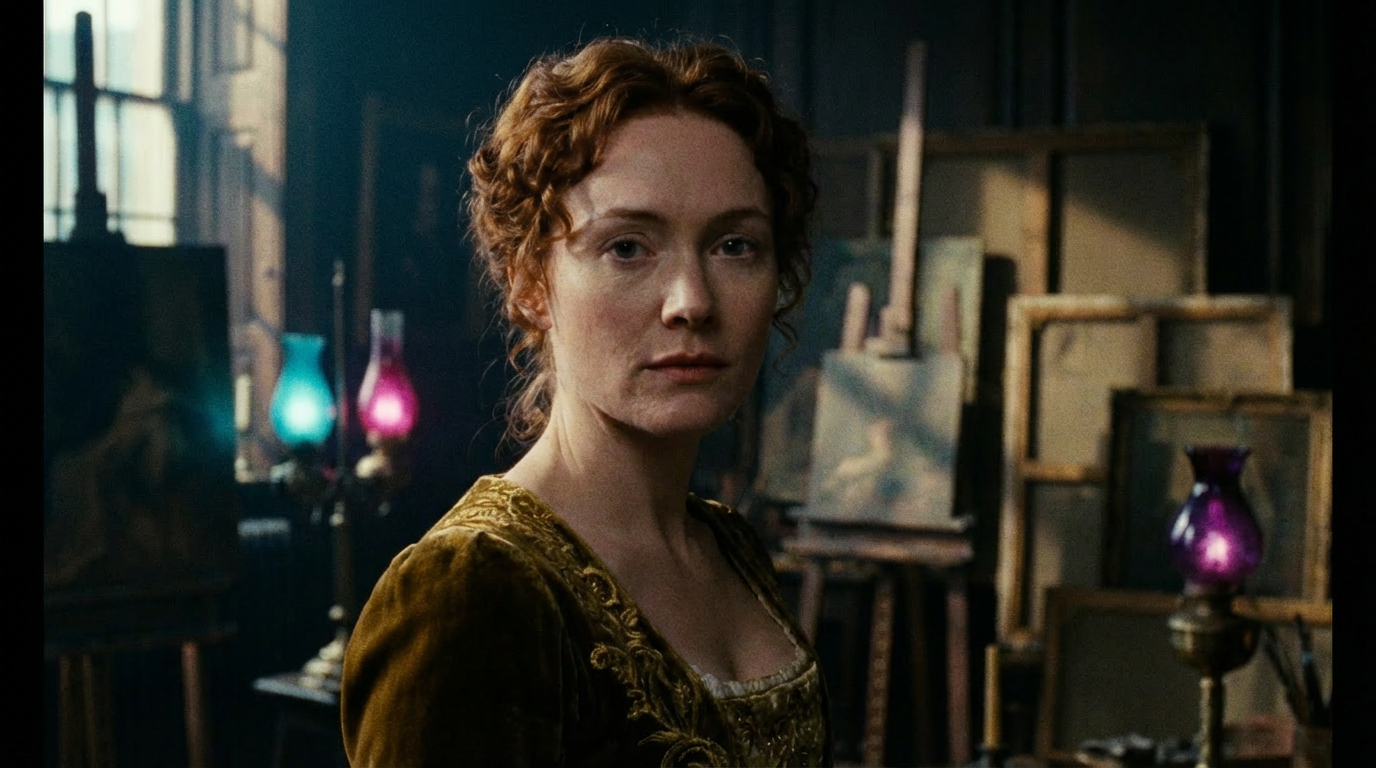
Elizabeth's development as a watercolourist continued steadily throughout her adult life, moving from the private accomplishment of her girlhood into a recognised artistic career. Her landscapes — predominantly Tasmanian scenes depicting the Derwent Valley, the coastlines of the south-east, and the gardens of colonial estates — earned critical attention for their luminous handling of light and their sensitive rendering of the island's distinctive atmosphere. She favoured early morning and late afternoon subjects, capturing the soft, angled illumination that gave Tasmania's scenery its characteristic quality of gentle melancholy.
Her work was exhibited regularly in Hobart's galleries, where it attracted both popular admiration and the respect of fellow artists. The paintings' appeal lay not in dramatic composition or technical virtuosity — Elizabeth made no claim to the innovative ambition of her male contemporaries — but in their quietly observant truthfulness and their evident affection for the landscapes they depicted. Collectors valued them as records of a Tasmania that was rapidly changing under the pressures of industrial development, and several pieces found their way into private collections across the Australian colonies.
Elizabeth channelled her artistic reputation toward broader cultural purposes. As a patron of the Hobart School of Arts, she supported its mission to provide affordable instruction in drawing, painting, literature, and the sciences to students from all social backgrounds. Her financial contributions enabled the expansion of class offerings and the creation of scholarships for disadvantaged young people, whilst her personal involvement — attending exhibitions, critiquing student work, and occasionally teaching informal workshops — gave the institution a connection to Hobart's artistic establishment that enhanced its reputation and practical value.
Perhaps the most significant artistic commission of Elizabeth's later career was the portrait she painted of her mother in 1895. Ellen, by then in her seventies and increasingly confined by arthritis, sat for her daughter in the Jeffries Manor sitting room over several weeks of sessions that both women treasured as an extension of the intimacy they had shared since Elizabeth's childhood. The finished portrait, rendered with a tenderness that transcended technical accomplishment, captured Ellen's penetrating intelligence and quiet moral authority with an emotional directness that Elizabeth's landscape work rarely attempted. It was subsequently hung in the Tasmanian Museum and Art Gallery, where it remains — a daughter's tribute to the woman who had shaped her character and nurtured her talent.
Philanthropy and Community Service
Elizabeth's charitable work, though less conspicuous than the grand philanthropic programmes established by her parents, reflected the same underlying conviction that privilege demanded active contribution to communal welfare. Her approach differed from her mother's in scale and method — where Ellen had wielded influence through institutional reform and political advocacy, Elizabeth worked through personal engagement and cultural initiative, creating change through individual relationships rather than systemic restructuring.
Her co-founding of the Hobart Women's Shelter represented her most substantial institutional commitment. Established as one of Tasmania's earliest safe spaces for women and children fleeing domestic hardship, the shelter drew upon Elizabeth's organisational skills, her ability to raise funds through her social and artistic connections, and her genuine compassion for those whose circumstances offered none of the protections she had enjoyed. She managed fundraising efforts, organised volunteer networks, and contributed both financially and personally to the shelter's operations over several decades.
Beyond the shelter, Elizabeth dedicated considerable energy to art education initiatives aimed at young women. She offered informal painting classes at her Battery Point home, providing materials and instruction to aspiring artists who lacked the means to pursue formal training. Several of her students went on to establish their own artistic practices or teaching careers, extending Elizabeth's influence through a network of mentorship that operated outside official institutional structures. She also used her exhibition proceeds to fund charitable causes, directing portions of sales revenue toward local schools and community programmes — a practice that reflected her mother's philosophy of embedding philanthropic purpose within every sphere of activity.
Her relationship with her elder sister Madelyn, who had become a prominent philanthropist in her own right following her marriage to lawyer Charles Benjamin Worthington, provided a complementary partnership in charitable work. Where Madelyn focused upon women's shelters and social justice advocacy, Elizabeth contributed the artistic and cultural dimensions of their shared commitment to community improvement. Their regular visits to one another and their coordinated efforts on behalf of various causes maintained a bond between the Jeffries sisters that endured through the family disruptions caused by their brothers' escalating rivalries.
Family Losses and Later Years (1880–1925)
The death of her father on 18 August 1880, when Elizabeth was thirty years old, marked the beginning of a period of progressive familial loss that tested her resilience. William Edward Jeffries Jr.'s passing from heart failure at the age of sixty concluded a life that had grown increasingly isolated and tormented, and whilst Elizabeth grieved the father she had loved, she also mourned the more present version of him she remembered from childhood — the man who had existed before his obsession with his own father's disappearance consumed his attention and warmth.
The years following her father's death exposed the fractures within the Jeffries family that his authority had partially contained. The deepening enmity between her brothers William III and Edwin — one driven by commercial ambition, the other by political calculation — created tensions that drew the entire family into uncomfortable alignments and loyalties. Elizabeth, temperamentally unsuited to familial conflict and geographically removed from the daily operations of Jeffries Manor, found herself occupying a mediating position alongside her mother. She visited Ellen regularly throughout the 1880s and 1890s, bringing her own children to the manor and attempting to maintain connections between the family's increasingly estranged branches.
Her mother's death on 5 September 1898 represented the most profound loss of Elizabeth's life. Ellen had been her closest confidante, her artistic mentor, her moral compass, and her most reliable source of emotional sustenance. The woman who had spent the final evening of her life playing piano for grandchildren and discussing educational plans with Madelyn had embodied everything Elizabeth valued — intellect, compassion, cultural refinement, and an unwavering commitment to using privilege in service of others. Elizabeth's grief was deep and lasting, though she channelled it, characteristically, into continued pursuit of the causes her mother had championed.
The death of Charles Alfred Bennett in 1902 compounded Elizabeth's sense of personal diminishment. Her husband's passing deprived her of the domestic partnership that had provided stability and creative companionship for over three decades. She managed the family's affairs with the practical competence she had inherited from generations of capable Jeffries women, but the loss left her quieter and more reflective, her social engagements becoming less frequent as she devoted increasing time to painting, correspondence, and the charitable commitments she maintained through force of habit and genuine conviction.
The death of her brother William III on 18 November 1905 — found slumped over his desk in the locked study, surrounded by papers related to their grandfather's disappearance — confirmed the tragic pattern that had haunted the Jeffries men across three generations. Elizabeth attended the funeral alongside the remnants of a family that the obsession with William Sr.'s fate had scattered and embittered. She continued to visit Jeffries Manor for her mother's grave, though the estate itself had become a place of uncomfortable memories.
Thomas Nathaniel's death on 14 March 1923, in circumstances that invited questions about the business rivalries his brother Edwin had cultivated, grieved Elizabeth deeply. Of her brothers, Thomas had been the sibling whose temperament most closely resembled her own — thoughtful, constructive, more interested in building something useful than in accumulating power for its own sake. His loss left Elizabeth as one of only two surviving children of William Jr. and Ellen, alongside Edwin, whose political machinations she had never fully trusted.
Elizabeth Amelia Bennett died peacefully on 21 July 1925 at the age of seventy-five. Her final years had been spent in the Battery Point home she and Charles had shared, surrounded by her paintings, her books, and the company of her children and grandchildren. She had continued painting well into her seventies, her later works displaying a softness of focus that owed as much to failing eyesight as to artistic choice, yet retaining the luminous sensitivity to Tasmanian light that had characterised her best work.
Her children established the Elizabeth Bennett Art Scholarship in her honour, providing financial support to young Tasmanian artists and ensuring that the commitment to artistic education she had pursued throughout her life would continue beyond it. The scholarship, though modest in its resources, embodied the principle Elizabeth had absorbed from her mother and lived by throughout her seven decades — that beauty, carefully nurtured and generously shared, possessed the power to enrich lives in ways that wealth alone could never achieve.







