Eliza Lloyd (née Woolley)
Eliza Lloyd, née Woolley, was born in Hobart, Van Diemen's Land, on 20th August 1838, the eldest of four children of Frederick and Elizabeth Woolley. The first native-born Tasmanian in the Woolley line, she married Henry Lloyd in 1860 and relocated to Launceston, where she navigated the expectations of colonial merchant society whilst managing a household, charitable obligations, and the private melancholy that shadowed her throughout adulthood. She died in Launceston on 3rd May 1897, aged fifty-eight.
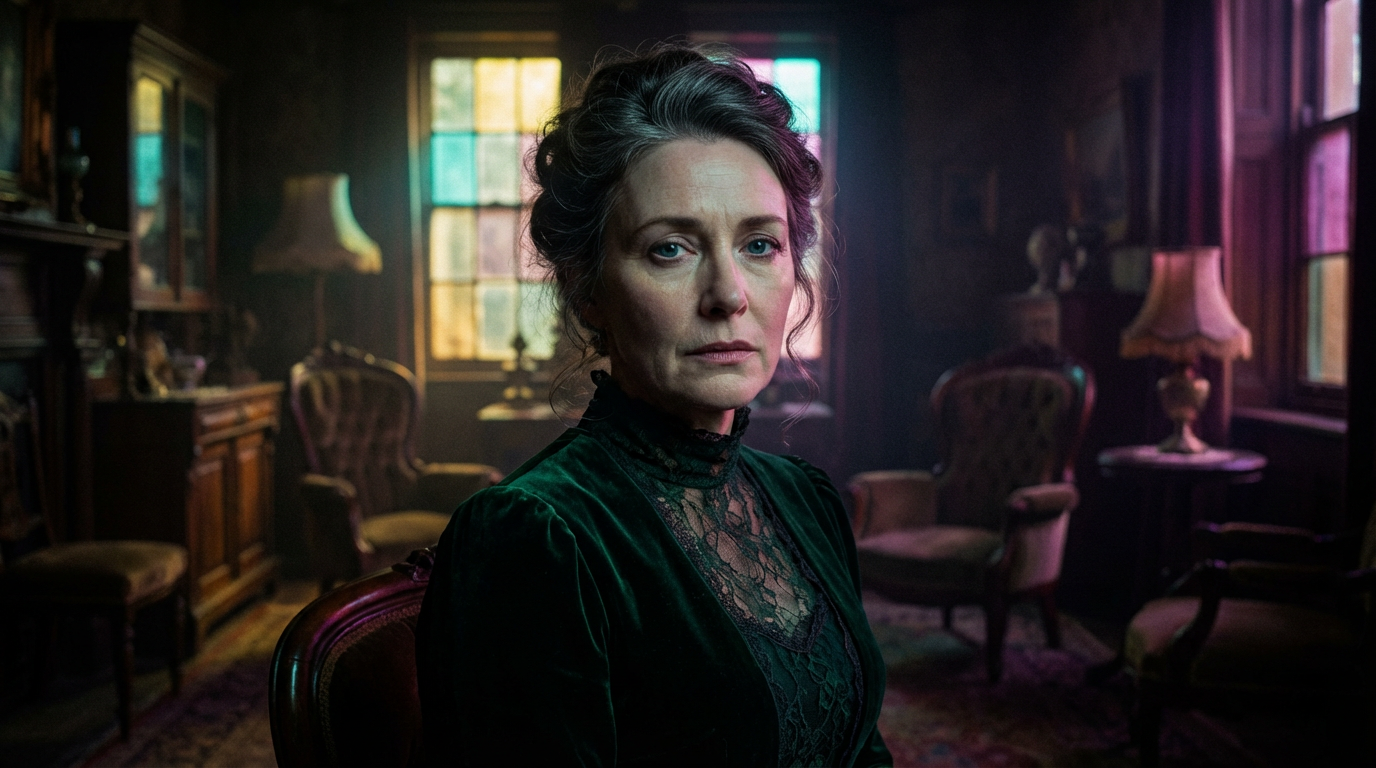
The First Colonial Daughter (1838–1850)
Eliza Woolley arrived on 20th August 1838 in the cottage on Macquarie Street, Hobart, the first child of Frederick Woolley, postmaster, and his wife Elizabeth, née Turner. Her birth followed eighteen hours of difficult labour that frightened Frederick more than any hazard he had encountered during his years as a post boy riding through the Tasmanian bush. The infant's survival, and her mother's slow but eventual recovery, established the Woolley household as a family rather than merely a marriage—a transformation that Frederick, raised in the crowded dysfunction of the founding Woolley generation, greeted with an intensity of feeling he had not anticipated and could not articulate.
The Macquarie Street cottage provided the sensory landscape of Eliza's earliest years: the smell of ink and sealing wax that clung to her father's clothes, the sound of her mother's careful footsteps managing the household with the efficient economy that a postmaster's salary required, and the particular quality of Hobart's winter light filtering through windows her mother kept scrupulously clean despite the mud streets outside. As the eldest child, Eliza occupied a position of both privilege and expectation. She received her parents' undivided attention for eighteen months before Thomas's arrival in February 1840 disrupted her monopoly on their affections—an adjustment she negotiated with the jealous indignation of a toddler who regarded her brother's cradle as an intrusion upon territory that was rightfully hers.
William's birth in May 1843 and Mary's in December 1845 expanded the household beyond the Macquarie Street cottage's capacity, and the family's move to a larger house on Liverpool Street coincided with Eliza's transition from infant to child. At six, she began attending Mrs Henderson's dame school on Elizabeth Street, where the daughters of Hobart's middling classes—merchants' girls, clerks' daughters, the occasional child of a prosperous tradesman—received instruction in reading, writing, arithmetic, and the domestic accomplishments that colonial society required of its respectable women. Eliza proved quick but not exceptional academically. Where she excelled was in navigating the schoolroom's social hierarchies, developing an instinctive understanding of which friendships to cultivate and which to merely acknowledge—skills inherited, perhaps, from a mother who had spent her own youth learning to maintain appearances under pressure.
The scarlet fever that swept through Hobart in 1847 marked the first genuine crisis of Eliza's childhood. All four children fell ill within a fortnight, and Thomas came closest to dying—his fever so severe that the doctor prepared Frederick and Elizabeth for the worst. Eliza, at nine, was old enough to understand what was happening but too young to do anything beyond lying in her own sickness and listening to her mother's footsteps moving between sickrooms at all hours, the sound of competence refusing to acknowledge the possibility of catastrophe. The experience embedded in her a permanent awareness that ordinary life could be interrupted without warning by forces beyond any person's control—a knowledge that would inform both her caution and her melancholy in the decades ahead.
Adolescence and Education (1850–1858)
The 1850s brought Eliza through the years between childhood and womanhood during a period of significant upheaval in colonial Tasmania. The Victorian gold rushes drained Hobart of young men, disrupted commercial life, and tested her father's postal service to its limits. She watched Frederick work eighteen-hour days to maintain services with a skeleton staff, and she absorbed from his example the principle that duty meant performing regardless of whether the circumstances were reasonable—a lesson that would serve her in certain contexts and exhaust her in others.
Her formal education concluded at fifteen, as was customary for girls of her station, though her father insisted on continued intellectual development through reading. He provided access to his growing library and the newspapers that passed through the post office, though he screened material he considered unsuitable with a protectiveness that Eliza found simultaneously touching and infuriating. She discovered novels through friends—the Brontës, Dickens, Austen—reading them with the guilty pleasure of someone who suspected that fiction might contain truths more honest than the improving literature her parents approved.
Her grandmother Margaret Turner's presence in the Liverpool Street house from 1850 onward, following James Turner's death, added another layer to the household's dynamics. Margaret was frail and sometimes querulous, requiring management that fell disproportionately on Elizabeth and, by extension, on Eliza as the eldest daughter. The experience taught her what her mother already knew: that women's lives were structured around the care of others, that the competence required for this care was simultaneously essential and invisible, and that the person providing it would be noticed only in her failure, never in her performance.
By sixteen, Eliza had developed into what colonial society described as handsome—not beautiful, but possessed of clear skin, her father's intelligent eyes, and a height that exceeded most of her female contemporaries by several inches. This last characteristic caused her considerable self-consciousness during the years when social events began to assume romantic possibility. She attracted suitors—a surveyor's assistant who called on Sunday afternoons, a pastoral family's second son with whom she shared literary interests for six months before his elder brother's death elevated him beyond her social reach—but none whose attachment survived the practical calculations that colonial courtship imposed on both parties.
Henry Lloyd (1858–1860)
Henry Lloyd entered Eliza's life at a church fundraising bazaar in September 1858, where she was managing the needlework stall with the determined competence she brought to all obligations. He was a merchant's son, slightly younger than her—a detail that initially gave her pause—but possessed of a quiet confidence and established position in his family's import business that suggested maturity beyond his years. The Lloyds represented genuine colonial prosperity: Henry's father had arrived as a free settler with capital in 1831, building a successful import operation that maintained a substantial house on Davey Street and employed four servants. Yet Henry himself seemed unimpressed by these markers of status, preferring conversation about books and ideas to the commercial calculations that consumed most young men of his background.
Their courtship proceeded with the measured propriety that Hobart's merchant society demanded. Henry called twice weekly with appropriate notice. They attended public events in carefully chaperoned groups. He sent winter roses on her birthday, a gesture whose expense Eliza understood precisely because her mother had taught her what everything cost. Her parents responded to the suit differently: Frederick conducted discreet enquiries into the Lloyd finances with the thoroughness he applied to all information management; Elizabeth recognised in Henry the kind of reliable steadiness she had herself sought in Frederick thirty years earlier, and approved accordingly. Only Mary, thirteen and observant beyond her years, noticed the tremor in her elder sister's hands when Henry's name was mentioned.
The wedding on 15th June 1860 at St David's Church was everything a colonial merchant family's alliance should be—elegant without ostentation, properly attended, and conducted with the awareness that the occasion established not merely a marriage but a social position. Eliza wore cream silk, her mother's careful economy having ensured that the dress represented the family's best appearance without exceeding what honesty could sustain. Frederick gave his daughter away with the controlled emotion of a man who had spent decades managing his feelings in professional contexts and found that the skills transferred imperfectly to personal ones.
Marriage and Launceston (1860–1875)
The early months of marriage required adjustments that the courtship's propriety had not prepared for. Henry had leased a house on Harrington Street in Hobart, close enough to his family's business for convenience, and Eliza found that managing a household independently—the servants, the accounts, the social obligations that a merchant's wife was expected to sustain—tested capabilities she had observed in her mother without ever fully appreciating how demanding they were in practice.
A miscarriage in March 1861, barely acknowledged publicly, devastated her privately. The physical ordeal was compounded by a melancholy that descended without warning—weeks of weeping, of inability to face social obligations, of staring at patterns in the wallpaper until they seemed to shift and writhe. Her mother, recognising the condition from her own experience after Eliza's birth, provided the only genuinely useful counsel: that it would pass, that it was not weakness, and that the passage would be faster if she moved through the world even when movement felt impossible.
Their first surviving child, Frederick Henry—called Harry—arrived on 2nd August 1862, and his safe delivery restored something that the miscarriage had fractured. Margaret Elizabeth followed in 1864. Stillborn twins in 1866 precipitated another period of melancholy so severe that Henry, alarmed by her withdrawal, engaged a nurse to manage the household whilst Eliza recovered. The loss of the twins haunted her with a specificity that subsequent years could not diminish—the weight of carrying them seven months, the silence where crying should have been, the coffins barely two feet long. Catherine Jane arrived in 1868, Henry James in 1871, and Alice Mary in 1873, each pregnancy extracting a physical toll that compounded the emotional one until Eliza regarded her own body with the exhausted wariness of someone who had been simultaneously sustained and betrayed by it.
Henry's father's declining health in the early 1870s necessitated reorganisation of the family business, and in 1875 Henry was designated to manage the northern branch in Launceston. The relocation separated Eliza from the Liverpool Street household where her ageing parents maintained their routines, her mother now managing Frederick's declining health with the quiet competence she had applied to every challenge. Eliza greeted the move with emotions she could not disentangle—grief at the distance from her parents, relief at escaping Hobart's increasingly suffocating social expectations, and the private recognition that Launceston offered what Hobart had denied: the chance to become someone other than Frederick and Elizabeth Woolley's eldest daughter.
The Merchant's Wife (1875–1893)
Launceston society proved both familiar and foreign. The northern town maintained pretensions to gentility that its rougher edges occasionally contradicted, and the Lloyds' prosperity ensured Eliza's immediate inclusion in the charitable committees and social networks that structured respectable women's public lives. Their house on Charles Street was grander than any Woolley residence had been—six bedrooms, a proper morning room, a garden that Eliza made her particular project, cultivating English roses alongside native plants in an aesthetic compromise that visitors found either charming or confused.
She joined the Ladies' Benevolent Society, the Church Building Fund Committee, and the Orphan School Auxiliary, discovering in charitable work a purpose that domestic management alone could not provide. Her particular focus on the orphan school—where she established a programme teaching older girls practical skills that might secure respectable employment—brought her into contact with realities that her sheltered upbringing had not advertised. The stories she encountered, of abandonment and abuse and destitution, challenged assumptions she had not realised she held and disturbed sleep that was already intermittent.
Her father's death on 5th January 1870 had preceded the move to Launceston, and Eliza had returned from Hobart to be at his bedside during the final days—watching the man whose quiet authority had structured her childhood diminish into someone whose whispered final words she could not reliably distinguish. The loss settled into her alongside the other griefs she carried, joining the miscarriage and the twins in the collection of absences that occupied more space in her interior life than any presence could fill.
Henry's business faced increasing competition from Melbourne firms during the 1880s, and his response—longer hours, increased travel, a growing reliance on whisky for the relief that sleep no longer provided—created distance within the marriage that courtesy could paper over but not repair. He was never cruel or even unkind, but his emotional withdrawal left Eliza managing both household and children essentially alone, performing the role of merchant's wife in public whilst inhabiting the reality of functional solitude in private.
Her mother's death on 6th July 1893, with Eliza and Thomas at her bedside, severed the last connection to the generation that had made her. Elizabeth Woolley had been the person who understood—without Eliza needing to explain—what the melancholy cost, how the performance of competence could exhaust the person performing it, and what it meant to build a life from materials that were adequate rather than ideal. The pearl necklace Elizabeth bequeathed her, a wedding gift from Frederick, carried emotional weight that exceeded any monetary value. Eliza wore it every day afterward, the cool weight against her collarbone a constant reminder of the woman whose steadiness she had inherited without ever fully replicating.
Final Years and Death
The 1890s compressed around Eliza with increasing pressure. Her health, never robust, deteriorated through chronic digestive complaints that physicians could not definitively diagnose. The children had dispersed into their own lives—Harry married in 1891, his struggles with a melancholy that mirrored his mother's creating a painful recognition she preferred to avoid; Margaret's marriage to a banker's son proved respectable but cold; Catherine's religious intensity had channelled itself into mission work; young Henry showed commercial aptitude; Alice, the youngest, preferred her books and garden to the social obligations her mother had spent decades performing on schedule.
The final illness began in February 1897 with what appeared to be severe influenza. The fever passed but left her weakened beyond recovery, and the cancer that had probably been advancing for years revealed itself in the months that followed. The last weeks brought increasing confusion—periods when she called for her mother, or searched for the twins, or spoke to her father about letters and secrets that nobody else in the room could understand—interspersed with moments of clarity sharp enough to recognise the family gathered around her bed and to request that they not look so frightened.
Eliza Lloyd died on 3rd May 1897, aged fifty-eight. The funeral at St John's Church in Launceston drew the cross-section of colonial society that a merchant's wife's decades of careful cultivation had assembled: committee members, charitable associates, social acquaintances, and the handful of people who had known her well enough to understand that the composed public figure had contained a considerably more complicated private one. The obituary in the Examiner praised her charitable work and noted her family connections with the conventional language that such notices employed, describing the architecture of a life without acknowledging the person who had inhabited it.
Henry remarried within eighteen months—a practical arrangement with a younger widow that surprised nobody familiar with colonial pragmatism regarding household management. The children divided their mother's possessions with the efficiency that characterised their generation: Margaret took the silver, Harry the books, Catherine their mother's Bible, and Alice requested nothing except the garden tools. The pearl necklace, which Eliza had worn daily since her mother's death, was placed in her coffin at her own prior request—returned, in a sense, to the woman who had given it, carried into whatever came next as evidence that she had been loved by someone who understood her.







