Eleanor Ainsworth (née Sinclair)
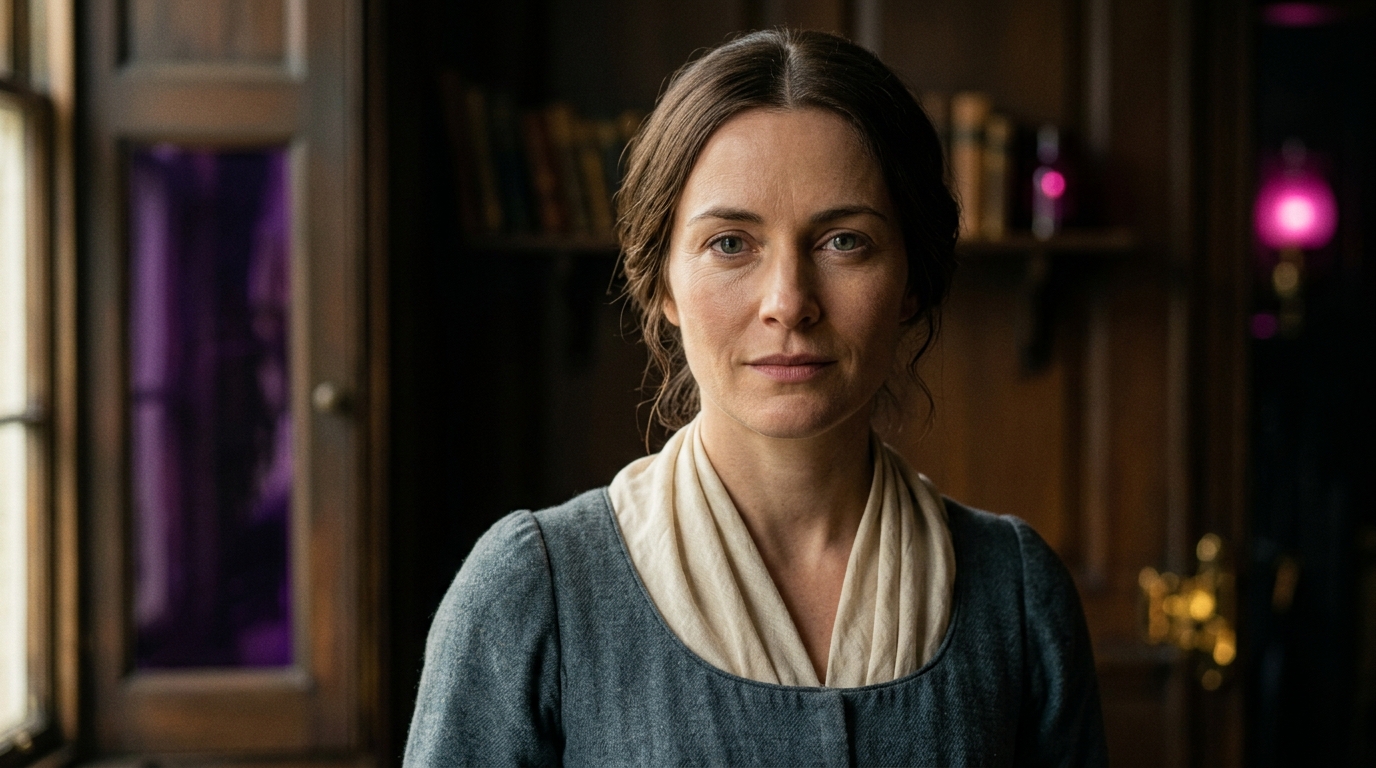
Eleanor Ainsworth (née Sinclair) (1780–1850) was a Bristol naval officer's daughter, painter, and founding settler of Brierly in Clivilius. Raised running her mother's boarding house, she turned that practical competence to organising the new settlement, steadying it through the hard founding years. She chose to cross into Clivilius as a founder in her own right, painted its unfamiliar country into something settlers could call home, and raised both a family and a community alongside her husband Thomas until her death.
A Daughter of the Harbour
Eleanor Sinclair was born on 4 February 1780 in Bristol, the great western port of England, into a city that had always been a place of departures. Ships left its quays for every coast of the known world, and the talk of the streets was of tides and cargoes and men who had gone away and not come back. It was a fitting birthplace for a woman who would one day make the longest departure of all, though no one who knew the harbour child could have guessed it.
Her father was Captain Henry Sinclair, a naval officer whose duties kept him at sea for long stretches of Eleanor's childhood, a presence felt most often in his absence and in the letters that arrived from distant stations. Her mother was Amelia Sinclair, née Grey, a capable and warm-natured woman who ran a modest but well-kept boarding house near the water. Through its rooms passed a steady current of travellers, merchants between voyages, and officers awaiting their ships, and Eleanor grew up among their comings and goings.
It was an upbringing that gave her the world in miniature. She heard the speech of a dozen ports without leaving her mother's parlour, learned to take the measure of a stranger across a supper table, and absorbed early the truth that the horizon was not the edge of anything. The harbour taught her that places could always be left and that the leaving need not be feared. She carried that lesson, half-formed, into everything that followed.
The Sinclairs were not wealthy. They belonged to that broad middling rank of port society that lived respectably by its own industry, neither gentry nor poor, and Eleanor grew up without the helplessness that comfort sometimes bred in women of her age. Bristol itself was a hard, mercantile, unsentimental city, grown rich on long and not always honourable voyages and wholly unillusioned about the cost of them. Something of its plain clear-sightedness lodged permanently in the daughter it raised, a refusal to be deceived by appearances that would serve her well in a world built entirely on the unfamiliar.
The Keeper of the Boarding House
With her father so often away, responsibility came to Eleanor young. She became her mother's right hand in the running of the house, and the work was real: rooms to be turned over, accounts to be balanced, provisions to be bought shrewdly and stretched, difficult guests to be managed with a firmness that never tipped into rudeness. By the time she was a girl others would still have called a child, she could keep a ledger, settle a dispute, and judge to the penny what a week's housekeeping ought to cost.
She had also the care of her younger siblings, Charles and Margaret, whom she half-raised in the gaps her parents could not fill. It made her watchful and steady, a maker of order out of the small daily chaos of a busy household. Where another girl might have chafed at so much duty, Eleanor took a quiet satisfaction in competence, in the knowledge that a house ran better for her being in it.
None of this was the education a gentlewoman was supposed to prize, and Eleanor never mistook it for refinement. Yet it was an education in the things that actually held a household, and through it a community, together: thrift, foresight, the management of people who did not always wish to be managed. She could not have known how exactly these skills would one day be needed, in a place with no shops, no neighbours, and no margin for error at all.
She learned, too, the art of reading what a house needed before anyone thought to ask. She could tell which lodger was about to cause trouble, which week's stores would run short, and when her mother's patience had worn thin and the running of the place had quietly become hers for the evening. It was an education in anticipation, in seeing a difficulty while it was still small enough to prevent, and it sharpened in her a foresight no schoolroom could have given. The habit of providing against a lack before it became a crisis would one day stand between a struggling settlement and disaster.
Paint and Letters
For all her practicality, Eleanor was not made only of ledgers and lists. Her mother, who valued the things a hard life left little room for, encouraged in her daughter a love of painting and of books, and in these Eleanor found the part of herself the boarding house could not use. She painted whenever the work of the day released her, and she read whatever came into the house, carrying off the volumes left behind by departing lodgers as though they were treasure.
She had a true eye. She could catch the particular grey of the harbour under rain, the set of a face, the way light fell across the masts at evening, and set it down with a fidelity that surprised those who saw her work. Painting was not an accomplishment to be displayed for suitors but a way of looking, a discipline of attention that taught her to see a place exactly as it was before deciding what it might become.
Between the paint and the letters and the talk of travellers, Eleanor's imagination ranged far beyond the streets she actually walked. There was in her a tension that defined her youth, between a life lived within a few hundred yards of one quay and an inner world that took in oceans. She did not yet know how that tension would resolve. She knew only that she was waiting, without quite admitting it, for something the harbour could not supply.
The Yorkshireman
In 1801, at a social gathering somewhere in the city, Eleanor met Thomas Edward Ainsworth. He was a landowner's son from the moors of Yorkshire, a traveller and a maker of maps, and he spoke of far country with a hunger she recognised at once because it answered her own. He, for his part, found in the harbour-bred young woman an intelligence and composure that set her apart from anyone he had met, and a seriousness that matched the weight of his own ambitions.
Their courtship was brief and certain. They were married on 14 June 1802, and Eleanor left the only city she had ever known to settle with Thomas in the West Riding, exchanging the salt and clamour of the port for the wind and silence of the high country. It was her first true departure, and if she felt the loss of her mother's house and the harbour world, she also felt the opening of the wider life she had long sensed waiting for her.
For the better part of a decade they lived as country gentry, Eleanor keeping their affairs with the same sure hand she had learned at her mother's side, Thomas travelling and surveying as his restlessness demanded. Theirs was a marriage of two capable people who had each found in the other a genuine equal, and it was steadied by mutual respect rather than mere affection. When the great upheaval of their lives arrived, it would find them ready, and it would find Eleanor every bit as willing as her husband to walk through the door it opened.
A Door in the World
The summons came in the form of an old friend of Thomas's, Jonathan Blackwood, who was no longer merely a man of their acquaintance but a Guardian, the holder of a key to another world. He had been charged with founding a settlement in Clivilius, a land reached through doorways bound to the blood of those who opened them, and he wanted Thomas among the five who would raise it. It was a proposition of staggering magnitude, and it asked the Ainsworths to leave not merely Yorkshire but the Earth itself.
Eleanor did not have to go. A wife might have stayed behind, kept the Yorkshire house, and waited, as her mother had waited for a husband at sea. But waiting had never been Eleanor's nature, and the woman who had grown up certain that the horizon was not the edge of anything was not about to let her husband cross the greatest horizon of all without her. She chose to go, fully and with open eyes, understanding the risk as clearly as anyone could understand a thing without precedent.
In choosing, she went as a full partner in the undertaking rather than a passenger to it. She held no Portal Key and bore none of the Guardian's office — that fell to the five, Thomas among them — but the settlement that would rise in Clivilius would owe much of its survival to the harbour-bred competence Eleanor carried through the doorway, alongside Thomas's leadership and Blackwood's design. She set the affairs of her earthly life in order, took her leave of the world she had been born into, and prepared to begin again, at the age of thirty, with nothing on the far side but bare ground and the people she trusted.
Making a Home from Nothing
What waited in Clivilius was a desolation: barren country along an unfamiliar river, with no shelter, no stores, and no soft landing for the settlers who followed the Guardians through. It was, in its way, the precise opposite of the crowded, provisioned, well-worn harbour of Eleanor's childhood, and yet the skills the harbour had given her proved the very ones the new settlement most needed. A community starting from nothing is, before it is anything else, a vast and precarious household, and Eleanor knew how to run a household.
She turned at once to the work of organising the place. Provisions had to be counted and rationed against an unknown future; shelter had to be arranged and labour shared; the hundred small disorders of frightened people in a hard place had to be soothed into something workable. The competence she had learned managing her mother's boarding house she now brought to bear on an entire settlement, and the settlers steadied themselves by her steadiness as much as by Thomas's leadership.
There was nothing glamorous in the work, and that was precisely its value. The founding is remembered for its Guardians and their Portal Keys, but it survived on humbler things: on stores that lasted the winter because someone had counted them honestly, on quarrels settled before they could fester, on the sick kept fed and the frightened kept usefully busy. Eleanor attended to all of it without ceremony, and the settlement lived in part because she refused to let the small disciplines of a household lapse merely because the household had become a world.
The early years tested every one of them. The weather of Clivilius kept its own counsel, the soil gave up its crops grudgingly, and there were seasons when the whole venture hung in the balance. Through them Eleanor was a constant: a source of wise and practical counsel to her husband, a steady hand in the face of fear, and the person to whom others turned when they did not know what to do. She had spent her girlhood making order out of small daily chaos. Now she made it out of a far larger one, and the settlement held.
The Painter of Clivilius
Amid all the labour of survival, Eleanor never set down her brushes, and in time her painting became a gift to the whole community rather than a private solace. She turned her harbour-trained eye upon the strange country the settlers had come to, and she painted it as faithfully as she had once painted the masts and grey water of Bristol, capturing the rugged colours and unfamiliar contours of a world no one on Earth had ever seen.
The work was more than decoration. In a place that might easily have been experienced only as hardship, Eleanor's paintings gave the settlers a way of seeing beauty in the land they had chosen, of recognising their harsh new home as a thing worth looking at and not merely enduring. Her canvases were the settlement's first images of itself, a record of how Clivilius appeared to the eyes that first beheld it, and they did quiet, lasting work upon the spirits of those who saw them.
Settlers who could not have explained why found themselves steadier for seeing their own valley framed and fixed upon a wall, as though the act of painting it had granted them permission to belong there. In the absence of any other hand to do it, Eleanor became the keeper of the settlement's image of itself, and those who in later years recalled the founding remembered it partly through her eyes, in the particular colours she had chosen to set down. Her paintings outlasted the worst of the early hardship and became, without anyone quite deciding it, the settlement's memory of its own beginning.
In this Eleanor was wholly herself. The discipline of attention she had practised since girlhood, the habit of seeing a place exactly as it was, served the community as surely as her ledgers and her counsel did. Where Thomas charted the country to make it navigable, Eleanor painted it to make it home, and between the surveyor's lines and the painter's colours the bare ground of the founding slowly became a place the settlers belonged to.
Mother of the Settlement
On 17 November 1814, after years in which the struggle of the founding had left no room for children, Eleanor gave birth to a son, Edward. He was the first child born in Brierly, and the settlement kept his arrival as a sign that it had become not merely a foothold but a future. Two more children followed, Charlotte in 1816 and William in 1819, and the Ainsworth household grew into a small image of the larger community Eleanor had helped raise around it.
Motherhood did not draw her out of the settlement's life but deepened her place within it. To the people of Brierly she became a maternal figure in more than the domestic sense, a woman whose steadiness, warmth, and sure judgement made her someone the whole community leaned upon. She had half-raised her own siblings in a Bristol boarding house; now she was, in a manner of speaking, helping to raise a whole settlement, holding it together with the same patient competence she had shown all her life.
Through the long middle decades she remained the steady centre of her family and her adopted home, her partnership with Thomas the bedrock beneath the settlement's growing stability. The barren ground of the founding had become a living community with vines and a town hall and children who knew no other world, and Eleanor had been indispensable to every stage of that becoming, though she had never sought to stand at its head.
Eleanor Ainsworth died on 29 August 1850, in her seventy-first year. Brierly grieved her deeply, for there was scarcely a part of its life her hands had not touched in its first four decades, from the rationing of its earliest stores to the pictures that hung in its homes. Thomas, who would outlive her by five years, was left a widower in the house they had built together from nothing, and their children and the wider community mourned the woman who had been mother to far more than her own family. She was laid to rest in the ground she had helped make habitable, and the paintings she left behind kept her eye upon Brierly long after her hands were stilled.







