Edward James Reynolds
Edward James Reynolds, born 23 April 1940 in Newlyn, Cornwall, spent his life commanding the FV Cornelia through Atlantic waters, embodying Cornish fishing traditions spanning generations. Captain of a 32-foot vessel registered from Hayle Harbour, Edward's quiet competence and profound understanding of sea rhythms earned respect throughout Cornwall's maritime community. His marriage to Margaret Penrose created a household balancing oceanic uncertainty with coastal stability, raising three children who each carried forward his patient dedication through divergent paths.
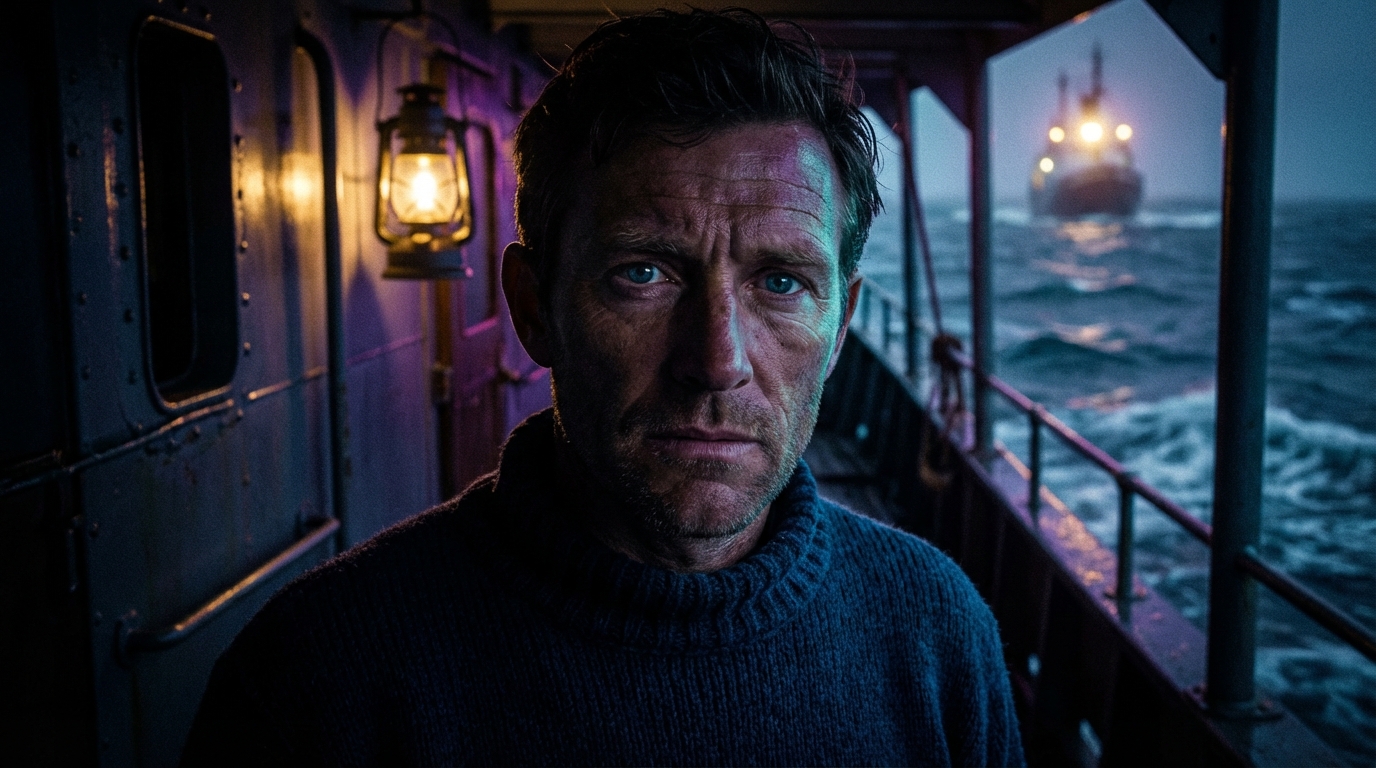
Newlyn Harbour: Born to the Sea
Edward James Reynolds was born on 23 April 1940 in Newlyn, Cornwall, arriving into a world where the Second World War was reshaping Britain and where Cornwall's fishing industry remained fundamental to community survival. He was the second of four children born to William Thomas Reynolds (born 1910) and Dorothy May Reynolds (née Trelawny) (born 1912), both descended from families whose connection to Cornish fishing stretched back through documented generations to the seventeenth century.
The Reynolds family resided in a granite cottage on North Quay, steps from Newlyn Harbour where the family's fishing boat was moored. The location meant Edward's earliest memories were saturated with maritime rhythms—the creak of boats against harbour walls, the cry of gulls, the smell of fish and salt and diesel, the voices of fishermen departing before dawn and returning in afternoon with catches that would feed communities throughout Cornwall and beyond.
William Reynolds captained the FV Dorothy May, a 38-foot fishing vessel named for his wife, working primarily mackerel and pilchard fisheries that had sustained Newlyn for centuries. He was known throughout the harbour for steady competence rather than spectacular catches, for maintaining his vessel meticulously, for treating crew fairly, for the quiet integrity that made him reliable partner in an occupation where trust between crew members could mean the difference between safe return and tragedy.
Dorothy Reynolds managed the household with the practical competence required of fishing wives—women who maintained family life whilst husbands were at sea, who budgeted uncertain incomes from variable catches, who understood that the Atlantic determined family fortunes more surely than any human planning. She supplemented family income through pilchard processing during peak seasons, working long hours at Newlyn's processing facilities alongside other fishermen's wives, creating the salted and preserved fish that were exported throughout Britain and Europe.
Edward grew up alongside three siblings who would each navigate different relationships with Cornwall's maritime heritage. His older brother, James William Reynolds, born in 1938, would follow their father into fishing, eventually captaining his own vessel. His younger sister, Dorothy Anne Reynolds, born in 1943, would marry a farmer from the Penwith hinterland, trading coastal life for agricultural rhythms inland. His youngest brother, Michael Thomas Reynolds, born in 1947, would be the family's first member to pursue education beyond basic schooling, eventually becoming a teacher in Plymouth—geographic and social mobility that earlier generations couldn't have imagined.
Childhood: Learning the Trade
Edward's childhood during the 1940s and early 1950s was shaped by post-war austerity, Cornwall's relative poverty compared to more prosperous English regions, and the fishing community's tight-knit social structures. Food was often simple but plentiful—fish featured in daily meals, vegetables came from small gardens most families maintained, the communal networks of extended family and neighbours meant that genuine hunger was rare even when cash was scarce.
His formal education began at Newlyn County Primary School in 1945, where he proved a capable if unremarkable student. Teachers noted his reliability, his practical intelligence, his particular aptitude for mathematics—skills that would later prove essential in navigation and catch management. Yet like many working-class Cornish boys whose futures were predetermined by family occupation, Edward's education was primarily practical rather than academic, oriented toward preparing him for the work he would inevitably do.
From age eight, Edward spent summer holidays and weekends aboard the Dorothy May, learning fishing's fundamentals from his father and older brother. He learned to tie knots—dozens of variations each suited to specific purposes, to read weather signs in clouds and wind patterns, to understand tides and currents, to maintain engines and equipment, to handle fish without damaging them, to work long hours in cold and wet conditions without complaint. These weren't merely technical skills but cultural inheritance, the accumulated knowledge of generations who had drawn their living from seas that gave life whilst also claiming it.
His relationship with his father was characterised by the working-class masculine emotional economy of the period—minimal verbal communication, knowledge transmitted through demonstration and correction rather than explanation, affection expressed through teaching rather than stated openly. William Reynolds was not unkind but neither was he demonstrative, expecting competence without praise, correcting errors without elaborate explanation. Edward absorbed both the skills and the emotional style, developing the controlled reserve that would characterise his own approach to fatherhood decades later.
Adolescence and Professional Formation
Edward left school at age fifteen in 1955, the minimum leaving age under British law at the time, and immediately began working full-time aboard the Dorothy May. His adolescence was brief—childhood ending abruptly as he assumed adult responsibilities, adult earning capacity (though initially modest), adult participation in family economic survival. This transition, whilst typical for working-class boys of his generation, meant Edward never experienced the extended adolescence that would later become normative, the experimental period between childhood and adult commitment.
His late teens and early twenties (1955-1962) represented intensive professional development and physical maturation. He grew into a tall, strong young man whose body adapted to fishing's physical demands—the constant motion on deck, the heavy lifting of nets and catches, the endurance required for fourteen-hour days in cold and wet conditions. He developed the weathered appearance characteristic of Cornish fishermen—skin toughened by sun and salt, hands callused and scarred, a physical presence that spoke of competence in harsh environments.
He also developed deep practical knowledge of Cornwall's coastal waters—the locations where different species congregated at different times, the underwater geography of fishing grounds, the relationship between weather patterns and fish behaviour, the business networks through which catches were sold. This knowledge was partly transmitted by older fishermen but also learned through direct observation, through failures and successes, through the patient attention to patterns that characterised Edward's intelligence.
By his early twenties, Edward had become valuable crew member on the Dorothy May, trusted to make decisions about net deployment and catch handling, occasionally taking the helm when William needed rest during extended trips. Yet he also understood that remaining as crew on his father's vessel represented limitation—he would need his own boat to achieve full independence and economic security, to establish himself as master rather than perpetual apprentice.
Meeting Margaret and Establishing Independence
Edward met Margaret Ellen Penrose in 1960 at a church social in Penzance, an event that brought together young people from Newlyn's fishing community and Penzance's more diverse working-class population. Margaret, born in 1942, was the daughter of Harold Penrose, who worked at Penzance's docks, and Violet Penrose (née Tregenza), who had worked in domestic service before marriage. Margaret herself worked as waitress at The Dolphin Tavern near Penzance harbour, saving money toward her own business aspirations.
Their courtship was conventional by the standards of working-class Cornwall in the early 1960s—evening walks along the coast, attendance at cinema in Penzance, chaperoned visits to each other's family homes, the gradual building of relationship within frameworks that family and community understood and approved. Edward was drawn to Margaret's warmth and practical competence, her ambition to establish her own business (already unusual for working-class women of her generation), her understanding of the rhythms and risks of maritime life through her own harbour-adjacent upbringing.
They married in June 1962 at St Peter's Church in Newlyn, a ceremony attended by over one hundred guests from both extended families and the broader fishing community. The wedding reflected working-class Cornwall's social patterns—generous celebration despite limited means, extensive family networks providing support through contributed food and services, the recognition that marriage wasn't merely personal union but community event with economic and social dimensions beyond romance.
The couple initially lived in rented rooms in Penzance whilst saving toward purchasing property and boat. Margaret continued working at The Dolphin Tavern whilst also developing plans for her own tearoom business. Edward continued working on the Dorothy May whilst also seeking opportunities to acquire his own vessel—a process requiring both capital accumulation and navigation of tight-knit maritime community's networks regarding boat sales and ownership transitions.
Captaining the Cornelia
In 1964, Edward achieved the significant milestone of purchasing the FV Cornelia, a 32-foot fishing vessel built in 1948 and previously owned by retiring fisherman who had no family members willing to continue the trade. The purchase—financed partly through family loans and partly through credit from Newlyn's fishing cooperative—represented Edward's establishment as independent fishing captain, his transition from crew member working for wages to boat owner bearing both risks and potential rewards of maritime enterprise.
The Cornelia became Edward's primary workplace for the next fifty years, the site where he spent more waking hours than in any other location, the vessel whose maintenance and operation would dominate his financial and temporal resources throughout his working life. The boat, registered from Hayle Harbour, was sturdy rather than elegant, functional rather than comfortable, built for the practical demands of Cornish fishing rather than aesthetic appeal. Edward maintained it meticulously, understanding that his family's economic security and his own survival depended on the vessel's reliability.
His fishing career primarily targeted mackerel, pilchard, and various groundfish species depending on seasonal availability and market demand. He worked both day trips close to Cornwall's coast and occasional longer trips to more distant grounds when conditions and potential catches justified the additional fuel costs and time away from family. His approach to fishing was characterised by steady competence rather than spectacular success—he rarely returned with the largest catches but he consistently returned with adequate catches, rarely experienced mechanical failures or weather-related disasters, maintained steady if modest income across decades of fishing's notorious economic volatility.
His reputation within Cornwall's fishing community centred on reliability and quiet wisdom about sea conditions. Other fishermen sought his judgment about whether weather windows would hold, about where different species might be congregating, about equipment modifications that might improve efficiency. He was elected to Newlyn Fishermen's Association committee in 1972, serving intermittently in various capacities through the 1970s and 1980s, contributing to collective efforts to negotiate fair prices and resist regulatory changes threatening traditional fishing practices.
Family Life in St Ives
Margaret's entrepreneurial ambitions were realised in 1966 when she opened The Rose Harbour Tearooms on Fore Street in St Ives, the picturesque coastal town where the couple had relocated after purchasing a modest terraced cottage on Back Road West. The tearoom became successful through Margaret's combination of genuine hospitality, reliable quality, and the location capitalising on St Ives's growing tourism whilst also serving local community. The business meant that the Reynolds household had dual income streams—Edward's fishing income supplemented by Margaret's tearoom profits—providing more economic security than most single-income fishing families enjoyed.
Their first child, Thomas Edward Reynolds, was born in 1967, named for both his father and paternal grandfather, continuing family naming traditions that connected generations. Thomas would eventually follow maritime calling through different route—becoming a marine engineer with the Royal Fleet Auxiliary, translating his father's practical understanding of vessels into technical expertise about their mechanical systems, serving the sea through professional engineering rather than fishing.
Their second child, Emily Grace Reynolds, born in 1970, would pursue career in early childhood education, becoming a nursery school teacher in Falmouth. Her choice reflected both Margaret's influence—the nurturing hospitality that characterised The Rose Harbour—and the expanding educational opportunities that allowed working-class daughters to pursue professional careers their mothers' generation couldn't access.
Their third child, Sharon Louise Reynolds, born on 12 October 1975, completed the family. Sharon inherited both her mother's entrepreneurial drive and her father's patient precision, qualities that would later express through her hairdressing career, her salon ownership, her eventual migration to Tasmania. Edward's relationship with Sharon was particularly close—she was the youngest, the final child, and perhaps because of this Edward displayed toward her a warmth and verbal affection he had struggled to express with older children.
The Reynolds household was known throughout St Ives for generous hospitality despite modest means. Sunday lunches regularly included extended family and neighbours, creating the social abundance that Cornish working-class culture prized—generous portions, lively conversation, the understanding that material limitation need never constrain warmth or welcome. These gatherings represented Edward and Margaret's shared values—his Newlyn fishing community's mutual support traditions combined with her more middle-class aspirations toward creating beautiful domestic spaces.
Later Years and Continued Fishing
Throughout the 1980s and 1990s, Edward continued fishing despite industry's increasing challenges. Overfishing concerns led to tighter regulations and quotas. Foreign competition, particularly from larger industrial fishing operations, depressed prices. Cornwall's fishing ports contracted as younger generations sought more stable employment elsewhere. Yet Edward persisted, partly from economic necessity but also from genuine inability to imagine alternative identity. He was a fisherman—it was what he knew, what he was good at, what connected him to his father and grandfather and the generations stretching back through Reynolds family history.
He adapted to changing conditions through diversification—taking tourists on fishing trips during summer months, occasionally working as marine consultant for harbour development projects requiring practical knowledge of local waters, participating in efforts to promote sustainable fishing practices that might preserve industry for future generations. These adaptations reflected pragmatism rather than enthusiasm—Edward remained fundamentally a working fisherman whose greatest satisfaction came from successful fishing rather than these supplementary activities.
His relationship with his adult children evolved as they established independent lives. Thomas's career with the Royal Fleet Auxiliary meant long deployments and infrequent visits, though father and son maintained connection through letters and occasional reunions characterised by mutual respect if limited emotional intimacy. Emily's teaching career in Falmouth allowed more regular contact, and Edward took quiet pride in her professional achievements even if he couldn't fully understand her work's details.
Sharon's emigration to Australia in 1998 following her marriage to Adrian Pafistis represented the most significant geographic rupture. Yet Edward accepted her choice with characteristic stoicism, understanding that children's opportunities exceeded their parents' experiences, that migration for love and career advancement reflected opportunities his generation hadn't possessed. He maintained contact through occasional phone calls—expensive international conversations kept brief by both cost and his natural verbal economy—and through letters that Margaret primarily wrote but which he signed, adding brief postscripts.
Present and Reflections
Edward James Reynolds remains in St Ives with Margaret, now living in assisted accommodation after selling the Back Road West cottage that had been family home for decades. He ceased fishing in 2010 at age seventy, selling the Cornelia to a younger fisherman from Newlyn who had apprenticed aboard Edward's vessel. The sale closed a chapter spanning forty-six years, ending his direct participation in occupation that had defined his identity, his daily rhythms, his relationship to Cornwall's maritime culture.
He maintains routines around visiting St Ives harbour daily, observing current fishing operations, exchanging brief greetings with other retired fishermen who similarly find comfort in proximity to maritime activities they no longer perform. He reads extensively about Cornwall's fishing history, contributing occasional interviews to oral history projects documenting traditional fishing practices before they disappear entirely. He gardens modestly, maintaining vegetables that supplement their limited pension income whilst also connecting him to practical productivity he values.
Sharon's mysterious disappearance in 2018—her vanishing alongside Adrian and her daughters into circumstances that defy explanation—represents grief complicated by geographic distance and inability to participate in any search efforts. Edward processes this loss with the same controlled reserve that has characterised his approach to life's other challenges, understanding that the Atlantic taught him long ago that some things cannot be controlled, that acceptance doesn't mean indifference but rather recognising limits of human power against forces larger than individual will.







