Edward Francis Barwick
Edward Francis Barwick (1828–1874), the third child of corruption investigator Francis Edward Barwick and Elizabeth Mary Sinclair, was born in Hobart, Tasmania. Drawn to the sea from childhood, he built a shipping empire connecting Tasmania to India and the Far East, transforming the colony's maritime commerce. His marriage to Amelia Catherine Thompson produced five children, including Jane, who married into the Jeffries dynasty. Yet his relentless pursuit of distant horizons cost him everything closer to home.
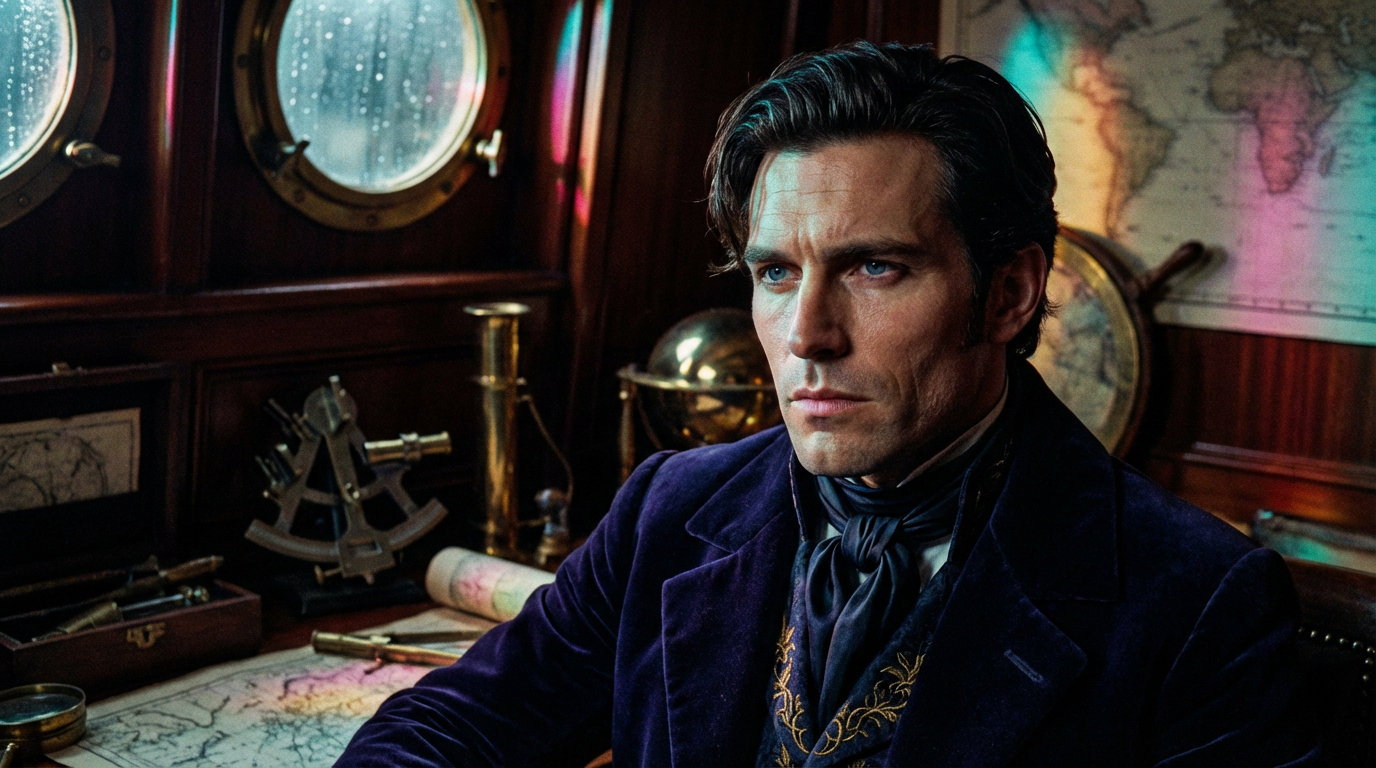
Early Years and Family Position (1828–1841)
Edward Francis Barwick was born on 23 September 1828 at the family's Murray Street residence in Hobart, the third child of Francis Edward Barwick and Elizabeth Mary Barwick (née Sinclair). His father, born in Canterbury in 1773, had spent decades as one of the British Empire's most formidable corruption investigators before settling in Van Diemen's Land, where his pursuit of colonial fraud brought him into direct conflict with some of the colony's most powerful figures. His mother, the daughter of Scottish merchant William Sinclair, had brought to the marriage both commercial connections and a warmth that tempered her husband's austere moral absolutism.
Edward arrived into a household already shaped by the contrasting personalities of his elder brothers. Jonathan, four years his senior, had been marked early as their father's successor in legal pursuits, absorbing Francis's rigid principles with a thoroughness that would eventually produce one of Launceston's most respected magistrates. Henry, two years older, showed a clear inclination toward their maternal grandfather's commercial interests, gravitating toward the warehouses and counting houses that William Sinclair operated along the Hobart waterfront. Edward's position as the middle son — a designation rendered more complex by the arrival of his sister Margaret in July 1829 — offered both freedom and frustration. Less burdened by expectation than Jonathan, less defined in purpose than Henry, he occupied an ambiguous space within the family that bred in him a restless ambition to carve out territory that was indisputably his own.
His earliest memories centred upon the harbour. Where other boys might have been drawn to parks or fields, Edward haunted the wharves, watching vessels arrive from ports whose names he could barely pronounce but whose existence stirred in him a longing that no amount of domestic comfort could satisfy. Unlike Henry, who accompanied their grandfather to inspect consignments of wool and timber with a merchant's appraising eye, Edward was captivated by the ships themselves — their construction, their rigging, the foreign accents of their crews, the manifests that catalogued goods from places he could only imagine. At six, he began constructing elaborate model ships from scraps of wood, rigging them with thread pilfered from his mother's sewing basket and sailing them across the parlour floor toward destinations marked by volumes from his father's library. Elizabeth noted her son's obsession with affectionate bemusement; Francis, who regarded commerce as a necessary evil tolerated only because the law required it, viewed the boy's maritime fixation with quiet disapproval.
William Sinclair's death in November 1831 struck three-year-old Edward differently from his elder brothers. Jonathan and Henry lost a mentor and business connection; Edward lost the grandfather who had indulged his maritime fantasies, who had taken him aboard actual merchant vessels and explained how wind and current could carry fortunes across the world. Elizabeth found her youngest son crying not from grief — three-year-olds process death imperfectly — but from fear that without his grandfather, nobody would teach him about ships. The anxiety was unfounded, but the emotional logic it revealed — the instinct to understand loss in terms of what it prevented rather than what it ended — would persist throughout Edward's adult life, shaping a man who measured every relationship by its utility and every departure by the opportunities it foreclosed.
Education and Maritime Awakening (1835–1848)
Edward's formal education at Hobart Grammar School from 1835 to 1844 confirmed what the household had already observed: his intelligence was genuine but sharply selective. He excelled at mathematics and geography with an aptitude that impressed even instructors accustomed to capable students, calculating cargo distributions and fuel requirements with a precision that suggested an instinct for the logistics of maritime commerce. Master Phillips noted in 1840 that the boy showed "persistent inattention during Latin recitation, preferring to sketch ship designs in his copybook margins." These sketches, some of which survived among the family papers, displayed a surprisingly sophisticated understanding of hull architecture and sail configuration for a twelve-year-old — evidence of an autodidactic obsession that operated alongside and largely independent of his formal schooling.
His father's death on 8 August 1841 struck thirteen-year-old Edward with a force that combined genuine grief with an unexpected sense of liberation. Francis Edward Barwick's sixty-eight years of uncompromising moral rigour had cast a long shadow over a household where legal rectitude was the prevailing ethos and commercial ambition was regarded as spiritually suspect. Without his father's disapproving presence, Edward could pursue his maritime interests more openly, and Elizabeth, managing her own bereavement whilst maintaining the household, had little energy to oppose her middle son's increasing absences as he haunted the waterfront, learning from sailors and studying the operations of established shipping companies.
His practical education accelerated when Captain James Morrison, a Scottish merchant sailor who had known William Sinclair, took Edward under his informal tutelage. Morrison had lost his own son to fever in Calcutta and found in Edward an eager student who absorbed navigation techniques, cargo management principles, and — most valuably — the complex web of personal relationships that made international trade possible in an era when contracts depended as much upon trust as upon paper. Under Morrison's guidance, Edward made his first voyage to Sydney in 1845 at the age of seventeen, sailing not as a passenger but as assistant supercargo, responsible for managing both cargo and the commercial aspects of the voyage. He returned with modest profits from personal trading — Morrison had permitted him to carry small quantities of goods on his own account — and a conviction that his future lay not on land but upon the water.
The years from 1846 to 1848 were spent in deliberate preparation. Edward worked for established shipping firms, accepting lower wages in exchange for access to their operational knowledge. He studied weather patterns, memorised port regulations across the colonies, and cultivated relationships with merchants, customs officials, and ships' captains whose goodwill would prove essential when he launched his own enterprise. His notebook from this period — filled with detailed observations about profitable cargo combinations, seasonal trading windows, and the reliability of various business partners — revealed a systematic intelligence inherited from his father applied to commercial ends that Francis would have regarded with dismay. Elizabeth, recognising ambition that would not be thwarted, quietly provided initial capital from her own carefully concealed investments — five hundred pounds presented as an early inheritance from William Sinclair's estate, though the money came from trading profits she had accumulated independently. Edward discovered the deception only years later, and the knowledge that his independence had been underwritten by his mother's quiet competence left a complicated impression that mingled gratitude with something less comfortable.
Marriage and the Early Ventures (1849–1858)
Edward met Amelia Catherine Thompson at a Government House ball in March 1849, though their first substantial conversation occurred two weeks later when she visited the warehouse where he was working. Amelia, the daughter of a prosperous Sydney merchant family recently settled in Hobart, possessed both beauty and intelligence, but what drew Edward most immediately was her fluency in the language of maritime commerce. Her father owned shares in several trading vessels, and Amelia had grown up discussing shipping routes and market conditions over the dinner table. In a society where women were expected to profess ignorance of commercial matters, her willingness to engage with Edward's business plans as a genuine intellectual equal both startled and captivated him.
Their courtship, conducted largely through correspondence during Edward's early trading voyages, revealed a depth of connection that neither had anticipated. Amelia's letters offered not merely romantic attachment but practical intelligence — warnings about unreliable captains, assessments of Sydney merchants' creditworthiness, even suggestions for profitable cargo combinations that Edward had not considered. Her advice in July 1849 to investigate the growing demand for Tasmanian timber in Indian shipyards led directly to one of his first significant commercial successes. Edward, who had inherited his father's instinct for methodical inquiry without the moral framework that governed its application, recognised in Amelia a partner whose capabilities extended far beyond what colonial society expected of a wife.
They married on 22 April 1849 at St. David's Cathedral, in a ceremony that brought together Tasmania's merchant elite and announced Edward's arrival as a serious figure in colonial commerce. The wedding was deliberately grander than either of his brothers' ceremonies — a statement of intent from a third son who meant to eclipse his siblings' achievements. Henry attended with barely concealed resentment, recognising in his younger brother's ambition a direct challenge to his own commercial position. Margaret, now twenty, observed the rivalry with the shrewd assessment that would later define her career as one of Tasmania's most influential social operators.
Jane Amelia arrived on 5 April 1850, born eleven months after the wedding at the family's Salamanca Place residence. Edward had been at sea when Amelia's labour began, returning three days after the birth to find not the son he had prepared for but a daughter. His initial disappointment — he had already imagined teaching a boy about ships and trade routes — transformed rapidly into a fierce protectiveness that surprised even himself. Jane became the centre of his emotional life, though his affection expressed itself primarily through material provision and ambitious plans for her future rather than through the sustained domestic presence that children require.
The 1850s saw Edward transform from ambitious trader into a maritime figure of genuine consequence. His first vessel, the brigantine Southern Cross, purchased in 1851 with loans secured against future cargo contracts, established regular routes to Calcutta and Bombay. Where Henry focused upon the reliable profits of coastal trading, Edward pursued the higher-risk, higher-reward international routes that connected Tasmania to the vast markets of the Indian subcontinent. The strategy generated substantial returns but also demanded extended absences that left Amelia managing household, children, and the shore-based aspects of the business with increasing independence and decreasing support.
The loss of their second child, Thomas William, born on 18 March 1852 and dead within six weeks of what the physician attributed to infant convulsions, devastated both parents in ways that pushed them further apart rather than drawing them together. Amelia retreated into a quiet, contained grief; Edward responded by departing on another voyage, leaving behind the small grave beside St. David's and the anguish it represented. The pattern — using distance to avoid emotional pain, substituting commercial activity for the harder work of domestic presence — established itself during these months and intensified throughout the remainder of the marriage.
Robert Francis arrived in January 1854, Sarah Elizabeth in November 1855, and Margaret Helen in September 1857, expanding the family whilst Edward's absences grew longer and more frequent. Amelia managed the children, the household, and increasingly the Hobart operations of the shipping enterprise with a competence that was essential to its success but that Edward never publicly acknowledged, presenting all business decisions as his own. The expansion to three vessels by 1858 brought him into direct competition with Henry, whose more conservative operation occupied commercial territory that Edward's ambitions now threatened. The brothers' rivalry, previously expressed through pointed remarks at family dinners, became open when Edward underbid Henry for a lucrative government contract to supply the settlement at Port Darwin — a victory that came at the cost of operating at a loss for six months and borrowing heavily from Sydney banks.
Peak Success and Personal Cost (1858–1868)
The 1860s brought Edward's greatest commercial triumphs alongside his most consequential personal failures. His fleet expanded to five vessels by 1862, with regular routes connecting Hobart, Sydney, Melbourne, Calcutta, Bombay, and Singapore. He constructed a house on Sandy Bay Road that was deliberately more ostentatious than Henry's residence, featuring Indian marble and Burmese teak that functioned as both domestic comfort and commercial advertisement — tangible proof that the third Barwick son had surpassed his brothers' achievements.
Yet success demanded his physical presence at sea for months at a time, and the household he had built suffered proportionally. Robert showed no aptitude for or interest in maritime commerce, gravitating instead toward artistic pursuits that Edward regarded as impractical. Jane, his eldest and privately his favourite, was developing the precocious competence that her father's absences necessitated — managing household responsibilities at an age when she should have been free of them. Sarah and little Margaret Helen knew their father primarily through the exotic gifts that arrived from distant ports, tokens of affection that substituted for the presence they actually needed.
The death of Margaret Helen from scarlet fever in July 1863 whilst Edward was in Bombay created an irreparable fracture in the marriage. Amelia's letter reached him two months after the event, and although Edward returned immediately, he departed again within a week — unable or unwilling to sit with the grief that the household demanded he share. Amelia, whose constitution had been robust throughout the years of childbearing, began using laudanum to manage the compounded weight of bereavement and isolation. The dependency would shadow her remaining years, and Jane — thirteen years old, already functioning as the household's de facto manager — absorbed responsibilities that no child should have carried.
Elizabeth Mary Barwick's death on 7 September 1864 intensified the rivalry between her sons. The inheritance disputes that followed were nominally about the division of assets but in reality concerned recognition — which son had best fulfilled the family legacy that Francis's moral rigour and Elizabeth's Scottish pragmatism had jointly established. Edward's international success against Henry's local dominance became a proxy for deeper questions about parental approval that neither brother could resolve, because the parents whose judgement they sought were no longer available to render it.
Decline and Final Voyage (1868–1874)
In 1868, Edward embarked upon his most ambitious venture: an attempt to establish regular trading routes to China, anticipating the expansion of the tea trade. The enterprise required him to mortgage existing vessels and borrow against future profits, committing the company's resources to an undertaking whose success depended upon negotiations whose complexity he had underestimated. The three-month absence stretched to six as discussions in Shanghai proved more difficult than anticipated.
He returned to find the household in a condition that demanded attention he was temperamentally ill-equipped to provide. Amelia's laudanum dependency had escalated to dangerous levels, and the family was functioning only because eighteen-year-old Jane had assumed responsibilities that encompassed both domestic management and significant aspects of the commercial operations. Edward's response followed the established pattern: he engaged better servants, increased Amelia's allowance, and began planning his next departure. The confrontation with Jane in November 1870 — when his eldest daughter accused him directly of abandoning his family for commercial ambition — marked the first time anyone had challenged Edward so openly. His defence, that his success guaranteed their financial security, sounded inadequate even to his own ears, but he possessed no other vocabulary in which to express what he felt or to acknowledge what he had failed to provide.
Amelia Catherine Barwick died on 26 July 1872, at the age of forty-one, her constitution weakened beyond recovery by years of laudanum dependency and emotional isolation. The official cause was pneumonia, though the family understood that the illness had found in Amelia a body whose defences had been systematically eroded by circumstances her husband might have mitigated had he been willing to sacrifice commercial ambition for domestic attention. Edward, in Sydney when word reached him, returned for the funeral seeming more bewildered than bereaved — as though the loss of the partner whose invisible labour had sustained both his household and his enterprise had confronted him with a dependency he had never acknowledged and could not now resolve.
Jane's marriage to William Jeffries III on 15 June 1872 — six weeks before Amelia's death — should have represented a triumph: the union of the Barwick shipping fortune with the Jeffries industrial dynasty. Instead, Edward experienced it as abandonment. His speech at the reception, slurred from drink and bitter in its references to loyalty and desertion, humiliated the assembled guests and confirmed for Jane that her departure from the family home, however painful, was both necessary and overdue. Robert had already relocated to Melbourne to pursue his artistic career. Sarah had married and settled in Adelaide. Edward, for the first time in his life, was alone.
The two years following Amelia's death saw the empire unravel with startling speed. Without Amelia's management of the Hobart operations — a contribution Edward had never publicly recognised and had failed to replace — the shore-based machinery of the business began to malfunction. Trusted captains skimmed profits. Warehouse managers inflated expenses. Competitors, including Henry, systematically poached contracts that Edward could no longer service reliably. His journal from this period recorded increasing paranoia and physical symptoms — persistent headaches, episodes of confusion, visual disturbances — that suggest the hypertension which would ultimately kill him.
The final voyage departed Hobart in March 1874. Edward, defying Dr. Mitchell's explicit warnings about his deteriorating health, insisted upon personally captaining the Eastern Star to Singapore. His first mate, James Crawford, later testified that Edward appeared confused during much of the passage, sometimes forgetting their destination or insisting they were bound for ports that were not on their route. The behaviour suggested the vascular deterioration that was progressing beneath the stubbornness that had defined both his career and his decline.
Death and Aftermath (1874)
The stroke occurred on 19 May 1874 as the Eastern Star entered Singapore harbour. Edward collapsed on the quarterdeck whilst supervising cargo operations, his last coherent words reportedly being "Tell Henry the horizon was mine." He lingered for four days, largely unconscious, before dying on 23 May 1874 at the age of forty-five — the same age his daughter Jane would reach when pneumonia claimed her twenty-one years later.
His body was returned to Hobart aboard one of Henry's vessels — a final irony that would have infuriated a man who had spent two decades competing with his brother for supremacy in the waters they both claimed. The funeral on 18 July 1874 drew a smaller congregation than might have been expected for a merchant of Edward's former stature. Many of his business associates were in distant ports, and his family was scattered across three colonies. Henry delivered a eulogy that carefully balanced acknowledgement of his brother's commercial achievements with subtle emphasis upon the costs at which those achievements had been purchased. Jane, newly married and carrying her first child, maintained the composure that had become her defining characteristic, though she was heard to remark that her father had "died as he lived — reaching for something just beyond his grasp."
The settlement of Edward's estate confirmed what the final two years of his life had already suggested: the empire he had built was as precarious as it was impressive. Assets were substantial, but debts nearly matched them. Only through William Jeffries III's intervention and Henry's strategic purchases of the most viable assets was outright scandal avoided. The five vessels were sold — three to competitors who had long coveted them, one to Henry who renamed it after Elizabeth, and one to a Chinese trading consortium whose partnership Edward had spent years trying to secure.
Edward Francis Barwick had lived forty-five years pursuing horizons that receded before him as relentlessly as the tides he had spent a lifetime navigating. His transformation of Tasmania's maritime commerce was undeniable — he had opened routes that connected the colony to the broader world, demonstrated that colonial merchants could compete in international markets, and generated wealth that, however briefly held, elevated both his family's standing and the colony's commercial reputation. Yet the cost of that achievement — a wife driven to laudanum and an early grave, children who learned self-sufficiency because paternal presence was not available, a brother alienated by decades of rivalry, and a fortune that dissipated almost as swiftly as it had been accumulated — confirmed the lesson that those who knew him best had understood long before his death: that in reaching constantly for distant shores, he had lost his connection to the home port that should have been his anchor.







