Edward Charles Jennings
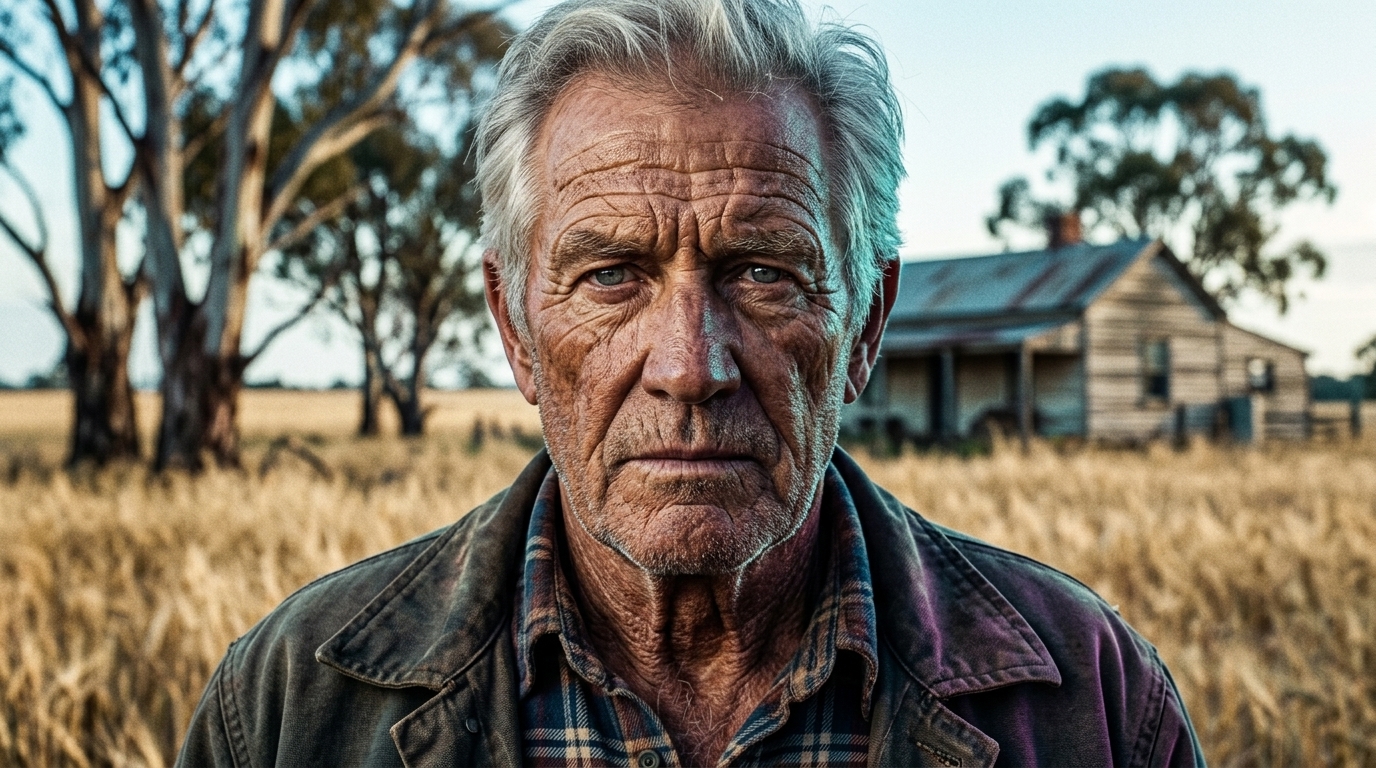
Edward Charles Jennings (1918–1997) was a South Australian farmer who spent his whole life on the Jennings Family Farm at Gawler, the property his Irish-immigrant parents had carved from the scrub in 1889. The youngest son, he took up its management in the early 1940s and held it for half a century. Husband to Margaret Fiona Sullivan and father of three, he was a traditionalist of formidable temper whose stubborn devotion to the land outran his gift for tenderness.
The Youngest Son of an Irish Farm
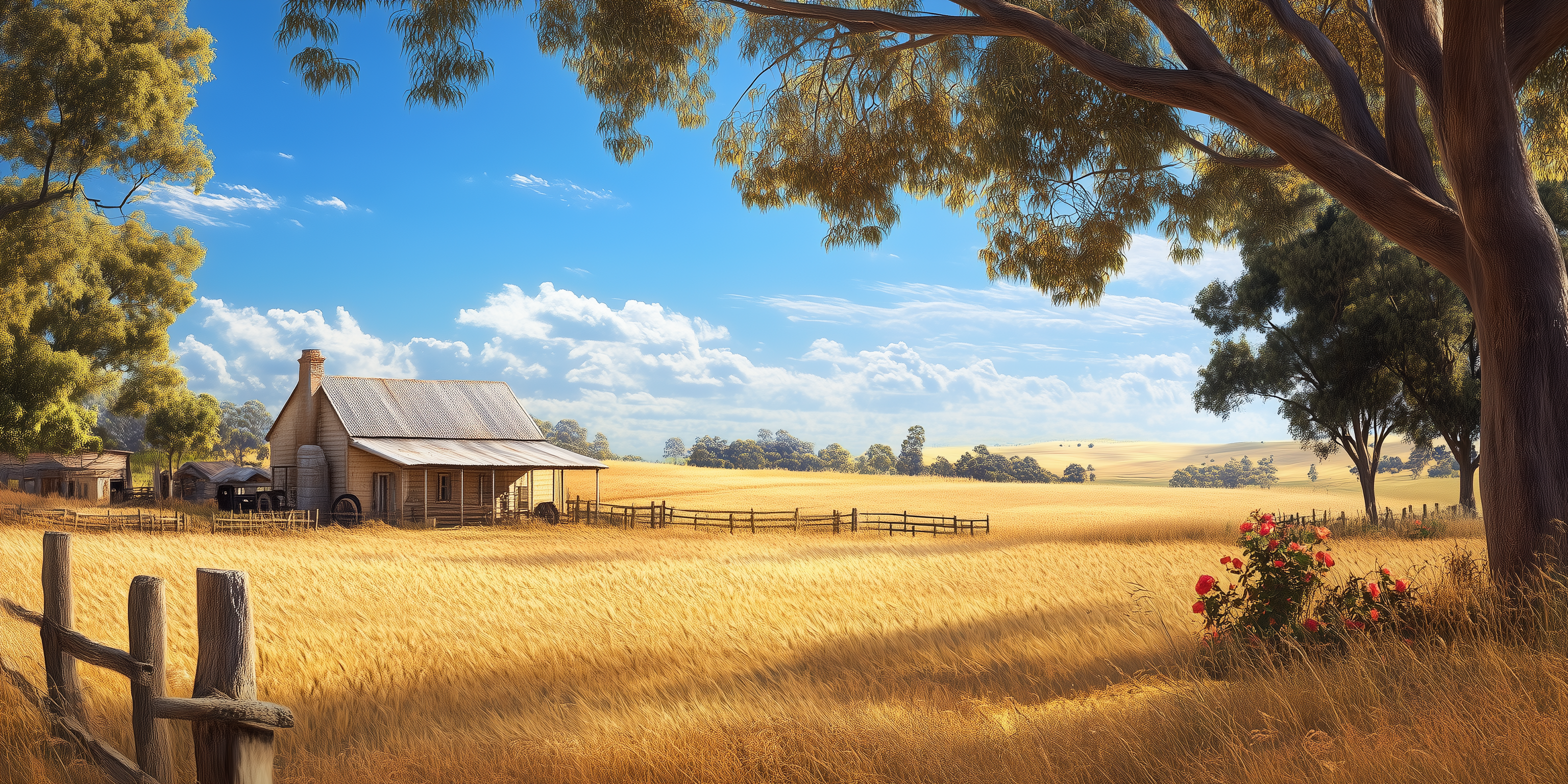
Edward Charles Jennings was born on 2 June 1918 at the family farmhouse on the outskirts of Gawler, South Australia, the youngest of the four children of William Jennings and Margaret Jennings, Irish immigrants from County Clare. William and Margaret had come out from Ireland in the late 1880s and carved the Jennings Family Farm from the scrubland bordering Stockwell's Scrub, establishing the property in 1889 some forty kilometres north of Adelaide. By the time Edward arrived, the farm was nearly thirty years old, his parents were well into middle age, and the household already rang with the voices of older siblings.
He was, in the family's own telling, something of an afterthought — a late child born long after his brothers and his sister, into a home where the hardest pioneering years had already passed into memory. His eldest brother, Thomas, was thirteen years his senior; his brother Henry and his sister Eleanor occupied the years between. Edward grew up in their shadow and in the longer shadow of the land itself, a boy who learnt the smell of barley dust and the particular silence of his father before he learnt much else.
William Jennings was a hard, contained man who measured affection in acres cleared and seasons survived, and Edward absorbed that grammar early. There was little spoken tenderness in the farmhouse. What there was instead was work — the unending, dignifying work of a property that had to be wrestled from drought and depression and made to yield — and the unspoken law that a Jennings did not complain, did not idle, and did not leave.
Edward attended the local Gawler schools and went on to Gawler High School, where he proved a steady but unremarkable pupil, more at ease in a paddock than a classroom. He had no great appetite for books and no patience for abstraction, but he could read weather and soil and stock with an instinct no examination could measure. He left school in the mid-1930s with no ambition beyond the one that had been settled for him before he could articulate it: that his life would be lived on the family's ground.
Family Tree
A War He Was Not Allowed to Fight
The Second World War reshaped the Jennings household as it reshaped every farming family in the district. Thomas, the eldest and the natural heir, enlisted with the Second Australian Imperial Force and sailed away in 1940. Henry, restless and never suited to the land, had already drifted to Adelaide for a tradesman's life, and Eleanor had married a Kapunda man and gone north. That left Edward, barely into his twenties, as the only son still standing on the soil.
He wanted to go. Most of the young men he knew were going, and the want of it sat in him like a stone. But his father's health had begun to fail, the property could not run itself, and the wartime manpower authorities held that a fit young farmer feeding the country was worth more on his land than in a uniform. Edward was directed to stay. He spent the war years working the farm half to death while other men's names came home on telegrams.
One of those telegrams was Thomas's. The eldest Jennings son was killed in 1942, and with his death the farm's succession fell, without ceremony or discussion, to the brother who had stayed. Edward assumed management of the Jennings Family Farm in the early 1940s — not as a triumph but as a duty inherited through other men's absence. He introduced barley rotations, pushed the cultivated acreage outward into ground his father had left as scrub, and steadied the property through the lean, anxious years of the war and the uncertain ones that came after it.
That he had not served was a wound Edward carried, quietly and badly, for the rest of his life. He never spoke of it directly, but it surfaced in a certain stiffness around returned men and a defensiveness that could harden into temper if he felt the subject brush too close. He had done what he was told and kept a family enterprise alive through a national emergency, and some part of him never quite forgave the war for making that feel a smaller thing than dying overseas.
William Jennings died in 1947, his body worn out by six decades of labour, and was buried in the Gawler cemetery beneath a modest headstone that gave his birthplace as County Clare. Edward's mother, the first Margaret Jennings, lived on at the farmhouse for another decade — a stern and frugal presence — before her own death in 1958. By then Edward was the unquestioned master of the property, and a husband and father besides.
Margaret Fiona Sullivan
It was in 1941, at a wartime fundraising social held in the hall of St Peter's Anglican Church in Gawler, that Edward met Margaret Fiona Sullivan. She was eighteen, the bright and quick-tongued daughter of Albert Sullivan, a Gawler schoolmaster, and his wife Florence. Margaret had a mind that ran ahead of most of the rooms she stood in, a love of reading her father had carefully fed, and ambitions the times and her sex conspired to narrow. Edward, twenty-three and grave, with big weathered hands and a way of saying little, was not an obvious match for her.
And yet something held between them. He admired an intelligence he did not share and could not have explained; she saw beneath his reticence a steadiness she trusted. Their courtship unfolded slowly across the war years, conducted with the decorum of the period and the constant background hum of rationing and absent men. On a clear autumn day in 1943 they were married at St Peter's, the same church in whose hall they had met, and Margaret came out to the farm to begin a life she had not been raised for.
She took to it with a resolve that surprised the district. Margaret Fiona Jennings, as she became, brought order and intellect to a farmhouse that had known little of either since the pioneering days. She kept the books, managed the household through good seasons and ruinous ones, and in time established the farm's first informal school for local women, teaching the practical agricultural and domestic skills that wartime and isolation demanded. Where Edward was rooted and immovable, Margaret was adaptable and inventive, and the marriage worked precisely because each supplied what the other lacked.
Her great private joy was her garden. Across the decades Margaret coaxed an extravagant rose garden out of the dry Gawler ground, a blaze of colour against the working drabness of the farm that became locally admired and quietly central to Edward's own sense of home. He never had her words for beauty, but he built the beds she asked for, hauled the water, and in his old age was most at peace pottering among her roses in the evening light.
Three Children and a Sparing Love
Edward and Margaret had three children. Brian Edward was born on 3 September 1945 at the Gawler and District Hospital, a firstborn son into whom Edward poured every expectation the land could carry. Sarah Louise followed in 1948, and David Charles in 1951, completing the family. The farmhouse that had fallen quiet after Edward's own childhood filled again with the noise and friction of children raised hard and raised to stay.
Edward was not a gentle father. He held his children to standards that could feel impossible to meet, governed the household with a temper the whole family learnt to read like weather, and expressed love almost entirely through provision and instruction rather than word or embrace. He never told his children that he loved them; the vocabulary simply was not in him, and it would not have occurred to him that its absence might be felt as a lack. He had been raised that way himself, and he raised his own the same.
What he gave instead was a place in the world and the knowledge to hold it. He taught all three to work — to drive the tractor, mend a fence, read a sky — and he gathered the family, as his own father never quite had, beneath the ancient eucalyptus trees that lined the property for the long midday meals that became the household's one reliable warmth. His workshop, the cluttered farm garage where he repaired whatever the farm broke, became an informal classroom in which Brian in particular discovered the mechanical gift that would come to define him.
Sarah and David grew up and, in the way of younger children on a single-heir farm, made their lives elsewhere. Sarah Louise married and moved to Adelaide, raising a family of her own and returning to Gawler for Christmases and funerals. David Charles, never drawn to the land, trained in a trade and settled away from the property, his relationship with his exacting father always more cordial than close. It was Brian, the eldest, who bore the weight of inheritance, and it was with Brian that Edward's love and his difficulty most fiercely collided.
The Society and the Soil
Beyond his own fenceline, Edward was a fixture of the Gawler Agricultural Society, the institution that had stitched the district's farming families together since the previous century. He showed produce and stock at its fairs, sat through its meetings, and argued its business with the conviction of a man who believed a farmer's obligations did not stop at his own gate. He advocated for sustainable methods and for policies that served the wider community of growers, and he was respected — if not always easily liked — for the unbending consistency of his views.
That consistency was, depending on the season, his great strength and his great limitation. Edward distrusted novelty on principle. He had watched too many clever schemes ruin good men, and he held that the methods which had carried the Jennings name through drought, depression and two world wars were not to be discarded for the latest enthusiasm out of a government pamphlet. He was a traditionalist in the deepest sense — not merely cautious, but morally certain that the old ways carried a wisdom the new ones lacked.
It made him a difficult man to move and, in time, a difficult man to farm beside. The very stubbornness that had held the property together through his hardest years became, as the world changed around him, the thing that set him most painfully against his own son.
Father and Son
Brian Jennings was, by temperament and conviction, an innovator, and from the moment he was old enough to take a real hand in the farm he pressed against the limits of his father's caution. He wanted sub-surface irrigation; Edward saw expense and folly. He wanted soil monitoring and new crops and, in 1980, solar panels on the sheds; Edward saw a rebuke to everything he had done. The disagreements between them could be fierce, conducted with the restrained, granite intensity of two men who loved each other deeply and had no language for saying so.
Much of Edward's resistance was not really about irrigation or panels at all. He read each of Brian's improvements as an implicit verdict on his own life's work — as though to modernise the farm were to declare that the way Edward had run it had been wrong. He could not see, or would not admit, that his son was trying to honour the property by ensuring it survived a future Edward himself would never see. The two of them circled the same love from opposite sides and called it conflict.
And yet beneath the friction ran a current neither could break. They shared an absolute, wordless reverence for the land, and on the questions that mattered most they were never truly divided. Visitors to the farm sensed it — that for all the slammed sheds and curt silences, Edward watched his eldest son work with a pride he would have died before speaking aloud. The sorrow of their bond was never an absence of feeling. It was the want of any acceptable way to show it.
The Slowing
Grandchildren came in a flood across the late 1960s, the 1970s and into the 1980s, almost all of them Brian's. Cody Brian was the first, born on 15 August 1968; Anne Elizabeth followed in 1970, and then came Catherine, Janice Marie, Kenneth Oliver, Raymond, and at last Tania in 1982 — seven in all, raised in the same farmhouse rooms where Edward himself had grown up. He was a more tolerant grandfather than he had ever been a father, the edges of his temper worn softer by age, and he took a gruff, watchful pleasure in the children swarming over the property.
Some of them baffled him. When Kenneth, scarcely more than a toddler, revealed a musical gift so extraordinary that the family eventually sent him to the Sydney Conservatorium at the age of eight, Edward could make little sense of a Jennings whose genius pulled him clean away from the soil. He grieved the boy's leaving in his undemonstrative way, even as he recognised that some things could not be kept on a farm. In Anne, by contrast, he saw the old aptitude — the granddaughter who understood the land in her bones, and who would one day, long after him, take up its stewardship as Anne Elizabeth Evans.
In 1993 a heart condition began to slow Edward's step, and for the first time in half a century he was forced to loosen his grip on the property. Gradually, and against every instinct he possessed, he ceded the daily management of the farm to Brian — the son who had, in truth, been driving its modernisation for years. It was the nearest thing to an admission Edward ever made: that the future belonged to the methods he had resisted, and that he could trust his eldest to carry the name through it.
His last years held an unexpected gentleness. He kept Margaret's roses, sat long over the midday table beneath the eucalypts, and took to filling cheap exercise books with a rambling, unliterary memoir of the farm's history that no one beyond the family would ever read. The hard man of the middle years receded a little, and what remained was an old farmer at something like peace with a life lived entirely within sight of the ground he was born on.
15 August 1997
Edward Charles Jennings died on 15 August 1997 at the farmhouse, aged seventy-nine. His heart, which had been failing him by degrees for four years, gave out quietly on a winter morning with Margaret near him. It was, by the strange arithmetic of families, his grandson Cody's twenty-ninth birthday — the boy who had been the first of the next generation born exactly twenty-nine years earlier, now the man on whose birthday the old founder's heir finally let go.
He was buried from St Peter's Anglican Church, where he had met and married Margaret more than half a century before, and where the Jennings family had marked its births and its deaths for generations. The Gawler district turned out in number to bury him — neighbours, growers, Agricultural Society men, the wide net of a life lived in one place. Margaret, his partner of fifty-four years, stood widowed at the graveside of the only man she had ever married, and would carry the household forward with the resilience that had always defined her.
His son Brian was undone by the loss. The father who had taught him to work, to persist, to hold something larger than himself was gone, and the farm felt hollow with his absence. Edward had been a hard man and an imperfect one — undemonstrative, immovable, marked by a war he was never permitted to fight and a tenderness he was never able to speak. But the ground he had been born on in 1918 was still, on the day he died, a working Jennings farm, kept whole through depression and drought and the long argument of his own stubbornness. For a man of his making, that was the only kind of love letter he knew how to write.







