Dragon Ascending Through Cloud
An ink painting on silk by the Southern Song artist Chen Rong, completed on the 21st of June 1244 in Fuzhou. Depicting a single dragon ascending through layered cloud with jaws parted and claws extended, the painting exemplifies Chen Rong's celebrated mastery of the dragon subject — works he reportedly produced only whilst intoxicated. Ink spatters and controlled washes create a sense of explosive upward energy and atmospheric turbulence.
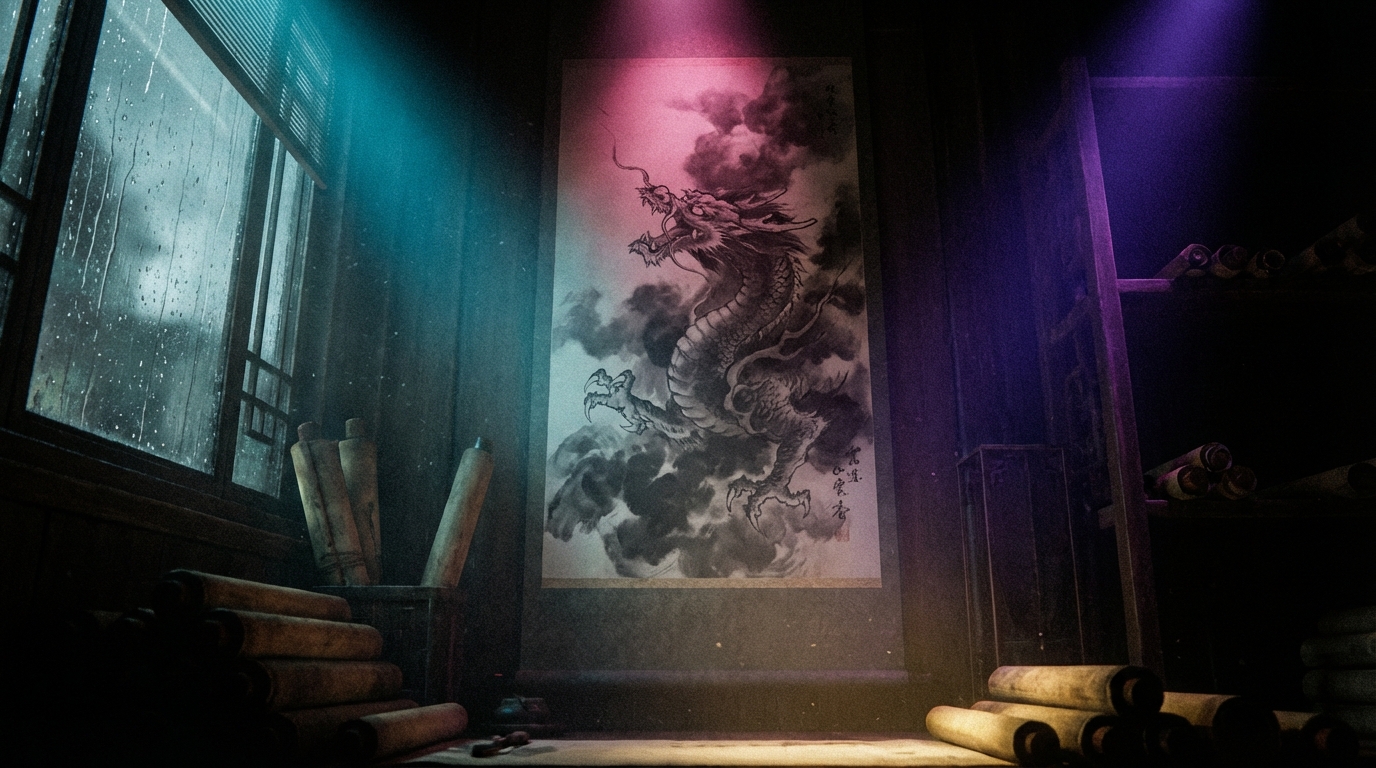
Description
The painting measures approximately one hundred and twenty centimetres in height and fifty in width, executed almost entirely in ink on silk with only the faintest touches of colour — a wash of pale red at the dragon's eyes and a hint of green at the claws. The composition is vertical, depicting a single dragon surging upward through banks of cloud rendered in broad, turbulent ink washes.
The dragon is captured mid-ascent, its serpentine body coiling through three layers of cloud, each rendered with a different ink technique: the lowest in dense, wet washes suggesting rain-heavy vapour; the middle in dry-brush strokes conveying wind-torn mist; the uppermost in pale, ethereal washes that dissolve into the bare silk above. The dragon's head, emerging from the highest cloud bank, is depicted with fierce energy — jaws parted, whiskers streaming, eyes blazing with the pale red wash that provides the painting's only colour.
The work bears Chen Rong's distinctive seal and a colophon in his own hand.
Historical Setting
The painting was completed on the 21st of June 1244 (the 4th year of the Chunyou reign era), by the painter Chen Rong at his studio in Fuzhou, Fujian province. Chen Rong was a government official who served as a prefect in several postings, but he was celebrated above all as the greatest dragon painter of the Southern Song period — and, by the assessment of later Chinese critics, perhaps the greatest dragon painter in the entire history of Chinese art.
Contemporary accounts record that Chen Rong produced his dragon paintings only whilst under the influence of wine, splashing ink onto the silk with his hands, his cap, and even his hair, achieving effects of spontaneous energy that could not be replicated through sober technique. The colophon on this painting, written in Chen Rong's own hand, reads: "Painted on the summer solstice after three cups of Shaoxing wine. The dragon came unbidden."
The dragon ascending through cloud was a subject laden with symbolic meaning in Song Dynasty culture — representing imperial authority, cosmic renewal, and the dynamic forces of nature that connected earth to heaven.
Provenance
Following Chen Rong's death in approximately 1262, his paintings became highly sought after by collectors. This work passed through several eminent Chinese private collections during the late Song, Yuan, and Ming periods. It left China through the Canton maritime trade in the early eighteenth century, appearing in the records of a British East India Company agent in Madras in 1738. It subsequently entered a private collection in Edinburgh before being sold at auction in London in 1811. It was acquired through William Jeffries Sr.'s intermediaries in 1818 and was among the earliest artefacts installed in the Blue Room at Jeffries Manor, predating even the jade dragon.






