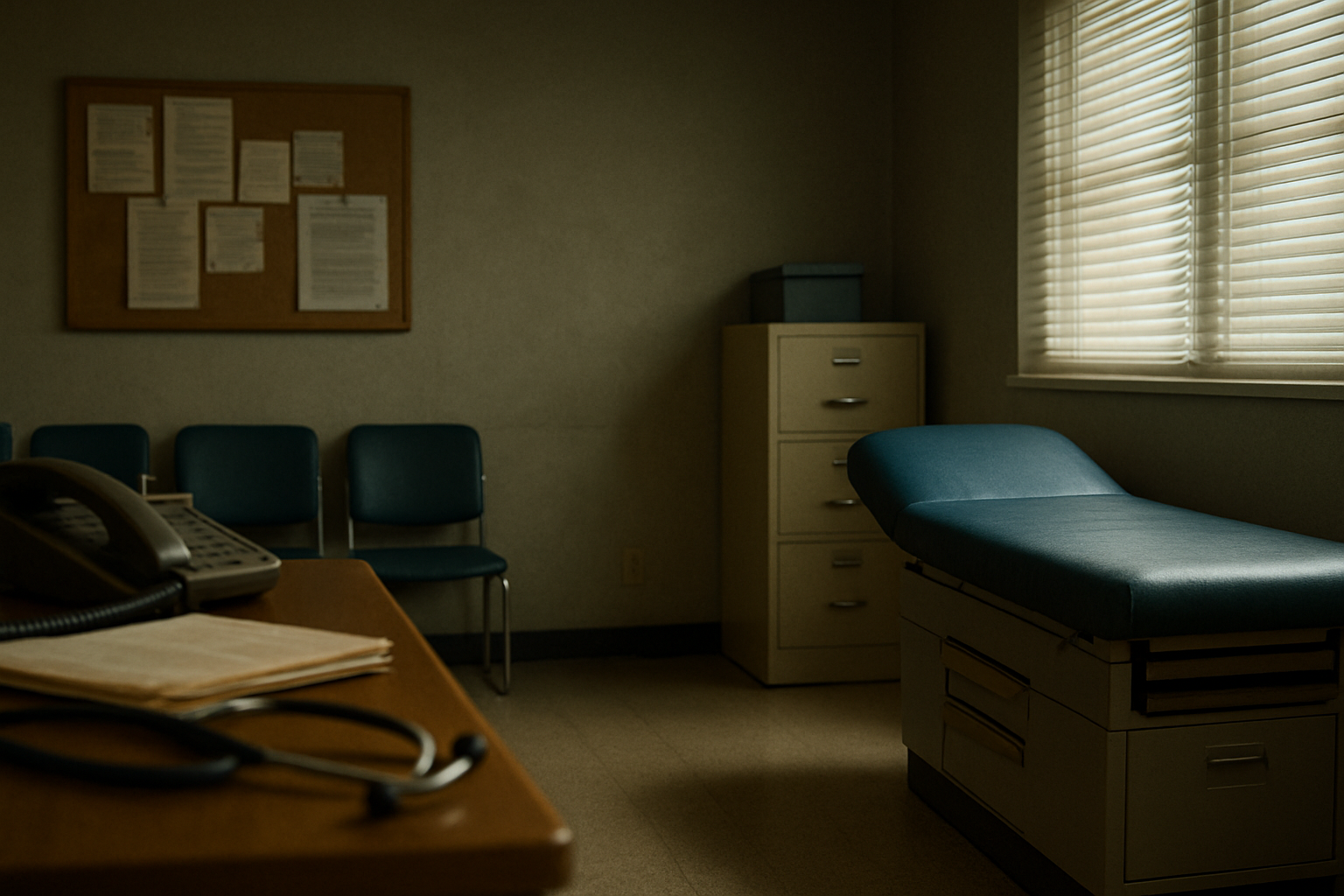
Douglas Edward Schofield
Douglas Edward Schofield, born in 1956 in the Adelaide Hills, was a paediatric physician at the Adelaide Women's and Children's Hospital, known for understanding children who could not speak for themselves. The eldest son of a war-haunted biology teacher, he learned early to read people rather than meet them — a gift that made him formidable at the bedside and absent almost everywhere else. Unmarried and intensely private, quietly certain he saw more than he could ever prove, he kept his own life where no one could reach it.
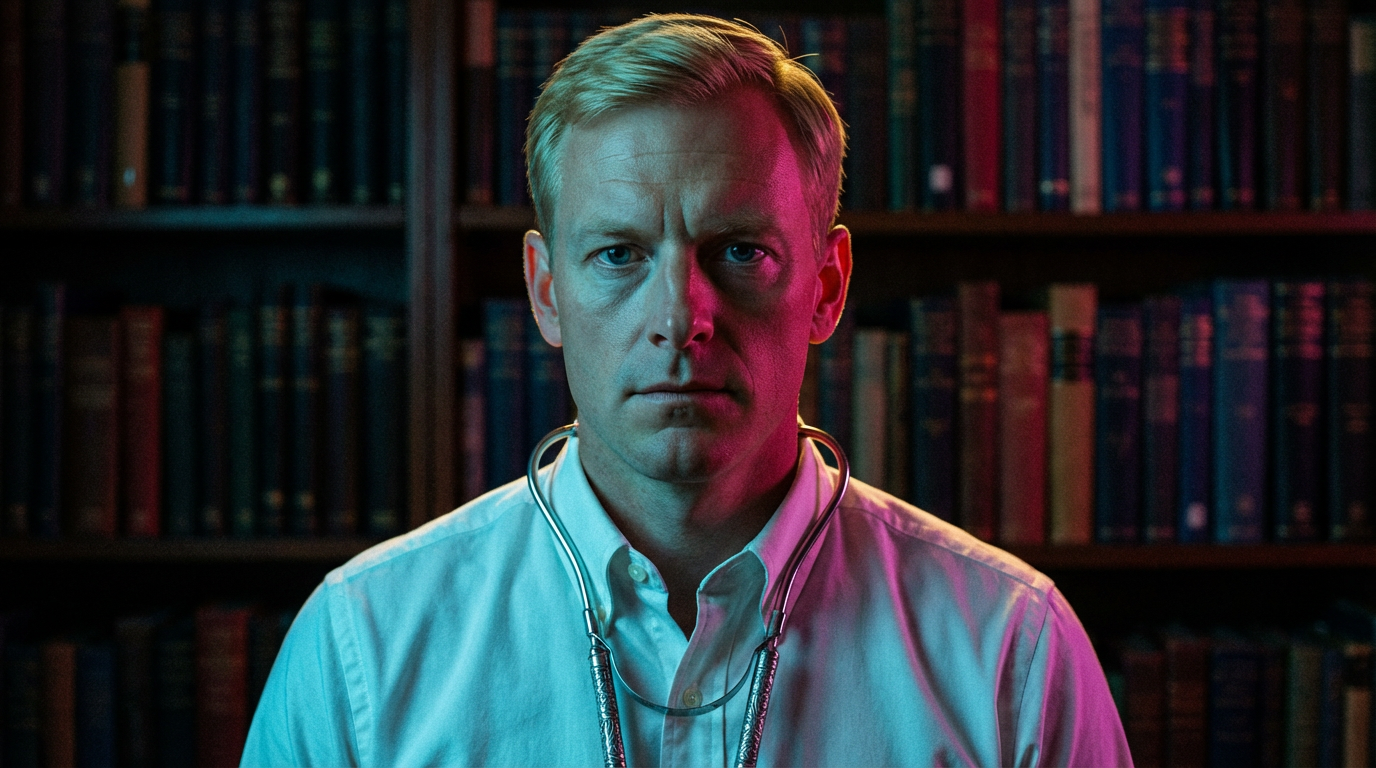
The Boy Who Watched His Brother
Douglas Edward Schofield was born on 14 February 1956 at the Stirling District Hospital, a timber-framed institution on the edge of the Adelaide Hills, on a still summer morning that asked nothing of anyone. He was the first child of Edward James Schofield and Marion Ruth Schofield, née Carrington, and from the beginning he was the kind of baby people described with relief rather than delight: he did not cry much, he watched the room, and he seemed, even in the cot, to be waiting to understand something before he committed to it.
Edward had come home from the New Guinea campaign with a medical orderly's education in how easily a body fails and a habit of keeping the worst of it to himself. He did not become a doctor; he became a biology teacher at a Hills high school, and he taught cell structure and evolution with a gravity his students never quite traced to its source.
What he could not say about the men he had held while they died, he folded into long silences at the dinner table, and his eldest son learned to read those silences the way other children learned to read faces. Marion, a storeman's daughter who had helped run her widowed mother's boarding house and grown up tending other people's needs without comment, kept the household running and her own thoughts to herself. Between them they raised their children in a house that mistook composure for peace.
The home sat against bushland, and Douglas spent his earliest years inside its patterns — the shift of light through the canopy, the architecture of an ant trail, the calls of birds he could tell apart long before he could read. His sister, Felicity Marion, arrived in 1958 and filled the house with a noise he observed from its edges: she painted, invented games, narrated her own childhood as though an audience were always present, and grew up to teach, which suited her. Douglas loved her the way he loved most people — attentively, from a small distance, taking note.
His brother, James Albert Schofield, was born in 1961, and James was the first person Douglas could not simply love. James's mind worked in ways the medicine of the era had no proper name for; he was slow to speak, easily lost, gentle in a manner the world outside the house was not built to protect. The family arranged itself quietly around him.
And Douglas — five years old, then ten, then fifteen — watched. That was the word for what he did. He did not roughhouse with James, or resent him, or rescue him. He studied him: the triggers, the small fixed routines, the particular distress that certain rooms produced.
Years later he would tell himself that watching James had made him the doctor he became. It was true. It was also the first time he chose observation over the harder, plainer thing, and learned how much safer the watching was.
Reading Beneath the Words
Douglas's intelligence announced itself early and quietly, and in 1969 it earned him a partial scholarship to St Peter's College in Adelaide — sandstone, Latin mottoes, and the sons of the professional class, a long way from a teacher's house in the Hills. He did not try to belong there. He watched that world too, learned its codes well enough to move through it unremarked, and left it in 1973 with top marks in biology, chemistry and English literature.
It was the last of these his masters remembered: a boy who could read a poem for what sat underneath it, who found the meaning a text was trying not to say. He would spend the rest of his life doing the same thing to people.
The University of Adelaide took him into medicine that same year. He moved through six years of training with a competence that never tipped into flamboyance, and it was a placement on the children's cancer ward at the Queen Elizabeth Hospital that fixed his direction.
The other students managed those children by keeping a careful distance from them. Douglas did the opposite, and found he was suited to it — not because he was braver, but because dying children had stopped performing, and a person who has stopped performing is the easiest kind of person for a watcher to read. They knew things adults spent their lives avoiding, and they no longer troubled to hide it. He preferred their company to almost anyone's.
He took his degree at Bonython Hall on 7 December 1979 and went on to a fellowship at the Royal Children's Hospital in Melbourne, choosing the work that sat at the seam of body and mind: developmental disorders, psychosomatic illness, the children whose symptoms were really sentences about their homes. By the time he returned to South Australia in 1986, he carried a reputation for an attention that unsettled as often as it comforted.
Twice in those years he was loved, and twice he could not let it land. The first was a fellow medical student, Diane Holloway, who spent the better part of two years trying to reach a man who answered her most open questions as though they were case histories — gently, accurately, and from somewhere he would not let her follow.
The second, a few years later, was a social worker named Janet Pryor, whom he met on a community health placement and who lasted longer because she understood, professionally, what avoidance looked like — until she understood he was doing it to her. Both women left with a version of the same complaint: that he saw them with extraordinary precision and would not, under any circumstances, be seen in return.
He did not pursue anyone after Janet. He had learned that being loved meant being read back, and reading was the one transaction he could only bear to run one way.
The Children Who Knew Too Much
He joined the Adelaide Children's Hospital in 1986 — the institution that merged, in 1989, into the Women's and Children's Hospital — and was placed in the Paediatric Medical Assessment Unit, where his particular gift made itself obvious almost at once. Children who had not spoken to anyone in days gave him sentences. Teenagers who had sealed themselves shut let him in by a careful inch. The nurses noticed before the doctors did, as nurses usually do, and a phrase attached itself to him in staffrooms and handover meetings: he was the one who understood the children who could not speak for themselves.
What that meant, in practice, was that he read what the ward could not chart — the flinch, the held breath, the way a child's eyes tracked a particular adult across a room. By the early 1990s he was a consultant and a supervisor, drawn again and again into the cases that unsettled everyone else: the illnesses that did not behave like illnesses, the injuries whose explanations arrived a beat too smoothly, the children some of his colleagues called, half under their breath, the ones who knew too much. Fabricated illness. Abuse wearing the costume of chronic complaint. He was rarely wrong about which was which.
He was also, far more often than the work could tolerate, unable to prove a thing — and it was into that gap the notebook went. He kept a leather-bound journal that travelled between the hospital and the cottage at Norwood, and into it he wrote what the medical record was not permitted to hold: the suspicions, the patterns, the names of children whose files had closed long before his attention to them did.
He told himself, and anyone who ever glimpsed it, that this was vigilance — a way of holding what the system dropped. It was that. It was also a ledger of his own helplessness, kept in his own hand, that he could not stop adding to and could not put down.
A quiet truth sat beneath it he never examined too closely: most of those children never received a single word of benefit from a single page. The notebook served the watcher more than the watched. It was the one relationship in his life that asked nothing of him and could never leave.
His registrars divided cleanly into those who revered him and those who could not bear him, and the second group were not simply failing to understand him. He taught by withholding — posing the question and letting the silence do the work, declining to say what he had already seen — and on his worse days the method shaded into something less defensible: a man who enjoyed, just slightly, being the only one in the room who knew. He could leave a junior doctor stranded in front of a family to make a point. He mistook his own evasiveness for rigour. The ones he wounded were not wrong about him; they had simply met the part of him the grateful patients never saw.
Gloria, and the Boy Who Wouldn't Speak
In October 1990 a six-year-old named Luke Smith came onto the ward with a confusion of physical complaints and a watchfulness Douglas recognised before he could have justified recognising it. The boy's symptoms did not add up; the mother's account of them added up too well. It became one of those situations the ward learned to carry without naming — high suspicion, thin proof — and Douglas attached himself to the case with an intensity nothing in the notes could warrant. He walked the corridors with Luke. He asked him about his dreams. He spent hours no assessment could account for, building a trust he was in no hurry to spend.
He told himself it was for the boy, and some of it was. But a question sat under it he preferred not to put to himself: whether a child who could not safely be reached at home, who would leave when the admission ended and could never truly know him, was not also the safest possible object for a man who could love only from a distance. The protectiveness he felt for Luke ran close to paternal. It also cost him nothing he was afraid to lose.
It was during the same admission that Gloria died. She was another of the ward's children — bright past the limits of her failing body, a girl who had made the place lighter simply by being awake in it — and she went in the night, alone, in the way the ward least wanted for any of them.
It was Douglas who found her. It was Douglas who lifted her from the bed and carried her out past the other sleeping children so they would not wake to it, and the nurses who saw him do it never described it the same way twice, except that they agreed on his face. It was not shock, and it was not the professional blankness they were used to from him. It was grief, held at a pressure that looked very close to dangerous.
It was the only time the ward saw the wall come down, and it came down for a dead child rather than a living adult. Those who knew him understood, afterwards, that the containment had never been the absence of feeling. It had been the management of far too much of it.
What the Watching Cost
The case he returned to most often was not Luke's, and he never spoke of it at all. In 1993 a girl of eight named Robyn Calder came under his care with the kind of recurring, ill-fitting injuries his whole training had taught him to read. He read them. He was certain almost from the first afternoon. And he did what he always did: he took his time, built the trust, gathered the pattern, and waited for the proof that would let him move without being wrong — because being wrong, in these cases, broke families, and because the careful long game was the method that had never once failed him.
The family stopped attending before the proof arrived. He told himself he needed more before he escalated; he told himself a great many reasonable things. Eighteen months later Robyn Calder came back through a country emergency department and then to the city, with injuries that closed every question he had been so carefully holding open, and by then the matter belonged to the police and the courts and not to him.
He had been right the entire time. He had been right slowly, and slowness, it turned out, was not a neutral thing. A child had lived inside the gap between his certainty and his nerve.
It was the great unexamined irony of his career that a man so praised for his integrity had, in the place it mattered most, so often declined to act. He never faced a formal complaint in forty years, a fact his colleagues cited as proof of his judgement. The truer reading was plainer: complaints come from confrontation, and Douglas confronted almost nothing. He watched, he noted, he built his cases in private and let most of them go unspoken, and a record stayed clean precisely because its keeper so rarely forced the issue.
After Robyn, the notebook stopped being only a record of what the system had dropped. It became, in part, a record of what he had dropped himself — a penance performed nightly and shown to no one, because confession, to mean anything, needs a listener, and he had spent his life making certain he never had one.
Chopin for No One
He lived alone, for the whole of his adult life, in a stone cottage in Norwood, behind a small native garden he tended with the precision he brought to a difficult assessment — each plant set where it would answer the ones around it. Inside were books that ran from medicine to philosophy to the literature he had never stopped reading for its undersides, and a piano he played well, alone, in the evenings, favouring Chopin and Debussy. He made things of real beauty in that house and let no one hear them.
On weekends, when the hospital released him, he walked the trails of the Cleland Conservation Park by himself, and the colleagues who occasionally saw him there described a man who seemed, among trees that asked nothing of him, almost present.
He was not, up close, an easy man. Beneath the courtesy ran a contempt for sloppiness — in colleagues, in thinking, in anyone who settled for the obvious — that he kept behind his teeth as his father had kept the war, but which the perceptive could feel. He disliked being touched, and arranged his body in every room so that it would not happen. He could not abide small talk and would let a conversation die rather than feed it, which read as rudeness as often as depth.
He liked things kept in their order and went cold when they were not. And there were stretches — after Robyn, and again in his sixties — when the careful garden went to seed and the cottage filled with unopened post, the discipline that held him together loosening into something that looked, from outside, like a man quietly going under.
His brother remained the truest measure of him. James lived on into adulthood under part-time care, gentle and diminished, and Douglas did not abandon him — he arranged the care, met the costs, appeared when appearance was required, and was, by every outward account, a dutiful brother.
What he could not do, even now, even for James, was the plain thing: sit beside him with nothing to assess and simply be his brother. He visited the way he did rounds. He read James's moods with a clinician's accuracy and met them with a clinician's distance, and some part of him understood, on the drive home, that he had spent fifty years studying the one person he had been given to love without conditions, and had never once managed to put the notebook down and just hold him.
It went on like that into his late sixties without any of it resolving, because a life of that shape did not resolve so much as continue. By 2025 he was still on the staff of the Women's and Children's Hospital, having turned down, across the decades, every academic chair and administrative post that would have lifted him out of the consulting room and away from the children — the only people he had ever found it safe to give himself to.
He was called now for the cases that frightened the younger doctors, and he taught the ones who could bear his methods to see what they had been missing, and he walked the corridors inside a weight his colleagues read as reverence and that was, in truth, something lonelier.
He saw everyone. He let no one see him. And each night he went home to the cottage and the piano and the leather notebook, and added, in his small exact hand, to the long private record of all the children he had watched, and understood, and not always saved.







