
Douglas Alexander Fitzpatrick
Douglas Alexander Fitzpatrick arrived in Van Diemen's Land in 1807 with nothing but a letter of introduction and a willingness to work until his hands bled. Within eight years, he had transformed himself from desperate emigrant into one of the colony's most substantial pastoralists, acquiring land grants, building flocks, and establishing the foundation of what would become significant wealth. The transformation came at a cost he never stopped calculating. At a dinner in September 1815, he confessed to William Jeffries—a former convict newly arrived from Sydney—the moral compromises that colonial success demanded: the bribes paid, the convict labour exploited, the principles abandoned one by one until the man who stepped off the ship had become unrecognisable. It was not a warning meant to dissuade but an education offered to someone he recognised as capable of understanding. Four years later, he would sell Jeffries the coal-rich land that launched Jeffries Industries into mining. He lived another three decades after that transaction, watching the colony change around him, never entirely escaping the knowledge of what he had done to prosper in it.
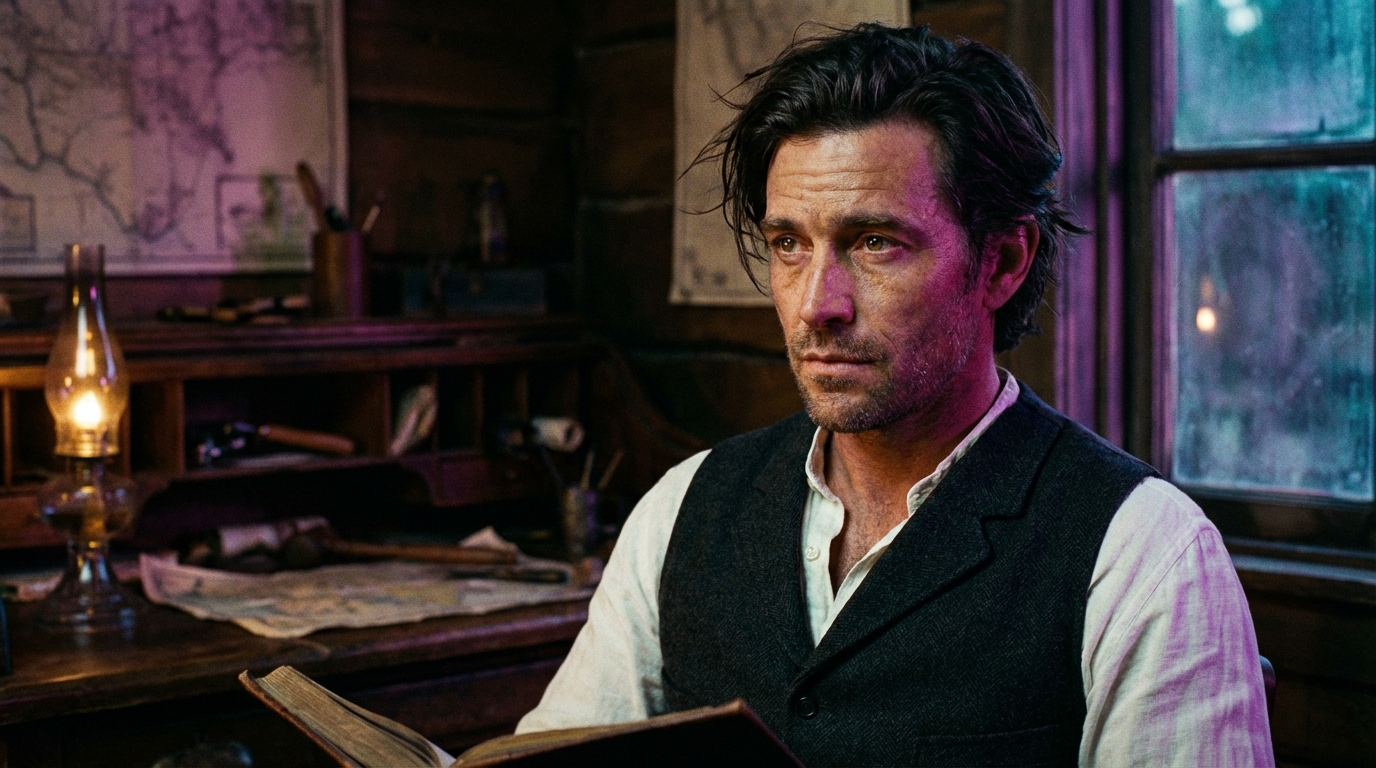
Early Life in Portsmouth
Douglas Alexander Fitzpatrick was born on 12th March 1775 in Portsmouth, Hampshire, the second of four children born to Jonathan Fitzpatrick and Eleanor Fitzpatrick (née Ashworth). His father operated a modest chandlery supplying naval vessels, a business that provided comfortable respectability without significant wealth. The harbour town shaped Douglas from his earliest years—the constant movement of ships, the rhythm of tides and sailings, the awareness that the world extended far beyond the horizon he could see from the waterfront.
His older brother James was destined to inherit the chandlery; Douglas understood from childhood that his path lay elsewhere. His father arranged apprenticeship with a wool merchant in Southampton when Douglas was fourteen, hoping to establish the boy in a trade with better prospects than supplying ships' candles and rope. The apprenticeship proved formative. Douglas learned the wool trade from fleece to fabric, developing an eye for quality and an understanding of the markets that determined prices. He also learned that success in commerce required flexibility—that the difference between profit and loss often lay in accommodations with circumstance that no ledger would record.
He completed his apprenticeship at twenty-one and spent the following years working for various merchants in Hampshire and Wiltshire, building experience and connections but never quite finding the opportunity that would allow him to establish himself independently. England in the years after the French Revolution offered limited prospects for young men without capital or powerful patrons. The established merchants had sewn up the trade routes; the great landowners controlled the wool supply; and the wars with France disrupted what opportunities might otherwise have existed.
By his late twenties, Douglas had begun to feel the walls closing in. He would never be more than an employee in England, never own the land that produced the wool he traded, never escape the narrow circumstances of his birth. The feeling bred a restlessness that his family noted with concern and that he himself recognised as potentially dangerous. Desperate men made desperate choices, and Douglas was determined not to become one of them.
Marriage and Decision
His marriage to Catherine Everly in June 1799 represented both refuge and complication. Catherine was the daughter of a small farmer in Wiltshire, a woman of practical intelligence and quiet strength who had caught Douglas's attention during his travels through the wool-producing country. Their courtship was brief—Douglas was not a man who deliberated long once he had made a decision—and their wedding modest, befitting their combined circumstances.
The early years of marriage brought children in rapid succession: William in 1801, Anne in 1803, Thomas in 1806. Each birth increased both the joy and the pressure of Douglas's situation. He was thirty-one when Thomas arrived, still working for other men, still unable to provide his family with the security he had promised Catherine on their wedding day. The gap between his ambitions and his circumstances had become a wound that would not heal.
The solution, when it presented itself, came from an unexpected quarter. A merchant Douglas had worked for in Southampton had connections to the Colonial Office and spoke of opportunities in the Australian colonies—vast tracts of land available to men willing to work them, fortunes to be made by those with the courage to seek them. Van Diemen's Land, in particular, offered prospects for pastoralists. The colony was barely three years old, desperately short of capable settlers, and the government was offering land grants to free emigrants who could demonstrate the means to develop them.
Douglas had no such means. What he had was knowledge of the wool trade, experience in agriculture acquired during his travels, and a determination that had been sharpening itself against English limitations for a decade. He also had a letter of introduction from the Southampton merchant, addressed to colonial officials and attesting to Douglas's character and capabilities.
The decision to emigrate required him to leave Catherine and the children behind. The voyage was too dangerous, the colony too uncertain, to risk his family on what might prove a fool's errand. He would go first, establish himself, and send for them when he could offer something more than hope. Catherine accepted this plan with the pragmatism that characterised her approach to life's difficulties. She would return to her father's farm with the children and wait for word from the other side of the world.
Douglas sailed from Portsmouth in February 1807, thirty-two years old, carrying everything he owned in a single trunk and everything he hoped for in the letter tucked inside his coat.
Arrival and Establishment
Van Diemen's Land in 1807 was a raw wound carved into the wilderness. The settlement at Hobart Town had existed for only three years, a collection of wooden buildings huddled against the base of Mount Wellington as if seeking protection from the vast unknown that surrounded them. The convicts who comprised most of the population laboured under the supervision of soldiers and free settlers whose authority derived from guns and distance from any power that might check their exercise of it.
Douglas arrived with his letter of introduction and immediately discovered that letters meant little in a place where capability was measured by what a man could actually do. The colonial officials who reviewed his credentials were polite but unhelpful; land grants went to those who could demonstrate capital, and Douglas had none worth mentioning. His knowledge of the wool trade impressed no one in a colony that had barely begun to develop its pastoral potential.
What followed was the hardest period of Douglas's life. He took whatever work he could find—labouring on other men's properties, clerking for merchants whose operations bore no comparison to the sophisticated trade he had known in England, accepting positions that would have been beneath him at home. He lived in conditions that would have horrified Catherine, slept in quarters little better than those housing the convicts, and learned what it meant to build from nothing in a place that cared nothing for what a man had been.
The transformation came gradually, through a combination of hard work, sharp observation, and the moral flexibility he had begun developing during his Southampton apprenticeship. He noticed which officials responded to flattery, which to small gifts, which to the promise of future considerations. He learned the informal economy that operated alongside the official one—the favours traded, the blind eyes turned, the arrangements that everyone understood but no one acknowledged.
His first land grant came in 1809, secured through a bribe to a clerk in the Governor's office. Twenty pounds and a barrel of rum ensured that his application reached the top of a pile while better men waited their turn. Douglas told himself it was necessary, that the system was corrupt anyway, that he was simply playing by the rules as they actually existed. The justifications came easily at first. They would become harder to sustain as the years passed.
Building a Fortune
The grant was modest—a few hundred acres of land that required clearing, fencing, and stocking before it would produce anything worth selling. Douglas attacked the work with the energy of a man who had waited too long for his chance. He acquired convict labour through the assignment system, telling himself he would treat his workers better than most masters treated theirs. And perhaps he did, by the standards of the time and place. But he still worked them fourteen hours a day in summer, still housed them in huts that would not have sheltered a decent man's dog, still fed them rations that kept them alive without ever satisfying their hunger.
The wool he produced found ready markets. Douglas's knowledge of the trade, acquired through years of English apprenticeship and employment, gave him advantages that other settlers lacked. He understood quality, understood what English mills were seeking, understood how to present his product to maximum advantage. His flocks grew; his acreage expanded; his reputation as a capable and successful pastoralist began to establish itself.
He sent for Catherine and the children in 1811, four years after his departure from Portsmouth. The family that stepped off the ship in Hobart Town barely recognised the man who met them at the dock. Douglas had grown weathered and lean, his skin darkened by colonial sun, his hands calloused from work he had never imagined doing. The soft wool merchant's son had become something harder, something forged by necessity and compromise into a shape his younger self would not have recognised.
Catherine adapted to colonial life with the same pragmatism she had brought to everything else. If she was shocked by the conditions, by the roughness of society, by the convict servants who now worked in her household, she did not say so. She set about making a home in the wilderness, raising her children in circumstances she could never have anticipated, and supporting her husband in ways both visible and invisible.
The children grew up colonial, knowing no other life. William, the eldest, absorbed his father's knowledge of pastoral operations and would eventually take over management of the family properties. Anne developed the accomplishments expected of a young woman of her station, though the station itself was uncertain in a colony where traditional hierarchies had not yet fully established themselves. Thomas, the youngest, showed aptitude for commerce that reminded Douglas of his own youthful ambitions.
The Weight of Success
By 1815, Douglas Fitzpatrick had achieved everything he had dreamed of during his desperate English years. He owned thousands of acres of grazing land, ran flocks that produced some of the colony's finest wool, employed dozens of convict labourers whose work enriched him year by year. He was recognised as one of Van Diemen's Land's most substantial pastoralists, invited to the dinners and gatherings where colonial society conducted its real business.
And he was haunted by what he had done to achieve it.
The compromises that had seemed necessary in the desperate early years had accumulated into something he could no longer ignore. The bribe that secured his first land grant had been followed by others—payments to officials, gifts to men whose influence could smooth his path, accommodations with a system he knew to be corrupt. The convict labour that built his fortune operated through a framework he had come to see clearly for what it was: slavery by another name, dressed in the legal fictions of sentences and reformation but reducible, in the end, to human beings worked without consent, bought and sold between masters, denied the fruits of their own labour.
He treated his convicts better than many masters did. He told himself this, and it was probably true. But he still profited from their bondage, still built his fortune on their broken backs, still participated in a system whose injustice he could no longer pretend not to see.
The awareness did not make him stop. That was perhaps the hardest truth of all. Douglas Fitzpatrick, who had left England partly because he refused to accept the limitations imposed by birth and circumstance, had become a man who imposed limitations on others. He had escaped one form of bondage only to profit from another, had built his freedom on the unfreedom of those beneath him.
Catherine knew some of this. How much, Douglas was never certain. She managed their household with the same efficiency she brought to everything, supervised the convict servants with firm fairness, and never asked questions whose answers might disturb the equilibrium they had achieved. Whether this represented acceptance, wilful blindness, or a pragmatism that simply had no space for moral examination, Douglas could not say. Their marriage remained solid, grounded in shared history and mutual respect, but there were territories within it that neither ventured to explore.
The Harding Dinner
The dinner at Sir William Harding's residence on 3rd September 1815 brought Douglas face to face with a man who stirred something unexpected in him.
William Jeffries was a former convict, recently arrived from Sydney with credentials from Reginald Donnelly and ambitions that colonial gossip had already begun to discuss. Douglas observed him throughout the evening—his careful navigation of social complexities, his watchful assessment of the powerful men around him, his refusal to be diminished by his origins. He saw in Jeffries something of his own younger self: the determination, the hunger, the willingness to work until his hands bled for a chance at something better.
He also saw someone standing at the edge of the same precipice Douglas had crossed years before. Jeffries was about to enter a world that would demand compromises, that would offer success only at the price of accommodation with injustice. And Douglas found himself wanting to speak honestly to this man in a way he had not spoken to anyone in years.
The confession came after dinner, in the masculine space of port and cigars where different rules applied. Douglas told Jeffries about the bribe that secured his first land grant, about the convict labour that built his fortune, about the gap between the man he had been when he stepped off the ship and the man he had become. He described the colony's moral economy in terms that stripped away the polite fictions: blood and bone and broken lives, slavery by another name, every fortune built on the labour of men and women who had no choice in the matter.
It was not a warning meant to dissuade. Douglas understood that Jeffries would make his own choices regardless of what anyone told him. It was an education—an attempt to ensure that if Jeffries chose to enter this world, he would do so with his eyes open, knowing what he was building on and what it would cost him.
"The question isn't whether you'll compromise," Douglas told him. "You will. The question is whether you'll do it with your eyes open, knowing what you're doing and why, or whether you'll tell yourself pretty stories to make the ugliness easier to bear."
Whether Jeffries took the lesson to heart, Douglas could not know. But he saw something in the younger man's eyes that suggested the words had landed, that the truth had been heard even if its implications remained to be worked out.
The Land Sale
Four years later, in August 1819, Douglas sold William Jeffries a tract of land in Granton that would transform the trajectory of Jeffries Industries.
The land contained coal deposits that Douglas had long suspected but never developed. His expertise lay in wool, in the pastoral operations he had built over twelve years; mining was a different enterprise entirely, requiring capital and knowledge he did not possess. When Jeffries approached him about the property, guided by the advice of mining expert Andrew Crosby, Douglas recognised an opportunity to convert potential into profit whilst divesting himself of land he could not properly utilise.
The transaction was straightforward—a fair price for valuable property, conducted through proper legal channels with none of the grey-area dealings that had characterised Douglas's early years. He had grown wealthy enough to afford the luxury of clean commerce, at least in this instance.
But there was something else in the sale, something Douglas did not fully acknowledge even to himself. He had warned Jeffries, four years earlier, about the compromises colonial success demanded. Now he was providing Jeffries with the means to expand that success, to build the empire that would transform Van Diemen's Land's economy. In selling the land, Douglas was making himself complicit in whatever Jeffries would become—participant in a story whose ending neither of them could foresee.
Whether this troubled him, whether he lay awake wondering what he had enabled, the historical record does not reveal. What is certain is that the sale marked a turning point for Jeffries Industries and, in a smaller way, for Douglas himself. The capital he received allowed him to consolidate his pastoral holdings, to provide more generously for his children's futures, and to begin the gradual withdrawal from active management that would characterise his later years.
Later Years
The decades following the land sale saw Douglas Fitzpatrick transform from ambitious builder to established elder. His sons took over increasing responsibility for the family properties; his daughter Anne married well and established her own household; his grandchildren began to arrive, carrying the Fitzpatrick name into a future Douglas would not live to see.
He remained active in colonial affairs, serving as a magistrate for many years and contributing to the establishment of schools and churches that might civilise the rough settlement he had helped build. These philanthropic efforts represented, perhaps, an attempt to balance the ledger—to offset the moral debts accumulated during his years of compromise with contributions that might benefit others.
Catherine died in 1847, after nearly fifty years of marriage. Douglas mourned her with a grief that surprised him in its intensity. She had been his partner through everything—the desperate English years, the voyage into the unknown, the building of a fortune in the wilderness. Whatever she had known or suspected about the compromises he had made, she had never withdrawn her support, never made him feel judged for what he had done. Her death left a vacancy that nothing could fill.
He lived another three years, watching the colony transform around him. Van Diemen's Land had grown from the raw settlement of his arrival into something approaching civilisation, with proper institutions and established hierarchies and all the apparatus of English society transplanted to the southern hemisphere. The convict system that had provided his labour force was under increasing scrutiny, its injustices no longer quite so easy to ignore. Transportation would eventually end, though not until after Douglas's death, and the colony would have to find new ways to build its wealth.
The Jeffries empire he had helped enable through the 1819 land sale had grown into one of the colony's most significant enterprises. William Jeffries had indeed made his compromises—everyone who succeeded did—but he had also built something substantial, something that employed hundreds of people and contributed to the colony's development. Whether this vindicated Douglas's decision to sell him the land, whether the enterprise justified its moral costs, Douglas could not say. He had learned long ago that such questions had no clean answers.
Death and Legacy
Douglas Alexander Fitzpatrick died on 17th October 1850, aged seventy-five, at the property he had built from nothing over four decades of colonial life. His children and grandchildren gathered around him at the end, representatives of the dynasty he had founded through determination, hard work, and compromises he never stopped calculating.
He was buried on the property, in a plot overlooking the grazing lands that had made his fortune. The funeral was attended by many of the colony's leading citizens—men who had known him as a capable pastoralist, a fair magistrate, a contributor to colonial development. Few of them knew the full weight of what he had done to achieve his position, the bribes and accommodations and moral debts that lay behind his respectable facade.
The estate he left was substantial—thousands of acres of pastoral land, flocks that produced premium wool for English markets, a reputation that his descendants would carry forward into the colony's future. His sons continued the operations he had established; his grandchildren inherited the prosperity he had built; the Fitzpatrick name remained respected in Tasmanian society for generations.







