Dorothy Maureen Novak (née Hennessy)
Dorothy Novak, born Dorothy Hennessy in 1947, was a plain-spoken Adelaide factory and canteen worker from a large Irish-Catholic family in the city's northern suburbs. She gave her thirties to nursing her ailing mother, married the Czech widower Pavel Novak in 1989, and raised his teenage son Stefan without thanks. A lifelong, uncomplaining carer who found her warmth late in her step-grandchildren Taryn and Connor, she nursed Pavel through his final illness and died in her sleep in 2024.
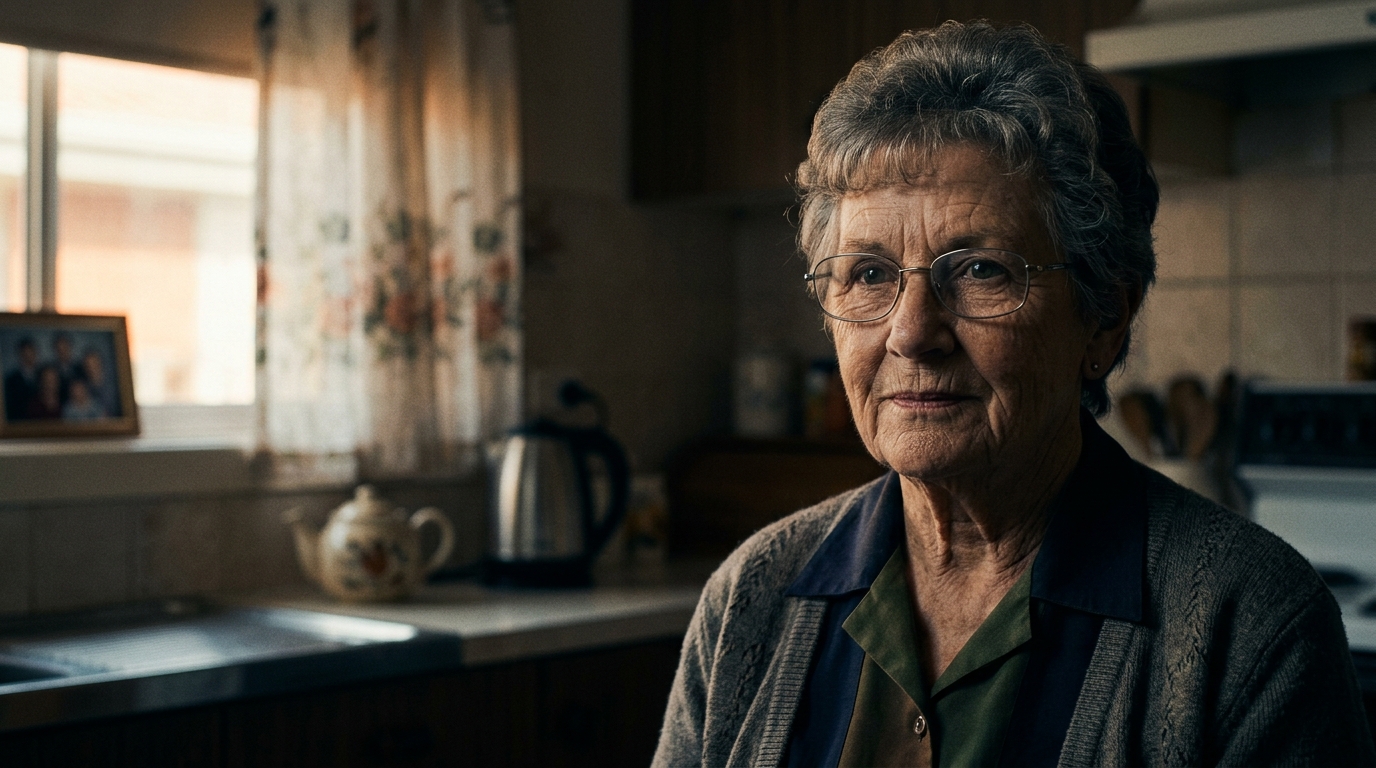
The Hennessy Girl
Dorothy Maureen Novak was born Dorothy Maureen Hennessy on the 4th of October 1947, in a rented terrace in Brompton, in the close, smoke-stained inner-north-west of Adelaide where the city's Irish-Catholic families had clustered for three generations within earshot of the foundries and the abattoirs. She was the fourth of the six children of Patrick Hennessy, a labourer of unfailing reliability and few words, and his wife Eileen (née Brennan), a Mass-going, rosary-telling woman who ran a crowded house on a thin wage and an iron sense of how things ought to be done.
The Hennessys were poor in the ordinary, unremarkable way of their street, and Catholic in the bone. There were Kathleen and Brian above her, and Vincent just ahead, and Patricia and the baby, Gerard, below; six children in three bedrooms, a statue of the Sacred Heart on the mantel, and a mother who counted attendance at eight o'clock Mass the way other women counted the housekeeping. Dorothy grew up in the middle of that noise, neither the eldest who was relied upon nor the youngest who was indulged, and she learned early the particular invisibility of the capable middle child — the one who was noticed only when something needed doing.
When she was ten the family joined the great northward shift of the decade, leaving the terrace for a brand-new Housing Trust home in Salisbury, where Patrick had found steadier work and the streets still smelled of cut timber and wet cement. For Dorothy it was a vast improvement — a bedroom shared with only one sister, a yard, a sense of space — and it fixed her, for the rest of her life, in the flat northern suburbs of Adelaide, among the people who had come there to make things.
She was schooled by the Josephite nuns, who taught her a fine copperplate hand, a horror of waste, and the conviction that complaint was a form of vanity. She was not a clever girl in the way the nuns rewarded, but she was steady and neat and never any trouble, and that, in a girl of her time and place, was counted as virtue enough.
Family Tree
Machines and Canteens
She left the convent school at fifteen, at the end of 1962, because there was no money for more and no expectation of it, and went straight to work as every Hennessy girl did. Her first job was at a hosiery mill in the northern suburbs, sitting at a machine in a long shed full of women and noise, and she was good at it in the way she would be good at everything she ever turned her hands to — quick, accurate, uncomplaining, and faster than the girls who chattered.
The work was monotonous and the pay was poor and Dorothy minded neither very much. She handed most of her wage to her mother, as was expected, and kept back enough for stockings and the pictures and the occasional dance at the Catholic club, and she found in the company of the factory floor a warmth and a roughness that suited her. She was not a beauty and did not pretend to be; she was square-built and plain-faced and dryly funny, with a tongue that could take the skin off a man who deserved it, and the other women liked her for it.
Through her twenties she moved between factories as the work came and went — the hosiery mill, then a food-processing plant, then a spell on a packing line — riding the long boom of the manufacturing north, when the factories around Elizabeth and Salisbury seemed to multiply each year and a woman who turned up sober and worked hard need never be idle. She barracked, without much passion but with local loyalty, for the Central District football club up the road, and she went to the club of a Saturday night, and on Sundays she still went, mostly, to Mass.
It was an ordinary life, and she had no quarrel with it. If she imagined a different one — a husband, a house of her own, children underfoot — she did so privately and without urgency, in the unhurried way of a woman who assumed, as most women of her street assumed, that such things arrived in their own time and did not need chasing.
The One Who Stayed
There was a man, once. His name was Trevor Bührer, a fitter's mate from a German-Lutheran family in the Barossa foothills, and Dorothy walked out with him for the better part of four years, from the time she was twenty-one. He was easy company and not unkind, and her mother disapproved of him on the single ground that he was not a Catholic, and for a while it seemed that Dorothy would have her house and her children after all, and that the disapproval would be worn down in the usual way.
What undid it was not the religion but the distance. In 1972 Trevor was offered a good tradesman's wage at a works in Western Australia, and he asked her to come, and she found that she could not. Her father was ageing and her mother was not strong, and of the six Hennessy children Dorothy was the one still at home and the one most relied upon, and she made — quietly, almost without deciding it — the choice that would shape the next sixteen years of her life. She let him go. He married a Perth girl within two years and sent a Christmas card for a while and then did not, and Dorothy folded the whole thing away and rarely spoke of it again.
She did not, at the time, think of it as a sacrifice. She thought of it as the obvious thing, the thing a decent daughter did, and it was only much later, in the long quiet of her widowhood, that she allowed herself to wonder what the other life might have been.
The choice was sealed four years on. In 1976 her mother suffered a stroke that took the strength from one side of her and left her needing a great deal, and there was never any question of who would provide it. Kathleen had a husband and a brood of her own; Patricia had moved to the country; the brothers were brothers, and it was not, in that family, a thing the brothers did. So Dorothy stayed. She arranged her factory shifts around her mother's hours, took canteen and cleaning work when it offered the flexibility she needed, and gave over the heart of her thirties to the slow, thankless, unglamorous labour of keeping another person comfortable.
Her father died in 1983, worn out at sixty-six by a lifetime of heavy work, dropping where he stood in the back garden on an autumn morning. Her mother lingered five years more, declining by inches, and died at last in the winter of 1988, with Dorothy holding her hand and the rosary she had never quite managed to believe in coiled on the bedspread. Dorothy was forty-one years old. The house went back to the Trust, her brothers and sisters were scattered into their own lives, and for the first time since girlhood she had no one to look after but herself, and did not entirely know what to do with the freedom.
A Quiet Marriage
She met Pavel Novak in the spring of 1989, at a social club in Salisbury, over a game of bingo and a shandy. He was a Czech widower a couple of years her senior, a quiet, careful man who worked the line at the Holden plant and spoke in a heavy accent and an economy of words that matched her own, and what struck her first was not romance but recognition — here, plainly, was another person who had learned to make do.
There was nothing headlong in it. They were two people in their forties who had each, separately, stopped expecting to be chosen, and the courtship was conducted over more bingo and the occasional roast dinner with the careful good manners of adults who knew their own minds. When Pavel asked her, she said yes without drama, because the alternative was a solitary middle age in a rented flat, and because she liked him, and because being needed by someone was the shape her life had always taken and she did not know how to refuse it.
They married quietly later that year, in a registry office, with a handful of her family and almost none of his, and Dorothy moved her few things into the small fibro house in Elizabeth that Pavel had bought on a mortgage that frightened him. It was not a marriage of passion, and she would have been the first to say so, in her flat way, had anyone been foolish enough to ask. It was a marriage of two undemonstrative people who valued steadiness over fire, and within its narrow, undemanding walls Dorothy was, for the first time in a long while, something like content.
Raising Another Woman's Son
The house came with a boy. Stefan was fourteen when Dorothy arrived in it — a sullen, watchful adolescent, motherless since he was ten, with his father's silence and a grievance he could not have named, and he regarded the plain Australian woman who had married his father with the flat suspicion of a child who had learned not to count on anyone. Dorothy did not try to win him. She had no instinct for the warm gesture, no gift for the maternal performance; what she had was competence, and she applied it.
She packed his lunches and ironed his shirts and sat up when he came home late smelling of other people's cigarettes. She fed him properly, kept his room habitable, and absorbed his adolescent rudeness without ever once returning it, in the manner of a woman who had nursed a difficult invalid and found a difficult teenager no great trial by comparison. She did the whole unglamorous work of raising him, and she asked nothing in return, and she got nothing, and she had not expected to.
He never called her anything but Dorothy. There was no warmth between them, not really; she was not the kind to inspire it and he was not the kind to give it, and the most that could be said was that she was reliably, undramatically there, year after year, a fixed point in a house of quiet men. If she ever resented it — the sudden acquisition, at forty-two, of someone else's half-grown son, the second withdrawn male she had bound her life to — she kept it as she kept everything, folded away and unmentioned.
That self-effacement was her great virtue and also, in a way she never examined, her central flaw. She had spent her whole life making herself small enough to fit around other people's needs, asking for nothing so insistently that she was given very little, and the line between her steadiness and a kind of quiet self-erasure was one she had crossed so long ago that she no longer knew it was there.
The Grandchildren She Was Given
Stefan grew up and, to general surprise, married. Dorothy sat in the registry office in 1998 in her good frock and watched him take on Kylie Hammond and a family of his own, and when the children came — Taryn first, then Connor five years behind her — Dorothy discovered, somewhat to her own astonishment, a tenderness she had never managed for their father.
With the grandchildren she was easier than she had ever been with anyone. They were no blood of hers, and she knew it, and it did not matter in the slightest; they were small and they liked her and they made no demands her competence could not meet. She minded them when Kylie was at work, kept their drawings on the fridge, and slipped them lollies against their mother's wishes, and in their uncomplicated affection she found, late and unlooked-for, something close to the family she had let go of in 1972.
So when Stefan walked out on them in February 2010 — vanished one ordinary morning into a life an hour up the river, leaving Kylie and two bewildered children behind — Dorothy's response was never in doubt. She and Pavel closed ranks around the family their son had abandoned without a word being needed between them. She kept up with Kylie, who was holding a household together on a checkout wage; she turned up at the school concerts and the birthdays; she pressed folded notes into small hands and waved away the thanks.
It was the work she had always done, done now for love rather than duty, and she did it without fuss for as long as she was able. The grandchildren got from their step-grandmother the steadiness their own father had refused them, and Dorothy got, in return, the only thing she had ever secretly wanted, which was to be needed by people who were glad of her.
Nursing Pavel
The last hard task of her life was her husband. Pavel had a stroke in 2015 and another the following year, and the careful, capable man she had married was slowly taken from her in pieces — his speech, his balance, the use of one side, and at last the thread of who he was. Dorothy nursed him at home for as long as her own ageing body could manage it, and longer than was wise, until the lifting and the watching and the broken nights had worn her thin.
By the end of 2016 she could no longer keep him safe, and she made the decision she had dreaded above all others and moved Pavel into a nursing home in Salisbury, a few minutes from the streets where they had spent their twenty-odd years together. She was at peace with none of it and she did it anyway, because it was right, and then she visited him almost every day, sitting beside a man who less and less often knew her, doing what she had always done, which was to be present whether or not it was acknowledged.
He died there in November 2017. At the funeral, in a small Salisbury chapel, Dorothy sat at the front, dry-eyed and upright, and those who did not know her took it for coldness. It was not. She had simply done her grieving privately and over years, in the long erosion of his illness, and by the time they buried him there was little left to weep that she had not already wept alone. She had been a wife for twenty-eight years to a man who never quite said he loved her, and she had never needed him to. She had known what she was, and what she was for, and she had been content with it.
The Last Seven Years
Widowhood, when it came, was quieter than she had feared and lonelier than she let on. She stayed in the Elizabeth house, kept it as immaculate as ever, and arranged her weeks around the small fixed points that had always steadied her — the club, the Saturday football, the telephone calls to her surviving sisters, the slow round of a life pared back to its essentials.
Her real warmth in those years went to the grandchildren. She lived long enough to see Taryn become the first of that branch of the family to go to university, and she said little about it, in her way, but she kept the girl's progress folded close, and she was prouder than she would ever have admitted of the determined young woman who had refused to become her father. Connor she watched grow into a steadier man than anyone had feared. They were not hers, and they were the nearest thing to hers she had ever had, and she loved them with the undemonstrative constancy she had spent a lifetime perfecting.
She kept, in a drawer, the rosary that had been her mother's, and she went to Mass at Christmas and at funerals and otherwise let her faith sit where it had always sat, a faded inheritance she neither practised nor disowned. She grew slower and a little stooped, and she complained of none of it, and she went on.
Dorothy Novak died in her sleep in August 2024, in the Elizabeth house, at the age of seventy-six. There was nothing dramatic in it; she simply did not wake, which was, those who knew her agreed, exactly the undemanding way she would have chosen to go.
They buried her on a grey winter morning, and Taryn and Connor were there, grown now, to mourn the step-grandmother who had been more reliably present in their childhoods than their own father. Stefan was not. The boy she had raised from fourteen, the man she had fed and clothed and stood by without thanks for nearly thirty years, could not bring himself to face the children he had abandoned, and so the woman who had given uncomplaining care to everyone who had ever needed it went into the ground unthanked by the one who had owed her most. She would not have made a fuss about it. She never had.







