4338.209 · July 28, 2018 AD
Don't Wait Up
Two police officers come up the mountain in the rain, and one of them asks Jenny about her marriage. She has a second to decide, and she gives them a good one. Then a text arrives from her husband's phone telling her not to wait up — and it is signed, and in eleven years he has never once signed a message to his wife, and she is the only person in the room who can hear it.
"I told a police officer that my husband and I had made love that morning. It was the finest work I have ever done, and I have never once been able to decide whether she believed a word of it."
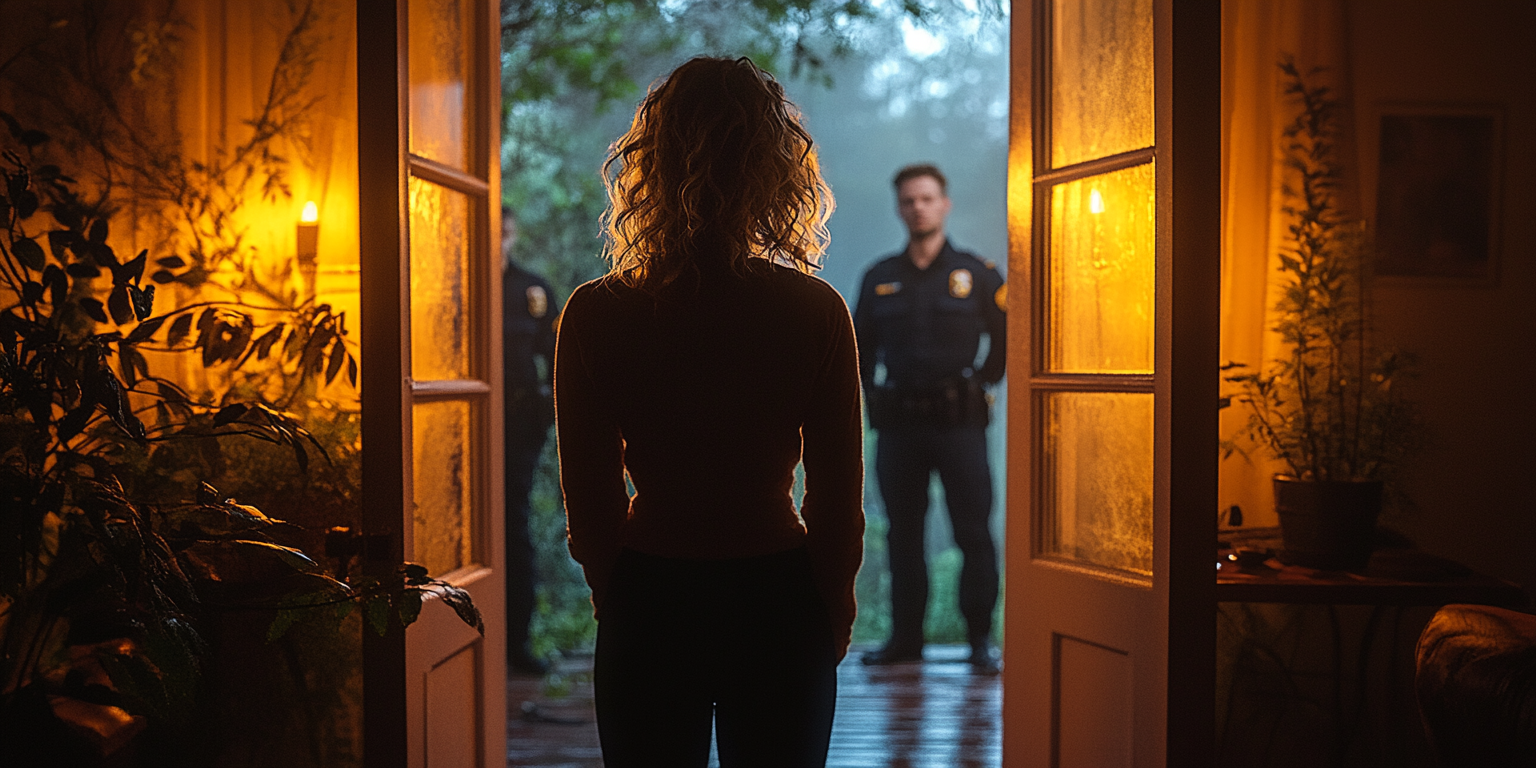
The cold came in at me the moment I had the door open, and it brought the rain with it, and underneath the rain there was cigarette smoke and somebody's perfume — and none of that belonged on my verandah, and my body knew it before I did.
The porch light was going. It had been going since May.
And it was not the man I had built. All the way down that hallway I had been building him — grey at the temples, a raincoat, a notebook, somebody who had seen a hundred of these and would take one look at my house and know. What was standing under my porch light was a woman of about twenty-six in a uniform without one crease out of place in it, with her hat on and her feet apart and her hands down at her sides, and she looked at me the way a stock inspector looked at a paddock.
"Mrs Triffett?"
"Ahh… yes, that's me."
And my hand went down the front of my jumper and smoothed it, and I felt myself do it, and I could have wept. Thirty-two years old, standing in my own doorway, tidying myself up for a girl young enough to have sat in my Year Twelve class.
"You called about your husband, Nial Triffett?"
"Yes."
"And you believe he's missing?"
Believe.
She said it flat, with nothing on it at all, and I heard the whole of the rest of that evening inside it. Not he's missing. Not when did you last see him. She had driven up a mountain in the rain on a Saturday night with an opinion already folded in her pocket, and she had brought it to my front door, and she was going to leave with it.
The second one was getting out of the car behind her. Younger — younger than her, which I would not have thought possible — and he came up my path too fast and stopped too close, and he had put on so much cologne that I got the whole of it from four feet away in the open air, the sort eighteen-year-old boys bought at the airport. He did not say a word. He stood in behind her shoulder with his hands down and did not know what to do with his face.
"Please, come in."
Their boots went down my hallway, and the whole house heard it.
I had never had a police officer in my house. That sounded like nothing at all, and it was not nothing — nobody had ever walked down that hall in boots, and it changed the size of every room they went past.
Rowena's head came up from her tea as we came by the dining-room door, and I watched it go across her face: the surprise, and then, half a second behind it and before she had any chance at all to stop it, the brightness.
"Oh," she said.
One syllable, out of a woman who had spent sixty years placing sound in a room, and there was an entire overture inside it.
"Mother."
It came out through my teeth. She did not so much as blink. She sat there in my dining room with my son making a green snake beside her and her cup halfway to her mouth, and she gave me a small serene smile, and she was enjoying herself.
"Watch Sammy for me, would you?"
She tilted her head. She put her lips out.
"Please," she prompted.
Sixty-two years old. Two police officers standing in my hallway. Her son-in-law gone since nine o'clock that morning.
"Please, Rowena."
"Of course." She was already rising, cup in hand, unhurried, entirely magnificent, and she went past me towards the kitchen and stopped in the doorway with one hand on the frame, the way she stopped at the top of a staircase. "You've got this under control, dear. Do let me know if you need help explaining things."
My fists shut at my sides, and I let her go.
"This way, please," I said, and I took them through into the living room, and behind me I could already hear her in my kitchen, going through my cupboards, running my tap.
"I'll put the kettle on and make some tea. What would you like? Peppermint? Chamomile?"
Bright as a bell. Pitched to carry the length of the house and into the room I was standing in.
"Rowena!"
It came out of me at full stretch and I did not care in the least who heard it.
"This isn't a social visit! Nial is missing. They're not here for tea!"
There were about two seconds of silence out of the kitchen.
"Well, I'm only trying to help, Jenny. Someone around here has to keep things civilised."
And I stood in the middle of my own living room with two police officers watching me shout at my mother, and I put both hands over my face for a moment, and then took them down and turned round.
"Please, have a seat."
I pulled the French doors to behind us. They did not close properly and they had not closed properly since the winter we bought that house, but I pushed them until the two panes met — and it was the only thing I had done all day that felt like a decision.
"I'm so sorry about my mother," I said. "She really can't help herself."
And the boy laughed. A small one, down in his chest, and his whole face changed with it.
"It's okay, ma'am," he said. "I've seen worse."
And I could have kissed him.
Then the woman cleared her throat, and it was not a cough at all, it was a note played very precisely — and the boy's face shut like a door and he sat down and put his hands flat on his knees.
I sat on the edge of the armchair with my hands pushed down between my knees. The heat pump hummed away on the far wall and the room was far too warm, and I could smell my mother's perfume and the boy's cologne and the leather of their belts all at once, and I could not get any air into the bottom of my lungs.
"Mrs Triffett," the woman began.
"Jenny," I said. "Please, call me Jenny."
Because Mrs Triffett was a woman in a file. Mrs Triffett was a name on a form and a box to be ticked and a car to be got back into. And I needed to be a person in that room, and I needed it very badly indeed.
She stopped. And then she gave me a small nod, and something in her face came down about half an inch.
"Of course, Jenny," she said. "Thank you. I'm Officer Langley, and this is Officer Cribthorpe. Why don't you start by telling us about your husband?"
And I opened my mouth, and there was nothing in it.
"Well... umm..."
I have stood in front of six hundred people. I have gone on with a temperature of thirty-nine and got through two hours of it and taken a curtain call at the end of it. And I sat on the edge of my own armchair in my own living room in front of two children in uniform and could not get one single word out about my own husband — because there was an entire day of it sitting in my chest, and every last piece of it made him look like a man who had left.
And then she put her hand out and touched the back of mine.
Once. Two fingers. And her hand was warm.
"It's okay, Jenny," she said. "Take your time."
And I was so grateful for it that it very nearly undid me — and it had cost her nothing at all, and that was exactly why she had been able to do it.
"Nial left this morning," I said. "He was supposed to meet someone about a potential job. He said it might be with a past client, but... I haven't seen or heard from him since."
Her pen started. The sound of it going across that paper was the best sound I had heard all day.
The boy was not writing. The boy was reading my house — the toy cars under the coffee table, the photographs along the mantelpiece, the dust on the inside of the window frame that I had not touched in three weeks — and he was building a story out of all of it while he did it, and I knew perfectly well that it was not going to be the one I was telling him.
"Do you know where he went? Or who this person might have been?"
"No." And the shame came up my neck and into my face. "He didn't say. He seemed... distracted after the phone call. Agitated, even."
The boy came forward on the sofa.
"You mentioned a phone call," he said. "Can you tell us more about that?"
And I gave it to them.
"He took the call in the bedroom," I said. "It wasn't long – a few minutes, maybe. I didn't hear much, just the tone of his voice. He sounded... tense. Almost annoyed. But I didn't ask him about it." I looked down at my hands. "He didn't offer anything, and I didn't think to push."
Every word of that was true, and every word of it was wrong, and I sat in my own living room and did not know it. I handed two police officers a telephone call and a bathroom mirror and put them inside the same ten minutes of the same morning — and they were not the same morning at all, and it would be a very long time before I understood what I had done to them, and to him.
"But," I said.
And they both came forward at once, and the whole room came with them.
"Right after hanging up, I saw him staring at himself in the bathroom mirror. He looked... concerned, like he was unsure whether he should meet this person."
And Langley's eyes went across to Cribthorpe. Half a second. Nothing at all.
I had been reading that exact look across a staffroom for ten years and I could have written out what was in it word for word. Careful. She wants a particular answer.
"No!"
It was out of me before I had decided anything.
"I know what you're thinking. And that's not what's happening."
Langley did not move. She uncrossed her legs and crossed them the other way and looked at me — and I sat there with my heart going and understood exactly what I had just done to myself, because I had watched girls do it in my own rehearsal room for a decade. Deny it before anybody has said it. Get in first. Not one of them was ever believed afterwards, and neither was I.
"And when was this phone call?" she said.
"Early this morning."
I wiped both palms down my thighs.
"Have you tried calling him?" said the boy, and he said it kindly.
"Yes. Several times. But it just goes straight to voicemail."
"It sounds to me like he really doesn't want to be disturbed."
He said it, and then he heard himself say it, and his ears went red to the tips of them, and he looked down at my carpet. And I did not answer him, because there was no way of answering him without screaming.
And then Langley laid her pen down flat across her notebook.
"How are things in the bedroom? How's your intimacy? Anything that might raise concerns?"
The room stopped.
Cribthorpe went scarlet from the collar upwards and found something enormously interesting on the arm of my sofa. Langley did not move a muscle. She sat opposite me with her hands still and her face entirely level and waited — and she was not embarrassed, and she was not enjoying it, and she was not going to look away.
She was going to sit there until I answered.
"Umm. No," I said.
And my hand went up and started twisting a piece of my hair round one finger, which I had not done since I was seventeen years old, and I felt myself doing it and I could not stop.
And I had about one second.
One second, on the edge of an armchair, in a room I had chosen the curtains for — and inside that second I saw the whole of it laid out in front of me the way a set was laid out on a model box. Because I knew what that question was for. She was not asking about my marriage. She was asking whether my husband had a reason to go. And if he had a reason to go, then he had gone. And if he had gone, then there was no crime, and no case, and no search, and nobody walking a paddock with a torch — there was a file with my name on it and a word at the bottom of it, and everybody would go home and have their dinner.
And she would have been right to. That is what I have to sit with, and I have sat with it every day since. She would have been entirely right to — because the marriage was not good, and it had not been good for a month, and I had lain awake in the dark at four o'clock that morning listening to my husband agree to something.
So I gave her a good marriage.
"We actually had sex this morning," I said.
And I let it sit for exactly one beat — one, and no more, because I had spent ten years telling girls that a beat too long was a lie and a beat too short was a lie — and I let a little colour come up into my face, and I brought my eyes up off the carpet and gave her the small rueful embarrassed smile that says well, you did ask.
"And then he showered, and it was right after that he received the phone call."
Cribthorpe sat up so fast that he very nearly went over the back of my sofa. He got both hands into his lap and looked at the ceiling and did not know where on this earth to put himself, and I had him completely, and there was no pleasure in it anywhere.
And Langley wrote it down.
That is all she did. She picked her pen back up off her notebook and she wrote it down, and she did not look up at me, and she did not smile, and she did not give me one single thing.
Out in the kitchen, my mother had stopped moving the crockery.
"Jenny," Langley said at last. "You've given us a lot to think about. Let's continue with the timeline. After the phone call, did you notice anything else unusual about Nial's behaviour?"
And there it was.
The door was open. She had opened it herself and she was standing there holding it for me, and all I had to do was walk through.
Yes. Yes, I did. Come down the hall with me — there is a room at the end of it and my husband's desk is in it. This morning that desk had his invoices on it, and a mug with three biros in it, and a roll of blueprints standing on end in the corner, and a laptop. Now there is a clean rectangle in the dust and a cable hanging off the front edge of it with nothing on the end. And there was a sheet of paper lying square in the middle of the blotter with a list of names on it in his own handwriting, and half of them struck out so hard the pen went clean through the paper, and one of them was my son's doctor — and that is gone as well, and somebody lifted it while I was asleep in a chair twenty feet away with a book on my chest.
I sat there with my mouth shut.
Because I could see exactly what would happen. I could see it the way I could see a scene before it was blocked. Two police officers in my living room would hear that a man had emptied his own desk and taken his own laptop and removed his own paperwork on the day he walked out of his own front door — and they would put their pens away, and they would be very kind to me on the way out.
Every true thing I had made him look like a man who had left.
So I sat in my armchair and gave them nothing at all.
"No," I said. "Nothing else."
And that was when my phone went off on the coffee table.
It went hard against the wood, twice, and the screen lit up, and his name came up on it — Nial — and everything else in that room went out, and I had it in my hands.
"Oh!"
I heard Cribthorpe make a small noise, so I must have made a considerable one first.
I got the screen open with my thumb going all over the place, and I read it.
I'll be home late. Don't wait up for me. Nial.
"Oh," I said.
And the phone very nearly went out of my hands and onto the floor.
"Is Nial okay?" said Langley, and she was forward in her chair.
"I… I don't know."
And I gave it to her, because I could not hold it any longer, and she took it and read it and her eyebrows came down a fraction — and then she read it out loud into my living room in a flat professional voice, the way she might have read out a docket.
"'I'll be home late. Don't wait up for me. Nial.'"
Cribthorpe let a breath out through his nose.
And I sat on the edge of my armchair and looked at the pair of them and understood, with a coldness that went the whole way down through me, that they had just heard a completely different sentence from the one I had heard.
They heard a man who was alive. A man who was fine — at the pub, on a job, in somebody else's bed — and who had finally got round to telling his wife not to sit up for him. I watched the whole thing settle into place behind Langley's face, and it fitted, and it was tidy, and it explained every single thing I had told them.
And I heard a man who had signed his name.
Nial.
Eleven years. Thousands of messages — from the shop, from the ute, from the queue at Bunnings, from the other end of our own house. bread? running late sorry tell sammy the digger is coming tomorrow love u x. And not once. Not one single time in eleven years had my husband put his own name at the bottom of a message to his wife.
Why would he. Why would he sign his name for me.
"He signed it," I said.
Langley looked up.
"Sorry?"
"He signed it. He wrote his name at the end of it." My voice was climbing and I could hear it climbing and I could not get hold of it. "He doesn't do that. He has never done that. Not once, not in eleven years — and he doesn't say 'don't wait up for me', he says 'don't wait up', he doesn't—"
And I stopped, because I had been watching her face the entire time I said it.
I had taught four hundred girls how to keep a thing off their faces, and I had never seen it done better than Langley did it in my living room that night. And she did not do it well enough. It was in the set of her mouth. And it was in the fact that she did not write it down.
I heard myself. I was standing in my own living room in front of two police officers, explaining to them why it was a very bad thing that my husband had just sent me a message to say he was coming home.
She stood up.
"I think we're done here," she said.
"Done?"
I was out of that chair.
"But… but…"
"But what, Jenny?"
And she said it patiently. That was the part of it I could not get past afterwards, and cannot now — she said it patiently, exactly the way I had said things patiently to sobbing girls in corridors about matters that did not matter in the slightest.
"What about Buffy… the dog?"
She tilted her head, and her mouth went thin.
"Nial must have her," she said.
And something came straight up out of me.
"That's preposterous!" It was the wrong word, and it came out at the wrong pitch, and I heard both of those things and I did not stop. "Nial would never take Buffy without saying a word! It's completely out of character for him!"
Nothing moved in her face at all. Cribthorpe had his hands out in front of him and was doing something with his fingers.
"He wouldn't." My voice went right down. "You don't understand. He loves that dog. He loves us. Something's wrong. I know it. I can feel it."
She looked at me for a long moment.
"We'll make a note of it," she said.
And she went for the door.
I went after them down my own hallway with my hands half up in front of me and nothing at all left to say and nothing left to give them, and I have never in my life felt smaller than I did walking behind those two people through my own house.
She stopped on the threshold and turned round.
"Jenny," she said. "I think you had better contact your family lawyer."
And the floor went out from under me.
Because she was not talking to a woman whose husband was missing. She was talking to a wife whose husband had walked out on her. That was the assessment. She had reached it somewhere between my sofa and my front door, and she handed it to me on my own doorstep with her coat already buttoned — and everything that had been happening inside my house for eleven weeks got folded up very neatly in front of me and put away in a box with the word marriage on the lid.
Something came up out of my chest and I could not hold it, and it went out of me in front of all three of them.
And Langley's face broke. Only a little. Only for a second. But it broke, and she put her hand on my shoulder, and she left it there.
"I'm sorry," she said. "There really isn't anything more we can do right now."
"Please." I could barely get it out. The tears were coming down my face and they were hot and my face was cold and I did not lift a hand to them. "I know something's not right."
And then the boy stepped forward.
"Try to be a little patient," he said. "Wait and see if he comes home later tonight."
And he looked across at his sergeant, once, quickly. And then he did it anyway.
"If he isn't home by tomorrow afternoon and you still can't reach him," he said, "come to the station. We might be able to trace the call he received or find out who he went to meet."
"Cribthorpe."
It went off in my hallway like a whip.
He straightened up. His face went red the whole way to his hairline. And he did not take it back, and he did not look away from me, and he stood in my doorway in all that cologne with his sergeant's eyes on the side of his face, and he did not take back one word of it.
I got hold of his hands. Both of them, and I could not afterwards have told anybody how I got there.
"Thank you," I said. "Thank you."
He nodded. He gave me about a quarter of a smile. And then Langley opened my door and put her chin towards the car, and he went.
I stood in that doorway with the cold coming into my house and watched the two of them go down the path. The streetlight at the bottom of the road put its little grey halo down onto the wet and everything else was black, and their tail-lights went round the corner and were gone.
And I shut my front door, and put the deadbolt across, and stood in my own hallway in the dark.
The French doors came open so hard that they hit the wall.
I had not even got back into the living room properly. I was three steps into it, and my mother came through those doors like something out of Wagner — and her hair had come down on one side, and there was nothing at all on her face. Nothing arranged, nothing held, nothing placed. I had never in my life seen my mother look like that.
"Oh, Mother—"
And I went.
All of it went, all at once. My knees stopped taking me and I went down, and she caught me. She was sixty-two years old and she took the entire weight of me standing up, and she got both arms right round me and held on.
"There, there," she said.
And she put her hand up into my hair and moved it, over and over, the way she used to when I was six years old and had come off my bicycle.
"Nial will come home. It'll all be alright."
She said it into the top of my head with total authority — the way she had said everything she had ever said in her life, as though the universe might reconsider its position once she had made hers clear.
I had my face in her shoulder. Chanel No. 5. It had been Chanel No. 5 since 1979, and it was the smell of being small, and of watching her put her earrings in, and of being sent out of a room, and of a hand on the back of my head at a funeral — and I stood in my own living room at thirty-two years of age and cried into it like a child.
"What if—"
"No 'what ifs'."
She had me by the face. Both hands, one on either cheek, and she pulled my head up and made me look at her.
"Don't go down that road, Jenny. Not now. Nial needs you to believe he'll come back. Sammy needs you to hold it together."
And there it was. The only thing she had ever asked of me. The only thing she had ever asked of herself.
Hold it together.
Eleven months of tea in her kitchen, and not once did either of us say his name.
I looked up at my mother, with her hands on my face and her hair down and her son-in-law gone, and I was about to say something. I never knew what.
And then I felt it.
Her hands.
Those hands. The ones that had held six hundred people in a hall completely silent. The ones that had never in sixty years missed a single thing. The ones that had never, in the whole of my life, so much as flickered.
They were shaking.
