Deutsche Werft AG Administration Building, Hamburg-Finkenwerder, West Germany
The Deutsche Werft AG Administration Building at 7 Neßpriel served as the operational heart of one of Germany's most significant shipbuilding enterprises. The four-storey brick structure, constructed in the late 1920s and rebuilt following wartime damage, housed management offices, the engineering division, and administrative functions coordinating over three thousand workers. For international engineers recruited during containerisation expansion in the early 1960s, the building represented their primary workplace where technical problems were solved through systematic analysis.
Architecture and Physical Structure
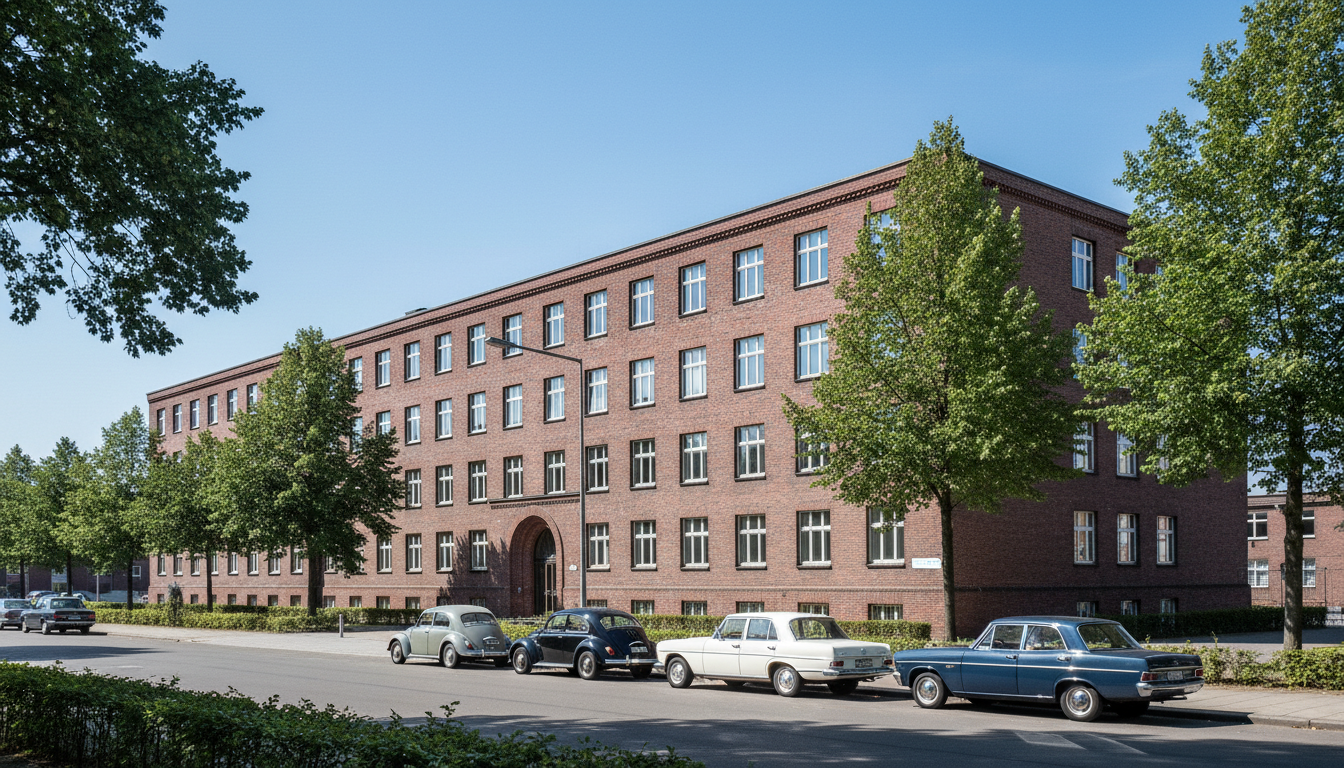
The Deutsche Werft AG Administration Building at 7 Neßpriel exemplified the functional industrial architecture that characterised Hamburg's shipbuilding district during the interwar period. Constructed between 1927 and 1928 during Deutsche Werft's expansion phase, the structure was designed by Hamburg architect Hermann Distel, whose portfolio included numerous industrial and commercial buildings throughout the city. Distel's approach favoured practicality over ornamentation, creating structures that served their purposes efficiently whilst maintaining the solid, respectable appearance that German industrial concerns valued.
The building rose four storeys above street level, its façade composed of red brick that had weathered to a darker, more sombre tone over decades of exposure to Hamburg's maritime climate. The ground floor featured taller ceilings and larger windows than the upper levels, accommodating reception areas and spaces requiring natural light for technical drawing work. The upper three floors maintained more uniform proportions, their windows arranged in regular patterns that reflected the internal organisation of offices and meeting rooms behind them.
The structure measured approximately forty metres in length and fifteen metres in width, its relatively narrow footprint a consequence of the Neßpriel site's constraints. The building's orientation provided views of the Elbe River to the north, allowing occupants of offices on that side to observe ship movements along the waterway that was simultaneously the reason for Deutsche Werft's existence and the destination for vessels constructed in the yards adjacent to the administration building. The southern façade faced inland toward Finkenwerder's residential areas, creating visual connection between the shipyard's management and the community from which much of its workforce was drawn.
The roof was steeply pitched in the north German tradition, covered with slate tiles that required periodic maintenance but which had proven durable through decades of Hamburg weather. Dormer windows punctuated the roofline, providing natural light to storage spaces in the attic where archived drawings and documentation accumulated over decades of operations. A small cupola at the building's centre, more functional than decorative, housed the mechanical equipment for the building's heating system and provided access for roof maintenance.
War Damage and Post-War Reconstruction
The administration building survived the Second World War with significant but not catastrophic damage. During Operation Gomorrah in July 1943, when Allied incendiary bombing created firestorms that devastated much of Hamburg, the Finkenwerder district suffered less severe destruction than central Hamburg due to its location south of the Elbe. Yet the shipyard remained a military target, and subsequent bombing raids throughout 1944 and early 1945 caused damage to Deutsche Werft's facilities including the administration building.
The eastern end of the structure sustained direct hit from high-explosive ordnance in March 1945, destroying approximately one-quarter of the building and killing seven employees who'd been working night shifts coordinating final vessel completions before the war's end. The blast damaged adjacent sections through structural compromise and fire, leaving the building partially roofless and exposed to weather during the final months of conflict.
Post-war reconstruction began in 1949 once Allied authorities permitted resumption of German shipbuilding. The damaged eastern section was rebuilt using salvaged bricks from Hamburg's extensive bomb ruins, creating subtle colour variations in the façade that marked where original structure ended and reconstruction began. The interior reconstruction provided opportunity to modernise layouts, installing improved electrical systems and reconfiguring office spaces to accommodate post-war administrative needs that differed from 1920s requirements.
The reconstruction work completed in 1951, restoring the building's functionality whilst leaving visible traces of wartime damage. Slight irregularities in the eastern façade's brickwork, differences in window frame styles between original and reconstructed sections, and the newer slate tiles covering the rebuilt roof portion all testified to the building's passage through Germany's catastrophic mid-century conflict.
Ground Floor: Public Interface and Technical Core
The administration building's ground floor served dual purposes as public interface and technical core. The main entrance on Neßpriel opened into a reception hall finished in terrazzo flooring that could withstand heavy foot traffic whilst maintaining respectable appearance. The walls were panelled in dark wood to waist height, above which cream-coloured plaster provided necessary light reflection in a space that, despite large windows, struggled with illumination due to Hamburg's frequently overcast skies.
The reception desk, positioned to command views of both the main entrance and the corridor leading to interior offices, was staffed during business hours by Fräulein Weber, a formidable woman in her fifties who'd worked for Deutsche Werft since before the war and who maintained absolute authority over who could proceed beyond the public areas. Her knowledge of the company's personnel, organisational structure, and current projects was encyclopaedic, making her simultaneously gatekeeper and informal information centre for anyone seeking to navigate Deutsche Werft's administrative complexity.
Beyond the reception hall, the ground floor housed the technical drawing offices where engineering designs were translated into the detailed plans that construction crews required. This space occupied the building's entire northern side, taking advantage of the superior natural light from north-facing windows—crucial for detailed technical work in an era before fluorescent lighting became standard. Approximately thirty drawing tables filled this large room, each equipped with precise drafting tools, parallel rules, and the accumulated reference materials that individual draftsmen had collected over years of work.
The drawing office maintained particular atmosphere—quieter than most workspaces, the concentration required for precise technical drawing creating environment where conversation was minimal and even footsteps were softened by the need to avoid disturbing colleagues' focus. The smell of paper, ink, and the particular chemical odour of ammonia from the blueprint machine created distinctive sensory environment. Senior draftsmen occupied positions nearest the windows, their status acknowledged through better light and proximity to the views of the Elbe that provided brief respite during long working days.
The ground floor also contained the mail room, the telephone exchange—a small space where operators connected internal and external calls through a switchboard requiring constant manual attention—and various storage areas for supplies and archived materials requiring frequent access. A set of rear doors provided direct access to the shipyard proper, allowing engineers and managers to move between office environment and construction sites without navigating through public spaces.
Second Floor: Management and Operations
The second floor housed Deutsche Werft's operational management—the offices from which daily shipyard activities were coordinated, production schedules maintained, and the constant problem-solving that large-scale industrial operations required was conducted. Operations Director Kapitän zur See Heinrich Schmidt occupied the corner office at the building's northwest corner, positioned to observe both the Elbe and the shipyard facilities, his windows providing practical overview of the domains he managed.
Schmidt's office reflected his dual background in German naval service and commercial shipyard management—nautically precise in its organisation, with charts of ship designs covering the walls and models of vessels built at Deutsche Werft displayed on shelves, yet businesslike in its focus on schedules, budgets, and the practical coordination of resources. The oak desk that had served previous operations directors dominated the space, its surface typically covered with production reports, contract documents, and the constant flow of communications that modern industrial management demanded.
Adjacent to Schmidt's office, a large conference room accommodated meetings requiring space for ten to twelve participants. This room hosted contract negotiations with shipping company representatives, coordination meetings between engineering and production divisions, and the weekly management reviews where progress on all active projects was systematically assessed. The room's walls displayed photographs documenting Deutsche Werft's history—vessels launched, ceremonies attended, technological achievements celebrated—creating visual narrative of the company's evolution through decades of German industrial development.
The second floor's remaining spaces housed offices for production coordinators, department heads responsible for specific vessel sections (hull, machinery, electrical, finishing), and the contract administration staff who managed the complex documentation that shipbuilding required. Personnel coordinator Herr Walter Schneider occupied a modest office toward the building's eastern end, his domain containing filing cabinets with employment records, immigration documents for international staff, and the accumulated paperwork that managing a workforce of over three thousand people generated.
Third Floor: Engineering Division Headquarters
The third floor belonged to the engineering division, the intellectual heart of Deutsche Werft's operations where vessel designs were developed, structural problems solved, and the technical innovations that maintained the company's competitive position were created. Chief Structural Engineer Herr Dipl.-Ing. Klaus Werner Bachmann's office occupied prime position at the northwest corner, mirroring Schmidt's office below but reflecting different priorities—walls covered with technical diagrams rather than production schedules, shelves holding engineering references rather than contract files, the atmosphere more academic than administrative.
Bachmann's office served as command centre for the engineering division's approximately one hundred and fifty technical staff. Daily meetings occurred here where senior engineers reported on project progress, discussed technical challenges requiring collective expertise, and coordinated approaches to problems that individual engineers had encountered. Bachmann's leadership style emphasised systematic analysis and collaborative problem-solving, creating environment where junior engineers were encouraged to contribute ideas whilst maintaining clear hierarchical structure about who made final decisions.
The third floor's main space was divided into offices for senior engineers and shared workspaces for junior staff. The international engineers recruited for containerisation work were integrated throughout this floor, their offices interspersed with German colleagues rather than segregated into separate areas. This physical integration supported technical collaboration even when linguistic and cultural differences complicated social interaction. A small library occupied space near the building's eastern end, containing technical references, engineering journals from multiple countries, and the accumulated documentation of vessels Deutsche Werft had constructed over decades.
The containerisation specialists—including Patrick Lahey during his 1961-1962 tenure—worked primarily from this floor, their days spent conducting structural analysis, developing reinforcement designs, consulting with production staff about implementation feasibility, and occasionally travelling to other European ports to inspect vessels similar to those Deutsche Werft was modifying. The work required extended concentration punctuated by collaborative problem-solving sessions, creating rhythm of solitary analysis alternating with intensive group discussion.
Fourth Floor: Administration and Executive Functions
The fourth floor housed administrative functions requiring less frequent public interaction—accounting, legal services, and various support functions that kept the company operating but which didn't directly engage with shipyard operations. The offices were smaller here, the ceilings slightly lower, reflecting these functions' supporting rather than central role in shipyard operations.
The accounting department occupied much of the floor's northern side, its windows providing views of the Elbe that accountants rarely paused to observe, absorbed instead in the ledgers, invoices, payroll records, and financial reporting that modern corporate operations demanded. The department maintained meticulous records using systems that combined traditional German bookkeeping precision with gradually increasing mechanisation through calculating machines and early business equipment that was beginning to transform office work even in relatively conservative German industrial concerns.
The legal department, smaller but wielding disproportionate influence, occupied offices at the building's western end. The company's attorneys managed contract review, labour relations issues, insurance matters, and the various regulatory requirements that governed shipbuilding in post-war Federal Republic. Their work was typically invisible until problems arose, at which point their expertise became essential for navigating German commercial law's considerable complexity.
A small meeting room on the fourth floor, less formal than the second floor's conference room, served for internal meetings not requiring executive presence or elaborate setup. This space also occasionally hosted the informal gatherings where international engineers socialised with German colleagues, the less formal environment facilitating the social connections that professional interaction alone didn't automatically create.
Infrastructure and Daily Operations
The administration building's infrastructure reflected 1950s standards with some modernisation through the early 1960s. Heating was provided by a central boiler system, with radiators in each office controlled by individual thermostatic valves that were perpetually subject to adjustment negotiations between employees preferring different temperatures. The system struggled during Hamburg's coldest winter periods, requiring supplemental electric heaters in some offices and creating persistent complaints that management addressed with promises of future improvements.
Electrical service had been upgraded during the 1951 reconstruction, providing sufficient capacity for the increasing number of electric lights, typewriters, calculating machines, and other business equipment that modern offices required. Yet the system remained somewhat unreliable, with occasional power interruptions requiring that critical work be timed around the grid's more stable periods. Emergency lighting provided minimal illumination during outages, though in practice most work simply stopped until power returned.
Toilet facilities on each floor reflected period standards—separate facilities for men and women, adequate for the building's population but not generous, maintained by cleaning staff who worked overnight to prepare the building for each day's operations. A small kitchen on the ground floor provided coffee and tea preparation capabilities, with each floor maintaining its own supplies and informal systems for managing shared resources.
The building was cleaned nightly by a crew of four women employed through a contract cleaning service, their work beginning after most employees had departed and completing before the next morning's arrivals. The cleaning staff had keys providing access to all areas, making them inadvertent witnesses to the physical traces of the previous day's work—documents left on desks, calculations abandoned mid-process, the accumulated evidence of how the building's occupants spent their working hours.
Social Geography and Workplace Culture
The administration building's social geography reflected both formal organisational hierarchy and informal status markers that accumulated over years of operations. Offices with Elbe views were more desirable than those facing inland, corner offices provided both prestige and better natural light, proximity to executive offices conferred status that interior spaces lacked. The distribution of office space had been negotiated and renegotiated over decades, creating complex political landscape where moves between offices carried meanings beyond mere logistical convenience.
The engineering division's culture differed markedly from administrative areas. Engineers moved more freely between floors, their work requiring consultation and collaboration that formal hierarchies couldn't constrain. The drawing office on the ground floor functioned as common ground where engineers from all levels encountered each other, technical discussions occurring across rank divisions that administrative areas maintained more rigidly.
Coffee breaks provided opportunities for informal information exchange, with clusters of employees gathering in corridor spaces or around the ground floor kitchen to share gossip, discuss problems, or simply escape briefly from work's demands. These informal networks were essential for how the organisation actually functioned—information flowed through them more efficiently than through formal channels, problems were identified and sometimes solved before reaching official attention, and the social relationships that made collaborative work possible were maintained through repeated casual interaction.
For international employees, particularly those who'd recently arrived, the administration building's social geography was initially bewildering. The informal rules about where one could go, whom one could approach directly versus through formal channels, what topics were appropriate for discussion—all of this required learning through observation and occasional embarrassing mistakes. The more established international engineers served as informal guides, helping newcomers navigate both physical space and social protocols that Germans took for granted but which required explicit instruction for outsiders.
The Building During Patrick Lahey's Tenure (1961-1962)
For Patrick Lahey during his Deutsche Werft tenure from March 1961 through late 1962, the administration building at 7 Neßpriel represented his primary professional environment. His office on the third floor overlooked the Elbe, positioning him amongst the containerisation specialists whose expertise Deutsche Werft had recruited specifically for the technical challenges that container shipping created. The space was modest—approximately twelve square metres, sufficient for a desk, filing cabinet, small table for spreading drawings, and the accumulated reference materials that marine engineers required.
Patrick's working days typically began around seven in the morning and extended until eight or nine in the evening, often later when problems demanded immediate attention. The long hours were both personal choice and professional necessity—containerisation work was deadline-driven, shipping companies needed vessels retrofitted quickly to remain competitive, and Patrick's perfectionist tendencies made him reluctant to leave problems unresolved simply because working hours had nominally ended.
The building during evening hours had different character than daytime operations. Most administrative staff departed by six, leaving the engineering division isolated in the increasingly empty structure. The cleaning crew's arrival around seven marked transition from day to night operations, their presence providing human company without requiring social interaction that might interrupt technical concentration. The building settled into quiet broken only by occasional footsteps, the heating system's operations, and the sounds of ships moving along the Elbe beyond the windows.
Patrick occasionally used Herr Hoffmann's ground floor office for private telephone calls, including the crucial February 1962 call to his sister Patricia in Adelaide arranging adoption of Jane's expected child. The privacy these borrowed spaces provided was essential for managing personal crises that couldn't be conducted from shared offices or from the flat in Finkenwerder where privacy was equally compromised by thin walls and neighbours whose curiosity about the Australian couple's lives was barely concealed.
Post-Merger Changes and Later History
The 1968 merger creating Howaldtswerke-Deutsche Werft brought gradual changes to the administration building's role and character. The Finkenwerder facilities continued operating, but administrative functions increasingly centralised in Kiel where the merged company's headquarters were established. The building at 7 Neßpriel retained importance as operational centre for the Finkenwerder yard, but its status diminished as higher-level decision-making shifted elsewhere.
Through the 1970s and 1980s, the building underwent periodic renovations and technological updates—improved heating systems, modernised electrical infrastructure, eventually computerisation of functions previously conducted through manual record-keeping. Yet the fundamental structure remained recognisable to anyone who'd worked there during earlier decades, the continuity of physical space preserving connections to the building's earlier incarnations even as the work conducted within evolved with changing technology and industry conditions.
By the early twenty-first century, as European shipbuilding declined and the Finkenwerder facilities underwent transformation from industrial production to mixed-use development, the administration building's future became uncertain. The structure retained enough historical significance to warrant preservation considerations, yet its purpose had disappeared with the shipyard operations it had served. The building's fate illustrated broader challenges facing industrial heritage—how to preserve structures whose meaning was inseparable from functions that no longer existed, how to maintain connections to working-class history in landscapes being redeveloped for different purposes entirely.







