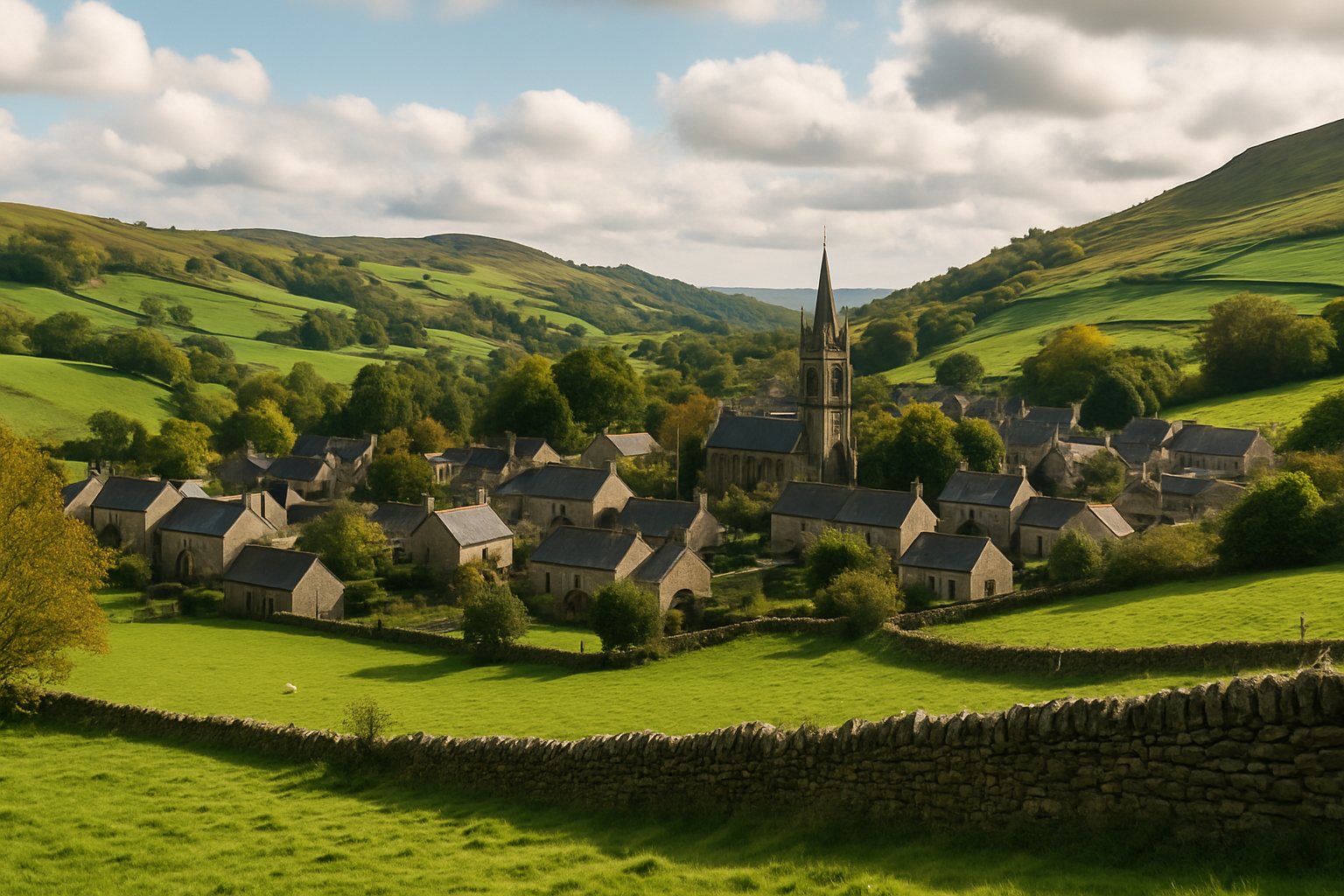
Derbyshire, England
Derbyshire is a county in the East Midlands of England, bordered by Yorkshire, Nottinghamshire, Leicestershire, Staffordshire, and Cheshire. Its landscape ranges from the wild gritstone moorlands of the Peak District — Britain's first national park, designated in 1951 — to the fertile lowlands of the Trent valley in the south. The county was the cradle of the Industrial Revolution, where Richard Arkwright's water-powered cotton mill at Cromford in 1771 transformed the world of manufacturing. Its county town is Matlock, and its largest settlement is the city of Derby.
Landscape and Boundaries
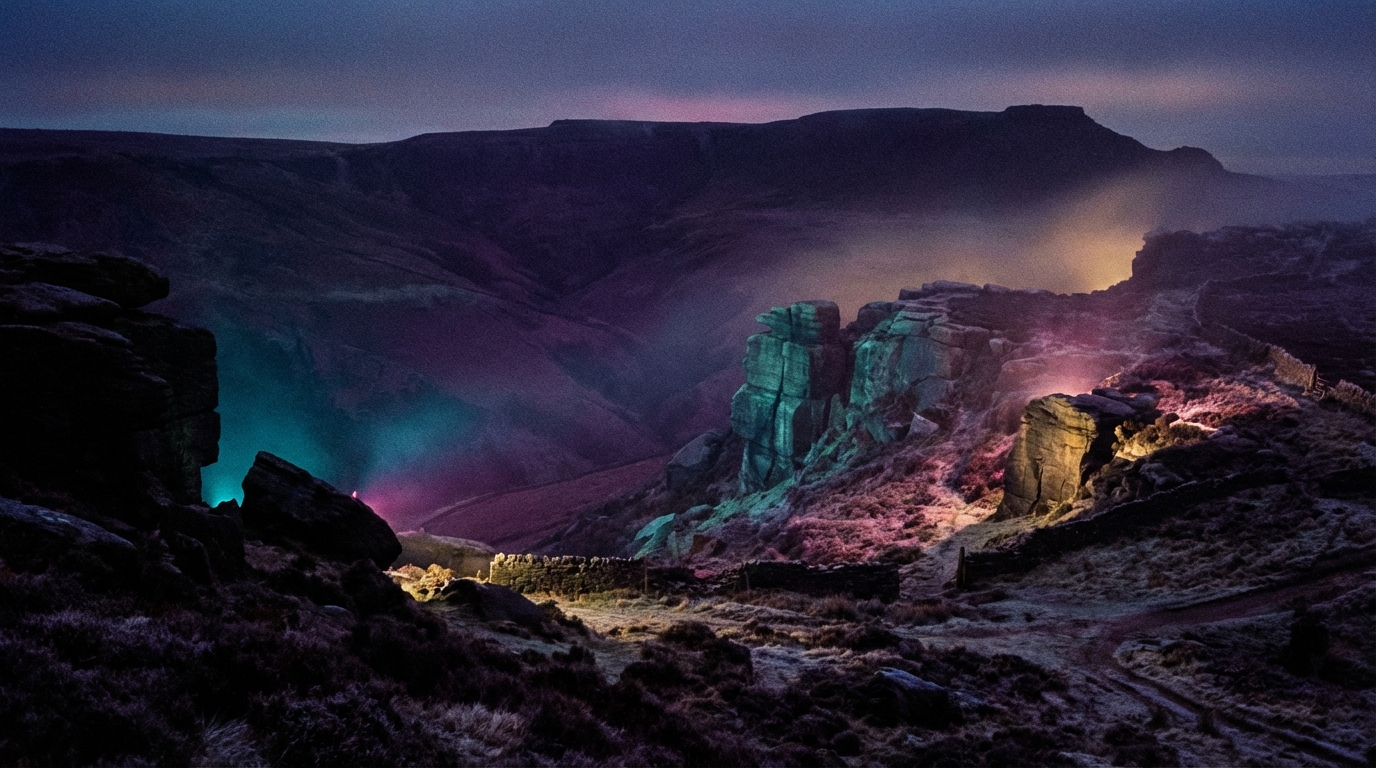
Derbyshire lies at the northern edge of the English Midlands, a county of vivid contrasts stretching fifty-five miles from north to south and thirty-five miles at its greatest breadth, covering approximately 2,625 square kilometres. Its borders are shared with Yorkshire to the north, Nottinghamshire to the east, Leicestershire and Staffordshire to the south, and Staffordshire and Cheshire to the west. The county's defining feature is its geology: the northern and central regions rise into the Pennine uplands of the Peak District, where the Derbyshire Dome — a plateau of carboniferous limestone flanked by a horseshoe of younger gritstones and shales — creates two distinct landscapes. The White Peak, named for its pale limestone, occupies the centre and south of the uplands, while the Dark Peak, formed of millstone grit, sweeps in an arc across the north, east, and west, culminating in the peat-covered plateau of Kinder Scout at 636 metres, the highest point in the county. The southern lowlands, by contrast, are gentle country of marls and pebble beds where the River Derwent — at sixty-six miles, the county's longest river — flows southward through Derby to meet the Trent. Church Flatts Farm at Coton in the Elms, near Swadlincote, holds the distinction of being the point in the United Kingdom furthest from the sea.
Before the Romans
The area that is now Derbyshire bears traces of human presence stretching back some 200,000 years, evidenced by a Middle Palaeolithic hand axe found near Hopton. The limestone caves at Creswell Crags, on the Nottinghamshire border, have yielded some of the most important Palaeolithic finds in Britain, including stone tools, bones of hyena and woolly rhinoceros, and ancient rock art dating to around 12,000 years ago — among the oldest known in the country. The Neolithic period left more substantial monuments: the henge of Arbor Low, west of Youlgreave, has been dated to approximately 2500 BCE and is the largest stone circle in Derbyshire, sometimes called the Stonehenge of the North, while chambered tombs at Minninglow and Five Wells date to between 2000 and 2500 BCE. Real evidence of settled agriculture appears only in the Bronze Age, with signs of field clearance, arable cultivation, and hut circles discovered on the moorlands of the Peak District.
Romans, Mercians, and Danes
The Romans were drawn to Derbyshire by the rich veins of lead ore in the limestone hills, and they settled widely across the county from the first century AD onward. Forts were built at Navio in the Hope Valley and at Ardotalia near Glossop, while a substantial town grew up at Aquae Arnemetiae — present-day Buxton — famed for its warm springs. Near modern Derby, the fort of Derventio occupied the site now known as Little Chester. Following the Roman withdrawal, the area became part of the Anglo-Saxon kingdom of Mercia, with Derby — then called Norþworþig, the north place — serving as its northern capital. The Peak District was known as the territory of the Pecsæte, a distinct Mercian province. Several kings of Mercia were buried at Repton, which served as a royal and religious centre of the kingdom.
In 873, a Danish army captured Repton and massacred its defenders — a chronicle of violence confirmed in recent decades by the discovery of mass burials at the site. Derby became one of the Five Boroughs of the Danelaw, and Norþworþig acquired the half-Danish name Deoraby, meaning the settlement of the deer, from which both the town and county take their names. The Danes held the territory until 917, when Lady Æthelflæd of Mercia liberated Derby in a campaign of reconquest. The shire of Derbyshire was probably formalised after 975, in the reign of Æthelred the Unready, through the dismemberment of the old Pecsæte province. The Domesday Book of 1086 records 352 places in Derbyscire, listing among its tenants-in-chief William Peverel, who built Peveril Castle at Castleton to guard the Forest of High Peak. The county was traditionally divided into six wapentakes, later reorganised into hundreds: Appletree, High Peak, Morleyston and Litchurch, Repton and Gresley, Scarsdale, and Wirksworth.
Lead, Plague, and the Great Houses
For centuries, Derbyshire's economy was dominated by the extraction of lead from the limestone hills of the White Peak, an industry that had flourished since Roman times and reached its height in the Middle Ages, when Wirksworth served as the lead-mining capital of England and the ancient Barmote Courts administered the mineral rights of the King's Field. The county remained largely pastoral, with scattered market towns — Ashbourne, Bakewell, Chesterfield, Wirksworth — serving the surrounding agricultural districts, and its remoter valleys preserved a way of life little changed from medieval times.
In 1665, when a consignment of cloth from London brought the bubonic plague to the village of Eyam in the Peak District, the rector William Mompesson and his predecessor Thomas Stanley persuaded the villagers to quarantine themselves rather than flee and spread the disease. Over fourteen months, roughly a third of Eyam's population perished, but the surrounding villages were spared. The sacrifice of Eyam became one of the most celebrated acts of communal courage in English history.
The county's great houses are among the finest in England. Chatsworth, seat of the Dukes of Devonshire and home to the Cavendish family since 1549, was first built by Bess of Hardwick and her husband Sir William Cavendish, then rebuilt between 1687 and 1707 by the first Duke in the baroque style that stands today — a house that Jane Austen is thought to have used as the model for Mr Darcy's Pemberley in Pride and Prejudice. Hardwick Hall, built between 1590 and 1597 for Bess of Hardwick after the death of her fourth husband, the Earl of Shrewsbury, is one of the finest Elizabethan prodigy houses in England, its vast expanses of glass a testament to its builder's supreme wealth and ambition. Haddon Hall, near Bakewell, seat of the Dukes of Rutland, is among the best-preserved medieval manor houses in the country.
The Cradle of the Industrial Revolution
Derbyshire's claim to have been the birthplace of the factory system rests on solid ground. In 1717, John Lombe built Britain's first water-powered silk mill on the River Derwent in Derby, a five-storey structure housing Italian throwing machinery that established the principle of mechanised production under one roof. More transformative still was Richard Arkwright's water-powered cotton-spinning mill at Cromford, opened in 1771, which proved the viability of factory-based textile manufacture on a commercial scale and made its inventor's fortune. Arkwright was followed by his partner Jedediah Strutt, a Unitarian industrialist who built further mills at Belper and Milford, and whose son William constructed the iron-framed, fireproof North Mill at Belper in 1804. The Derwent Valley Mills — stretching from Matlock Bath through Cromford, Belper, Milford, and Darley Abbey to Derby — are now inscribed as a UNESCO World Heritage Site, recognised as the birthplace of the modern factory system.
The eastern coalfields of the county developed in parallel, with iron and coal working around Chesterfield, Bolsover, and the Erewash Valley driving the industrial economy of the nineteenth and twentieth centuries. The Cromford and High Peak Railway, completed in 1831, carried industrial goods between the Cromford Canal and the Peak Forest Canal at Whaley Bridge, while the arrival of passenger railways opened the Peak District to tourism and transformed Buxton into a fashionable spa town. The fifth Duke of Devonshire had already begun the town's development in the late eighteenth century, commissioning John Carr to design The Crescent between 1780 and 1784 in the style of Bath's Royal Crescent, and the fine Pavilion Gardens followed in 1871. Buxton's Opera House, designed by Frank Matcham and opened in 1903, remains one of the finest Edwardian theatres in England.
The Peak District and the Modern County
The Peak District National Park, designated in 1951 as the first national park in the United Kingdom, covers 555 square miles of hills, dales, and dramatic escarpments, the majority of which lie within Derbyshire. Its creation owed much to the long campaign for public access to open countryside, a struggle symbolised by the Kinder Scout Mass Trespass of 1932, when several hundred walkers from Manchester and Sheffield defied private landowners to claim the right to walk on the moorland plateau — an act of civil disobedience that contributed directly to the post-war legislation establishing national parks. The Pennine Way, Britain's first long-distance footpath, begins at Edale in the Hope Valley. The park's landscapes — from the wind-scoured gritstone edges of Stanage and Froggatt to the limestone dales of Dovedale and Monsal — attract millions of visitors each year.
Derbyshire today is administered through a county council based at Matlock, with eight districts, while the city of Derby — the county's largest settlement, with a population of some 250,000 — operates as an independent unitary authority. The county's economy reflects its divided geography: tourism and farming in the west, former coalfield communities in the north-east and Erewash Valley, and the engineering and manufacturing traditions of Derby itself, where Rolls-Royce has been a major employer since the early twentieth century. Chesterfield, the largest town in the north-east, is recognisable from miles around by the famous twisted spire of the Church of St Mary and All Saints, warped by the unseasoned lead and timber of its medieval construction. The Derwent reservoirs in the upper valley, built in the early twentieth century to supply water to the cities of the East Midlands, achieved a different kind of fame in 1943, when 617 Squadron of the Royal Air Force practised their bouncing-bomb runs over the waters of the Derwent and Howden reservoirs before the celebrated Dambusters raid on the Ruhr dams. The market town of Ashbourne, on the county's south-western edge, serves as the gateway to Dovedale and the southern Peak District — a town whose Georgian streets, medieval church, and ancient Shrovetide football match embody the character of a county shaped by both the wildness of its uplands and the enterprise of its valleys.







