Declan James Sayers
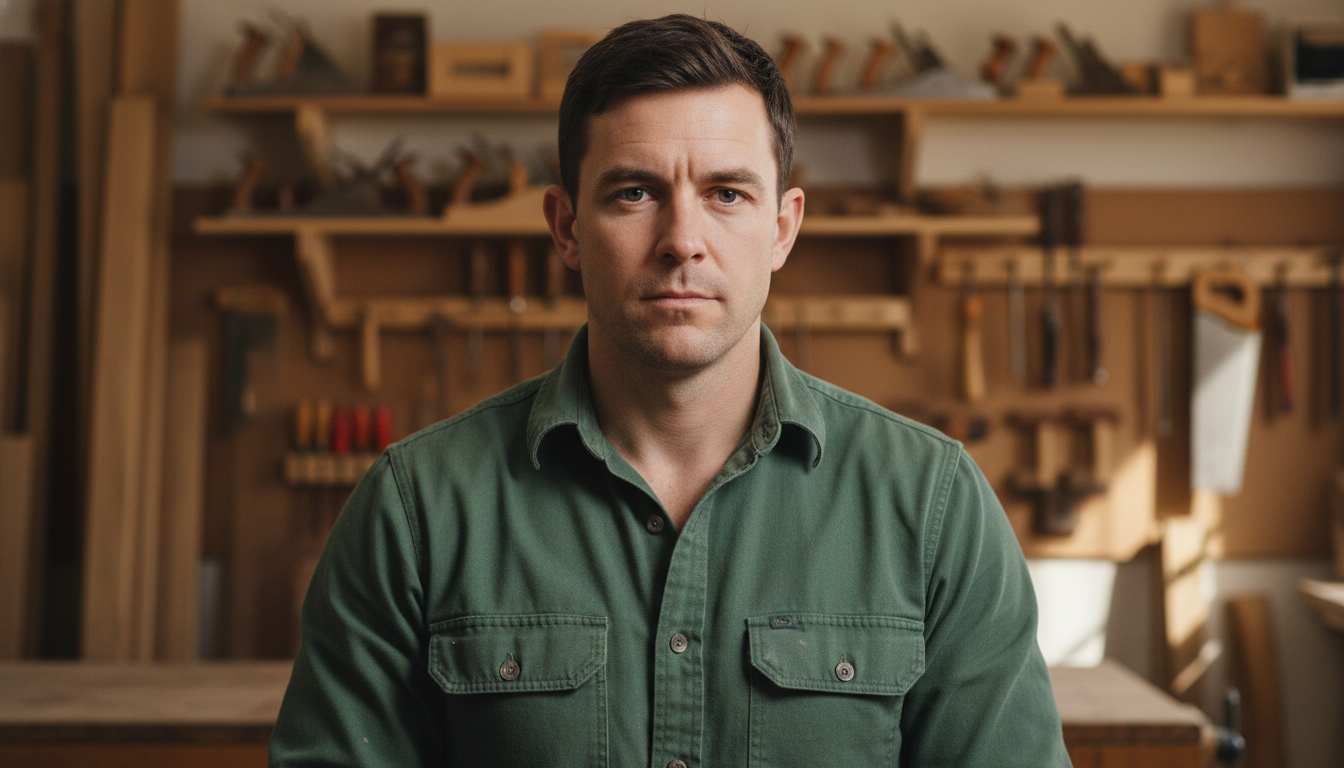
Declan James Sayers, born 17 February 1991 in Launceston, Tasmania, emerged from a family steeped in Tasmanian timber traditions to become one of Pafistis Construction Co.'s founding craftsmen. Recognised for exceptional technical aptitude and reverence for traditional joinery, Declan contributed to the firm's early heritage restorations before departing in 2017. His brief but formative tenure helped establish Pafistis's reputation for meticulous craftsmanship. Though maintaining a deliberately low profile since, his influence on Tasmania's sustainable construction ethos quietly endures.
Tamar Valley Roots and Timber Heritage
Declan James Sayers was born on 17 February 1991 at Launceston General Hospital, arriving into a family whose connection to Tasmanian timber and craftsmanship stretched back through multiple generations. He was the second of three children born to Thomas Edward Sayers and Elise Margaret Sayers (née Walling), a working-class couple residing in Ravenswood, a semi-rural suburb on Launceston's eastern fringe where the city gradually dissolved into farmland and native forest.
The Sayers family home was a modest timber weatherboard cottage on Tulloch Grove, a quiet cul-de-sac where children played in tree-lined streets and neighbours maintained vegetable gardens and chicken coops. Behind the house stood a converted shed that served as Thomas's workshop—a space filled with sawdust and timber offcuts, hand tools hung precisely on walls, the distinctive smell of native hardwoods, and the patient rhythms of traditional craftsmanship.
Thomas Edward Sayers, born in 1956, was a furniture restorer and part-time boatbuilder whose skills had been acquired through informal apprenticeship with Arthur Gleeson, a renowned Huon pine craftsman from Strahan on Tasmania's west coast. Thomas specialised in colonial-era furniture restoration—painstaking work requiring deep knowledge of traditional joinery techniques, understanding of how different Tasmanian timbers aged and behaved, patience to disassemble damaged pieces and reconstruct them using original methods. He also occasionally assisted on wooden dinghy restorations for the Launceston Wooden Boat Workshop, contributing skills to vessels that would be displayed at Hobart's biennial Australian Wooden Boat Festival.
Thomas's approach to work emphasised reverence for materials and methods. He taught that Tasmanian native timbers—Huon pine, King Billy pine, blackwood, myrtle—possessed distinctive characteristics requiring respectful treatment, that proper joinery didn't require modern fasteners because well-executed traditional methods created joints stronger than the timber itself, that restoration meant honouring original craftsmen's intentions rather than imposing contemporary preferences. These values, absorbed by Declan from earliest childhood, would profoundly shape his own approach to carpentry.
Elise Margaret Sayers, born Elise Walling in 1960, was a primary school teacher at Ravenswood Heights Primary School, where she taught for over two decades with particular focus on early literacy intervention and creative environmental education. She brought to teaching the same patient attention Thomas applied to timber—understanding that children, like wood, responded better to careful guidance than to force, that learning happened through engagement rather than mere instruction, that creativity and practical skills deserved equal status with academic achievements.
Elise's teaching philosophy emphasised environmental connection—she established bush classrooms on school grounds, created sensory trails through native plantings, taught literacy through environmental storytelling that connected reading and writing to children's experiences of place. This approach reflected her own childhood in Deloraine, where her father Geoffrey Walling's work as council road engineer and her mother Iris's role as children's librarian had instilled appreciation for both practical infrastructure and imaginative learning.
Declan grew up alongside two siblings who would each pursue distinctive paths reflecting the family's values. His older sister, Olivia Maree Sayers, born in 1987, trained as a registered nurse at Australian Catholic University's Ballarat campus before returning to Tasmania to specialise in palliative care, eventually working at Beaconsfield District Health. His younger brother, Hamish Robert Sayers, born in 1994, completed horticulture training at TasTAFE Alanvale and established GreenSouth Flora, a native plant nursery and landscaping consultancy promoting drought-resistant gardens throughout northern Tasmania.
The Sayers household was characterised by practical rhythms and quiet industry. Weekends meant time in Thomas's workshop, where Declan and Hamish learned to use hand tools safely, to recognise different timber species by grain and colour, to understand that good work required patience and attention rather than speed and force. Family camping trips to Narawntapu National Park, Ben Lomond, and Liffey Falls reinforced environmental awareness—Elise would identify native plants and discuss their traditional uses, Thomas would point out how early settlers had used local timber for buildings and tools, both parents modelling appreciation for Tasmania's distinctive landscapes.
The family maintained active involvement in Ravenswood's community institutions. They attended Holy Trinity Anglican Church, where Thomas volunteered to maintain nineteenth-century pews and organ casing—work requiring traditional techniques and materials that Declan would later help complete as part of a youth skills initiative in 2008. Declan also participated in the Launceston Scout Group (3rd Tamar Troop), achieving the Venturer Award in 2007. His scout leader, Colin Barwick, would later describe him as "methodical, observant, and entirely unafraid of solitude"—characteristics that would serve him well in carpentry requiring sustained concentration.
Education and the Emergence of Craftsmanship
Declan's formal education began at Ravenswood Heights Primary School (1996-2002), where his mother's colleagues noted his early spatial reasoning abilities and preference for hands-on learning over purely abstract work. His Year 6 teacher, Mrs Harriet Langford, recalled him as "a quiet but determined student who could disassemble and reassemble a pencil sharpener with more care than most would afford a violin"—capturing both his mechanical aptitude and his unusual attention to detail.
In 2003, Declan began secondary education at Queechy High School in Norwood, a public school known for strong technical and trade-aligned curriculum serving working-class families throughout Launceston's eastern suburbs. He excelled in Design and Technology, Industrial Arts, and Environmental Science—subjects combining practical skills with conceptual understanding, allowing him to work with hands whilst also developing theoretical knowledge about materials, structures, and systems.
His Year 10 final project demonstrated his emerging capabilities—a scale timber model of the Cataract Gorge Suspension Bridge constructed using reclaimed King Billy pine and brass fastenings. The model required researching historical engineering drawings, calculating appropriate structural proportions, executing precise joinery at miniature scale, and finishing the piece to professional standard. The work was selected for exhibition at the 2007 Tasmanian School Trades Showcase in Devonport, earning recognition beyond Queechy's immediate community.
Declan's technical drawing teacher and mentor, Mr Terry Robards, Head of Design Technology at Queechy, recognised his unusual combination of technical aptitude, patience for detailed work, and genuine passion for craftsmanship. Mr Robards encouraged Declan to pursue formal trade training rather than the increasingly common route of pre-tertiary academic studies leading to university. With strong references and a portfolio of precision woodwork, Declan was accepted into the Certificate III in Carpentry and Joinery programme at TAFE Tasmania's Launceston campus in early 2008.
TAFE Training and Professional Formation
Declan's three years at TAFE Tasmania (2008-2010) represented intensive development of both technical skills and professional identity. The Certificate III programme combined classroom instruction in building codes, mathematics, material science, and safety regulations with practical workshop training in carpentry techniques and on-site work placements providing real-world experience.
Declan quickly distinguished himself through his meticulous approach to hand-tool techniques and traditional joinery methods. Whilst many apprentices gravitated toward power tools and modern fastening systems offering speed and efficiency, Declan devoted attention to mastering traditional skills—hand-planing timber to achieve perfectly smooth surfaces, cutting mortise-and-tenon joints that fit precisely without glue or screws, understanding how different chisels and saws served different purposes, learning to sharpen tools properly so they performed as designed.
His instructors noted his unusual combination of technical precision and aesthetic sensibility. He didn't merely execute joints correctly—he ensured they were beautiful, that exposed joinery displayed craftsmanship worthy of appreciation, that finished pieces demonstrated care and skill. This approach reflected his father's influence, the understanding that furniture and buildings weren't merely functional objects but cultural artifacts bearing witness to craftsmen's capabilities and values.
In 2009, Declan was awarded the Anderson Craftsmanship Prize for his restoration of an 1890s sash window system using only traditional mortise-and-tenon joinery, finished with locally sourced blackwood trim and traditional linseed oil putty. The project required researching historical window construction methods, sourcing appropriate materials, executing techniques that contemporary builders rarely used, and producing work meeting both historical accuracy and contemporary performance standards.
His final-year apprenticeship placements provided exposure to different aspects of Tasmania's construction and restoration industries. At Tamar Heritage Restorations, he assisted in structural underpinning of a Federation-era homestead near Grindelwald, learning how historical buildings were stabilised and repaired using methods compatible with original construction. At Coppin & Marks Joinery, he worked on detailed interior timber finishes for the Queen Victoria Museum & Art Gallery renovation project, gaining experience with public institutional work requiring exceptional quality standards.
In late 2009, Declan was selected for the Tasmanian Master Builders Association Advanced Training Sponsorship, a competitive programme placing promising apprentices with innovative or high-integrity building firms. His placement was arranged with Pafistis Construction Co., a newly founded firm in Hobart established by Adrian Pafistis and known for commitment to sustainable heritage restoration. The opportunity meant relocating to southern Tasmania—significant change for twenty-year-old who had never lived away from family or Launceston's familiar landscape—but represented chance to work with firm whose values aligned closely with his own.
Pafistis Construction Co.: The Formative Years
Declan arrived in Hobart in early 2010, relocating to a shared house in West Hobart with other tradesmen and beginning work with Pafistis Construction Co. in March. The firm was just establishing itself—Adrian Pafistis had registered the company weeks earlier, Lina Morrow was setting up office systems, the converted Kelly Street warehouse office still smelled of fresh paint and sawdust. Declan was joining at the absolute beginning, when every decision shaped what the firm would become.
His first project was the Marine Terrace refurbishment, the heritage-listed 1883 residence that represented Pafistis Construction Co.'s inaugural commission. The project required restoring deteriorated sandstone façade, reconstructing internal stairwell using traditional methods, creating custom timber windows matching original designs, and integrating contemporary environmental systems without compromising historical integrity. For Declan, this work represented ideal combination of heritage preservation, skilled craftsmanship, and environmental responsibility.
Adrian Pafistis immediately recognised Declan's exceptional abilities and character. Where some apprentices needed constant supervision and repeated instruction, Declan could be shown technique once and execute it reliably thereafter. Where some young tradesmen were careless with materials and tools, Declan treated both with obvious respect. Where some workers prioritised speed over quality, Declan understood that good work couldn't be rushed, that excellence required time and attention. Adrian later described him as "unshakably precise and entirely unselfish"—high praise from builder known for demanding standards.
Declan's work on Marine Terrace's internal stairwell restoration demonstrated his capabilities. The original 1880s staircase had been damaged by rising damp and previous unsympathetic repairs. Declan carefully dismantled deteriorated sections, documented construction methods, sourced appropriate replacement timber (locally milled celery top pine matching original species), reconstructed damaged components using traditional joinery, and reassembled the staircase so seamlessly that distinction between original and restored elements was nearly invisible. The work earned quiet respect from heritage consultants and established Declan's reputation within the firm.
Throughout 2010-2016, Declan contributed to most of Pafistis Construction Co.'s major projects. Franklin Manor (2012) required precision timber framing for luxury apartments, work he executed whilst coordinating with multiple other trades. The Aurora Business Centre (2016), his last major documented project involvement, involved on-site preparation and custom joinery for commercial spaces requiring both durability and aesthetic refinement.
His relationships within the firm were characterised by respect rather than intimacy. He worked closely with Isabelle Longey on heritage detailing, their collaboration based on shared commitment to craftsmanship and mutual professional respect rather than personal friendship. He shared quiet but collegial relationship with Lina Morrow, whose procurement coordination ensured materials he needed arrived when required. He learned from Adrian Pafistis not just carpentry techniques but broader understanding of how buildings served environmental and social purposes beyond mere shelter.
Yet Declan also experienced tensions between his values and commercial construction's realities. Even at Pafistis, where environmental commitments were genuine, budget constraints sometimes required compromises he found uncomfortable—using adequate rather than ideal materials, accepting machine-made components when hand-crafted alternatives were too expensive, prioritising efficiency over perfection. These tensions weren't unique to Pafistis—they reflected construction industry's broader economic pressures—but they troubled someone whose understanding of craftsmanship emphasised uncompromising quality.
Departure and Return to Rural Roots
In early 2017, after seven years with Pafistis Construction Co., Declan made the significant decision to leave the firm. The reasons were complex and not fully articulated even to close colleagues. Internal memos indicate he cited "desire to work in smaller, rural-scale builds"—accurate but incomplete explanation that didn't capture his deeper motivations.
The truth was that Declan had grown increasingly uncomfortable with Hobart's urban construction environment and the firm's expanding scale. What had begun as three-person operation tackling modest heritage restorations had evolved into substantial firm managing multiple concurrent projects, employing numerous staff, navigating complex client relationships and contractor coordination. Projects were more ambitious and received greater recognition, but they also involved more compromise, more bureaucracy, more distance between craftsman and finished work.
Declan yearned for something simpler and more direct—individual relationships with clients who understood craftsmanship's value, smaller projects allowing personal involvement from conception to completion, work where he could exercise traditional skills without constant pressure to accept modern alternatives for efficiency's sake. He wanted to build the way his father restored furniture—slowly, carefully, honouring materials and methods, producing work that would endure for generations.
His departure was amicable but left gap in Pafistis Construction Co.'s capabilities. Adrian understood and respected Declan's motivations even whilst regretting his loss. Isabelle appreciated his integrity whilst wishing he would stay. Nathaniel, always pragmatic, simply noted that replacing someone of Declan's abilities and character would prove difficult. They were correct—subsequent carpenters were competent but lacked Declan's unusual combination of technical excellence, aesthetic sensibility, and genuine humility.
Life After Pafistis: Quiet Practice
Following his departure, Declan returned to Tasmania's north, settling in the West Tamar region near his family but maintaining independence. He established modest carpentry practice, deliberately keeping scale small and profile low. He worked on farm structure renovations, created bespoke interiors for eco-cottages, undertook selective heritage restoration projects, occasionally collaborated with Heritage Timberworks Tasmania on specialised conservation work.
His approach was deliberately old-fashioned. He rarely advertised, relying instead on word-of-mouth recommendations. He accepted only projects genuinely interesting to him—work requiring traditional skills, serving clients who valued quality over speed, producing buildings or furniture worthy of pride. He charged fair rates rather than maximising profit, understanding his modest needs didn't require aggressive business expansion. He worked alone or with single apprentice, maintaining personal involvement in every aspect of projects he accepted.
This lifestyle provided satisfactions urban construction couldn't offer. He worked at his own pace without client pressure or contractor coordination headaches. He used traditional techniques without needing to justify their time requirements. He built relationships with individual clients rather than navigating institutional bureaucracies. He lived simply in rural setting resembling his Ravenswood childhood, surrounded by native forest rather than suburban development, maintaining connection to Tasmania's landscapes that had always fed his soul.
Yet this choice also meant limitations and losses. His income was modest and irregular, sufficient for simple lifestyle but precluding significant savings or major purchases. His professional impact was necessarily limited—individual projects touching few people rather than major buildings serving broader communities. His skills, whilst highly developed, benefited relatively few clients rather than being deployed at scale. His influence on Tasmania's construction culture was minimal compared to what it might have been had he remained with Pafistis or established larger practice.







