4338.208 · July 27, 2018 AD
Dead Line
A phone call to Adelaide. A name muttered under breath that wasn't meant to be heard. A lead that vanishes the moment it starts to matter. Felicity's first real investigation is already tangling itself around family loyalties, small-town consensus, and the uncomfortable weight of being the only person in the room who thinks something is wrong. Everyone has the same advice: ignore it. She's not sure she can.
"When three people who don't talk to each other all tell you the same thing, either they're right — or they're all looking the wrong way at once."
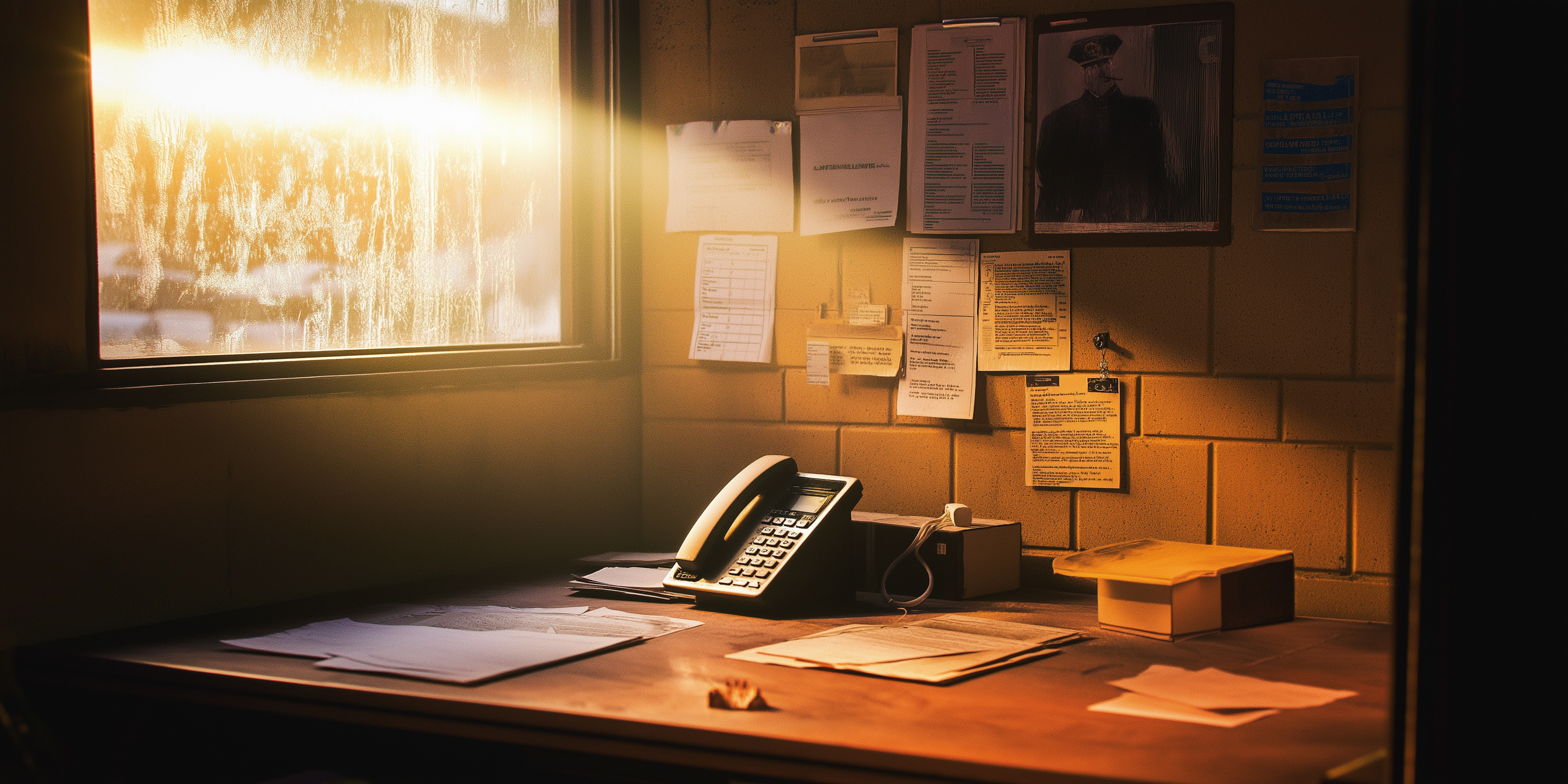
The incident form sat half-complete in front of me. I'd written the date, the time, Claire's name, and the words husband — missing? with a question mark I wasn't sure I'd earned the right to use. The post-it note was already peeling from the monitor's edge, its adhesive giving up in the dry heat. I pressed it flat, read Greta's number twice, and picked up the receiver before I could talk myself into waiting for Sal to come back from lunch and do it properly.
My fingers found the keypad with a confidence my stomach didn't share. The line clicked through — that hollow interstate distance, the faint crackle of signal crossing too much empty country — and a woman answered on the fourth ring.
"Greta speaking."
I opened my mouth.
"Shit."
It was out before I could catch it. Barely a whisper, but the line carried it the way lines always carry the things you least want heard. I'd been expecting voicemail, or at least a hello — a few seconds of preamble to arrange myself behind. Instead I had a live, irritated stranger, and the first thing she'd heard from the New South Wales Police Force was me swearing into the phone like a probationary constable who'd just dropped her pen.
Which, to be fair, I had. It clattered against the desk and rolled off the edge, landing somewhere beneath the chair with the resigned finality of an object that knew it wouldn't be retrieved gracefully.
"Excuse me, who is this?"
"My sincere apologies for that," I said, bending sideways and fishing the pen from under the chair with one hand whilst pressing the receiver against my ear with the other. A strand of hair fell across my face. I blew it away and straightened up. "This is Officer Felicity Massey from the Broken Hill Police."
A pause. Not long — a breath, maybe two. But the quality of the silence changed. Something behind it shifted, like furniture rearranging itself in a darkened room.
"Is this about Paul?"
No hesitation. No which Paul, no Paul who. The name had been sitting right behind her teeth, and that told me more than anything she'd say next. This wasn't a woman hearing unexpected news. This was a woman who'd been waiting for a phone to ring and dreading which phone it would be.
"It is, actually," I said, pulling the incident form closer and uncapping the pen I'd only just rescued. "I've just finished speaking with his wife, Cla—"
"Claire went to the police station?"
The interruption was sharp enough that I pulled the receiver back an inch. Something beyond surprise in it — a heat that sounded rehearsed, as though Claire's name was a match she'd struck so many times the head barely needed friction.
"Yes, Ma'am. She left our offices only a few minutes ago."
I waited, pen hovering over the form. The line held its breath.
Then, faint — muttered, not meant for me: "Stupid cow."
I held still. The words sat between us for a moment, venomous and small, and I couldn't tell who they were aimed at. Did she mean Claire? Or had she forgotten I was on the line — was there someone in the room with her, someone whose presence I was only catching the edge of? My pen found the margin of the incident form and I wrote hostile to Claire in small, neat letters.
Before I could decide whether to ask, Greta's voice shifted back into its public register — the kind of reset that comes from long practice, from years of saying the sharp thing first and the presentable thing second.
"Claire has always been an attention-seeker. She's constantly creating unnecessary drama. You should just ignore her."
Ignore her. The same instruction Claire herself had anticipated — ignore what they say about me. Both women pre-empting the other's version, both trying to plant their flag in the narrative before the other could get there. I noted the symmetry without commenting on it. In my experience, when two people were that desperate to discredit each other, the truth was usually hiding somewhere neither of them was pointing.
"You've heard from Paul recently, then?" I asked, steering back to the only question that actually mattered.
"No."
A flat syllable. No elaboration, no softening. Just a door shut in my face and bolted.
I leaned back in the chair, pressing the pen against my lower lip. The disconnect between Greta's hostility towards Claire and her apparent lack of curiosity about her own missing son was striking. If my child had disappeared, the last thing I'd be doing was character-assassinating his wife to the officer who'd called to ask about him.
"If you haven't heard from Paul either, why exactly should I simply ignore his wife's concerns?"
"Hmm… Yes," Greta murmured — but the response was somewhere else entirely. I could hear movement on the line, a rattle, the background noise of a household intruding on the call. A clatter that sounded like ceramic on a benchtop, and something that might have been a voice — younger, male, indistinct. She wasn't answering me. She was answering the room.
"Yes?" I pressed, sitting forward again. "Yes, you have seen Paul recently?"
"No. I just told you quite clearly that I haven't seen Paul." Sharper now, embarrassed at being caught out. Whatever had distracted her had been dealt with, and the impatience was back in full — that particular defensiveness of someone who knows they've just undermined their own credibility and resents you for noticing.
I rubbed my temple with my free hand. The beginnings of a headache — that dull pressure behind the eyes that arrives when you're trying to hold two contradictory conversations at once and neither of them is giving you anything useful. The pen had left a small blue mark on my lower lip. I wiped it with the back of my hand.
"Mrs Smith, do you have any particular concerns for Paul's wellbeing?"
"Of course I do. He's my son." Fast, defensive — the words delivered like a reflex rather than a feeling. "I have exactly the same amount of concern for him as I do for all of my children."
The phrasing was odd. The same amount. As though concern were a finite resource she distributed in careful equal portions, and she wanted me to know nobody was getting more than their fair allocation. I wrote measured / guarded beside her name on the form and underlined it.
"I meant specifically, are you worried that you haven't heard from him for several days now?"
The pause was longer this time. I could hear her breathing — slower now, the rhythm of someone deciding how much of themselves to let through. Some of the armour thinned.
"I am… a little concerned, yes." The brittleness in her voice cracked, just for a moment, and something softer bled through before she caught it and patched the wall back up. "But you have to understand that Paul and Claire are constantly arguing about something. Can you believe she actually had the audacity to accuse me of lying!"
There it was — the pivot from worry to indignation. Easier to be furious at Claire than frightened about Paul. I'd seen it before, back in Sydney. The families who couldn't sit with the fear, so they converted it into something more familiar. Anger had edges you could hold. Worry just pooled around your feet and rose.
"What specifically does she think you lied about?"
"Hmph!" Pure scorn, expelled like a pip she'd been rolling around her mouth. "She's convinced that Paul is here in Adelaide with us, hiding out. She claims he drove down after they had another one of their dramatic arguments the other night. But he's not here with us, and we haven't heard a single word from him. I suppose I am genuinely a little worried about him."
The admission slipped through almost reluctantly — a mother's fear squeezed out between the insults like water through a clenched fist. I underlined worried on the incident form. Circled it. Drew a second circle around that one. Two women — one angry, one afraid, both of them arriving at the same word from opposite directions.
"If Paul isn't in Adelaide with your family and he isn't currently in Broken Hill with his wife," I said, keeping my voice level, methodical, the way my father used to speak when he was walking a patient's family through something difficult, "do you have any idea where else he might be?"
A soft gasp — the sound of a thought arriving suddenly, like a light switched on in a room she'd forgotten to check.
"I don't know why I didn't think of this possibility before, but he may very well have gone to visit one of his brothers in Hobart."
I sat up straighter. Pen ready, fresh line on the form. The first concrete lead that didn't come wrapped in someone else's grievance.
"What's the brother's name?"
"Luke." Something in her voice eased at the name — a loosening, almost fond, before a familiar tightness closed back around it. "We don't maintain regular contact with him these days — family relationships, you know how they can be — but I know he and Paul have stayed in touch. They talk often. Paul actually spent Christmas with Luke a couple of years ago, when things were particularly tense at home."
LUKE — HOBART. I wrote it in capitals and drew a box around it. Underlined Christmas. A family fractured enough that the son spent the holiday with a semi-estranged brother rather than face the tension at home. I was beginning to form a picture of the Smith family, and it wasn't a portrait any of them would have chosen to hang.
"That's excellent information, Mrs Smith. Do you happen to have a current contact number for Luke?"
"Yes, I do have his number. Just hold on one moment while I find it."
I could hear her fumbling — the clumsy urgency of someone navigating a phone screen whilst trying to keep the call alive. Fingernails tapping glass, a muffled curse, the particular frustration of a woman over fifty fighting with a touchscreen she hadn't asked for and didn't trust. My pen hovered over the paper, ready for the digits. I was so close to something useful — one phone number away from being able to actually do my job rather than arbitrate a family's grievances.
And then nothing. A clean severance, mid-sentence, as though someone had reached over and pressed the button.
"Mrs Smith? Are you still there?"
Dial tone. That flat, indifferent hum that tells you absolutely nothing about why the conversation just ended or whether it ended by accident or design.
I set the receiver down and stared at the post-it note. LUKE — HOBART, boxed in blue biro. Below it, Greta's number. Luke's number — the one thing that actually mattered — still missing, still trapped somewhere in Greta's phone between the dropped call and whatever had been happening in that kitchen.
I tried redialling. It rang out — that hollow interstate stretch again, emptier now. Tried again. Same. A third time, because three felt like diligence rather than desperation, and got nothing but silence pretending to be patience.
I set the phone down and sat with it. The incident form looked back at me from the desk, half-finished, littered with my own marginalia — hostile to Claire, measured / guarded, worried circled twice, LUKE — HOBART boxed. A document that raised more questions than it answered, which in my experience meant I was asking the right ones.
The front door opened with its usual creak — that particular groan of wood and hinges I was already learning to read like a clock, each officer's arrival carrying its own weight, its own rhythm. This one was unhurried, confident, preceded by the heavy scuff of boots that hadn't bothered to wipe themselves on the mat.
Brock Polden came through the door the way he came through most things — shoulders first, grin already loaded, radiating the boneless ease of someone who'd never once wondered whether he belonged in the room he was entering. He crossed the reception towards the desk he'd claimed as his own, though I'd seen no evidence of a formal seating arrangement and suspected Brock's claim to territory operated on the same principle as a dog and a fence post.
"Ignore her," he said, waving a hand without looking at me.
I looked up from the form. "Ignore who?"
"Claire." He didn't break stride. "Whatever she was here for, it'll only be some bullshit made-up fuckery that'll only leave us with more useless paperwork shit."
He'd said this before. I could hear it in the cadence — a well-worn groove, trotted out for every inconvenience, with varying levels of profanity adjusted for audience. I doubted he'd adjusted anything for me.
"How do you know Claire was here?"
"I saw her car leave the carpark." He dropped into his chair with one leg hooked over the armrest before his backside had even made contact, the kind of relationship with furniture that suggested neither party expected the other to survive the encounter. Wide grin. "Everyone in town knows Claire's car. You'll discover that quickly enough."
I studied him for a moment. Two days I'd known this man, and in that time he'd called me Massey approximately forty times and Felicity never once. Thirty-three, broad — farm work, not gym memberships — permanently sun-scorched across the nose and forearms, with a blunt, uncomplicated confidence that wouldn't have understood the concept of self-moderation if it came with diagrams. In Sydney I'd have pegged him as a liability. Out here, I was beginning to suspect he was the furniture.
"Claire is worried about Paul," I said, keeping my voice even, professional — testing how much information I could plant before he swatted it away. "They had an argument and it seems he's gone missing."
"I don't blame the poor bugger." He shrugged out of his jacket and draped it over the back of the chair. "That woman is a real cunt. I kid you not."
The scowl came before I could stop it — involuntary, the facial equivalent of a flinch, trained into me so deeply by years of Sydney policing that it fired ahead of thought. He laughed — easy, unselfconscious, genuinely delighted by my disapproval. To Brock, the word carried about as much weight as drongo, and my reaction was the funniest thing that had happened to him all morning.
"Where did you say you've transferred from again?" He tilted back in the chair, arms folded behind his head, studying me with the amused curiosity of a farmer watching a house cat try to navigate a paddock.
"Sydney inner-west." I said it flatly, refusing to give it the defensive edge he was fishing for.
"Claire should be right up your alley then." The smirk hadn't shifted. If anything, it had deepened, settling into the lines around his eyes like it lived there permanently and just occasionally went out for air.
I set the pen down deliberately. "You're not very helpful, you know."
"I've given you fair warning." One shoulder rose and fell, lazy, dismissive. "That's helpful enough."
Something in me bristled. Not at the dismissal itself — I'd dealt with worse in Sydney, been patronised by men with better vocabularies and worse intentions — but at the ease of it. The absolute absence of curiosity. A woman had come into this station frightened about her husband, and Brock's entire engagement with the situation was a character assessment delivered in four letters.
I reached for the post-it note, determined to push through regardless. "I was just talking to—"
The eye-roll was practically audible — his whole head went with it, tipping back, jaw loose, theatrical exhaustion performed for an audience of one. "I told ya. Just drop it already. It's shit. It doesn't matter."
"You don't even know what I was going to say."
"Yeah, I do." The chair legs came back to the floor with a thud. He leaned forward, elbows on knees, that infuriating certainty still spread across his face like sunburn.
"Tell me, then." I crossed my arms. "What was I going to tell you?"
He stood. Closed the distance in a few strides — not aggressive, not threatening, but testing. Seeing how far he could push before I pushed back, the way men out here took the measure of each other without quite registering that the same approach didn't always translate. His eyes held mine.
"You were gonna tell me that—"
The creak of the far door cut him off. Detective Inspector Harding emerged from the corridor, shrugging into his coat with the distracted, slightly bewildered air of someone whose mind had already left the building and was holding a table at the pub. He was older than Brock by a decade, leaner, quieter, his face permanently creased — thirty years of other people's problems folded into the skin like old linen. The kind of face that had stopped being surprised by anything a long time ago and resented being asked to try.
"You two children done with your bickering yet?"
"We're not bickering," I said, straightening instinctively, smoothing the front of my shirt in that automatic gesture I hated myself for — the reflex to present well for a superior, even one who'd just called me a child.
"Nah, we weren't," Brock agreed, and for a brief, disorienting moment we were allies — united in denying something everyone in the room knew was true.
Harding grunted, unconvinced, turning a slow circle looking for his coat's second arm. "I hardly believe that."
"I was just telling Brock about Claire's visit," I said, directing it at Harding because he was the detective — the one person in the building whose job description actually included the word investigate, and who might, I hoped, bring some professional curiosity to a case his constable had already buried.
"Brock's right." Harding's eyes found mine — not dismissive exactly, but flat. Decided. Claire Smith had already been filed, sorted, and shelved somewhere he had no intention of reaching. "Ignore her. Unless you want to get caught up in shitty mind-numbing paperwork that adds no value to… anything."
So that was the consensus, then. Greta from Adelaide. Brock from the carpark. Harding from his office. Three people who didn't talk to each other, all arriving at the same instruction: ignore Claire Smith. Either they were right and she was exactly the nuisance they described, or something about her made people want to stop looking before they'd started. In my experience, the things everyone agrees to ignore are precisely the things that turn out to matter.
"It's Friday. Come to The Palace for a beer," Harding said, already moving towards the door with purposeful strides — the invitation was a formality; he was going regardless.
I glanced at the screen. 12:47. "But it's barely lunchtime."
"Doesn't matter what time it is," Brock said, already at the door, jacket slung over one arm, not bothering to put it back on. He'd been in the building for less than five minutes.
"It's still Friday," Harding concluded, as though that were a complete and sufficient argument — and out here, apparently, it was. Two days in Broken Hill and I was already learning that Friday operated by its own physics, bending the ordinary rules of professional conduct around itself until they quietly gave up and went home.
Brock's head reappeared in the doorway. "Well, come on, then."
The post-it note sat where I'd left it. LUKE — HOBART. The incident form beside it, half-finished, my marginalia drying in the heat. The Smith file glowing on the screen, patient, unresolved.
"Paul's fine," I whispered — not because I believed it, but because I needed to hear something other than the silence Greta had left behind.
I tucked the post-it into my shirt pocket and followed them out.







