
David Nicholas Bedding
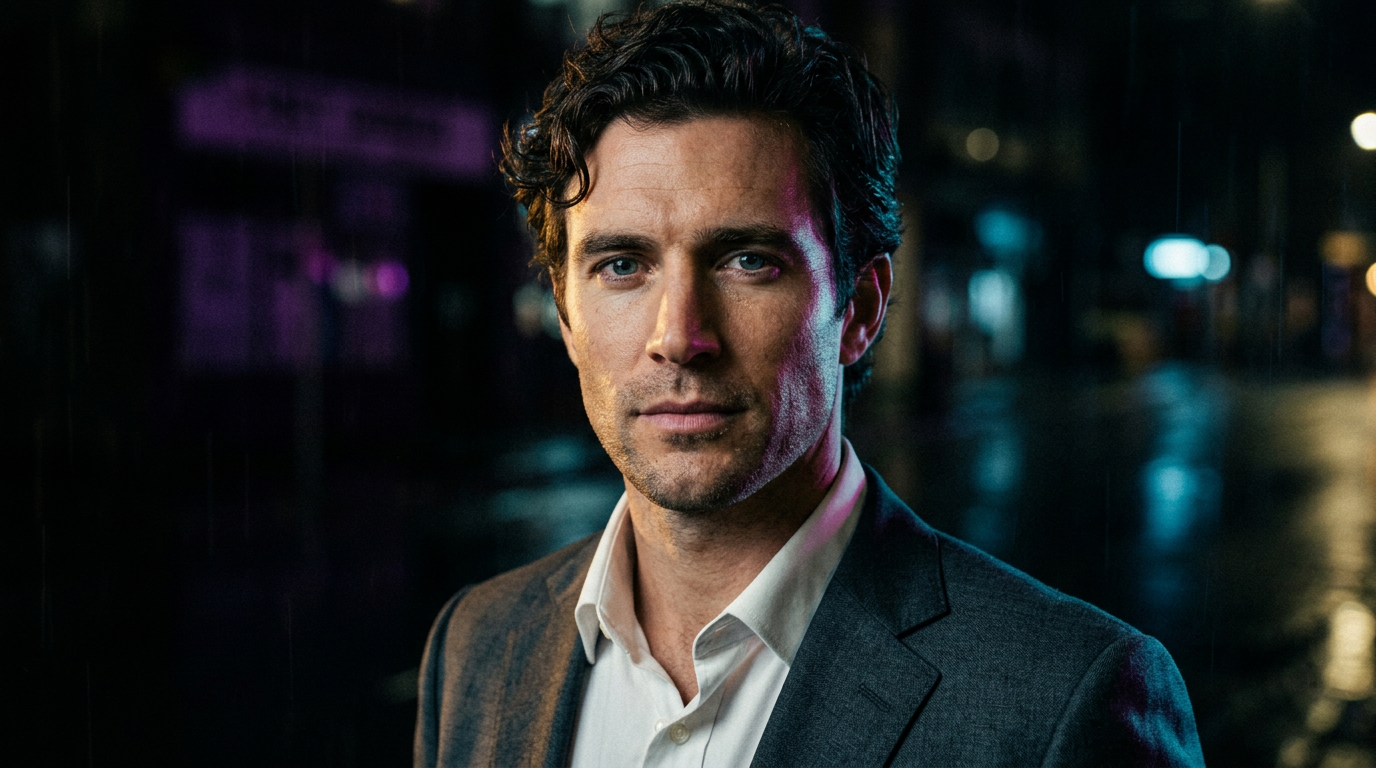
David Nicholas Bedding was born on 22nd March 1972 in Hobart, Tasmania, the youngest child of Theatre Royal stage manager Gerald Bedding and park ranger Patricia Collingwood. Educated at St Virgil's College and the University of Tasmania, he founded Bedding Event Management in 1995, building a three-decade career in immersive event design that expanded from Tasmanian festivals to international diplomatic receptions. He married visual artist Claire Hamilton in 1998, and they raised two children, Sophie and Max, from their restored sandstone cottage in Battery Point.
The Stage Manager's Son
David Nicholas Bedding was born on 22nd March 1972 at the Royal Hobart Hospital, the youngest of four children born to Gerald Anthony Bedding and Patricia Elaine Bedding née Collingwood. His arrival completed a family whose internal geography was already unusually varied — a household in which the smell of sawdust and turpentine competed with the damp earthiness of hiking boots left drying by the back door, and in which the phrase "good enough" was treated, by both parents and for entirely different reasons, as a form of surrender.
Gerald, born in 1942, had served as Stage Manager at the Theatre Royal in Hobart for the better part of two decades by the time David arrived. Backstage, where he was known simply as Gerry, he operated with the quiet authority of a man who believed that the magic an audience saw on stage was only as powerful as the invisible discipline sustaining it. "An audience should never see the struggle" — Gerald's governing principle, delivered not as instruction but as atmospheric fact — embedded itself in David's consciousness before he was old enough to understand what it meant. Many childhood weekends were spent trailing behind his father through the Theatre Royal's dim corridors, learning to coil heavy stage cables, patch worn backdrops, and adjust precarious lighting rigs with hands too small to grip the tools properly. Gerald taught by demonstration rather than explanation, and his approval, when it came, arrived in a brief nod or a hand rested momentarily on his son's shoulder — gestures whose rarity made them precious and whose insufficiency David would spend decades trying not to resent.
Patricia, born in 1945, embodied a different form of mastery entirely. As a Senior Park Ranger for the Southwest National Park Service, she lived by actions rather than words, her competence expressed through the instinctive skills that Tasmania's wild interiors demanded. Under her steady, unsentimental guidance, David learned to identify animal tracks, start fires without matches, and navigate vast forests by the stars. Where Gerald taught discipline and unseen perfection, Patricia taught improvisation and respect for forces beyond one's control. The tension between these two philosophies — the conviction that environments could be meticulously controlled and the knowledge that they could not — would define David's professional life in ways that neither parent anticipated.
His three older siblings each occupied a distinct position in the family's constellation. Matthew Thomas Bedding, born on 17th April 1967, pursued structural engineering with a particular passion for heritage conservation — the Bedding instinct for maintaining things that others might discard applied to buildings rather than stage sets. Claire Elizabeth Bedding, born on 9th August 1969, followed an artistic path into theatrical costume design, eventually working in the same theatres where she and David had played as children. Simon Patrick Bedding, born on 2nd June 1970, inherited Patricia's love for the wild and built a career as a field biologist specialising in endangered marsupials. David, as the youngest, grew up straddling all these worlds — the technical, the artistic, and the scientific — without ever fully belonging to just one, a condition that felt like disadvantage in childhood and only later revealed itself as the foundation of everything he would build.
Stagecraft
Sandy Bay Primary School, where David enrolled in 1978, revealed a child whose talents were observational rather than performative. Teachers described him as thoughtful and unusually adept at organising both ideas and people — qualities that generated respect without generating attention, which suited David's temperament precisely. He was not shy, but he possessed an early and instinctive preference for the position behind the curtain rather than in front of it, a preference that his father's example had rendered not merely comfortable but aspirational.
St Virgil's College, the all-boys Catholic institution where David enrolled in 1985, provided the first formal context for the skills he had been developing informally since childhood. He gravitated immediately toward technical theatre roles — set design, lighting, sound — where his attention to detail and quiet organisational authority soon made him indispensable to school productions. By his final year he had been elected President of the Arts and Culture Society, expanding its activities to include collaborations that blended theatrical performance with outdoor visual installations. These early experiments, conceived with more ambition than budget, hinted at the immersive approaches he would later pioneer — and taught him lessons about managing creative egos, logistical constraints, and the gap between vision and execution that no university course could replicate.
The University of Tasmania, where David enrolled in 1990 to study for a Bachelor of Business Management with a major in Event Management and Marketing, provided the theoretical framework that his practical instincts required. Over four years he refined a growing conviction that events could be more than logistical exercises — that they could function as designed experiences whose emotional resonance lasted beyond the final guest's departure. His final-year thesis, "Innovative Event Planning Techniques: Adapting Immersive Theatre to Corporate Events," earned distinction and attracted attention from both faculty and local industry professionals. Internship placements with the Hobart City Council Cultural Events Unit and the Tasmanian Theatre Company exposed him to the compromises that professional work demanded — the balancing of artistic integrity against political sensitivities and financial realities that university assignments conveniently omitted.
He graduated with Distinction in 1994 and founded Bedding Event Management barely a year later, renting a modest office above an old bookstore on Elizabeth Street in Hobart. The investment amounted to his savings, some second-hand furniture, and a fax machine. Tasmania's events industry in 1995 was fragmented and largely treated as an afterthought to tourism and business initiatives. David saw opportunity in what others overlooked: a hunger for experiences that felt intimate, authentic, and artfully constructed rather than merely competently administered. His first major contract — a cultural festival commissioned by the Hobart City Council — led to further work with the Tasmanian Tourism Board and various arts foundations. Word spread through Hobart's tight-knit business and creative circles with the speed that small cities permit: David Bedding didn't simply deliver events on time and on budget. He created occasions that people remembered.
Invisible Machinery
The early 2000s transformed BEM from a promising local firm into something more ambitious. David moved beyond traditional event models, developing immersive thematic experiences that blurred the boundaries between event, performance, and environmental installation. His leadership of the Hobart Summer Festival planning committee in 2002 marked a turning point — he reimagined the festival as a city-wide tapestry of pop-up performances, outdoor light installations, and participatory art, transforming Hobart's public spaces into stages whose audiences were also participants. The 2003 Tasmanian Arts Gala, spanning multiple historic venues across the city, cemented his reputation for orchestrating large-scale, multi-venue events that managed to feel both ambitious and intimate.
These professional successes coincided with — and were sustained by — the domestic stability that his marriage to Claire Hamilton had provided since 1998. Claire, a visual artist with a gift for community engagement whom David had first met at a cross-departmental arts symposium during their undergraduate years at the University of Tasmania, shared his conviction that experiences could serve both personal transformation and collective good. Their wedding, held at a windswept coastal reserve near South Arm, was characteristic of both: small, deliberately simple, with family and close friends gathered around a bonfire under a grey Tasmanian sky. They settled in Battery Point, in a sandstone cottage overlooking the water that they restored with the painstaking attention to historical character and thoughtful modern adaptation that reflected both their professional sensibilities.
Sophie Eleanor Bedding, born on 14th February 2000, arrived with the observant temperament that both parents recognised as their own — a child who watched the world with quiet intensity before engaging with it on her own terms. Max Oliver Bedding, born on 8th September 2003, inherited his mother's musicality and his father's spatial awareness, a combination that expressed itself in an early fascination with how things were put together and how they sounded when they were. David protected family time with the same organisational discipline he applied to his events — weekends spent hiking in the Tasmanian highlands, camping along remote beaches, or sailing the D'Entrecasteaux Channel. These excursions reflected Patricia's influence more than Gerald's, and David recognised in his determination to give his children the wilderness that his mother had given him a quiet acknowledgement that some of his most formative experiences had occurred not in controlled environments but in uncontrolled ones.
Gerald Anthony Bedding died on 11th August 2007, at the age of sixty-five, from complications following a stroke that had diminished him over six months into someone his family recognised only in fragments. David, whose entire professional philosophy had been constructed upon his father's principle of invisible discipline, found Gerald's decline almost unbearably at odds with the man's life — the loss of control, the visible struggle, the machinery not merely visible but broken. He delivered no eulogy at the funeral, understanding with painful clarity that his father would have considered the public performance of private grief a violation of the same principle that had governed his work. The loss settled into David's professional life as a deepened intensity — a perfectionism that colleagues noted had shifted from passionate to compulsive, a need to control every variable that had always been present but now carried an urgency whose origins David acknowledged only to Claire, and then reluctantly.
The same year, BEM was awarded Best Event Management Company at the Australian Event Awards — a recognition that confirmed David's national standing but arrived at a moment when professional validation felt hollow against personal loss. He accepted the award with characteristic composure and returned to work with the quiet resolve of a man who had learned, from his father's example and his father's death, that the only appropriate response to grief was to do the work well enough that nobody could see the struggle.
The Wider Stage
The years following Gerald's death brought projects whose emotional and political complexity tested capacities that event management textbooks did not address. In 2008, David was entrusted with the planning of the Port Arthur Anniversary Commemoration — an event requiring extraordinary tact, compassion, and logistical subtlety in a community where grief remained raw and public attention felt intrusive. The following year, he managed the State Government Bicentennial Reception, a diplomatic gathering marked by tight security, diverse stakeholder groups, and intense public scrutiny. Each project deepened his reputation as someone who could navigate high-pressure, multi-stakeholder environments without compromising the emotional integrity that distinguished genuine commemoration from institutional performance.
International expansion followed, though David approached it with the selectivity that characterised all his professional decisions — and that Claire sometimes observed, with the directness their marriage permitted, looked more like control than strategy. In 2012, he contributed to the Auckland Arts Festival, bringing an experiential design approach that was sensitive to Maori and Pasifika traditions whilst remaining accessible to contemporary audiences. The 2013 Australian Business Council Gala in Singapore required him to navigate the delicate balance of Australian cultural identity within Southeast Asian formalities. By 2014, BEM was planning private events in London — exclusive gatherings in Georgian townhouses and centuries-old garden estates where David's reputation for discretion and cultural fluency made him a natural choice for diplomatic receptions and philanthropic galas.
The MONA Charity Gala in July 2018, which raised over 1.2 million dollars for Tasmanian cultural and conservation causes, represented the synthesis of everything David's career had been building toward. The Museum of Old and New Art — itself an exercise in controlled provocation, in surfaces that concealed and revealed simultaneously — provided a venue whose philosophy aligned with David's own. The gala's success confirmed his position at the apex of Australian event management. Yet the preparation and execution of that evening also revealed, to those who worked closely with him, the costs of his perfectionism: the micro-management that exhausted his team, the inability to delegate decisions that others were competent to make, the controlled exterior that colleagues had learned to read not as calm but as suppression.
The launch of BEM Digital in 2018 — a subsidiary devoted to hybrid and virtual events — proved prescient when COVID-19 shuttered the physical events industry in early 2020. While competitors scrambled to adapt, BEM deployed remote event models that allowed communities to participate in festivals, conferences, and charity galas from isolation. David understood that audiences in lockdown were not seeking spectacle but connection, and he designed virtual events with the same attention to emotional architecture that had characterised his physical productions. The pandemic years confirmed both his professional judgement and his personal limitation: he was brilliant at creating controlled environments for other people's experiences whilst remaining largely unable to relinquish control within his own.
Battery Point
Claire's community arts practice, which had deepened throughout the years of David's expanding professional reach, provided the household with a gravitational centre that his travel schedule alone could not sustain. Their marriage had endured not through effortless compatibility but through the negotiations that two strong-willed creative professionals conducted daily — over whose turn it was to collect children from school, over whether David's latest international commitment constituted ambition or avoidance, over the sandstone cottage's perpetual need for maintenance that David planned meticulously and Claire executed with cheerful imprecision. The marriage worked because both partners understood that perfection was a professional standard, not a domestic one — a distinction that David found easier to articulate than to practise.
Sophie, whose observant childhood temperament had matured into a genuine artistic sensibility, pursued environmental photography with a focus that blended activism and aesthetics — her mother's community instinct expressed through her father's eye for composition. Max, whose musical and technical interests had been apparent since childhood, moved into theatrical production design, merging the technical ingenuity he had absorbed from Gerald's legacy with the emotional storytelling that David's career had championed. That both children had found creative paths gratified David, though he recognised — with the self-awareness that middle age occasionally permits — that his satisfaction contained an element of the same need for controlled outcomes that complicated other areas of his life.
By 2026, BEM had formally adopted a comprehensive sustainability charter — carbon-neutral operations, prioritised local partnerships, and a zero-waste initiative that embedded environmental responsibility into every proposal and supplier contract. The commitment reflected Patricia's influence finally finding formal expression in her son's professional life, decades after the skills she had taught him in Tasmania's forests had shaped his understanding of environments as systems requiring respect rather than mere management. David served as an adviser to the Tasmanian Land Conservancy and MONA's Community Inclusion Program, and returned to the University of Tasmania as a guest lecturer — offering emerging event professionals a philosophy grounded not merely in logistics but in the ethical obligations that designing other people's experiences imposed.
His parents' sandstone cottage on the waterfront at Battery Point — maintained now with the heritage conservation instincts that Matthew had professionalised and David had absorbed — remained the fixed point around which his life organised itself. Patricia, at eighty-one, visited with the frequency that her own diminishing mobility permitted, her observations about her youngest son's career delivered with the laconic pragmatism that decades of rangering had instilled. She had never fully understood what David did for a living, and said so with a frankness that amused everyone except David, for whom his mother's incomprehension touched something he preferred not to examine — the suspicion that Gerald, too, had never quite understood, and that the nod of approval David had spent his career earning might have meant less than he needed it to mean.
David Bedding at fifty-four remained a man whose professional mastery concealed the ordinary uncertainties that mastery could not resolve. He had built a career on the principle that an audience should never see the struggle — his father's philosophy, inherited and refined and applied with a discipline that Gerald himself might have considered excessive. Whether the invisible machinery that sustained his events also sustained his life, or merely disguised its workings from view, was a question David addressed in the only way his temperament permitted: by continuing to do the work, by ensuring that everything appeared seamless, and by trusting that the appearance of control and the reality of it were, if not identical, at least close enough to serve.







