David Charles Jennings
David Charles Jennings, born on 12 October 1951 in Gawler, South Australia, was the youngest child of the farmer Edward Jennings and his wife Margaret. Drawn to electricity rather than the land, he left the family farm as a teenager and trained as an electrician in Adelaide's northern suburbs, where he built a long-running contracting business and, with his wife Lynette, raised two children. Easygoing and self-made, he spent his life a contented distance from the farming dynasty he was born into.
The One Who Took Things Apart
David Charles Jennings was born on 12 October 1951 at the Gawler and District Hospital, the third and youngest child of Edward Charles Jennings, a farmer, and Margaret Fiona Jennings, née Sullivan. He arrived six years after his brother Brian and three after his sister Sarah, into a farmhouse on the outskirts of Gawler that was already crowded with the particular intensities of the family — his father's exacting silence, his mother's restless cleverness, and the long shadow of a property that had carried the Jennings name since 1889.
For the first years of his life the household was still presided over by his grandmother, the elder Margaret Jennings, the founder's widow, who died in 1958 when David was six. He kept only the dimmest memory of her — a flinty old woman in black at the head of the table — but he absorbed, more deeply than memory, his own place in the family's order. He was the youngest, arriving after the great questions of inheritance and favour had largely settled themselves around his elder siblings, and he was left, in consequence, a good deal freer than either of them.
It became clear early that David had inherited neither his father's feel for the land nor his mother's hunger for books. He was an affable, easily contented boy, well-liked at school and untroubled by ambition, who slipped through the family's defining intensities without being caught by any of them. What did catch him was electricity. Where Brian pulled engines apart in the farm workshop, David was the one forever dismantling the wireless, wiring up crystal sets, and asking how the current got from the pole to the lamp — a fascination with the unseen flow of things that nobody else in the household quite shared.
He was not unhappy as a farm child; he simply never belonged to the farm the way it seemed to expect. He did his chores without complaint and without aptitude, mislaid in a daydream while the stock wandered, hopeless at the wordless reading of weather and soil that came so naturally to his father and brother. The land that was the centre of every other Jennings life was, to David, simply the place he happened to live, and the kindest thing anyone could have said of him as a young farmer was that he tried.
Family Tree
Town Work
David attended the Gawler schools and then Gawler High, where he was a cheerful, middling pupil with no interest in staying a day longer than the law required. He left at fifteen, in the mid-1960s, certain of only one thing: that his future did not lie in the paddocks. It was a quiet rebellion, conducted without drama, but it cost him something with his father. Edward had his heir in Brian and did not need a second son on the land, yet he could not disguise his coolness toward a boy who looked at four generations of Jennings sweat and saw nothing he wanted.
What David wanted was a trade. In 1967 he took up an apprenticeship as an electrician with a firm in the booming northern suburbs of Adelaide, in the new industrial town of Elizabeth and the sprawl around Salisbury, where the Holden plant and a great wave of British migrants had thrown up whole suburbs almost overnight and the demand for tradesmen seemed bottomless. He left the farm with little ceremony, took a room near his work, and began the life that would be his — a working man in a young, raw, optimistic part of the world that had nothing to do with land or lineage.
The Elizabeth of those years suited him exactly. It was a town with almost no history of its own and no expectations of anyone, full of young families and migrants and tradesmen all starting from nothing at once, and a Jennings could disappear into it gratefully — judged on his work and his manner rather than his name. David thrived there in a way he never had at home. He was popular on the job, quick to learn, and easy in company, and for the first time in his life he was simply himself, rather than the youngest and least remarkable of somebody's sons.
The distance he put between himself and Gawler was, in part, deliberate. David was not a man who fought; he managed difficulty by removing himself from it, and a comfortable forty kilometres between his life and his father's disapproval suited him well enough. He came home for Christmases and the occasional Sunday, dutiful and warm and faintly relieved to leave again. The coolness between him and Edward was never dramatic and never repaired; it simply settled, across the years, into a low and permanent distance that both men learnt to live around.
Lynette
It was in the northern suburbs, around 1971, that David met Lynette Hartley. Lyn was the daughter of Frank and Joan Hartley, English migrants who had come out from the Midlands in the late 1950s on the assisted passage and settled in Elizabeth among the thousands of other ten-pound families building new lives on the Adelaide plains. She was bright, warm, and even-tempered, with a steadiness that complemented David's easy nature rather than competing with it.
They met through the social orbit of the local football club and courted across a couple of years of dances, drive-ins, and Saturday afternoons at the footy. In 1973 they married at a church in Salisbury, near the Hartleys' home — a modest northern-suburbs wedding, a world away from the Jennings farm and entirely David's own. Lyn brought a settledness to his life he had not known he needed, and the marriage proved one of the quiet triumphs of his existence: undramatic, durable, and genuinely affectionate across more than half a century.
Lyn worked in the office of a Salisbury manufacturer before the children came and returned to part-time bookkeeping once they were at school, and over the years she quietly became the organising intelligence of the household and, in time, of the business — the one who kept David's invoices in order and his temper even. Where his own mother had been sharp and his father remote, David had married warmth, and he knew his good fortune in it without ever needing to make a speech of it.
D.C. Jennings Electrical
David qualified as an electrician in the early 1970s and spent his first working years on the books of established firms, wiring the endless new houses and factories of a region that never seemed to stop growing. He was a careful, methodical tradesman, unflashy and reliable, the sort of man builders rang back. In 1979, with a young family to support and a quiet confidence in his own steadiness, he took the step that would define his working life and started his own business.
D.C. Jennings Electrical was never large and was never meant to be. For more than thirty years it was David, a van, an apprentice or two, and a reputation built one job at a time across the northern suburbs and out into the Gawler district he had come from. There was a symmetry in that which quietly pleased him: the farm boy who had wanted nothing to do with the land ended up wiring the houses, sheds, and pumps of the very country he had grown up in, welcomed back as a tradesman where he had never quite fitted as a son.
He was good at the work and good with the people, and the business gave him the one thing the farm never had — a place that was unarguably his, built by his own hands and answerable to no expectations but his customers'. He never chased wealth and was faintly suspicious of those who did; what he wanted was steady work, a fair name, and enough to keep his family comfortable, and across three decades he had all three. The early-1990s recession tested him, as it tested every small operator, but he weathered it by doing what he had always done — turning up, charging fairly, and finishing the job — and he came out the other side with his reputation intact.
For a man who had spent his childhood feeling like the least consequential person in a formidable family, the modest, solid success of his own firm was a deep and private vindication. He rarely spoke of it in those terms, or in any terms at all. But there was a settled pride in the way he ran his books and answered his phone, the pride of a man who had been quietly underestimated and had made, without fuss, a thoroughly good life out of the proving of it.
Andrew and Joanne
David and Lyn had two children. Andrew Charles Jennings was born in 1975 and Joanne Margaret Jennings in 1978 — the daughter given his mother's name, a gesture that pleased Margaret more than David ever quite said aloud. The family settled into an ordinary, contented suburban life in the north of Adelaide: a brick house with a decent shed, a Holden in the drive, school and football and the slow accumulation of a happy, unremarkable domesticity.
Andrew, to his father's quiet delight, inherited David's feel for the trade and followed him into it, serving his own apprenticeship and in time taking over the family firm. Joanne went a different way — she trained as a nurse, married, and built her own family in the southern suburbs. Between them they gave David and Lyn the grandchildren who became, in his later years, the unhurried centre of his world.
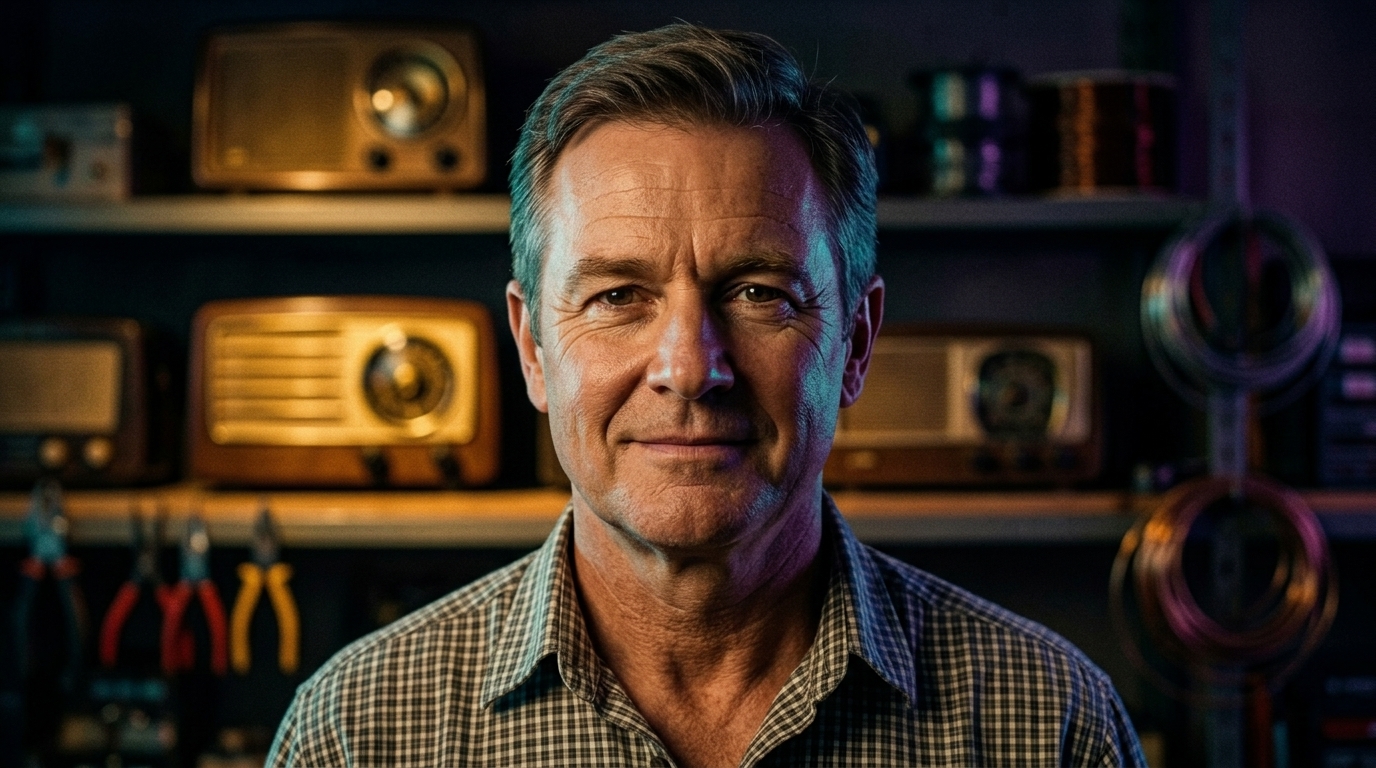
Away from work, David was a creature of small, contented routines. He was a devoted Central District man, following the Bulldogs through lean years and flush with a true believer's constancy, and for decades his business quietly sponsored the club that anchored his corner of the suburbs. His real refuge, though, was his shed, where he restored old valve wirelesses — the very machines that had first caught his boyhood imagination — coaxing warm light and crackling voices out of sets that everyone else had thrown away. It was a private, absorbing craft, and in it he carried, without ever recognising it, something of the family pattern: the Jennings habit of pouring the inarticulate parts of oneself into a quiet, solitary making.
The Brother Who Stayed
David's relationship with the family he had left behind settled, over the decades, into something affectionate but distant. He and Brian, the brother who had stayed and shouldered the farm, were fond of each other and saw each other rarely — two men leading lives so different that the six years and forty kilometres between them came to feel like a great deal more. An unspoken current of envy ran both ways. Brian, bound to the land and its relentless demands, half-envied David's freedom; David, who had spent his life building a place of his own, half-envied the rootedness and certainty his brother had been handed at birth.
With his sister Sarah, who had also left — for Adelaide and a life beyond the farm — David was closer. The two of them were the leavers, the ones who had chosen other ground, and there was an easy alliance between them that neither ever had to explain. They compared notes on their parents, covered for one another's absences, and shared the particular, slightly guilty freedom of children who had loved a family enterprise enough to honour it and not enough to give their lives to it.
Three Months in 1997
The winter of 1997 took from David, in the space of a single season, both the father he had never been close to and the brother he had never quite reached. Edward died at the farmhouse on 15 August, aged seventy-nine. David came home for the funeral and grieved a man he had loved at a careful distance all his life, mourning as much for the closeness they had never managed as for the loss itself.
Then, on 18 November, barely three months later, Brian collapsed and died of a heart attack on the farm, fifty-two years old. That loss struck David far harder. Brian had been the fixed point of his childhood, the elder brother against whom he had always measured himself, and he was gone with the whole unfinished distance between them still unbridged. David stood again at St Peter's, helped carry his brother, and felt the particular grief of the survivor who understands too late that there had always seemed to be more time, until there was none.
In the years that followed he did what he could for his widowed mother, the dutiful son closing a little of the distance at last, though it was Sarah who carried the greater part of it. He watched the farm pass to his niece Anne, who came back to take up the property, and felt no envy in it — only relief that the land he had never wanted was in hands that did. His sister-in-law Patricia died in 2002, and his mother Margaret in 2012, at the age of eighty-nine; and with Margaret's passing the generation that had raised him was gone, and David and Sarah were all that remained of Edward and Margaret's three children.
The Son Who Left
David handed D.C. Jennings Electrical to Andrew in the mid-2010s and stepped into a retirement as unhurried as the rest of his life had been. He and Lyn stayed in the north of Adelaide, close to their children and to the grandchildren who now filled the space the business had left, and he settled into the long, gentle occupation of being an old man with a shed, a football team, and the time at last to enjoy them both.
The grandchildren knew him as the easiest of men — the grandfather with the shed full of glowing valves and humming wirelesses, who let them turn the dials and never raised his voice, who turned up to every junior football match with a fold-out chair, a thermos, and a quiet word of encouragement. It was, perhaps, the role he had been made for all along: not the patriarch his father had been, but a warm and undemanding presence at the edge of a happy family, asking little and gladly giving what he had.
His relationship with the farm softened, in those later years, into something like fond pilgrimage. He drove up to Gawler to see Anne and the old place more often than he once had, walking the paddocks he had been so desperate to leave and finding, to his mild surprise, that he was glad they were still there — still worked, still Jennings ground. The coolness he had carried toward his father for so long had weathered into a kind of rueful understanding: two undemonstrative men, he had come to think, who had simply wanted different lives and never found the words to forgive each other the difference.
He had been, by any honest reckoning, the least dramatic of Edward and Margaret's children — not the heir, not the favourite, not the clever one, but the boy who had slipped quietly away and built a decent, self-made life precisely where no one had thought to look for him. And in the long view of it — a marriage of more than half a century, a business raised from nothing, a family who loved him, and a shed full of radios he had brought back from the dead — David Charles Jennings had made, out of the freedom of being overlooked, something that looked a great deal like contentment.







