
David Alexander O'Neil
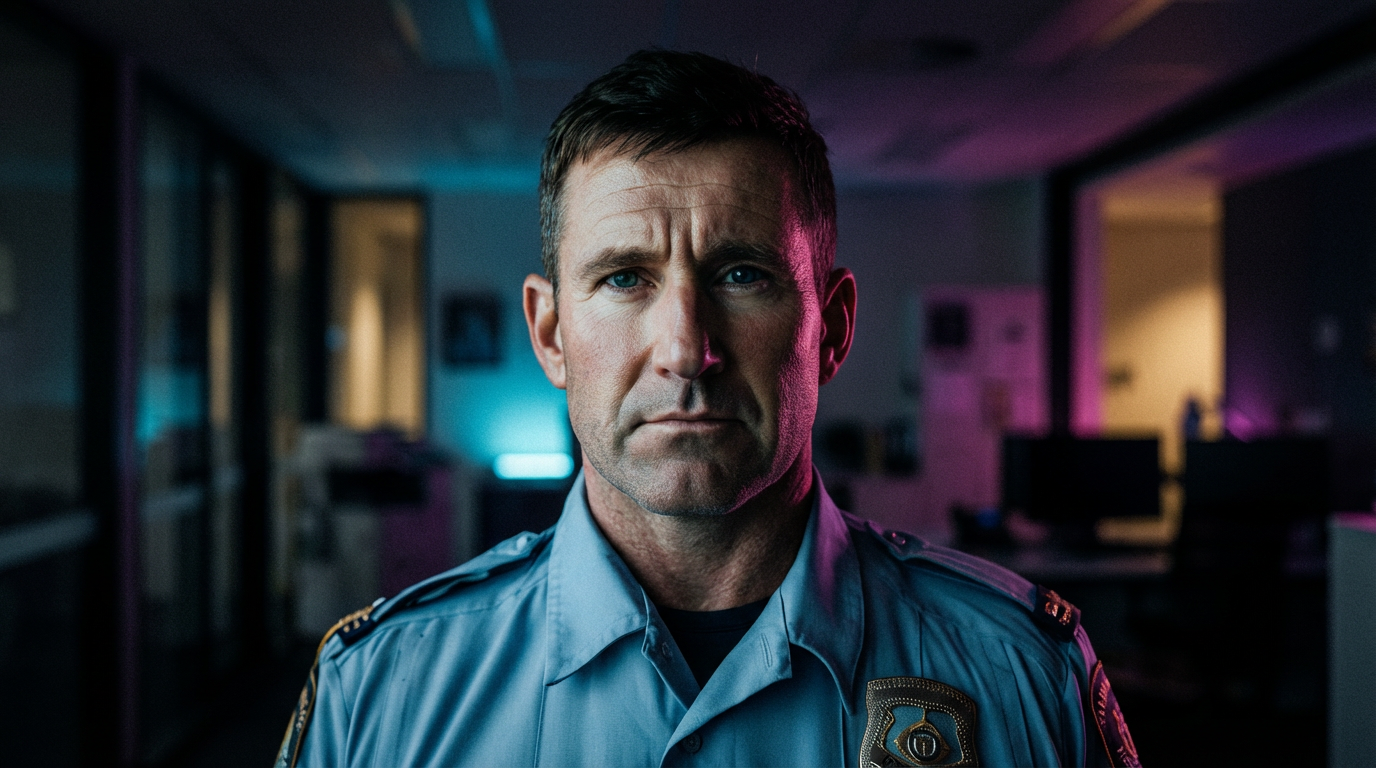
Born in Burnie in 1983, David Alexander O'Neil grew up on Tasmania's rugged north-west coast before relocating to Hobart as a teenager and forging a career with Tasmania Police that would span nearly two decades. A natural communicator whose empathy and steadiness earned him the trust of colleagues and communities alike, David's formative professional experience came during the devastating events of August 2018, when the disappearance of Detective Karl Jenkins tested every officer at Hobart Police Station.
Early Life on the North-West Coast
David Alexander O'Neil was born on 12 March 1983 at the North West Regional Hospital in Burnie, Tasmania, the only child of Michael Patrick O'Neil, a solicitor with a small practice on Wilson Street, and Sophia Margaret O'Neil (née Papadopoulos), a primary school teacher at Burnie Primary. The family lived in a brick veneer house on View Road in the suburb of Shorewell Park, close enough to the coast that David could smell salt on the wind from his bedroom window and hear the distant percussion of waves breaking against the basalt headland at Roundhill Point.
Burnie in the 1980s was a town built on industry — the pulp mill at the eastern end, the titanium dioxide plant, the shipping containers stacked along the wharf. Michael O'Neil had grown up in Ulverstone and moved to Burnie after completing his law degree at the University of Tasmania, establishing a general practice that served farming families, small businesses, and the steady stream of workers' compensation cases that the mills and factories generated. He was a measured, careful man who believed in due process with a fervour that bordered on the religious, and who brought home from his office an abiding conviction that the law, applied properly, was the closest thing to justice the imperfect world could manage.
Sophia brought warmth and colour to a household that might otherwise have tilted towards the austere. Her parents, George and Maria Papadopoulos, had emigrated from the Greek island of Kalymnos in 1961, settling in Burnie where George found work in the paper mill and Maria opened a small bakery on Cattley Street that became a local institution. Sophia inherited her mother's gift for making people feel welcome and her father's quiet resilience, qualities she passed to David alongside a fierce protectiveness that occasionally bordered on overindulgence — he was, after all, her only child, and she poured into him the affection that might otherwise have been distributed among siblings.
As a boy, David was drawn to the water with the single-mindedness that characterises coastal children. He surfed the breaks at West Beach and Cooee Point from the age of ten, swam competitively for the Burnie Aquatic Club, and spent long summer afternoons exploring the rock pools below the bluff with a loose cohort of neighbourhood children who knew every cave and channel between the headlands. He was sociable without being attention-seeking, athletic without being aggressive, and possessed an instinctive kindness that his teachers at Burnie Primary and later at Parklands High School noted alongside his solid academic performance and his willingness to include children who found themselves on the margins.
The family's social life revolved around the Greek Orthodox community that Sophia's parents had helped establish, the Burnie Football Club where Michael served as a committee member despite possessing no discernible sporting talent, and the network of solicitors, teachers, and small business owners who formed the town's civic backbone. David absorbed from this environment an understanding of community as something built through presence and participation — you showed up, you contributed, you looked out for the people around you. It was not a philosophy anyone articulated; it was simply what people did.
The Move to Hobart and Finding Direction
In January 1998, when David was fourteen, the family relocated to Hobart. Michael had been offered a partnership in a larger firm on Macquarie Street, and Sophia secured a teaching position at Taroona Primary School. The move was sensible and well-timed — David's educational opportunities would expand, Michael's career would advance, and Sophia would be closer to the University of Tasmania's education faculty, where she intended to pursue further qualifications. But for David, the transition meant leaving behind the only place he had ever known, a rupture that felt far larger than the three-hour drive down the Midland Highway suggested.
The family settled in a weatherboard house on Flinders Esplanade in Taroona, overlooking the Derwent. The proximity to water helped — David could still surf, though the breaks at Clifton Beach were a different proposition to the familiar swells of the north-west coast — but the social recalibration was harder. Hobart was larger, more stratified, and less forgiving of newcomers who carried the faint trace of regional accent and the uncomplicated openness of small-town upbringing.
Taroona High School, where David enrolled midway through Year Nine, provided the environment he needed to find his feet. He threw himself into sport — football with a natural versatility that saw him played across half-forward, and athletics where his endurance-built frame suited middle distance events — and discovered through a Year Ten legal studies elective a fascination with the mechanics of justice that clearly echoed his father's influence. His social sciences teacher, a former youth worker named Mr. Brennan, introduced him to criminological thinking and the idea that crime was not simply a failure of individual morality but a product of systemic factors that could be understood, addressed, and potentially prevented.
Outside the classroom, David volunteered with the Hobart Youth Mentoring Programme and a charity supporting underprivileged families in the southern suburbs. The volunteer work gave shape to instincts he had carried since childhood — the desire to be useful, to help people navigate difficulty, to be present in the way his Burnie upbringing had taught him mattered. By the time he completed Year Twelve in 2003, the decision to pursue policing had solidified not as a dramatic calling but as a natural convergence of temperament, values, and the practical desire to do work that mattered to real people in real communities.
The Police Academy and Becoming a Constable
David entered the Tasmania Police Academy at Rokeby in early 2004, beginning a two-year Diploma of Public Safety (Policing) that would test his physical endurance, intellectual discipline, and emotional resilience in roughly equal measure. He thrived in the collaborative environment — the group exercises and scenario simulations that some cadets found stressful played directly to his strengths as a communicator and a steadying presence under pressure. His academic performance was exceptional, and he graduated with honours in 2006, receiving the Commissioner's Award for Academic Excellence — an achievement that pleased his parents enormously and embarrassed David slightly, as public recognition sat uncomfortably with his preference for doing good work without fanfare.
His first posting as Probationary Constable at Hobart Police Station introduced him to the vast distance between academy training and the unpredictable reality of frontline policing. The domestic disputes that comprised a significant portion of his early workload taught him lessons no textbook could convey — that people in crisis need to be heard before they can be helped, that the difference between a situation that escalates and one that resolves often comes down to tone of voice and body language, and that genuine empathy is not a weakness in policing but perhaps its most essential tool.
David completed his probationary period in 2009 with commendations from supervisors who recognised his ability to connect with people across the full spectrum of Hobart's communities — from the affluent households of Sandy Bay to the public housing estates of Bridgewater, where his lack of condescension and his willingness to remember names and circumstances earned him a trust that more experienced officers sometimes struggled to achieve. He was promoted to Constable and continued in general duties, building a reputation as someone you could rely on when a situation required patience rather than force.
Marriage, Family, and Further Study
David had met Emily Catherine Marsden in 2007 through mutual friends at a barbecue in Kingston. Emily, a registered nurse at the Royal Hobart Hospital who had grown up in the Huon Valley, shared David's quiet determination and his instinct for service — they recognised in each other the particular blend of idealism and practicality that sustains people who choose careers built around helping others. Their courtship was unhurried and grounded in shared values rather than dramatic intensity. They married in March 2010 at a small ceremony at the Taroona Community Hall, with Michael O'Neil delivering a speech that combined legal precision with genuine emotional warmth in a way only he could manage.
That same year, driven by a desire to deepen his understanding of the systems he worked within, David enrolled in a Bachelor of Social Science (Criminology) at the University of Tasmania, studying part-time whilst maintaining his full-time policing duties. The balancing act was demanding — Emily, by then pregnant with their first child, managed the domestic logistics with the pragmatic efficiency her nursing training had instilled — but David approached the degree with the same disciplined commitment he brought to everything. His research focused on the effectiveness of community policing strategies in reducing crime and promoting social cohesion, a topic that drew directly from his frontline experience and reflected his conviction that policing worked best when it was embedded within the communities it served rather than imposed upon them.
Chelsea Emily O'Neil arrived in November 2010, followed by Adam Michael O'Neil in February 2013. David graduated with First Class Honours in 2012, earning recognition for his research, though the degree mattered to him less as a credential than as a framework for understanding the work he was already doing. Fatherhood reshaped his priorities without fundamentally altering his character — he remained the same steady, patient man, now with two small reasons to come home safely from every shift and a deeper appreciation for the vulnerability of the families he encountered professionally.
Criminal Investigation Branch and the Events of August 2018
The promotion to Detective Constable in 2015 and transfer to the Criminal Investigation Branch represented a significant professional evolution. David moved from the responsive, relationship-driven work of community policing to the more analytical demands of investigating property crimes, fraud, and complex criminal networks. He played a key role in dismantling a major identity theft ring that had been targeting vulnerable elderly residents across Hobart's eastern suburbs — a case that drew on his ability to build rapport with frightened victims whilst maintaining the evidential rigour the prosecution required.
By mid-2018, David was an established and respected member of the CIB — not the most senior detective, nor the most decorated, but someone whose judgement colleagues trusted and whose temperament made him invaluable in the chaotic, emotionally charged situations that major investigations inevitably produced. Nothing in his twelve years of service, however, had prepared him for what began on the afternoon of 2 August 2018.
David was among the officers who arrived as backup at Jeffries Manor in Granton that afternoon, responding to the call that Detective Karl Jenkins had vanished during a confrontation with suspect Luke Smith. The manor's ivy-clad Victorian grandeur felt surreal against the urgency of the scene — Detective Sarah Lahey visibly shaken, Sergeant Charlie Claiborne deploying teams across the expansive grounds, and an empty shed that offered no explanation for how two men had simply ceased to exist within its walls.
David led one of the search teams that scoured the estate — the manicured lawns, the outbuildings, the rugged bushland that bordered the property — finding nothing. When Sergeant Claiborne departed the scene that evening, David temporarily assumed coordination of the remaining officers, securing the perimeter overnight and ensuring the search would resume at dawn with additional resources. It was the first time he had held operational command in a situation of this gravity, and he managed it with the calm practicality that had characterised his career from the beginning.
The days that followed drew David deeper into the investigation. On 4 August, he was part of Detective Sergeant Alexander Stout's team that executed a search warrant on Karl Jenkins' residence, encountering the unnerving details that would define the case — an untouched newspaper on the porch, Karl's anxious dog Jargus, and case files containing cryptic notes about "hidden secrets" and research into Jeffries Manor and Killerton Enterprises.
On 7 August, David was selected as part of the covert surveillance team monitoring Detective Sarah Lahey, who had become the prime suspect in both Karl's disappearance and the murder of Cody Jennings. The assignment placed him in an impossible position — watching a colleague he had worked alongside, a woman whose competence he had admired, and confronting the possibility that institutional trust could conceal something far darker than professional rivalry or personal weakness.
Myrtle Forest and Its Aftermath
The evening of 8 August 2018 remains the defining experience of David O'Neil's career. Positioned with Constable Emily Rogers as part of Detective Sergeant Stout's covert team in Myrtle Forest during Operation Shadow Watch, David witnessed the confrontation between Sarah Lahey and Gladys Cramer that escalated beyond any scenario the operation's contingency plans had anticipated. When Sarah was fatally wounded, David and Rogers were the first to respond — securing the scene and calling for additional backup and medical assistance with the disciplined efficiency of officers operating on training whilst their minds struggled to process what had just occurred.
David stood in that forest as paramedics Scott Fleming and Kristy McIntyre worked to save Sarah Lahey's life, and he was there at approximately 4:50 PM when Fleming pronounced her dead. The clinical language of the incident report that Detective Sergeant Stout would later compile could not capture what that moment cost the officers who witnessed it — the particular devastation of watching a colleague die during an operation designed to bring her to justice, the collision of duty and grief that left no clean emotional resolution.
The aftermath reshaped David's trajectory within Tasmania Police. The events of August 2018 — Karl's disappearance, the betrayal of trust that Sarah's involvement represented, the tragedy at Myrtle Forest — left marks on everyone who served at Hobart Police Station during that period, but they affected David with a particular intensity because he had been present at so many of the critical moments. He continued his investigative work as a Detective Senior Constable from 2018, collaborating with interstate and federal agencies on cross-jurisdictional cases connected to the broader web of disappearances that Karl and Sarah's original investigation had begun to uncover.
Professional Standards and the Question of Trust
In 2021, David was promoted to the rank of Sergeant and assigned to the Professional Standards Command — a posting that some colleagues interpreted as recognition of his integrity and others saw as a natural destination for an officer shaped by the institutional betrayals of 2018. The truth, as with most things in David's life, was less dramatic than either interpretation. He had demonstrated throughout his career a commitment to ethical policing that went beyond procedural compliance, and Professional Standards required exactly the blend of empathy and rigour that defined his approach. The work involved overseeing internal investigations and ensuring the professional conduct of serving officers — holding the institution accountable to the standards it claimed to represent.
It was not work David had imagined doing when he entered the academy two decades earlier, dreaming of community engagement and crime prevention. But the events of 2018 had taught him that institutional integrity was not a bureaucratic abstraction — it was the foundation upon which every other aspect of policing depended. If officers could not trust each other, if the public could not trust the force, then the community policing strategies his Honours thesis had championed became meaningless. Professional Standards, unglamorous as it was, addressed the root condition.







