David Alan Marshall
David Alan Marshall was born on 11th January 1982 in Salt Lake City, Utah, the eldest of six children of insurance adjuster Gregory Marshall and schoolteacher Margaret Jensen. After serving a Latter-day Saint mission in Chile and studying political science at the University of Utah, he completed his law degree at the University of Denver's Sturm College of Law and built a career in corporate mergers and acquisitions at Hale Whitfield & Carr. He married attorney Catherine Whitmore in 2020, and their daughter Clara was born in 2022.
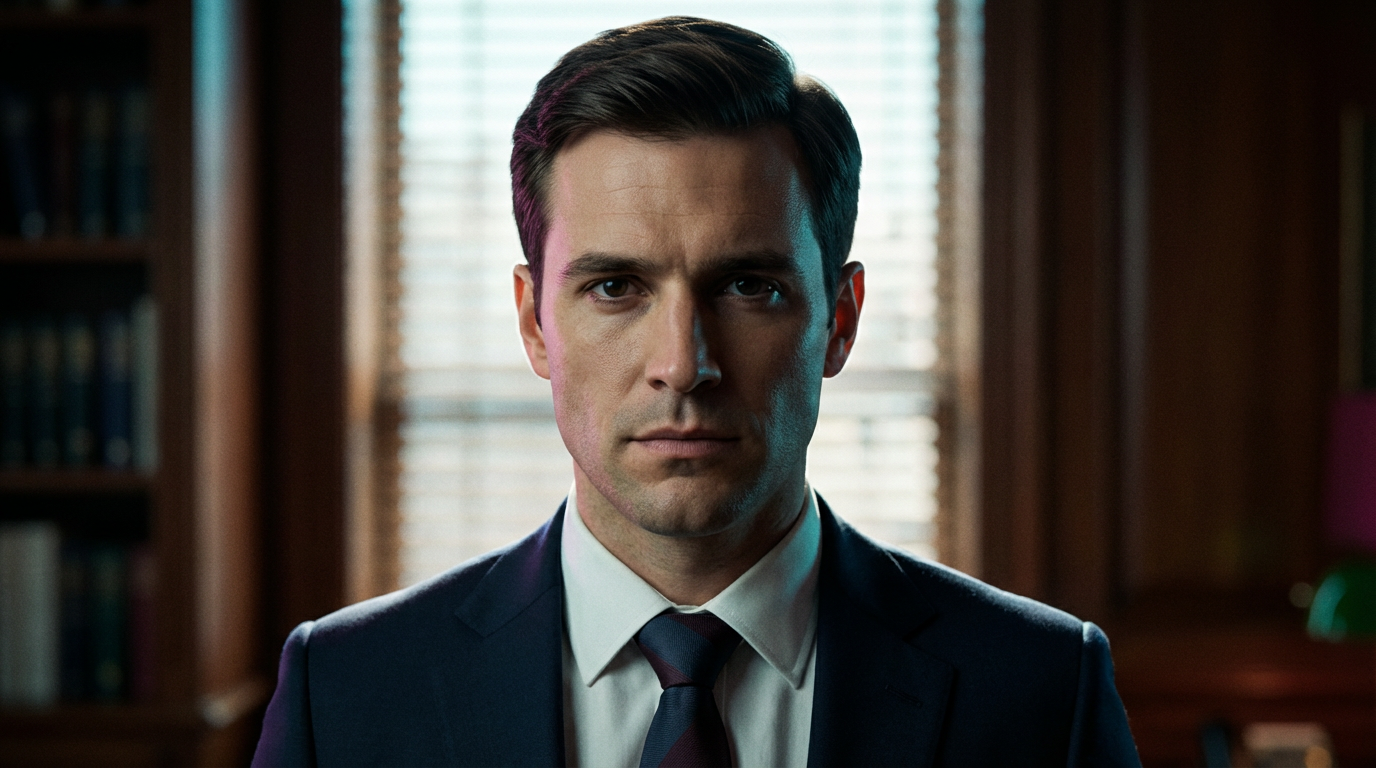
The First to Be Measured
David Alan Marshall was born on 11th January 1982 at LDS Hospital in Salt Lake City, Utah, the first child of Gregory Alan Marshall and Margaret Louise Marshall (née Jensen). He was the beginning of everything — the first to arrive, the first to be watched, the first against whom every subsequent Marshall child would be measured, and the first to learn what it cost to set the standard rather than simply meet it.
Gregory, born on 2nd April 1955, had spent his twenties as a lifeguard and swim instructor at public pools across the Salt Lake Valley before settling into a career as an insurance adjuster. He was twenty-six when David was born, newly married, and possessed of the intense conviction that his own chaotic upbringing — the product of a construction foreman father who was strong on principle and weak on warmth — could be improved upon through discipline, structure, and unwavering expectation. Margaret, born on 19th August 1958, had recently begun teaching third grade at Wasatch Elementary, a position she would hold for thirty-one years. She brought to motherhood the same patient attentiveness she brought to her classroom, though with David she discovered something no amount of professional training had prepared her for: the particular anxiety of raising a child who seemed determined to be perfect before anyone had asked him to be.
The Marshall household in the Avenues neighbourhood of Salt Lake City expanded steadily behind David. Michael James arrived on 22nd June 1984, bringing an easy temperament and mechanical curiosity that contrasted sharply with David's seriousness. Rachel Ann followed on 5th March 1986, fierce and organised from infancy. William Jacob was born on 12th September 1989, quiet and self-contained, his life rapidly subsumed by the chlorine-scented discipline of competitive swimming. Eric Daniel came on 9th November 1992, analytical and watchful, content with a chessboard and his own company. And finally Jared Nathan, born on 15th May 1995, whose boundless energy and cheerful defiance of every household rule seemed designed to test the very architecture of order that David had spent his childhood helping to build.
David was thirteen when Jared was born. He had already, by that point, absorbed the full weight of Gregory's expectations and converted them into something that resembled ambition but was closer to obligation. He was the son who set the table without being asked, who completed his homework before dinner, who accompanied Gregory to church leadership meetings and sat upright through discussions he was too young to contribute to but old enough to attend. He was, in the language of the ward, a fine young man — a phrase that pleased Gregory and made Margaret uneasy for reasons she couldn't articulate, because a thirteen-year-old boy who never caused trouble was either unusually mature or unusually careful, and the difference mattered more than most people realised.
The Study Door
David attended Wasatch Elementary from 1987, entering the same corridors where Margaret taught third grade. Unlike Jared, who would later find his mother's proximity a complication, David experienced it as reinforcement — another layer in a world where the expectations of home and school and church aligned so completely that deviation was almost unimaginable. He excelled academically with a thoroughness that left little room for surprise. His reading was advanced, his mathematics precise, and his handwriting the kind that teachers held up as an example, which won him marks and lost him friends in roughly equal measure.
At Bryant Middle School, which he entered in 1993, the academic gifts sharpened into something more specific. David discovered debate. The school's programme was modest — interscholastic competitions against other Salt Lake middle schools, coached by an English teacher with a passion for rhetoric — but for David it was a revelation. The structured adversarial format, the requirement to argue positions regardless of personal belief, the scoring that rewarded clarity and preparation above all else: it was as though someone had designed an activity specifically for his temperament. He spent hours in the family study preparing cases, his voice carrying through the closed door with the insistent cadence of a boy rehearsing a future he could already see. Eric, years later, would remember the sound of that debating practice as one of the defining textures of childhood in the Marshall house.
West High School, which David entered in 1995, consolidated the trajectory. He joined the debate team immediately and competed through all four years, eventually captaining the squad in his senior year and leading it to a state semifinal finish. His style was methodical rather than charismatic — he won arguments through preparation and logical structure rather than rhetorical flair, dismantling opponents' positions with a patience that opposing coaches found unsettling in a teenager. His academic record was distinguished across the board, with particular strength in history, government, and English composition. Teachers described him as serious, capable, and slightly remote — the kind of student who earned respect without seeking friendship, and who appeared most fully himself when constructing an argument.
He was also, quietly and without drama, the most observant of the Marshall children. David noticed things. He noticed that Gregory's discipline, which he had always accepted as the natural order of the household, landed differently on Michael, who shrugged it off, than on Will, who absorbed it, than on Rachel, who met it with her own equally formidable will. He noticed that Margaret's patience had a bottom, and that she reached it more often than anyone acknowledged. He noticed that Eric, even as a small child, processed the world at a slight delay, as though running every interaction through an internal calculator before responding. These observations didn't make David empathetic, exactly. They made him strategic. He understood his family the way a good lawyer understands a jury — thoroughly, usefully, and from a professional distance that could be mistaken for coldness.
He graduated from West High in the spring of 1999, valedictorian of his class, with acceptances to several universities and the quiet understanding that none of them would be attended before his mission.
Santiago and Dust
David received his mission call to the Chile Santiago South Mission in the autumn of 2000, departing in January 2001, shortly after his nineteenth birthday. He was the first Marshall child to serve, and Gregory drove him to the Missionary Training Centre in Provo with the particular pride of a man who had served his own mission in Sydney decades earlier and understood the experience as the crucible through which boys became men. Margaret cried in the car park afterwards. David did not.
Chile tested him differently than he expected. The language came quickly — David's aptitude for structured learning translated efficiently into Spanish acquisition, and his mission president noted that he was conducting discussions in fluent, if formal, Castellano within four months. But the mission required something beyond competence. It required vulnerability. In the sprawling parishes of Santiago's southern suburbs, where the streets smelled of fried empanadas and the conversations moved with a warmth and directness that David found simultaneously appealing and disorienting, he was asked to testify about personal spiritual experiences that he had always processed as intellectual convictions rather than felt realities. He could explain doctrine with the precision of a seminary manual. He could not always explain what it meant to him.
He served diligently and was promoted to zone leader in his second year, overseeing multiple companionships with the administrative efficiency that would later characterise his legal career. His mission president's final assessment described him as "a leader of unusual capability and composure, whose example inspires confidence in those he serves with." It was a generous and accurate evaluation. It also, like many assessments of David Marshall, described the surface without reaching what lay beneath it.
He returned to Salt Lake City in January 2003 to a household that had shifted in his absence. Michael was nineteen and already training in aviation maintenance. Rachel was sixteen and running the home with an authority that made Gregory uncomfortable and Margaret grateful. Will was thirteen, deep in the pool, his life narrowing around a stopwatch. Eric was ten, quiet, watchful. And Jared was seven, generating the kind of noise and chaos that made David wonder whether he had been born into a different family entirely. He stayed in the Avenues house for six weeks, relearning the rhythms of a home he no longer quite belonged to, before departing for university.
The Distance
David enrolled at the University of Utah in the spring of 2003, pursuing a Bachelor of Arts in Political Science with a minor in Philosophy. The choice of a local university surprised some who knew him — his academic credentials could have taken him further afield — but David's reasoning was characteristically pragmatic. In-state tuition was manageable without burdening Gregory and Margaret, and Salt Lake City's proximity allowed him to maintain his role as eldest son without the expense and inconvenience of distance. He intended to leave eventually. He simply intended to leave on his own terms.
University suited David in ways that high school had not. The scale of the institution offered anonymity, and anonymity offered freedom — not the freedom of irresponsibility, which he would never have permitted himself, but the freedom to build an identity that wasn't defined entirely by the Marshall household and the Avenues ward. He studied political theory with genuine intellectual excitement, discovering in constitutional law and jurisprudence a framework for understanding power, obligation, and justice that felt more rigorous than anything Sunday School had offered. His professors found him formidable: a student who arrived at office hours with questions that had clearly been developed over days of private deliberation, and whose written work demonstrated a capacity for sustained logical argument that was rare in undergraduates.
He graduated summa cum laude in December 2006 and applied to law schools with the focused intensity of a man who had been building toward this moment since the study door closed behind him in middle school. He was admitted to the Sturm College of Law at the University of Denver, beginning in the autumn of 2007. The move to Colorado was the first significant geographical separation from the family, and it arrived with a relief he had not anticipated. Denver was far enough to be his own city, close enough to drive home for Thanksgiving, and possessed of a legal market that was growing rapidly in energy, technology, and corporate governance. David arrived, rented a studio apartment in Capitol Hill, and discovered the particular pleasure of cooking dinner for one in a kitchen that contained no family photographs.
Law school was, by David's own later admission, the happiest period of his life. The Socratic method — the relentless interrogation of assumptions, the demand for precision, the public accountability of reasoning — felt like the intellectual equivalent of coming home. He excelled in corporate law and constitutional theory, served on the law review, and graduated in May 2010 in the top five per cent of his class. He had arrived in Denver as Gregory Marshall's eldest son. He left law school as David Marshall, Juris Doctor, a distinction that mattered more to him than he would have admitted aloud.
The Corner Office
David was hired directly out of law school by Hale Whitfield & Carr, a mid-sized corporate law firm in Denver's financial district, as a first-year associate specialising in mergers and acquisitions. The work was exhausting, intellectually demanding, and precisely calibrated to his strengths. He drafted contracts, conducted due diligence, navigated the dense regulatory landscape of corporate transactions, and billed the hours with a relentless consistency that earned him early recognition. His supervising partners described him as the kind of associate who made senior lawyers look good — thorough, reliable, and constitutionally incapable of producing careless work.
He made senior associate in 2014, junior partner in 2018, and full equity partner in 2022 — a progression that was steady rather than spectacular, driven by sustained excellence rather than the flashy dealmaking that propelled some colleagues faster. David did not court attention. He built a reputation, which was slower and more durable. His client roster grew through referrals, his name spoken in boardrooms with the particular respect reserved for lawyers who never surprised you and never let you down.
Denver became, incrementally, home. He bought a condominium in Cheesman Park in 2015, a handsome two-bedroom in a brick building with views of the mountains that he never tired of and rarely mentioned. He furnished it sparsely — a leather sofa, a dining table that seated four because anything larger would have been an aspiration he wasn't ready to declare, bookshelves dense with legal texts and, on the lower shelves, the fiction he read in private: Cormac McCarthy, Graham Greene, the kind of writers who understood that moral seriousness and narrative pleasure were not opposed. He ran along the Cherry Creek trail most mornings, early enough to finish before the commuters arrived, and attended a singles ward with the diminishing regularity of a man whose faith was transitioning from practice to habit.
The question of marriage followed David through his thirties with the persistence of a client file that refused to close. Gregory raised it annually, with the particular directness of a father who regarded marriage and family as moral imperatives rather than personal choices. Margaret raised it never, which communicated more effectively than any words could have. Rachel raised it with the brisk pragmatism of a woman who had already produced two children by the time David turned thirty-five and who regarded his bachelorhood as an inefficiency she would have corrected had the matter been within her jurisdiction.
David dated. He dated intelligent, accomplished women who found his seriousness attractive and his emotional reserve eventually intolerable. The pattern repeated with a regularity that a less self-aware man might have failed to notice: six months of careful courtship, a period of genuine connection, and then the slow withdrawal as the relationship approached the threshold of vulnerability that David could not cross. He was not afraid of commitment in the abstract. He was afraid of the specific commitment that marriage required — the surrender of the carefully maintained distance between himself and other people, the exposure of the parts of himself that he had spent a lifetime keeping professional.
He met Catherine Anne Whitmore at a bar association dinner in March 2019. Catherine, born in 1985, was a family law attorney at a smaller Denver firm — the kind of lawyer who spent her days navigating custody disputes and property settlements with a warmth and pragmatism that David found initially puzzling and eventually essential. She was three years younger, originally from Fort Collins, with a directness that bypassed David's defences not because she was cleverer than his previous partners but because she seemed genuinely uninterested in them. Where others had been drawn to his composure, Catherine was drawn to the cracks in it — the dry humour that surfaced unexpectedly, the way he softened around children, the tenderness he showed his mother on the phone when he thought nobody was listening. Their courtship was slower than either expected. David, for once, did not withdraw.
Letters and Long-Distance Calls
They married on 3rd October 2020, in a small civil ceremony in Denver that reflected both the pandemic restrictions of the moment and David's preference for occasions that prioritised substance over performance. Gregory and Margaret attended — Margaret delighted, Gregory pleased but quietly disappointed that the ceremony had not taken place in a temple. David noted the disappointment and did not address it. He had spent forty years meeting his father's standards. The wedding was the first occasion on which he chose not to, and the sky, he observed to Catherine afterwards, had not fallen.
Their daughter, Clara Margaret Marshall, was born on 7th June 2022, named for Catherine's maternal grandmother and for the woman David loved most completely and understood least. Margaret wept when she heard. Gregory held the baby with the careful awkwardness of a man whose experience of infants was extensive but distant, and said she had the Marshall jaw, which was as close to tenderness as his vocabulary permitted.
From Denver, David had observed the Clivilius crisis with the focused concern of a man whose instinct, when faced with the incomprehensible, was to identify what could be controlled. Lisa's departure in September 2018 had devastated Will, and David responded the way he always responded to family emergencies: with long-distance phone calls that were regular, supportive, and fundamentally inadequate. He called Will every Sunday evening for six months, conversations that followed a pattern both men recognised without acknowledging — David asking careful questions, Will providing careful non-answers, both of them circling the impossibility of a woman who had stepped through a portal into another dimension without either finding the language to address it directly.
When Jared refused his mission in 2013, David had sent a letter. It was a long letter — four handwritten pages, which for David represented an extraordinary expenditure of emotional capital — and it expressed, with the structured clarity of a legal brief, his respect for Jared's honesty, his concern for the family's response, and his own complicated feelings about the faith they had both been raised in. He did not tell Jared that he understood, because David's relationship with the Church was not Jared's kind of honest rupture but something quieter and harder to name: a gradual reclassification of belief from conviction to heritage, performed so smoothly that even Gregory hadn't noticed. The letter was the most vulnerable thing David had written in his life. Jared kept it in a drawer for years without mentioning it, which was, between the two of them, its own form of acknowledgement.
At forty-four, David Alan Marshall was a man who had done everything that was expected of him and then, quietly, begun doing what he wanted. He was a partner at a respected firm, a husband to a woman who loved the man behind the composure, a father to a daughter who was already showing signs of the Marshall seriousness that Gregory would have called character and Margaret would have called something to keep an eye on. He lived twelve hours from Salt Lake City by car, a distance he maintained not out of estrangement but out of the recognition — arrived at slowly, over decades of dutiful achievement — that he was most capable of loving his family when he was not standing inside the structure they had built for him. He called every Sunday. He visited at Christmas. He sent letters when the situation required more than a phone call could carry. It was not enough, and it was what he had, and the difference between those two things was the space in which David Marshall had learned to live.







