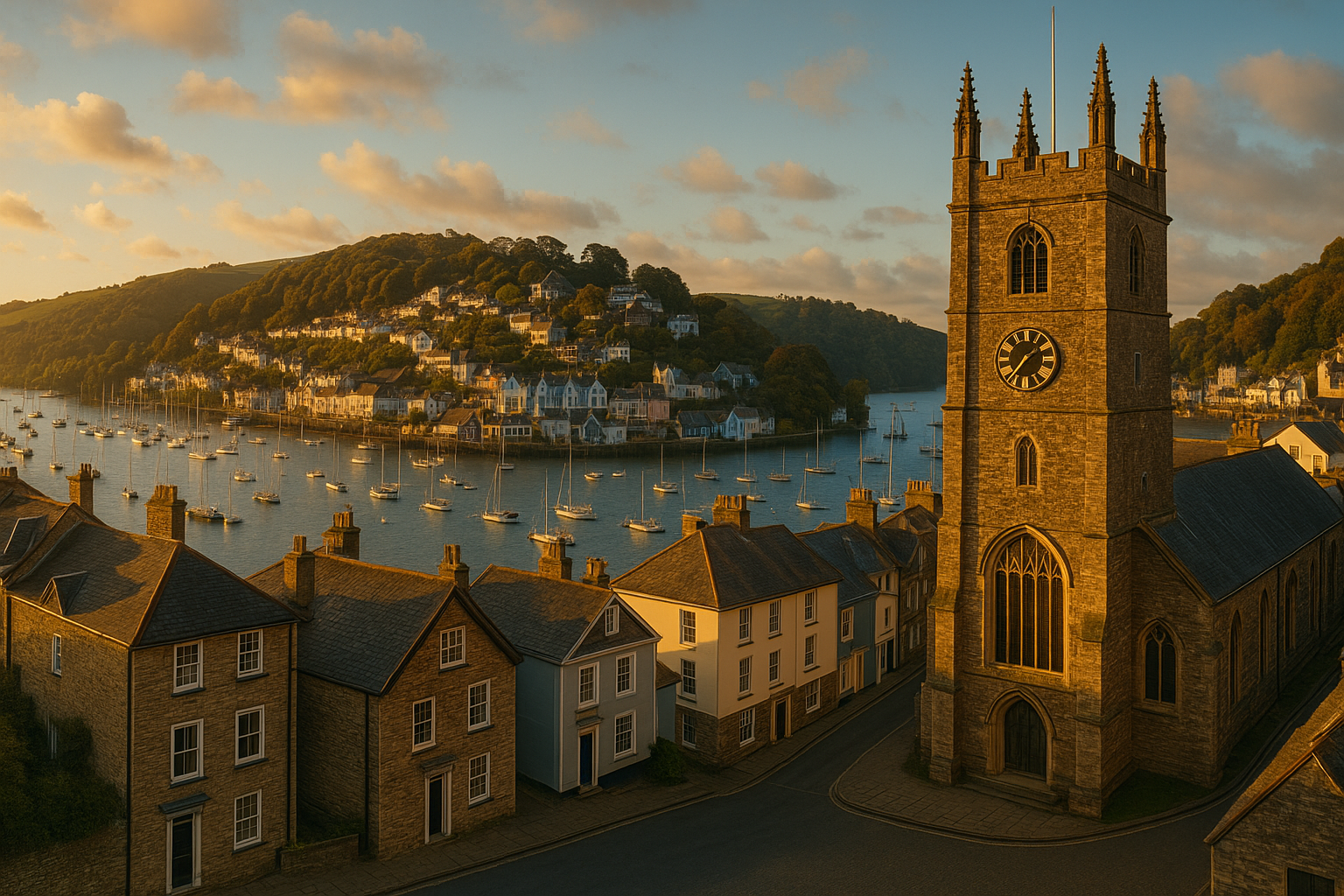
Dartmouth, Devon, England
Dartmouth is a historic port town on the western bank of the River Dart estuary in the South Hams district of Devon. An assembly point for Crusader fleets in the twelfth century and a prosperous medieval trading port, the town rose to prominence through the wine and wool trade, Elizabethan privateering, and the capture of the treasure ship Madre de Deus in 1592. Home to the Britannia Royal Naval College since 1863, Dartmouth served as a major embarkation point for the D-Day landings and remains the birthplace of the atmospheric steam engine inventor Thomas Newcomen.
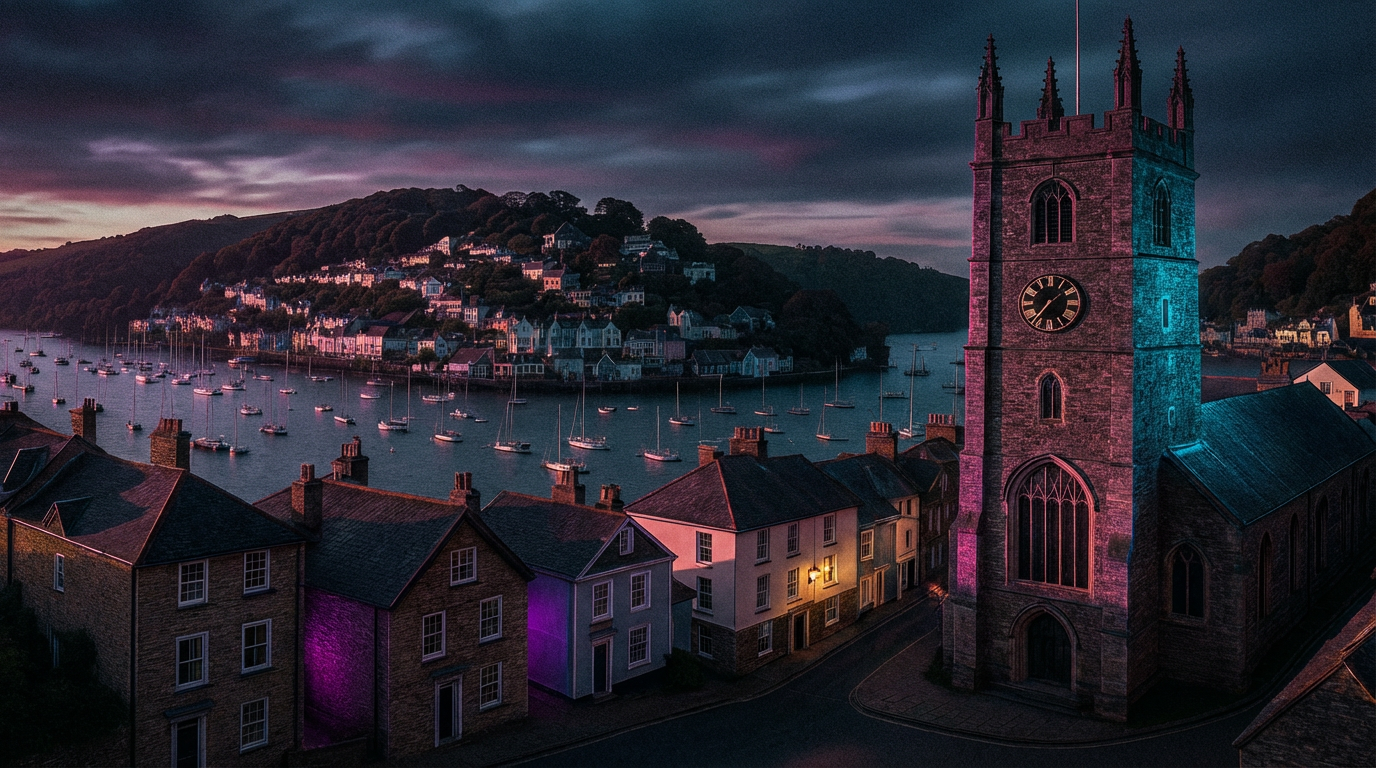
Origins and Early Settlement
Dartmouth's origins lie not at the waterfront but on the hilltop. The Domesday Book of 1086 records only Dunestal — the settlement of Townstal, held by Walter of Douai, paying tax on half a hide with two plough teams, two slaves, five villagers, and four smallholders — perched above the steep-sided valley where the River Dart meets the sea. In those early centuries, when coastal settlements remained vulnerable to raiders, Townstal was the safer choice. Only gradually did two fishing hamlets, Hardness and Clifton-Dartmouth, grow at the river's mouth, drawn by the deep sheltered estuary that would prove Dartmouth's greatest asset. A dam built across the tidal creek, on the site of modern Foss Street, joined the two hamlets and powered grain mills, creating the nucleus of the town that exists today. Much of the lower part of Dartmouth, from the river bank inland as far as the Guildhall, has been reclaimed from the river in stages since medieval times.
The Crusades and Medieval Port
The estuary's natural harbour — deep, sheltered by steep valley sides, with a narrow exit to the sea — made Dartmouth an ideal assembly point for seaborne expeditions. In 1147, a fleet of 146 ships gathered here before setting out on the Second Crusade, and in 1190 the harbour served again as a departure point for the Third Crusade. These events are believed to have given the name Warfleet Creek to the inlet just inside the river mouth. By the thirteenth century, the lords of Townstal were granted rights to hold weekly markets and an annual fair, and Dartmouth rivalled the Cinque Ports in importance. In 1341, Edward III granted Clifton Dartmouth Hardness a Royal Charter of incorporation, allowing for the election of a mayor. The borough was required to provide two ships for forty days per year. At the siege of Calais in 1347, Dartmouth furnished thirty-one ships and 757 men — surpassing Plymouth, which sent only twenty-six ships and 603. By 1377, Dartmouth had the third largest population in Devon, exceeding 650, and was prospering from trade with Genoa and Gascony.
St Saviour's Church, constructed from 1335 and consecrated in 1372, became the town church, sparing the inhabitants the arduous climb to St Clement's at Townstal. It contains a pre-Reformation oak rood screen dating to 1480 and a large medieval ironwork door decorated with two leopards of the Plantagenets. In 1373, Geoffrey Chaucer visited the area, and later wrote of a Shipman of Dartmouth among the pilgrims in the Canterbury Tales — a skilled sailor but also a pirate, widely believed to have been based on John Hawley, the leading merchant, privateer, and fourteen times Mayor of Dartmouth, who died in 1408 and lies buried in St Saviour's beneath a brass effigy of himself flanked by his two wives.
John Hawley, Privateering, and the Castle
John Hawley was the most formidable figure in Dartmouth's medieval history: merchant, shipowner, mayor, and privateer who blurred the boundary between licensed warfare and outright piracy with brazen regularity. During the Hundred Years War, when the crown lacked a standing navy, Hawley and his fellow shipmen were licensed to attack French and enemy vessels — keeping a share of the profits while forwarding a portion to the king. Chaucer's fictional shipman, who sent his enemies home by water and kept a dagger on a cord about his neck, captured something of the real Hawley, who was summoned repeatedly to account for his seizures, imprisoned in the Tower for six weeks in 1406, and was still accused of illegally taking seventeen foreign ships in the last year of his life.
In 1388, during the French threat, Richard II ordered Hawley to compel the townsmen to contribute to a fortalice at the mouth of the Dart — Dartmouth's first castle. A moveable iron chain, some 250 metres long, was strung across the river to Kingswear Castle on the opposite bank, raised in times of danger to block enemy ships. The castle was strengthened around 1481 with a new gun tower — the first purpose-built coastal artillery fort in Britain — and completed around 1493 after Henry VII demanded the work be finished with all godly haste. When a two-thousand-strong Breton force landed at Slapton in 1404, Hawley organised an army of untrained locals and defeated the knights at the Battle of Blackpool Sands.
Tudor and Elizabethan Dartmouth
Dartmouth's maritime significance reached its peak in the Tudor era. The town sent eleven ships to join the English fleet against the Spanish Armada in 1588, and the captured Spanish flagship Nuestra Señora del Rosario, commanded by Admiral Pedro de Valdés, was anchored in the Dart for over a year while her crew were used as labourers at the nearby Greenway estate — home of the explorers Sir Humphrey Gilbert and his half-brother Sir Walter Raleigh.
In 1592, the Portuguese carrack Madre de Deus, the richest prize ever taken by Elizabethan privateers, was sailed triumphantly into Dartmouth harbour on 9 September. Captured by an English fleet off the Azores, the enormous vessel — 165 feet long, with seven decks — was packed with jewels, pearls, gold, silver, ebony, spices, and silks from the East Indies. Nothing like it had ever been seen in England. Pandemonium erupted: traders, dealers, cutpurses, and thieves poured into the town from as far as London; sailors sold their plunder to local merchants and jewellers; Robert Cecil, sent to assess the cargo, reported he could smell cloves, pepper, and musk seven miles from the docks. By the time Raleigh — released from the Tower of London specifically to restore order — reached Dartmouth, a cargo estimated at half a million pounds had been reduced to roughly £140,000. The queen nonetheless received some £80,000 return on her original £3,000 investment, and the episode helped repair relations between the adventurer and his monarch.
In 1620, the Pilgrim Fathers, bound for America, berthed the Mayflower and Speedwell at Bayard's Cove for repairs to the leaking Speedwell before continuing their voyage.
The Civil War and Thomas Newcomen
During the English Civil War, Dartmouth changed hands more than once. Royalists besieged and captured the castle and held it for three years, constructing a fortification at Gallants Bower above the town — among the best-preserved Civil War defensive structures in England. In 1646, Sir Thomas Fairfax attacked and took the town for Parliament, and the Royalist garrison surrendered the castle the following day. In 1552, the soldier Sir Peter Carew had seized Dartmouth Castle by force, claiming it stood on his family's land, and held it against the town's legal challenges until his death in 1575. Charles II held court in the Butterwalk in 1671 while sheltering from storms, in a room now forming part of Dartmouth Museum.
Dartmouth's most significant contribution to world history came not from warfare but from invention. Thomas Newcomen, baptised at St Saviour's Church on 28 February 1664, was an ironmonger by trade and a Baptist lay preacher by calling. His family had deep roots in the town — his grandfather had been a merchant adventurer and town treasurer during the Civil War. In 1712, working with his partner John Calley, Newcomen installed the world's first successful atmospheric steam engine at a coal mine near Dudley Castle in Staffordshire. The engine used condensed steam to create a vacuum, driving a piston that pumped water from deep mines. By the time of Newcomen's death on 5 August 1729, over a hundred of his engines were operating across Britain and Europe, and more than two thousand would eventually be installed. Though James Watt's later improvements brought greater efficiency, it was Newcomen's invention that made deep mining economically viable and provided the essential catalyst for the Industrial Revolution. The Newcomen Memorial Engine — the world's oldest surviving steam engine — is now displayed at the Dartmouth Visitor Centre.
Decline, the Naval College, and the Railway
By the eighteenth century, Dartmouth's fortunes waned as larger ports dominated long-distance trade. The Newfoundland cod trade, which had sustained the town for generations — with locally made goods shipped to Newfoundland and salted cod sold to Spain and Portugal in exchange for wine — collapsed in the mid-nineteenth century. The difficult terrain delayed the arrival of the railway until 1864, when a line reached Kingswear on the opposite bank; steam ships replaced the sailing vessels traditionally built in Dartmouth's yards; and the hand weavers who had contributed to the local economy lost their livelihoods to industrial mills.
Salvation came from an unexpected quarter. In 1863, the Royal Navy moved the wooden training hulk HMS Britannia from Portland to the River Dart, establishing Dartmouth as a centre for officer training. The choice was partly dictated by the town's remoteness, which offered cadets few distractions. HMS Hindostan was added in 1864 to accommodate an influx of recruits. In March 1902, King Edward VII laid the foundation stone for a permanent shore-based college, and the Britannia Royal Naval College, designed by Sir Aston Webb in the Edwardian Baroque style, opened to cadets in 1905. The imposing building commands the hillside above the town. Among its most celebrated alumni are King George V, King George VI, the Duke of Edinburgh — who is said to have first met the young Princess Elizabeth at Dartmouth in July 1939 — and Charles III. In September 1942, six Focke-Wulf aircraft bombed the college, and students were evacuated to Eaton Hall in Cheshire until autumn 1946. Since 1998, BRNC has been the sole centre for Royal Naval officer training.
The Second World War and D-Day
Dartmouth's deep-water harbour made it a natural assembly point for the Allied invasion of Normandy. From late 1943, the town and its surrounding countryside were transformed by the American military presence. US Naval vessels, including minesweepers, were based in the harbour. Nissen huts sprang up in Coronation Park, and new slipways and ramps were built along the river's edge from Dartmouth to Dittisham. Over three thousand civilians in the villages around nearby Slapton Sands — selected for its resemblance to Utah Beach — were evacuated from their homes to allow American forces to conduct rehearsal landings. Exercise Tiger, the large-scale dress rehearsal held from 22 to 30 April 1944, ended in tragedy when German E-boats attacked a convoy of tank landing ships in Lyme Bay during the early hours of 28 April, killing at least 749 American servicemen. The torpedoed LST-289 limped back into Dartmouth harbour. The disaster was kept secret for decades.
On 4 June 1944, Dartmouth residents were ordered to stay indoors as tanks rolled through the streets and troops converged on the harbour. Over 480 ships left Dartmouth as part of the D-Day force — taking a full day to clear the river mouth — and at dawn on 6 June the invasion of France began. A Sherman tank recovered from the seabed off Slapton in 1984 by local resident Ken Small now stands at Torcross as a memorial to the men who died in Exercise Tiger.
The Town Today
Dartmouth retains the character of a working port town shaped by centuries of maritime endeavour. Its narrow streets, stone stairways, and overhanging medieval houses descend steeply to the waterfront, where chandlers and boatyards sit alongside galleries, boutique shops, and waterfront restaurants. The Butterwalk, built between 1635 and 1640 with its intricately carved wooden fascia supported on granite columns, houses Dartmouth Museum. The Cherub, a former merchant's house on Higher Street built around 1380, is among the oldest buildings in the town. The Dartmouth Royal Regatta, the town's major annual event, celebrates its maritime heritage with sailing races, rowing contests, and a fireworks display. The Dartmouth Steam Railway terminates at Kingswear, and boat cruises run up the Dart to Totnes, Dittisham, and the Greenway estate — Agatha Christie's much-loved holiday home, now owned by the National Trust.
The town had a population of 5,064 at the 2011 census and lies within the South Devon Area of Outstanding Natural Beauty. The South West Coast Path passes through the town, and extensive National Trust coastal properties at Little Dartmouth and Brownstone offer some of the finest cliff walking in Devon. The Dart Valley Trail connects Dartmouth to Totnes via both banks of the river.
Among those born in Dartmouth was Sebastian Hawke, the naval commander whose career bridged the turbulent waters of the Napoleonic Wars and the uncharted landscapes beyond. Born on 12 February 1780 into a seafaring family — the son of Captain Edward Hawke, a retired Royal Navy officer, and Margaret Hawke née Atwood, daughter of a West Country merchant family — the young Hawke entered the Royal Navy as a midshipman at fourteen and rose to distinction through service in the French Revolutionary Wars, at Gibraltar, Minorca, and on the Canadian frontier. His later career carried him far from the Devon estuary where he had grown up, though the discipline and self-reliance instilled by his father, and by the harbour town that had sent ships to every English conflict since the Crusades, remained with him to the end of his life.







