Crown and Anchor, Hobart Town
A modest two-storey public house established in 1811 on the corner of Argyle and Collins Streets, the Crown and Anchor occupied a quieter position away from Hobart Town's busier waterfront taverns. Under the proprietorship of Thomas Marsden, it became a favoured meeting place for merchants and tradesmen seeking conversation without the rough crowds of the wharfside establishments. For William Jeffries and Silas Croft, the Crown and Anchor's corner table witnessed the foundation of a friendship that would shape both their futures.
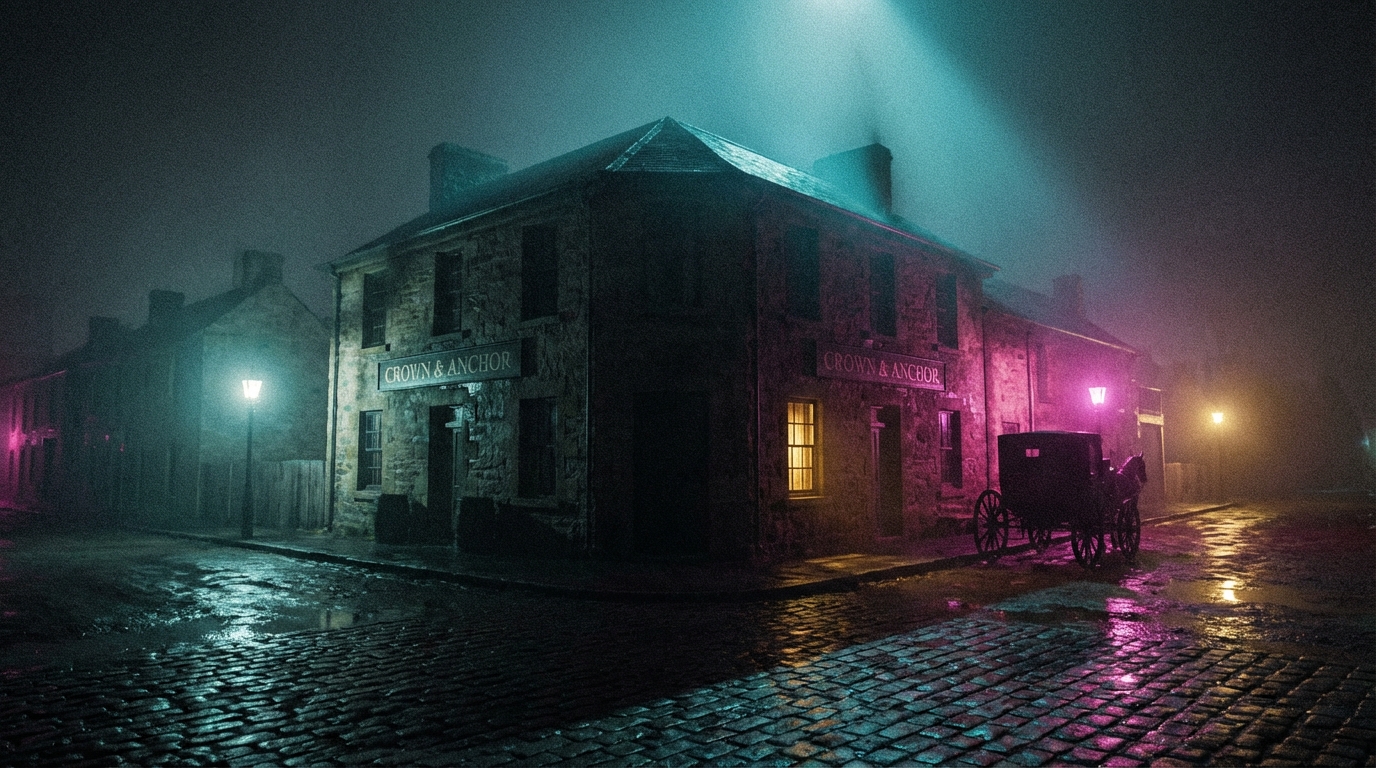
Location and Setting
The Crown and Anchor stood at the corner where Argyle Street crossed Collins Street, a position that offered the establishment its particular character. While Macquarie Street served as Hobart Town's main thoroughfare, carrying the bulk of commercial traffic between the waterfront and the settlement's expanding edges, Argyle Street ran parallel to it at a remove of some two hundred yards—close enough to the centre of things to attract custom, yet sufficiently distant to escape the constant noise and bustle that characterised the principal street.
Governor Macquarie had formalised Hobart Town's street plan during his visit in 1811, imposing order on what he had described as an "untidy" collection of wattle and daub huts. The intersection of Argyle and Collins Streets fell within the commercial heart of the newly organised settlement, surrounded by the modest dwellings and business premises of tradesmen, clerks, and minor merchants—those who had prospered enough to escape the rougher quarters near the waterfront but lacked the means or pretensions to establish themselves on the more fashionable blocks.
The corner position gave the Crown and Anchor a certain prominence despite its modest proportions. Travellers walking up Collins Street from the waterfront would find it on their left as they climbed the gentle slope away from the water, its painted sign—an anchor entwined with a royal crown—visible from some distance. The location proved advantageous for a particular class of customer: men of business who wished to conduct their affairs away from the scrutiny of the harbour crowds, yet close enough to the commercial district to make a meeting there convenient.
The Building
Thomas Marsden constructed the Crown and Anchor in the latter months of 1811, taking advantage of the newly surveyed street plan and a modest inheritance from a deceased shipmate. The building followed the straightforward Georgian style common to colonial establishments of the period: two storeys of rendered brick, whitewashed against the weather, with a simple hipped roof of wooden shingles. A modest verandah shaded the ground floor entrance, its posts of local timber showing the marks of the adze that had shaped them.
The ground floor housed the public room, a space of perhaps thirty feet by twenty, its ceiling kept deliberately low to retain warmth in the colder months. The walls had been plastered and whitewashed, though years of wood smoke had given them a yellowish cast that no amount of fresh paint seemed to overcome. A fireplace dominated the northern wall, its stone hearth worn smooth by the boots of countless patrons, the mantel above it blackened by smoke and decorated only with a carved wooden anchor that Marsden had salvaged from a wrecked sealer.
The interior presented itself as dim and cool even on summer days, the small windows admitting only modest light through their thick glass panes. Tables of local timber, rough-hewn but solidly made, occupied the floor in no particular arrangement, their surfaces marked by decades of tankards and elbows. In the corner farthest from both door and fireplace, a single table commanded a view of the entire room whilst remaining somewhat removed from it—a position that had become, through unspoken custom, reserved for those patrons whose conversations required privacy.
The serving counter occupied the eastern wall, behind which casks of ale and rum stood in wooden racks. A narrow stair beside the counter led to the upper floor, where Marsden maintained his private quarters and three small rooms available for lodgers—though these were seldom occupied, the Crown and Anchor's reputation being built on its drinking room rather than its accommodation.
Thomas Marsden, Proprietor
Thomas Marsden had arrived in Van Diemen's Land in 1807 as a free settler, though the circumstances that had brought him to the colony were rather more complicated than that simple designation suggested. Born in Plymouth in 1771, he had spent the better part of his adult life at sea, working his way from cabin boy to able seaman to bosun's mate aboard various merchant vessels trading between England and the East Indies. A fall from the rigging during a storm in 1805 had left him with a permanent limp and an end to his seafaring career—a common enough story, and one that explained his presence in the colonies without requiring further inquiry.
What Marsden did not advertise was that his passage to Van Diemen's Land had been facilitated by a captain anxious to be rid of a man who knew rather too much about certain irregularities in the ship's manifests. The modest inheritance that funded the Crown and Anchor's construction had been, in truth, a payment for silence—though this arrangement suited Marsden well enough, and he proved content to build a quiet life as a publican rather than pursue whatever advantages his knowledge might otherwise have afforded him.
By 1815, when William Jeffries first entered the Crown and Anchor, Marsden was a man in his mid-forties whose weathered face and sailor's rolling gait marked him immediately as one who had spent his years at sea. He kept his thinning grey hair cropped short in the naval fashion and maintained a quiet watchfulness that patrons sometimes found unsettling—the habit of a man accustomed to reading weather and men alike for signs of approaching trouble. He spoke little, served promptly, and asked no questions of his customers beyond what they wished to drink, a combination of qualities that made the Crown and Anchor attractive to those who valued discretion.
A girl named Sarah assisted Marsden in the serving room—whether daughter, niece, or simply an orphan he had taken in, no one knew for certain, and Marsden offered no clarification. She was perhaps sixteen or seventeen in 1815, quiet and watchful like her employer, with the kind of unobtrusive competence that came from years of hard work begun too young. She knew the regular customers and their preferences, appearing at tables with fresh tankards before men had quite finished their previous drinks, and had learned which patrons required cheerful service and which preferred to be left alone.
Character and Clientele
The Crown and Anchor occupied a particular niche in Hobart Town's social geography. Unlike the waterfront establishments—the Hope and Anchor, the Whale Fishery, and their ilk—it did not cater to sailors, whalers, and the rougher elements of colonial society. Neither did it aspire to the gentility of the establishments that served the colony's officers and officials. Instead, it attracted what might be called the middling sort: clerks, junior merchants, skilled tradesmen, and men of business whose circumstances placed them above the labouring classes but below the ranks of those who could afford pretensions to respectability.
This clientele gave the Crown and Anchor its distinctive atmosphere. Conversations here tended toward commerce rather than brawling, toward speculation about shipping schedules and commodity prices rather than the songs and fights that characterised the harbour taverns. Men gathered in small groups at the scattered tables, their voices kept low out of habit rather than necessity, conducting the informal business that colonial commerce required but polite society preferred not to acknowledge.
The corner table where Silas Croft chose to sit during his Saturday meetings with William Jeffries offered both privacy and observation—a position from which one could watch who entered and departed without appearing to do so, and from which conversation could not easily be overheard. That Croft had established this as his customary position suggested a man who understood both the value of information and the importance of controlling it.
For Jeffries, the Crown and Anchor represented something more than a meeting place. It was a space apart from both his daylight work at Hartley's offices and the shadow transactions that Blackwood required of him—a third territory where he might simply be a man sharing a drink with a friend, unburdened by the complications that defined his existence elsewhere. The ordinary commerce of the place, the low murmur of unremarkable conversations, the smell of wood smoke and hops—these became, in their way, a kind of refuge.
Later History and Demolition
Thomas Marsden continued to operate the Crown and Anchor until his death in the winter of 1834, succumbing to a fever that swept through Hobart Town that year. The establishment passed to Sarah, who by then had married a merchant named Robert Hendricks and had little interest in continuing in the tavern trade. She sold the building and its licence to a consortium of investors who maintained it as a public house for another two decades, though under various names and with none of the character that had distinguished Marsden's operation.
By the 1850s, the neighbourhood around Argyle and Collins Streets had begun to change. The commercial heart of Hobart had shifted, and the modest establishments that had served the town's earlier inhabitants gave way to more substantial construction. The Crown and Anchor, its timbers showing the wear of four decades and its customer base diminished by the changing geography of the town, became an increasingly marginal proposition.
The building was demolished in 1857 to make way for a larger commercial structure, the precise date lost to the imprecise record-keeping of colonial demolition. The site passed through various hands and purposes over the following century, eventually becoming part of the land acquired for the expansion of medical facilities in the area. Today, the corner where the Crown and Anchor once stood lies within the footprint of modern hospital buildings—structures whose antiseptic purposes stand in stark contrast to the wood smoke and hops that once defined the site.






