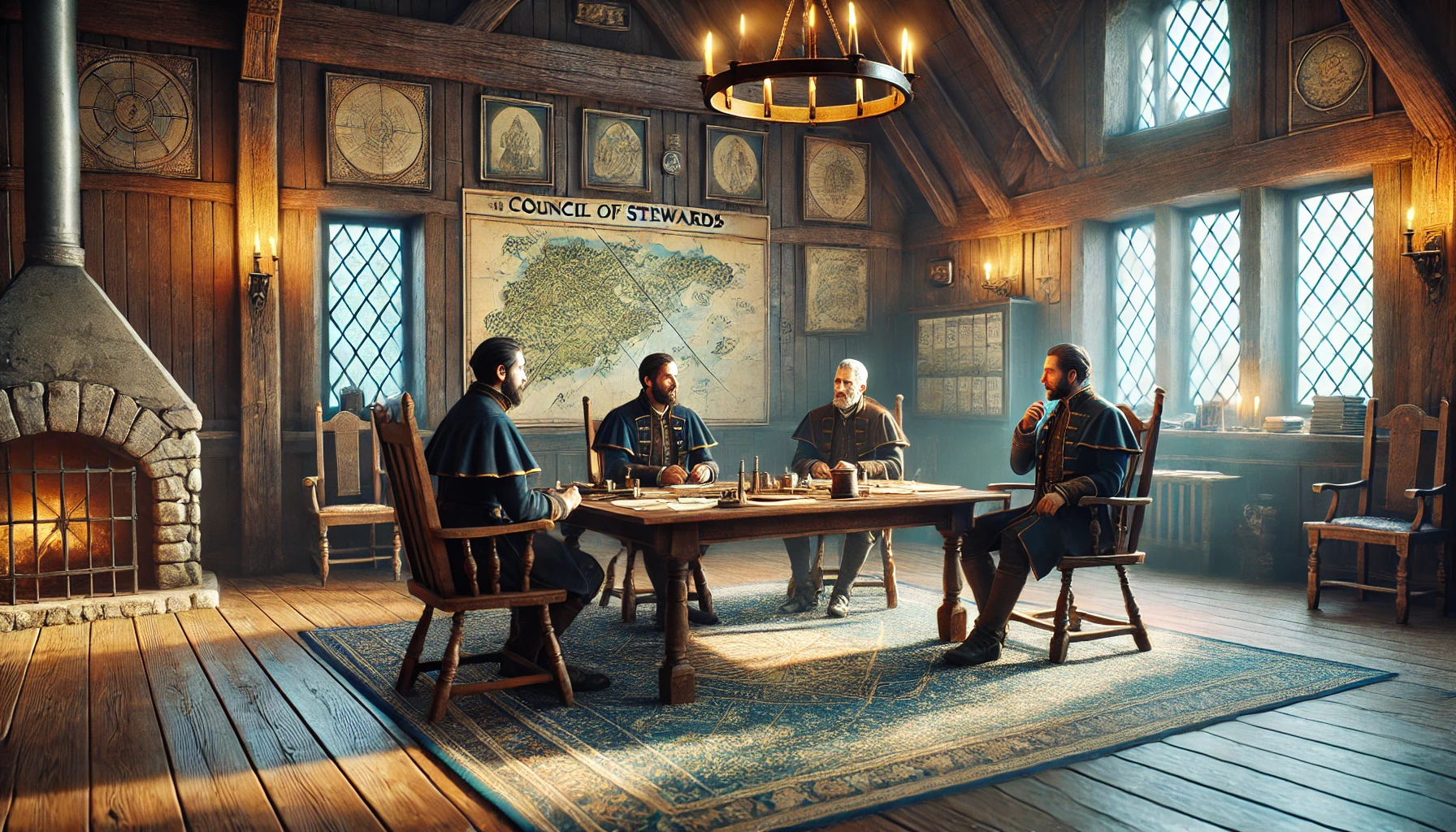
Council of Stewards
The Council of Stewards was the elected core of Belkeep's governance—three residents, each holding a domain vital to survival: storage and rationing, infrastructure and maintenance, and the community's well-being. Formed in 1990 alongside the office of Chief, it met daily to manage a settlement living on razor-thin margins, and its grip on food, repairs and morale gave it real weight against the Chief himself. When Belkeep was relocated and dissolved around 2030, the Council went with it.
An Elected Counterweight
The Council of Stewards was the elected half of Belkeep's governance, created in 1990 as part of the same reform that established the office of Chief. Where the Chief was appointed for life and the Second-in-Command served at the Chief's pleasure, the Council was the one part of the structure the community itself chose. Its purpose was straightforward: to ensure that the decisions keeping Belkeep alive were made with the consent and expertise of ordinary residents, rather than handed down by a single leader who might be wrong, absent or dead. In a settlement living permanently at the edge of catastrophe, that check mattered more than any principle of representation—a bad ration decision or a neglected heating system could kill people months later, and the Council existed so that no such decision rested on one person's judgement alone.
The Three Portfolios
The Council was small by design: three stewards, each holding a single domain critical to survival. The Storage and Rationing Steward managed the settlement's food and water reserves, the preservation methods that stretched them, and the rationing protocols that decided who went without and when—a role that was, in Belkeep's endless winter, a constant exercise in foresight where a single miscalculation surfaced as hunger a season later. The Infrastructure and Maintenance Steward kept the built settlement standing: the heating systems that separated the living from the dead, the storage vaults, the structures that had to be repaired in killing cold whether or not anyone was ready to do it. The Community Well-being Steward carried the least tangible and most relentless burden of the three—the physical and mental health of a population worn down by cold, confinement and grief, in a place where despair killed as reliably as exposure.
Election and Daily Work
Stewards were nominated and elected by Belkeep's residents to three-year terms, and could stand again as long as their performance and the settlement's needs warranted it. The election was less a political contest than a practical one; these were not ceremonial posts but daily labour, and the community tended to return whoever was keeping them alive. The three met every day with the Chief and the Second-in-Command in the Council Cottage, reviewing the state of the reserves, the infrastructure and the settlement's health, allocating what little there was against what was needed, approving urgent repairs, and coordinating the response to the failures and accidents that were a constant of Belkeep life. When the Chief was absent, incapacitated or dead, the three stewards held authority collectively—an arrangement that, given how often Belkeep's leaders were removed by the conditions they governed, was less a contingency than a regular necessity.
Power Without the Title
On paper the Council answered to the Chief. In practice its influence could rival his. Control of the food supply, of whether the heating held, and of the community's fraying morale was a form of power no title conferred, and a Council that dragged its feet or dug in its heels could shape the settlement's direction as surely as any decision from the Chief's chair. The relationship was usually cooperative, because the alternative was fatal to everyone, but the leverage was always there. In a place where the margin between order and collapse was measured in weeks of stored food, the Council's agreement was not a formality the Chief could take for granted.
Stewards of Note
Across four decades the office passed through many hands, some of whom shaped Belkeep as deeply as any of its Chiefs. Evie Mackenzie held the storage portfolio from the Council's earliest days and built the inventory and distribution systems that every steward after her inherited. Adelaide Margaret Stirling, whose preservation techniques in the mid-1990s cut the settlement's starvation deaths by more than half, turned the Storage and Rationing role from a matter of counting into a matter of engineering. Elda Marrick served from 2012 to 2018 and carried the settlement through the Long Winter of 2014, her precision ration modelling averting the shortages the extended cold should have caused. Janus Torin held the infrastructure portfolio in the settlement's later years, reinforcing the heating grid and repairing critical defences after blizzard damage, while Lira Sorren, the longest-serving of the Well-being Stewards, spent years holding the community's morale together through stretches of isolation that broke less resilient people. Others—among them Jaxon Hartley and Lachlan Gibbs—served terms recorded more quietly, but no steward's work in Belkeep was ever incidental.
The End of the Council
The Council outlived the office it was meant to advise. When Lewyyd Drikarsus died in 2021 and no new Chief was installed, the three stewards took up the collective leadership their role had always reserved for a crisis—except that this crisis was the settlement's last. It was the Council that governed Belkeep through its rediscovery by Bixbus in 2027 and the relocation that emptied it between 2028 and 2030. When the settlement was redesignated a research and heritage zone, there were no reserves left to ration, no infrastructure left to maintain and no community left to keep well, and the Council of Stewards dissolved with the place it had spent forty years keeping alive.







