Cornerstone Café
Cornerstone Café occupies a converted ground-floor warehouse space at 3 Purdy's Mart, a narrow laneway connecting Collins Street to a rear car park in Hobart's CBD. Established in 2003, the café predates the city's specialty coffee transformation, maintaining an unpretentious character that distinguishes it from more contemporary establishments. Known among regular patrons for its discretion and generous table spacing, Cornerstone has long attracted those who prefer their conversations unoverheard and their coffee unpretentious.
The Laneway
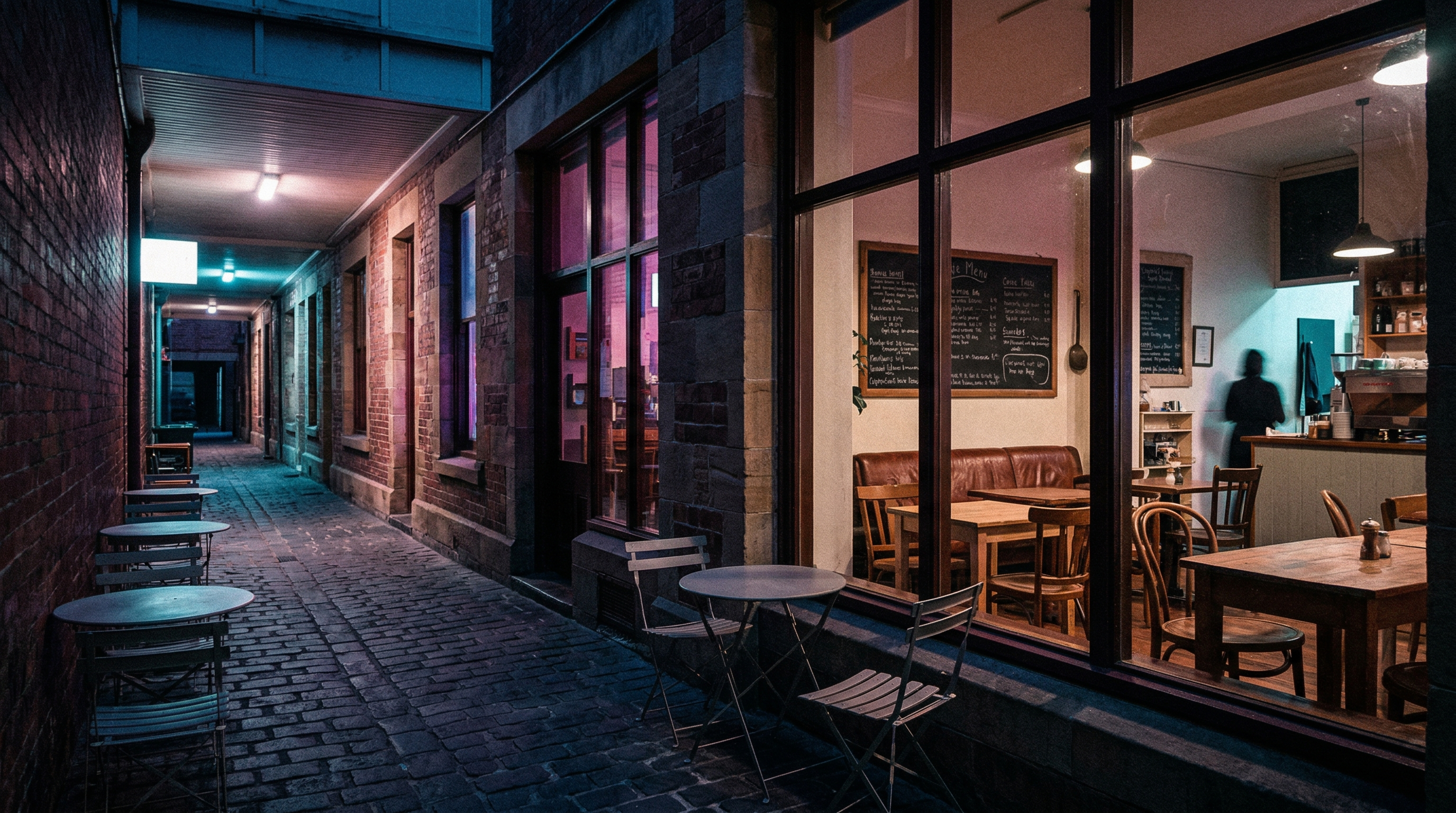
Purdy's Mart is one of Hobart's lesser-known historic passages, a narrow pedestrian laneway running between Collins Street and a small car park serving the surrounding commercial buildings. The lane takes its name from Arthur Purdy, who operated a second-hand furniture business from these premises for twenty-seven years between 1927 and 1955. In its heyday, the laneway would have been crowded with wardrobes, dressing tables, beds, and the accumulated domestic detritus of Hobart households—items bought, sold, and occasionally fought over in the pragmatic commerce of used goods.
The buildings flanking the lane date from the late nineteenth century, their brick and sandstone construction typical of Hobart's commercial architecture from that period. A remnant brick wall at the Collins Street corner is all that survives of Purdy's original premises, preserved less through deliberate heritage intervention than through the simple economics of demolition costs exceeding redevelopment value. The wall now serves as a canvas for commissioned street art, including a piece titled "Chairs"—a subtle tribute to the furniture dealer whose name the lane still carries.
Establishment
Cornerstone Café opened in August 2003, the venture of Gerald and Marie Ashby, a couple who had operated a small catering business from their Lenah Valley home before seeking permanent premises. Gerald had worked as a chef in various Hobart establishments since the 1980s; Marie had managed the administrative side of their catering operation while raising three children. Neither possessed the capital for a prime location, which led them to Purdy's Mart—affordable precisely because of its obscurity.
The premises they secured had most recently served as storage for a nearby accounting firm, and before that as a workshop for a picture framer whose retirement had left the space vacant. The Ashbys invested modestly in renovation, retaining the original brick walls and timber ceiling beams while installing the minimum equipment necessary for café operation. The aesthetic that emerged was less a deliberate design choice than a consequence of limited funds applied to an existing structure—authenticity born of necessity rather than intention.
The café's name referenced the building's sandstone foundations, visible through a glass panel Gerald installed in the floor during renovation. The exposed stonework provided a talking point for early customers and established the café's identity as a place connected to Hobart's colonial past—though Gerald himself admitted the name was primarily chosen because it was available and inoffensive.
The early years coincided with Hobart's gradual emergence as a food destination, though Cornerstone remained largely untouched by the waves of culinary innovation transforming other parts of the city. The Ashbys had neither the inclination nor the resources to chase trends; they served competent coffee, honest food, and maintained the kind of steady reliability that builds a regular customer base through accumulated small satisfactions rather than dramatic gestures.
Gerald Ashby died in 2019 following a brief illness. Marie continued operating the café for eighteen months before selling to Thomas Huang, a former regular customer who had recently taken redundancy from a state government department. Under Huang's ownership, Cornerstone has maintained its established character with minimal alteration—the same suppliers, the same opening hours, the same deliberate absence of the performative elements that characterise more contemporary establishments.
Character and Atmosphere
Cornerstone Café resists easy categorisation within Hobart's current hospitality landscape. It possesses neither the industrial-chic aesthetic of the Melbourne-influenced specialty venues nor the heritage-conscious refinement of establishments catering to tourist expectations. What it offers instead is something increasingly uncommon: a space that appears to have been assembled gradually over time rather than designed for immediate effect.
The interior accommodates approximately twenty-five seated patrons across an assortment of furniture that has accumulated across two decades of operation. Wooden tables of various vintages sit alongside chairs that match neither each other nor the tables they accompany. A leather banquette runs along the rear wall, its surface worn smooth by years of use, its cushions bearing the permanent impressions of countless patrons. The menu is handwritten on a chalkboard that shows evidence of regular revision, the ghost of previous offerings visible beneath the current selections.
The spacing between tables is generous for an establishment of Cornerstone's size—a deliberate choice that predates current pandemic-era distancing requirements. Gerald Ashby had insisted on this arrangement from the café's opening, maintaining that people came to cafés to talk as much as to eat, and that conversations conducted at normal volume should not be audible to neighbouring tables. This philosophy has persisted through changes in ownership, creating an atmosphere where privacy is possible without the formality of private rooms.
Outside, a cluster of small metal tables occupies the cobblestones of Purdy's Mart, their placement negotiated informally with the occasional delivery driver requiring access to the rear car park. The laneway's orientation provides shelter from Collins Street's noise and activity, creating a pocket of relative quiet within the CBD's commercial bustle. Fairy lights strung between buildings provide evening atmosphere, though the café closes at four on most days, catching only the earliest edge of twilight during summer months.
Coffee and Menu
Cornerstone's approach to coffee reflects its broader philosophy: competent execution without pretension. The café has maintained a relationship with the same local roaster since 2007, a small operation in North Hobart that supplies several independent establishments across the city. The beans are reliable rather than remarkable—the kind of product that satisfies without demanding attention, that accompanies conversation rather than commanding it.
The espresso menu follows traditional Australian conventions: flat whites, long blacks, cappuccinos, and lattes prepared on equipment that has been serviced and maintained rather than regularly upgraded. The baristas—typically one or two staff members working any given shift—are trained to produce consistent results rather than elaborate latte art. Milk alternatives have been available since 2018, a concession to changing dietary preferences that Thomas Huang implemented shortly after assuming ownership.
The food menu emphasises simplicity and reliability over innovation. Sandwiches, toasted items, and a rotating selection of cabinet food constitute the core offerings, supplemented by a daily soup during winter months. The portions are generous, the prices moderate, and the quality consistent—attributes that have sustained a loyal customer base across two decades of operation.
Clientele
Cornerstone's customer base has remained remarkably stable across its years of operation, comprising primarily regular patrons who have incorporated the café into their weekly or daily routines. Government employees from nearby departments constitute a significant portion of weekday custom, their presence lending the establishment an unofficial character as neutral ground for conversations that might be awkward in more formal settings.
The café has acquired a particular reputation for discretion among those who value such things. The table spacing permits conversation without concern for neighbouring ears; the staff maintain a policy of professional disinterest in customer discussions, attending to service requirements without lingering or engaging beyond necessity. Regular customers develop relationships with the space itself—particular tables becoming associated with particular patrons, their preferences anticipated without explicit communication.
New arrivals sometimes find the atmosphere unwelcoming, the absence of obvious charm or Instagram-ready aesthetics suggesting a venue that has failed to keep pace with contemporary hospitality standards. This misreading serves the café's existing clientele well; those seeking photogenic backdrops or curated experiences quickly move on, leaving Cornerstone to those who understand what it actually offers.
Significance
Cornerstone Café represents a strand of Hobart hospitality that has become increasingly rare as the city's culinary reputation has grown. It offers neither the performative excellence of specialty establishments nor the calculated nostalgia of heritage-themed venues. What it provides instead is simple continuity—a space that has remained essentially unchanged while the city around it has transformed into something its founders would barely recognise.
For those who pass through its doors regularly, Cornerstone offers more than coffee and food. It provides consistency in a world that increasingly prizes novelty, recognition in a city small enough that anonymity remains difficult to achieve, and the particular comfort of a place that asks nothing of its patrons beyond reasonable behaviour and timely payment.
The cobblestones of Purdy's Mart have witnessed countless conversations across two decades of the café's operation—workplace grievances, relationship difficulties, professional conspiracies, and the ordinary exchanges that constitute daily urban life. Some of these conversations have carried weight their participants could not have anticipated, moments when the café's particular atmosphere of sheltered discretion served purposes its founders never imagined.
The laneway keeps its silence. The café endures. And those who know to look for it continue to find exactly what they need in the space between Collins Street and the car park beyond—a small sanctuary of predictability in a city that has learned to sell its charms to the wider world.






